
Imagine entering a modern office building during a hot summer day. The environment feels cool and comfortable, but you cannot see any air conditioner on the walls. Instead, the cooling seems to come evenly from the ceiling. This is usually the result of a cassette air conditioner installed inside the ceiling.
Cassette air conditioners are widely used in commercial buildings such as offices, restaurants, hotels, and shopping malls. They provide uniform cooling while maintaining a clean and modern interior design. Unlike traditional wall-mounted air conditioners, cassette AC systems are installed inside a false ceiling and distribute air in multiple directions.
For electrical students, engineers, technicians, and beginners, understanding cassette air conditioners is very important. These systems are common in modern HVAC installations, and knowing how they work helps in installation, maintenance, and troubleshooting.
In this article, you will learn about the cassette air conditioner working principle, types, components, advantages and disadvantages, and real-world applications. By the end, you will clearly understand how cassette air conditioners work and how to select the right system for different environments.
Cassette Air Conditioners
Cassette air conditioners are a type of split air conditioning system designed to be installed in the ceiling, usually in false or suspended ceilings. Unlike wall-mounted AC units, cassette ACs are fixed in the ceiling, and only the decorative panel is visible from below, giving a clean and modern look.
These systems are commonly used in offices, shopping malls, restaurants, hotels, and large rooms where uniform cooling is required.
How Cassette Air Conditioners Work
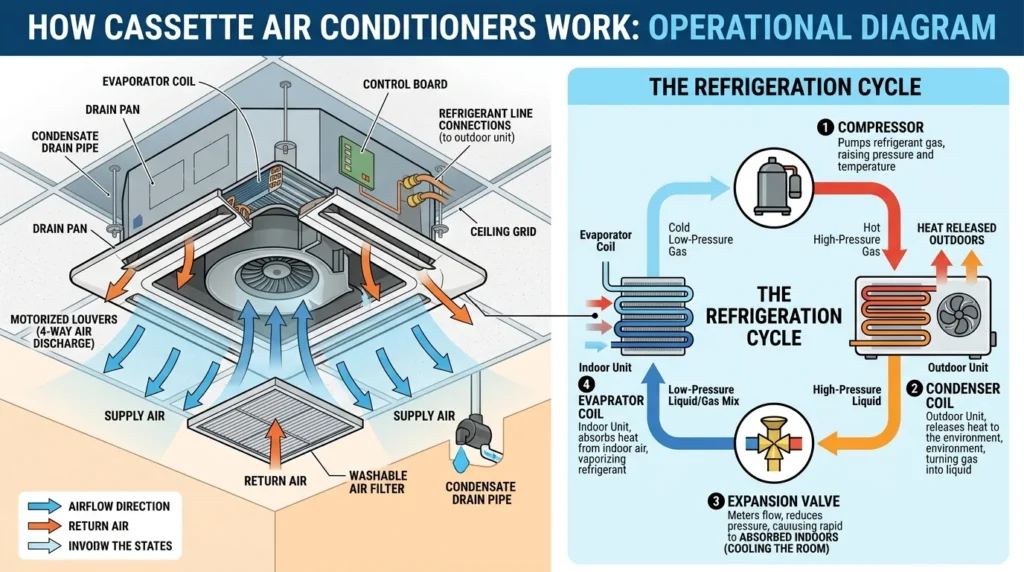
Cassette air conditioners work like standard split AC systems but with a different air distribution method.
- The indoor unit is installed inside the ceiling.
- The outdoor unit is placed outside the building.
- Refrigerant flows between indoor and outdoor units.
- The indoor unit absorbs heat from the room air.
- Cool air is blown out in four directions for even cooling.
This 360-degree airflow helps maintain a uniform temperature across the entire space.
Key Features
- Ceiling-mounted design saves wall space
- Four-way airflow for even cooling
- Quiet operation compared to many traditional systems
- Aesthetic appearance with hidden indoor unit
- Suitable for large areas
Advantages
- Provides uniform cooling in all directions
- Ideal for large rooms and commercial spaces
- Saves wall space and improves room design
- Better air distribution than wall-mounted ACs
Disadvantages
- Higher installation cost
- Requires false ceiling
- Maintenance can be slightly difficult
- Not suitable for very small rooms
Applications
- Offices and conference rooms
- Shopping malls and retail stores
- Restaurants and cafes
- Hotels and banquet halls
- Large residential living rooms
Cassette air conditioners are an excellent choice for spaces that require powerful, uniform cooling with a clean and professional look. Although the initial cost is higher, their performance, airflow distribution, and aesthetics make them a popular option in modern commercial and large residential environments.
A cassette air conditioner is a type of split air conditioning system where the indoor unit is mounted in the ceiling while the outdoor unit is installed outside the building.
Only the decorative panel of the indoor unit is visible from inside the room. The rest of the system is hidden in the ceiling space. This design allows the system to distribute cool air evenly across the room.
In simple words, a cassette air conditioner works like a regular split AC but is installed in the ceiling rather than on the wall.
Practical Example
Consider a large meeting room in an office. If a wall-mounted AC is used, it may cool only one side of the room effectively. However, a cassette air conditioner placed in the center of the ceiling can distribute air in four directions, ensuring uniform cooling across the entire space.
Because of this design, cassette air conditioners are commonly used in:
- Offices
- Shopping malls
- Hotels
- Restaurants
- Conference halls
Cassette Air Conditioner Working Principle
The cassette air conditioner working principle is based on the standard refrigeration cycle used in most air conditioning systems. The system removes heat from indoor air and releases it outside the building.
This process happens through four main stages: compression, condensation, expansion, and evaporation.
Step-by-Step Working Process of a Cassette Air Conditioning System
A cassette air conditioner works on a continuous refrigeration cycle that removes heat from indoor air and releases it outside. Below is a clear, improved explanation of the full working process:
1. Warm Air Intake Process (Indoor Air Suction – Detailed Explanation)
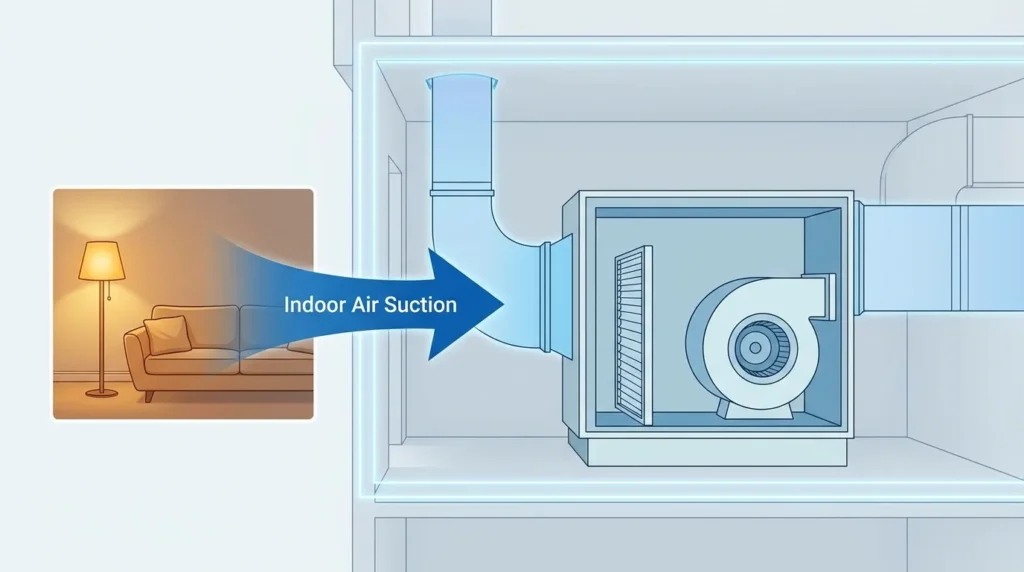
The warm air intake process, also known as indoor air suction, is the first and one of the most important stages in an air conditioning system. In this step, the indoor unit of the AC continuously draws warm air from the room to begin the cooling cycle. This process is essential because the air conditioner does not create cold air directly; instead, it removes heat from the existing indoor air.
At the start, the intake grille located on the indoor unit allows room air to enter the system. A blower fan or cross-flow fan then actively pulls this warm air inside. As the air enters the unit, it carries heat energy along with dust particles and humidity present in the environment. This warm air is then directed toward the air filters, which help remove dust, dirt, and other airborne impurities, ensuring cleaner airflow and better system performance.
After filtration, the clean warm air moves toward the evaporator coil, where the actual cooling process begins. The continuous suction of warm air helps maintain a steady airflow rate, which is necessary for efficient heat exchange. If this airflow is blocked or reduced due to dirty filters or obstructions, the overall cooling efficiency of the system decreases significantly.
The warm air intake process is not only responsible for starting the cooling cycle but also plays a key role in maintaining indoor air circulation, air quality, and temperature balance. Proper airflow ensures that the AC system works smoothly, reduces energy consumption, and provides consistent cooling throughout the room.
In simple terms, the warm air intake process works like a breathing system for the air conditioner, where it “inhales” warm room air, prepares it for cooling, and sends it forward to the next stage of the refrigeration cycle.
The process starts when the indoor unit pulls warm air from the room through the intake grille.
This air carries heat and is continuously circulated to maintain room comfort.
2. Cooling Process at the Evaporator Coil (Heat Absorption Stage – Detailed Explanation)
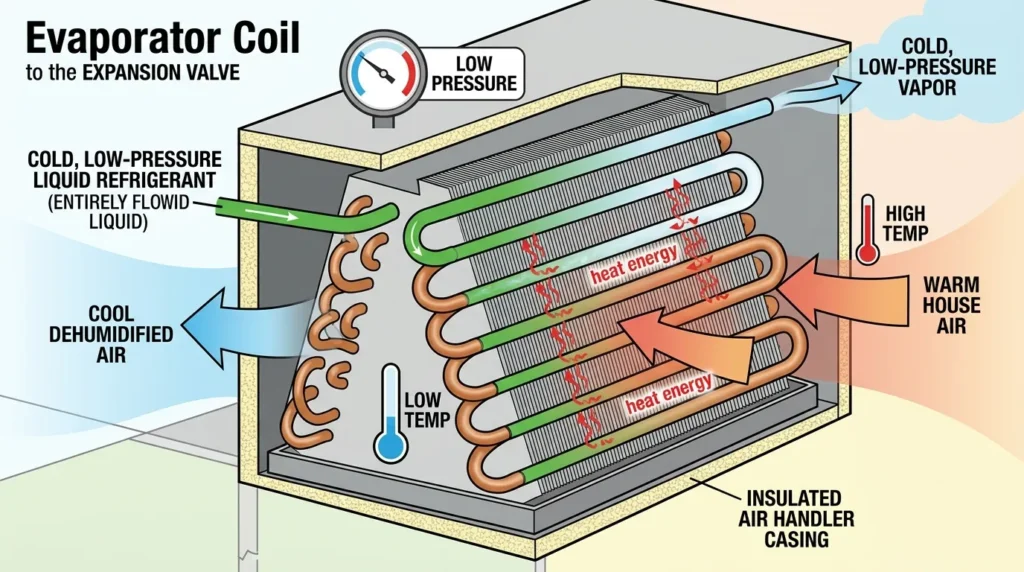
The evaporator coil is one of the most important components in an air conditioning system, and it is responsible for the actual cooling of indoor air. This stage is known as the heat absorption or cooling process, where warm air is converted into cool, comfortable air.
After the warm air is drawn into the indoor unit and passed through the air filters, it reaches the evaporator coil. Inside this coil flows a low-pressure, low-temperature refrigerant. This refrigerant is extremely cold compared to the indoor air. When the warm air comes in contact with the coil surface, heat from the air is transferred to the refrigerant through a heat exchange process.
As the refrigerant absorbs heat from the air, it evaporates and changes from liquid to gas form. This phase change is very important because it allows the refrigerant to carry a large amount of heat away from the room. Due to this heat removal, the temperature of the air drops significantly, and the air becomes cool and refreshing.
At the same time, the evaporator coil also helps in reducing humidity. When warm air passes over the cold coil surface, moisture in the air condenses into water droplets. This water is collected and drained outside through a drain pipe, making the indoor air more comfortable and less humid.
The cooling efficiency of this stage depends on several factors, such as proper airflow, clean coils, and correct refrigerant pressure. If the evaporator coil is dirty or blocked, heat transfer becomes weak, resulting in poor cooling performance.
In simple terms, the evaporator coil acts like a heat absorber, pulling heat and moisture out of the indoor air and turning it into cool, dry, and comfortable air for the room.
The warm air passes over the evaporator coil, which contains low-temperature refrigerant.
Here, the refrigerant absorbs heat from the air, causing the air temperature to drop.
As a result, the air becomes cool and refreshing.
3. Cool Air Distribution Process (Air Delivery Stage – Detailed Explanation)
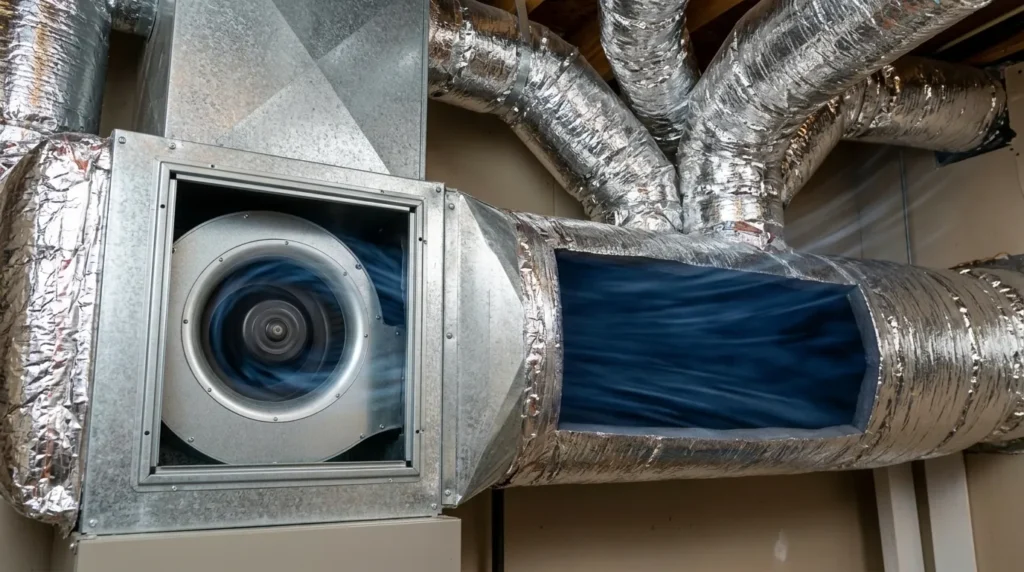
The cool air distribution process is the stage in an air conditioning system where the cooled air is evenly supplied back into the room. After the air has been cooled by the evaporator coil, it must be properly circulated to maintain a comfortable indoor temperature. This step plays a key role in ensuring uniform cooling and overall system efficiency.
Once the air passes through the evaporator coil and loses its heat, it becomes cool and is directed toward the supply air fan (blower fan) inside the indoor unit. This fan is responsible for pushing the cooled air out of the unit with sufficient force. In cassette air conditioners, especially 4-way, 2-way, and 1-way systems, specially designed air outlets control the direction of airflow.
In a 4-way cassette AC, the cool air is distributed in four directions to achieve 360-degree airflow coverage, ensuring that every corner of the room receives cooling. In a 2-way cassette AC, the air is supplied in two opposite directions, making it suitable for long or rectangular spaces. In a 1-way cassette AC, the air flows in a single direction, focusing cooling on a specific area.
The air distribution process is carefully designed to avoid uneven temperature zones. The louvers (air blades) inside the unit help control the direction and speed of airflow. These louvers can be fixed or adjustable depending on the system design. Proper airflow ensures that cool air reaches all occupied areas, preventing hot spots and improving comfort levels.
Good air distribution also depends on proper installation height, clean air filters, and unobstructed airflow paths. If airflow is blocked or poorly directed, cooling efficiency drops, and the system has to work harder, increasing energy consumption.
In simple terms, the cool air distribution process works like a circulatory system, where the air conditioner “breathes out” cooled air and spreads it evenly throughout the room to maintain a stable and comfortable environment.
A built-in fan inside the cassette unit blows the cooled air back into the room.
Most cassette air conditioners distribute air in four directions, ensuring uniform and balanced cooling across the entire space.
4. Refrigerant Compression (Outdoor Unit – Detailed Explanation)
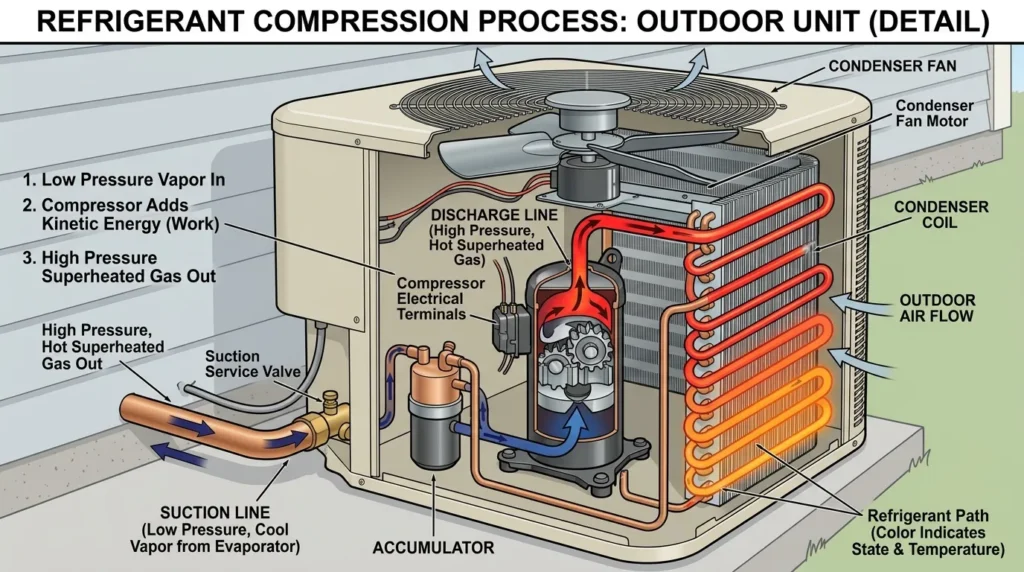
The refrigerant compression process is a crucial stage in an air conditioning system that takes place in the outdoor unit, specifically inside the compressor. This step is responsible for increasing the pressure and temperature of the refrigerant, allowing it to release heat effectively in the next stage of the cooling cycle.
After the refrigerant absorbs heat from the indoor air at the evaporator coil, it changes into a low-pressure, low-temperature gas. This gaseous refrigerant is then drawn into the compressor, which is considered the heart of the air conditioning system. The compressor uses electrical energy to compress the refrigerant gas, reducing its volume while significantly increasing its pressure and temperature.
As a result of compression, the refrigerant becomes a high-pressure, high-temperature gas. This transformation is very important because only high-pressure refrigerant can efficiently release heat in the condenser coil. Without this compression stage, the refrigerant would not be able to transfer heat effectively to the outside environment.
The compressor also ensures continuous movement of the refrigerant throughout the system. It maintains proper flow, pressure balance, and cycle efficiency. There are different types of compressors used in air conditioners, such as reciprocating, rotary, and scroll compressors, depending on the system design and capacity.
If the compressor is not working properly, the entire cooling cycle is affected, resulting in poor cooling performance or system failure. That is why it is considered one of the most important and sensitive components of the AC system.
In simple terms, the compressor acts like a pressure booster, taking low-energy refrigerant gas and converting it into a high-energy state so it can release heat outside and continue the cooling process efficiently.
After absorbing heat, the refrigerant changes into a gas and moves to the compressor located in the outdoor unit.
The compressor increases the pressure and temperature of the refrigerant, preparing it for heat release.
5. Heat Rejection in the Condenser Coil: Working Principle and Detailed Explanation
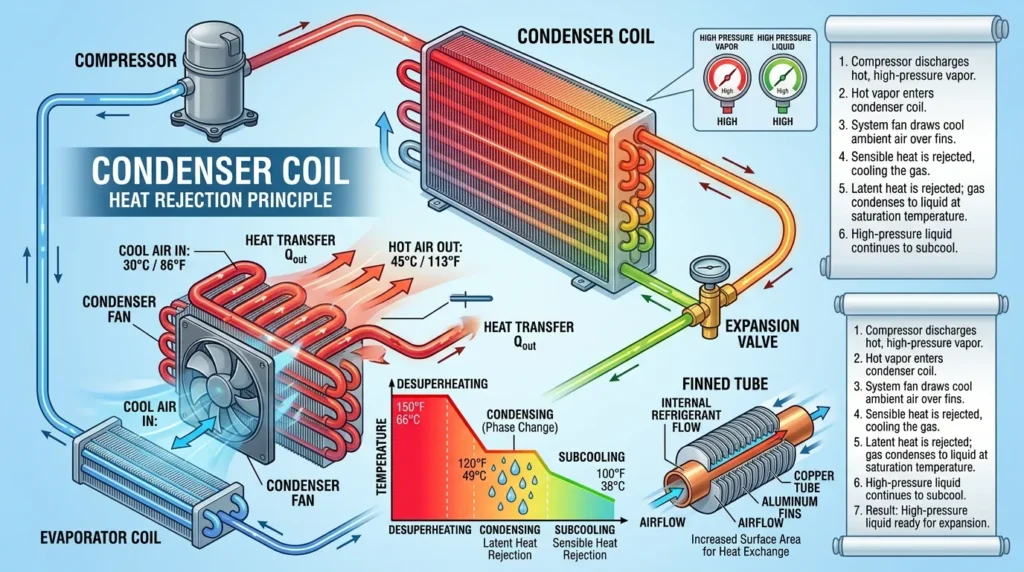
The high-pressure hot refrigerant flows into the condenser coil.
Here, it releases the absorbed heat into the outside environment with the help of a cooling fan.
As heat is removed, the refrigerant starts to cool down and condense into a liquid state.
The condenser coil is one of the most important components in an air conditioning and refrigeration system, responsible for rejecting heat absorbed from the indoor environment. After the refrigerant leaves the compressor in a high-pressure, high-temperature gaseous state, it enters the condenser coil located in the outdoor unit. In this section, the refrigerant releases its heat to the surrounding air with the help of a fan. As the heat is removed, the refrigerant gradually cools down and changes its state from high-pressure gas into a high-pressure liquid. This process is known as heat rejection.
The efficiency of heat rejection depends on several factors, including the cleanliness of the condenser coil, airflow around the outdoor unit, and ambient temperature. If the coil is covered with dust or dirt, or if airflow is blocked, the system cannot release heat properly, leading to reduced cooling performance and increased energy consumption. The condenser fan plays a key role by continuously blowing air over the coil to carry away the heat.
In simple terms, the condenser coil acts as a heat exchanger that transfers unwanted heat from the refrigerant to the outside environment. This step is essential for completing the refrigeration cycle and ensuring that cool air can be produced inside the room effectively and efficiently.
6.Expansion Process (Pressure Reduction): Working Principle and Detailed Explanation
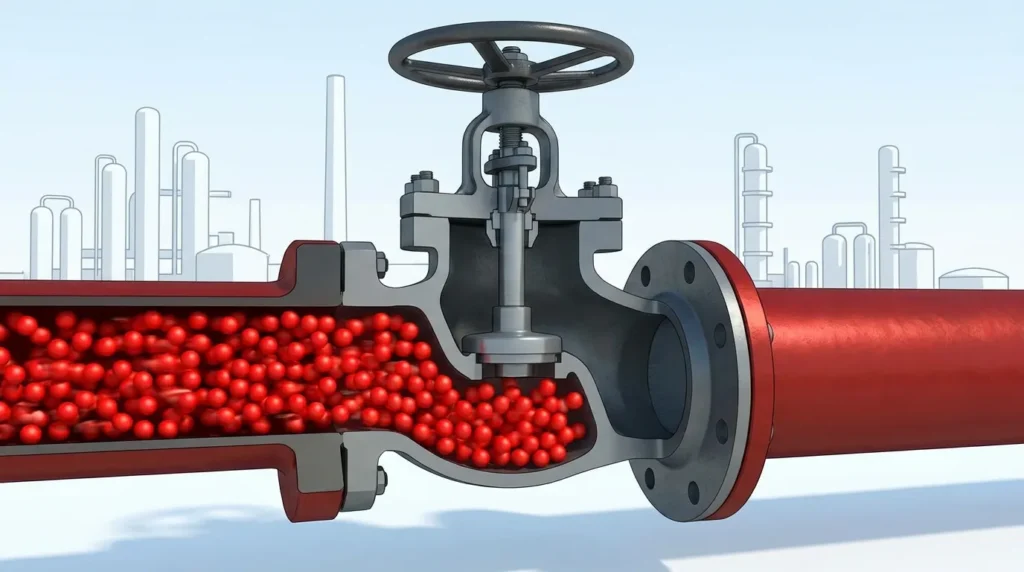
The liquid refrigerant then passes through an expansion valve.
This valve reduces the pressure and temperature of the refrigerant, making it cold again before it enters the evaporator.
The expansion process is a key stage in the refrigeration and air conditioning cycle where the pressure of the refrigerant is reduced before it enters the evaporator coil. After leaving the condenser as a high-pressure liquid, the refrigerant passes through an expansion device such as an expansion valve, capillary tube, or thermostatic expansion valve (TXV). This device restricts the flow of refrigerant, causing a sudden drop in pressure.
As the pressure decreases, the temperature of the refrigerant also drops significantly, and a portion of the liquid refrigerant starts converting into a low-pressure, low-temperature mixture of liquid and vapor. This process is called throttling, and it is essential for preparing the refrigerant to absorb heat efficiently in the evaporator.
The expansion process does not involve any heat exchange with the surroundings; instead, it is an isenthalpic process (constant enthalpy). Its main purpose is to control the flow of refrigerant and create the necessary low-pressure condition required for cooling.
In simple terms, the expansion process acts like a control point that “relaxes” the refrigerant pressure so it can effectively absorb heat in the next stage of the refrigeration cycle, ensuring proper cooling performance of the system.
7. Continuous Cooling Cycle: How the Air Conditioning System Provides Uninterrupted Cooling
The continuous cooling cycle is the complete and repetitive process through which an air conditioning or refrigeration system maintains the desired indoor temperature. This cycle operates continuously as long as cooling is required, ensuring a steady supply of cool air and comfortable conditions inside the conditioned space. The refrigeration cycle consists of four major stages: evaporation, compression, condensation, and expansion. Each component works together in sequence to transfer heat from the indoor environment to the outside atmosphere.
The process begins at the evaporator coil, where the low-pressure refrigerant absorbs heat from the indoor air and evaporates into a vapor. The compressor then draws in this low-pressure vapor and compresses it into a high-pressure, high-temperature gas. Next, the refrigerant flows through the condenser coil, where it releases the absorbed heat to the outdoor environment and condenses into a high-pressure liquid. This liquid refrigerant then passes through the expansion device, where its pressure and temperature are reduced before it re-enters the evaporator coil.
Because this sequence repeats continuously, the system is able to remove heat from the indoor space without interruption. The thermostat monitors the room temperature and controls the operation of the system by switching the compressor on and off as needed. Once the desired temperature is reached, the system slows or stops temporarily and restarts when the indoor temperature rises again.
In simple terms, the continuous cooling cycle is the heart of an air conditioning system. It allows the refrigerant to circulate repeatedly through the system, absorbing indoor heat and rejecting it outdoors, thereby delivering efficient, reliable, and consistent cooling performance throughout the operation of the unit.
The low-temperature refrigerant returns to the evaporator coil, and the entire process repeats continuously.
This cycle maintains a steady and comfortable indoor temperature.
Simple Understanding (Easy Analogy)
Think of the system as a heat transfer machine.
It does not create cold air; instead, it removes heat from inside the room and transfers it outside, leaving the indoor environment cool and comfortable.
Types / Classification of Cassette Air Conditioners (Improved Complete Guide)
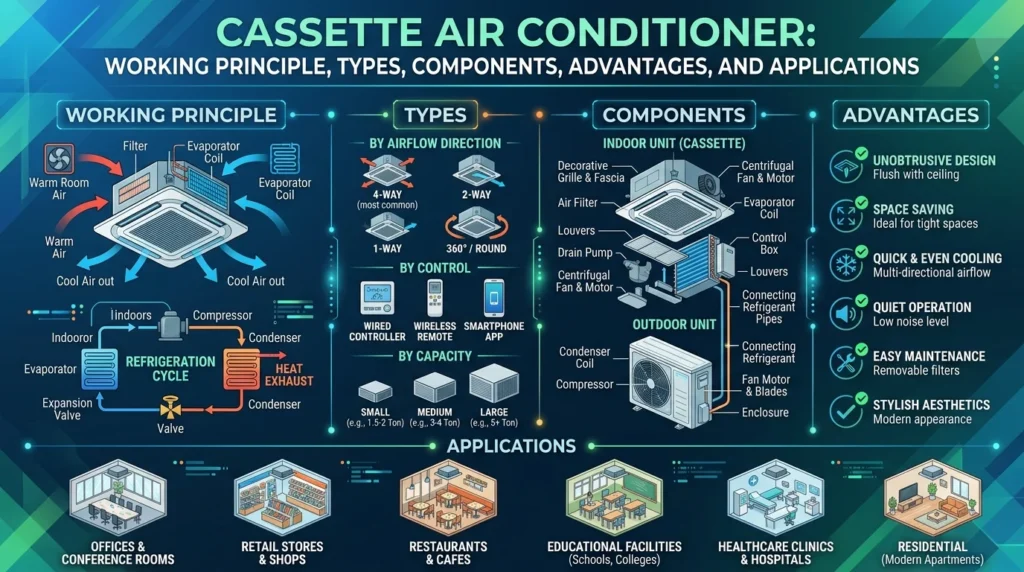
Cassette air conditioners are ceiling-mounted cooling systems designed to provide efficient and uniform air distribution in indoor spaces. These systems are widely used in commercial and residential buildings because they offer quiet operation, modern design, and effective cooling. They are mainly classified based on airflow direction and installation design.
1. 4-Way Cassette Air Conditioner
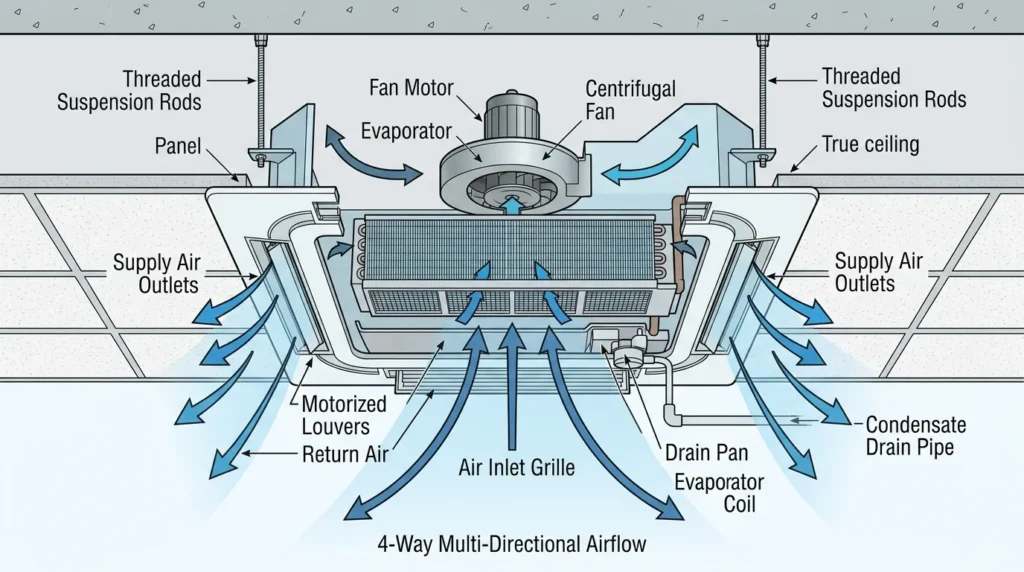
A 4-way cassette air conditioner is a ceiling-mounted cooling system that distributes cooled air in four different directions, providing 360-degree uniform airflow throughout the room. It is one of the most widely used types of cassette AC systems, especially in commercial and large indoor spaces, because it ensures balanced cooling without leaving hot or uneven zones. The indoor unit is installed inside the false ceiling, which gives a clean, modern, and space-saving appearance while maintaining high cooling efficiency.
The working of a 4-way cassette AC is based on the standard refrigeration cycle. First, warm air from the room is pulled into the indoor unit through the central intake grille. This air passes over the evaporator coil, where the refrigerant absorbs heat and cools the air. After cooling, a powerful built-in fan distributes the air evenly in four directions, allowing rapid and uniform temperature control across the entire space. Meanwhile, the absorbed heat is transferred to the outdoor unit through the refrigerant circuit, where it is released into the outside environment, and the cycle continues repeatedly to maintain consistent cooling.
The main advantage of a 4-way cassette AC is its ability to provide uniform cooling in large open areas, making it highly efficient for offices, shopping malls, restaurants, showrooms, and conference halls. It also enhances interior aesthetics due to its concealed ceiling installation and operates quietly compared to many traditional systems. However, it requires proper ceiling space and professional installation, and its cost is generally higher than simpler cassette types.
Overall, the 4-way cassette air conditioner is a powerful and efficient cooling solution designed for large spaces that require balanced airflow, high performance, and modern ceiling integration.
Key Features
- 360° uniform air distribution
- High cooling efficiency for large spaces
- Fast temperature control
- Modern and aesthetic ceiling design
Applications
- Offices and corporate buildings
- Shopping malls and showrooms
- Restaurants and cafes
- Large halls and conference rooms
2. 2-Way Cassette Air Conditioner
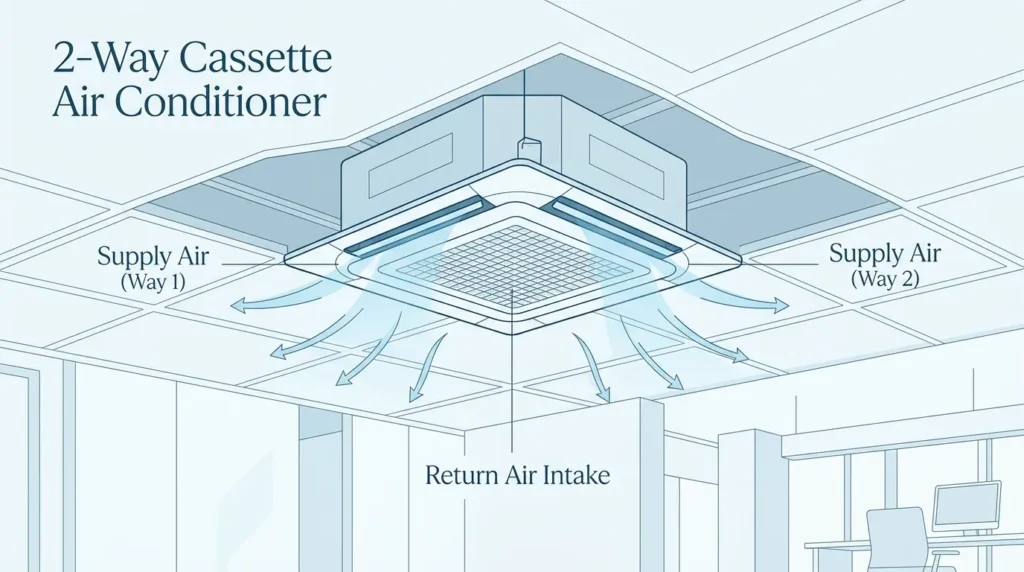
The 2-way cassette AC is designed to supply air in two opposite directions. It is mainly used in rectangular or elongated spaces where airflow needs to travel along the length of the room.
A 2-way cassette air conditioner is a ceiling-mounted cooling system designed to distribute cool air in two opposite directions. It is mainly used in long, narrow, or rectangular spaces where uniform airflow in all directions is not required. This type of AC is installed within the ceiling, giving a clean, modern appearance while saving wall space and maintaining interior aesthetics. It is a practical solution for targeted cooling where airflow needs to cover extended areas in a straight line.
The working of a 2-way cassette AC is based on the standard refrigeration cycle. First, warm air from the room is drawn into the indoor unit through the intake grille. This air passes over the evaporator coil, where the refrigerant absorbs heat and cools the air. The built-in fan then distributes the cooled air in two opposite directions, ensuring effective coverage along the length of the room. At the same time, the absorbed heat is transferred to the outdoor unit through the refrigerant, where it is released into the atmosphere, allowing the cooling cycle to continue.
The main advantage of a 2-way cassette AC is its ability to provide better airflow control in rectangular spaces, making it more efficient than single-direction systems for such layouts. It is commonly used in corridors, hotel passageways, long office rooms, and meeting areas. It also offers quiet operation, energy efficiency, and a neat ceiling installation. However, its limitation is that it is not ideal for large open halls, as its airflow is restricted to two directions only.
Overall, the 2-way cassette air conditioner is a reliable and efficient cooling solution for spaces that require linear airflow distribution and space-saving ceiling installation.
This type provides focused and efficient cooling in narrow layouts.
Key Features
- Dual-direction airflow
- Suitable for long and narrow spaces
- Better airflow control in specific layouts
- Energy-efficient for targeted cooling
Applications
- Corridors and hallways
- Long meeting rooms
- Hotel passageways
- Office cabins with rectangular design
3. 1-Way Cassette Air Conditioner
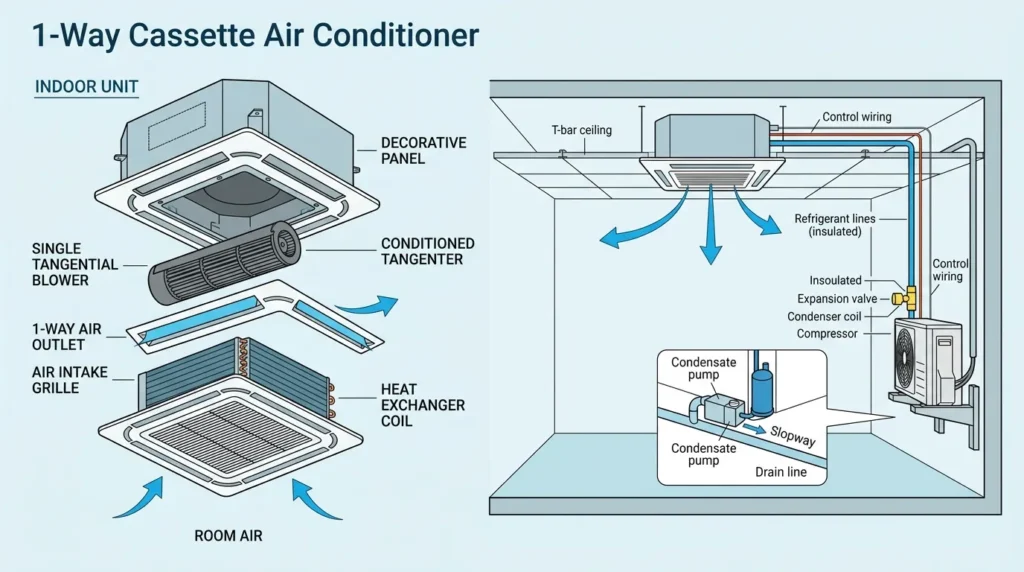
A 1-way cassette air conditioner is a ceiling-mounted cooling system that supplies cooled air in only one fixed direction. It is specially designed for focused cooling applications, where air needs to be delivered to a specific area instead of distributing it across the entire room. This type of AC is commonly used in small or narrow spaces where uniform multi-direction airflow is not required. The indoor unit is installed inside the ceiling, giving a clean and modern appearance while saving wall space.
In operation, the system works on the basic refrigeration cycle. Warm indoor air is drawn into the unit through the intake grille and passed over the evaporator coil, where the refrigerant absorbs heat and cools the air. A built-in fan then pushes this cooled air in a single direction, ensuring targeted cooling performance. Meanwhile, the absorbed heat is transferred to the outdoor unit through the refrigerant, where it is released into the environment, and the cycle continues continuously.
The main advantage of a 1-way cassette AC is its ability to provide direct and efficient cooling to a specific zone, making it ideal for reception areas, small offices, individual workstations, and retail counters. It also offers a neat ceiling installation, quiet operation, and better space utilization compared to wall-mounted units. However, its limitation is that it is not suitable for large or open areas because the airflow is restricted to one direction, which may lead to uneven cooling if used in bigger rooms.
Overall, the 1-way cassette air conditioner is a practical and efficient solution for spaces that require controlled, directional, and space-saving cooling.
It is commonly used in smaller spaces where full-room air distribution is not necessary.
Key Features
- Single-direction airflow
- Compact and space-saving design
- Focused cooling performance
- Easy installation and maintenance
Applications
- Small rooms
- Reception areas
- Individual workstations
- Shops and counters
4. Compact Cassette Air Conditioner
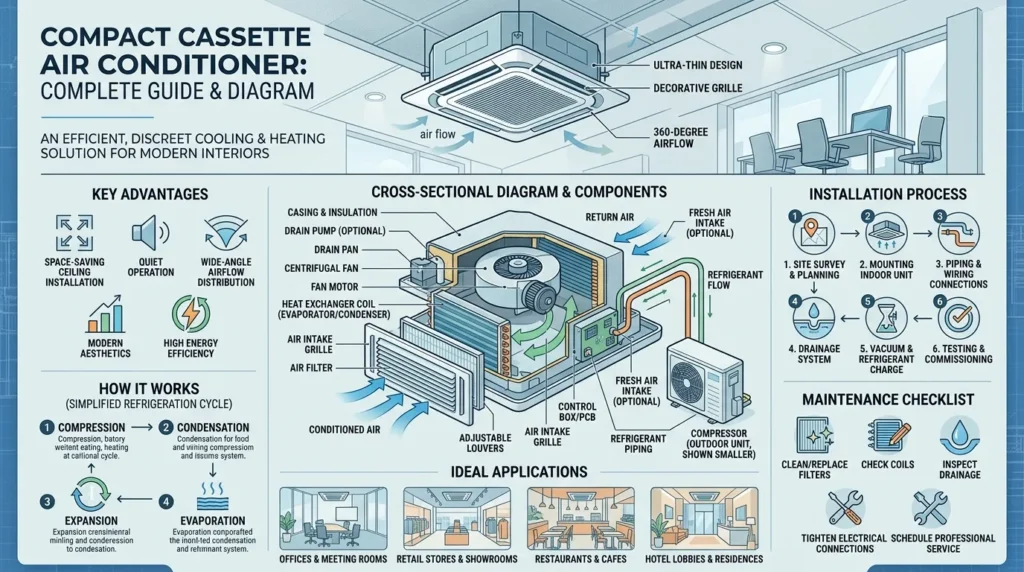
The compact cassette AC is specially designed for areas with limited ceiling space. Despite its small size, it provides efficient cooling and fits well in modern interior designs.
It is a perfect solution where aesthetics and space-saving are important.
Key Features
- Slim and lightweight design
- Ideal for low ceiling spaces
- Energy-efficient operation
- Modern and discreet appearance
Applications
- Hotel rooms
- Small offices
- Residential apartments
- Retail shops and small commercial spaces
Simple Summary
Cassette air conditioners are selected according to the shape and size of the room:
- 4-Way Cassette: Best for large open areas with uniform cooling needs
- 2-Way Cassette: Ideal for long and narrow spaces
- 1-Way Cassette: Suitable for focused and directional cooling
- Compact Cassette: Best for small rooms and limited ceiling space
Main Components of a Cassette Air Conditioner
A cassette air conditioner consists of several essential components that work together to provide efficient cooling, proper air circulation, and reliable system performance. Each component plays a specific role in the refrigeration cycle and overall operation of the unit.
Compressor
The compressor is often referred to as the heart of the air conditioning system. Located in the outdoor unit, it draws in low-pressure refrigerant vapor from the evaporator and compresses it into a high-pressure, high-temperature gas. This process enables the refrigerant to circulate throughout the system and transfer heat effectively.
Evaporator Coil
The evaporator coil is installed inside the indoor cassette unit and is responsible for absorbing heat from the room air. As warm indoor air passes over the cold coil surface, the refrigerant inside the coil absorbs the heat and evaporates into a vapor. The cooled air is then distributed back into the room, creating a comfortable indoor environment.
Condenser Coil
The condenser coil is located in the outdoor unit and functions as a heat exchanger. It releases the heat absorbed from the indoor space into the outside atmosphere. As the hot refrigerant gas passes through the condenser coil, it loses heat and condenses into a high-pressure liquid, preparing it for the next stage of the cooling cycle.
Expansion Valve
The expansion valve controls and regulates the amount of refrigerant entering the evaporator coil. It reduces the refrigerant’s pressure and temperature before it enters the evaporator, ensuring efficient heat absorption and maintaining the proper cooling effect within the system.
Indoor Fan (Blower)
The indoor fan, also known as the blower, circulates room air across the evaporator coil. After the air is cooled, the blower distributes it evenly throughout the space through the cassette unit’s multi-directional outlets, ensuring uniform temperature distribution.
Air Filters
Air filters trap dust, dirt, pollen, and other airborne particles before the air reaches the evaporator coil. They help improve indoor air quality, maintain efficient airflow, and protect internal components from contamination, ultimately extending the lifespan of the system.
Decorative Panel
The decorative panel is the visible portion of the cassette air conditioner mounted on the ceiling. Besides enhancing the aesthetic appearance of the room, it contains the air discharge louvers that direct conditioned air in multiple directions, providing balanced and effective cooling coverage.
Advantages and Disadvantages of Cassette Air Conditioners
Understanding the advantages and limitations of cassette air conditioners is essential before selecting this type of HVAC system. Their ceiling-mounted design, powerful airflow, and discreet appearance make them a popular choice for commercial buildings and large residential spaces. However, installation requirements and maintenance considerations should also be evaluated to ensure the system meets the application’s needs.
Advantages of Cassette Air Conditioners
Cassette air conditioners offer numerous benefits that contribute to their growing popularity in modern HVAC applications.
- Uniform Cooling Performance: Four-way or multi-directional airflow distributes conditioned air evenly throughout the room, eliminating hot and cold spots and improving occupant comfort.
- Space-Saving Design: Since the indoor unit is concealed within the false ceiling, it preserves valuable wall and floor space, making the room appear more spacious and organized.
- Enhanced Aesthetic Appeal: Only the decorative panel remains visible, creating a clean, elegant, and professional appearance that blends seamlessly with interior designs.
- Quiet Operation: Advanced fan technology and the concealed ceiling installation significantly reduce noise levels, making cassette units ideal for offices, hotels, classrooms, libraries, and meeting rooms.
- Suitable for Large Spaces: Their high cooling capacities and wide airflow coverage enable them to efficiently cool large rooms and open-plan areas.
- Superior Air Distribution: Compared to conventional wall-mounted air conditioners, cassette units provide more balanced and effective air circulation across the entire room.
- Flexible Airflow Adjustment: Many models allow users to control airflow direction, swing functions, and fan speeds to suit changing occupancy and comfort requirements.
- Improved Indoor Comfort: Continuous air circulation maintains a stable room temperature and creates a pleasant indoor environment for occupants.
- Energy-Efficient Performance: Modern inverter cassette air conditioners adjust compressor speed according to cooling demand, reducing electricity consumption and lowering operating costs.
- Professional Appearance: Their hidden installation makes them an excellent choice for retail stores, restaurants, hospitals, hotels, and corporate offices where aesthetics are important.
Disadvantages and Limitations of Cassette Air Conditioners
Despite their many advantages, cassette air conditioners also have certain drawbacks that should be considered during system selection and planning.
- Higher Initial Installation Cost: Cassette units are generally more expensive to install than wall-mounted systems because they require additional ceiling work and professional setup.
- Requires a False Ceiling: Adequate ceiling space is necessary to accommodate the indoor unit, drain piping, and refrigerant lines, making them unsuitable for buildings without suspended ceilings.
- Complex Installation Process: Proper installation demands experienced HVAC technicians to ensure correct positioning, drainage, refrigerant charging, and electrical connections.
- More Challenging Maintenance Access: Since the unit is mounted within the ceiling, servicing and repairs can be more difficult and time-consuming compared to easily accessible wall-mounted units.
- Not Economical for Small Rooms: The cooling capacity and installation costs may not be justified for compact spaces with lower cooling requirements.
- Potential Ceiling Modifications: Existing structures may require renovation or alterations to create sufficient installation space.
- Drainage Problems if Improperly Installed: Incorrect drain pipe installation can lead to water leakage and ceiling damage.
- Higher Repair Costs: Maintenance and replacement of internal components may involve additional labor costs due to restricted access.
Understanding these limitations helps HVAC technicians, engineers, and building owners select the most suitable air conditioning system based on budget, space availability, and operational requirements.
Cassette Air Conditioner Applications
Due to their efficient cooling performance, discreet installation, and excellent airflow distribution, cassette air conditioners are widely used in a variety of commercial, residential, and institutional environments.
Commercial Applications
Cassette AC systems are commonly installed in commercial spaces where appearance and uniform cooling are essential.
- Offices and corporate workspaces
- Shopping malls and retail outlets
- Restaurants and cafés
- Hotels and banquet halls
- Conference and meeting rooms
- Showrooms and reception areas
- Banks and financial institutions
Residential Applications
Although primarily used in commercial settings, cassette units are increasingly being adopted in high-end residential projects.
- Large living rooms
- Luxury apartments and penthouses
- Villas with false ceilings
- Open-plan residential spaces
- Home entertainment rooms
Industrial and Institutional Applications
Their reliable operation and wide air coverage also make them suitable for institutional facilities.
- Hospitals and healthcare centers
- Schools, colleges, and universities
- Laboratories and research facilities
- Training centers
- Libraries and study halls
- Religious and community halls
- Government buildings
Because of their concealed design, powerful airflow, quiet operation, and ability to maintain uniform temperatures, cassette air conditioners have become an important part of modern HVAC systems used in both commercial and premium residential applications.
Comparison: Cassette Air Conditioner vs Split Air Conditioner
One common question is the difference between cassette air conditioner and split air conditioner.
| Feature | Cassette Air Conditioner | Wall-Mounted Split AC |
|---|---|---|
| Installation | Installed in ceiling | Installed on wall |
| Airflow | Four-direction airflow | One-direction airflow |
| Appearance | Hidden inside ceiling | Visible indoor unit |
| Cooling Coverage | Large rooms | Small to medium rooms |
| Installation Cost | Higher | Lower |
| Best Use | Commercial spaces | Homes and small offices |
This comparison helps engineers and technicians select the appropriate system.
Cassette Air Conditioner Selection Guide
Choosing the right cassette air conditioner is essential for achieving optimal cooling performance, energy efficiency, and long-term reliability. Several factors should be carefully evaluated before purchasing or installing a system to ensure it meets the specific requirements of the space.
Room Size and Cooling Capacity
The size of the room is one of the most important considerations when selecting a cassette air conditioner. Larger spaces require units with higher cooling capacities, typically measured in BTU (British Thermal Units) or tons of refrigeration. Installing an undersized unit may result in inadequate cooling and continuous operation, while an oversized unit can lead to unnecessary energy consumption and poor humidity control. Proper load calculation ensures efficient and comfortable performance.
Ceiling Design and Installation Space
Cassette air conditioners are designed to be installed within a suspended or false ceiling. Therefore, sufficient ceiling depth must be available to accommodate the indoor unit, refrigerant piping, drainage lines, and electrical connections. Evaluating the ceiling structure beforehand helps avoid installation difficulties and additional renovation costs.
Air Distribution Requirements
The airflow pattern should match the room layout and occupancy needs. For spaces requiring uniform temperature distribution, a 4-way cassette air conditioner is generally the best option because it delivers conditioned air in multiple directions. Smaller or irregularly shaped rooms may benefit from 1-way or 2-way cassette models depending on the application.
Energy Efficiency
Selecting a system with a high energy-efficiency rating can significantly reduce electricity consumption and operating expenses. Inverter cassette air conditioners automatically adjust compressor speed based on cooling demand, improving efficiency, maintaining stable temperatures, and extending equipment life.
Maintenance Accessibility
Adequate access should be provided around the ceiling opening to facilitate routine maintenance activities such as cleaning air filters, inspecting drain lines, and servicing internal components. Easy maintenance access reduces downtime and lowers long-term service costs.
Noise Level Considerations
For environments such as offices, meeting rooms, hospitals, classrooms, and hotels, selecting a model with low operating noise is essential to maintain occupant comfort and productivity. Reviewing manufacturer noise specifications before installation can help identify quieter systems.
Budget and Lifecycle Cost
The total investment should include not only the purchase price but also installation expenses, maintenance requirements, and long-term energy costs. Evaluating the overall lifecycle cost allows users to select a system that provides the best value over time.
By considering these factors, HVAC learners, technicians, and building owners can confidently choose a cassette air conditioner that delivers efficient performance, comfort, and reliability.
Common Cassette Air Conditioner Problems and Solutions
Like any HVAC equipment, cassette air conditioners can develop operational issues over time. Understanding common faults and their solutions enables faster troubleshooting and minimizes system downtime.
Why Is the Cassette Air Conditioner Not Cooling Properly?
Insufficient cooling is one of the most frequently reported problems in cassette AC systems.
Possible Causes:
- Dirty or clogged air filters
- Low refrigerant charge due to leakage
- Blocked airflow around the indoor or outdoor unit
- Faulty compressor operation
- Dirty evaporator or condenser coils
- Incorrect thermostat settings
Solution: Clean or replace air filters, inspect and clean the coils, verify thermostat settings, and check refrigerant levels. If compressor problems are suspected, consult a qualified HVAC technician for diagnosis and repair.
Why Is Water Leaking from the Cassette Air Conditioner?
Water leakage can damage ceilings and reduce system efficiency if not addressed promptly.
Possible Causes:
- Blocked or clogged drain pipe
- Dirty evaporator coil causing ice formation
- Improper drain pipe slope
- Faulty condensate pump
- Incorrect installation
Solution: Clean the drainage system, inspect the condensate pump, ensure the drain pipe has the correct slope, and verify that the unit has been installed according to manufacturer recommendations.
Why Is the Cassette AC Making Unusual Noise?
Abnormal noises often indicate mechanical issues that require attention.
Possible Causes:
- Loose screws or internal components
- Worn or damaged fan motor bearings
- Dirt accumulation inside the blower assembly
- Vibrating panels or mounting brackets
- Foreign objects trapped in the fan section
Solution: Tighten loose components, clean the blower assembly, remove any obstructions, and inspect the fan motor. Persistent noise should be evaluated by a professional technician.
Why Is the Airflow Weak?
Reduced airflow decreases cooling efficiency and occupant comfort.
Possible Causes:
- Dirty air filters
- Obstructed supply air outlets
- Fan motor malfunction
- Blower wheel contamination
- Incorrect fan speed settings
Solution: Clean the filters and blower assembly, ensure air outlets are unobstructed, check fan settings, and inspect the fan motor for proper operation.
Why Does the Cassette AC Produce Unpleasant Odors?
Bad odors can affect indoor air quality and user comfort.
Possible Causes:
- Mold or bacterial growth on the evaporator coil
- Dirty air filters
- Moisture accumulation in the drain pan
- Poor maintenance practices
Solution: Clean and disinfect the evaporator coil, replace or wash air filters regularly, and ensure proper drainage to prevent moisture buildup.
Future Trends in Cassette Air Conditioner Technology
The HVAC industry is rapidly evolving to meet the growing demand for energy efficiency, smart automation, and environmental sustainability. Future cassette air conditioners are expected to incorporate advanced technologies that improve user experience and operational performance.
Smart Connectivity and Remote Monitoring
Modern systems are increasingly integrating Wi-Fi connectivity and mobile applications, allowing users to control temperature settings, fan speeds, operating schedules, and system diagnostics remotely from smartphones or tablets.
AI-Based Temperature Management
Artificial intelligence is being used to analyze occupancy patterns and environmental conditions. These intelligent systems automatically adjust cooling performance to maximize comfort while minimizing energy consumption.
Advanced Inverter Technology
Next-generation inverter compressors will provide even greater efficiency, quieter operation, and more precise temperature control by continuously adapting output to actual cooling requirements.
Eco-Friendly Refrigerants
Manufacturers are transitioning toward refrigerants with lower Global Warming Potential (GWP) to comply with environmental regulations and reduce the ecological impact of air conditioning systems.
Enhanced Air Purification Systems
Future cassette AC units are expected to feature advanced filtration technologies, including antibacterial filters, ionizers, and fine-particle purification systems that improve indoor air quality and promote healthier environments.
Predictive Maintenance Features
Smart sensors and diagnostic algorithms will enable systems to detect performance abnormalities early, alert users to maintenance needs, and reduce unexpected equipment failures.
Integration with Smart Buildings
Cassette air conditioners will increasingly become part of integrated building management systems, enabling centralized control, energy monitoring, and optimized operation across entire facilities.
These technological advancements will transform cassette air conditioners into smarter, cleaner, and more energy-efficient HVAC solutions, delivering enhanced comfort while supporting global sustainability goals.
Conclusion
Cassette air conditioners are a modern and efficient cooling solution, especially for large indoor spaces. Unlike traditional wall-mounted air conditioners, cassette units are installed in the ceiling and distribute air evenly in multiple directions. This design ensures uniform cooling and maintains the aesthetics of the room.
Understanding the cassette air conditioner working principle, components, and system operation is essential for electrical students, engineers, and technicians. These systems operate using the same refrigeration cycle as other air conditioners but provide better air distribution.
Although cassette air conditioners require higher installation cost and ceiling space, their performance, comfort, and design advantages make them ideal for commercial environments such as offices, hotels, and shopping centers.
Learning about the cassette air conditioner advantages and disadvantages, types, and applications will help beginners confidently install, maintain, and select these systems in real-world HVAC projects.