
Imagine entering your home after working outside on a very hot day. The temperature is high, the air feels heavy, and the room is uncomfortable. You turn on the air conditioner, and within a few minutes the room becomes cool and relaxing. Many homes and offices around the world experience this comfort through a Midea air conditioner.
Air conditioning technology has become essential for modern living, especially in regions with high temperatures. Reliable cooling systems not only improve comfort but also protect equipment, improve productivity, and support healthy indoor environments. Among many global air conditioner brands, Midea air conditioner systems are widely recognized for their affordability, energy efficiency, and modern technology.
For electrical students, engineers, technicians, and beginners, understanding how these systems work is important. A Midea air conditioner combines refrigeration technology, electrical motors, sensors, and electronic control systems in a single integrated design.
In this article, we will explain the Midea air conditioner working principle, types, main components, advantages, disadvantages, and applications. We will also discuss the difference between Midea air conditioner and other air conditioner brands, helping beginners understand where these systems fit in the HVAC industry.
What is a Midea Air Conditioner?
A Midea air conditioner is a cooling system manufactured by Midea, a global HVAC manufacturer known for producing residential and commercial air conditioning equipment.
These air conditioners are designed to remove heat from indoor air and release it outside, creating a comfortable indoor environment.
Simple Explanation
A Midea air conditioner works like a heat transfer system. Instead of creating cold air directly, it removes heat from the room and transfers it outdoors using refrigerant.
Practical Example
For example, a small apartment living room may become very hot during the summer. Installing a Midea split air conditioner allows the system to cool the room quickly while maintaining stable temperature and humidity.
Because of their reliability and energy efficiency, Midea air conditioners are widely used in homes, offices, hotels, and commercial spaces.
Midea Air Conditioner Working Principle
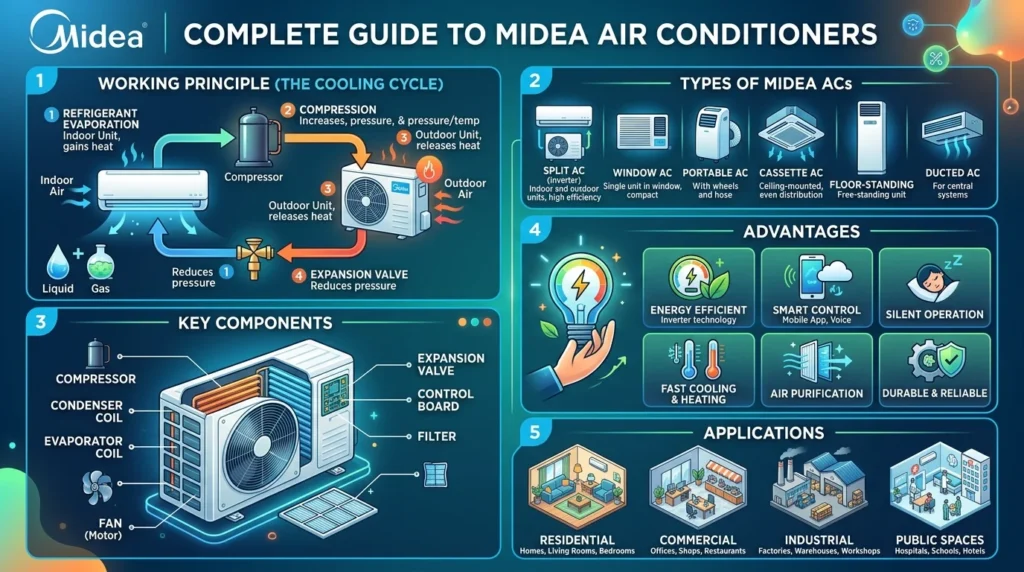
The Midea air conditioner working principle is based on the vapor compression refrigeration cycle, a highly efficient cooling process used in almost all modern air conditioning systems. Contrary to popular belief, an air conditioner does not generate cold air. Instead, it removes unwanted heat from the indoor environment and transfers it outside through a continuously circulating refrigerant. This refrigerant repeatedly changes its pressure, temperature, and physical state to absorb and release heat, creating a comfortable indoor climate. Understanding each stage of this process helps explain how Midea air conditioners deliver effective and energy-efficient cooling.
1. Indoor Air Enters the Evaporator
The cooling cycle begins inside the indoor unit of the Midea air conditioner. A built-in fan draws warm air from the room and directs it toward the evaporator coil. This coil contains refrigerant at a very low temperature and pressure. As the warm indoor air flows over the coil, the heat exchange process starts. The fan ensures a continuous movement of air so that the entire room can be cooled evenly and efficiently.
2. Heat Absorption by the Refrigerant
As the warm air passes across the evaporator coil, the cold refrigerant inside the coil absorbs heat from the air. This process removes thermal energy from the indoor environment, causing the air temperature to decrease. At the same time, moisture present in the warm air condenses on the surface of the evaporator coil, helping to reduce indoor humidity levels. The cooled and dehumidified air is then circulated back into the room, creating a more comfortable atmosphere.
3. Refrigerant Evaporation
After absorbing heat from the indoor air, the refrigerant undergoes a physical transformation known as evaporation. It changes from a low-pressure liquid into a low-pressure gas. Although the refrigerant changes state, it continues carrying the heat extracted from the room. This gaseous refrigerant then travels through insulated copper tubing toward the outdoor unit of the air conditioner.
4. Compression Stage
The refrigerant gas next enters the compressor, which is located in the outdoor unit. The compressor is often called the “heart” of the air conditioning system because it drives the entire refrigeration cycle. Its job is to compress the low-pressure refrigerant gas, significantly increasing both its pressure and temperature. As a result, the refrigerant becomes a high-pressure, high-temperature gas capable of releasing heat efficiently in the next stage of the process.
5. Heat Release Through the Condenser
The hot refrigerant then flows into the condenser coil, also located in the outdoor unit. An outdoor fan blows ambient air across the condenser coil. Since the refrigerant is much hotter than the surrounding outdoor air, heat naturally transfers from the refrigerant to the environment. This process effectively removes the heat that was originally collected from inside the room and releases it outside the building.
6. Condensation of the Refrigerant
As the refrigerant loses heat within the condenser coil, it begins to cool down and change its state once again. The high-pressure gas transforms back into a high-pressure liquid through a process known as condensation. Even though the refrigerant has returned to liquid form, it remains under high pressure and must be prepared for another cooling cycle.
7. Expansion Valve Operation
The high-pressure liquid refrigerant then passes through the expansion valve or capillary tube. This component regulates the amount of refrigerant entering the evaporator coil. As the refrigerant flows through the expansion device, its pressure drops suddenly. This rapid reduction in pressure causes a significant decrease in temperature, turning the refrigerant into a cold, low-pressure liquid mixture that is ready to absorb heat again.
8. The Cooling Cycle Repeats
The cooled refrigerant returns to the evaporator coil inside the indoor unit, where it once again absorbs heat from the room air. The entire process of evaporation, compression, condensation, and expansion continues repeatedly as long as the air conditioner is operating. This continuous cycle ensures a steady supply of cool air and maintains the desired indoor temperature efficiently.
Role of Refrigerant in Midea Air Conditioners
The refrigerant is one of the most important elements of the cooling system. It acts as a heat-transfer medium, carrying heat from inside the room to the outside environment. Modern Midea air conditioners commonly use environmentally friendly refrigerants that provide efficient cooling while minimizing environmental impact. Without refrigerant, the refrigeration cycle would not function.
Importance of the Compressor
The compressor is responsible for maintaining refrigerant circulation throughout the system. It increases the refrigerant’s pressure and temperature, enabling efficient heat rejection at the condenser. In many Midea inverter air conditioners, the compressor automatically adjusts its operating speed according to cooling demand, improving energy efficiency and reducing electricity consumption.
Simple Analogy
A simple way to understand the working principle of a Midea air conditioner is to think of it as a heat transportation machine. Imagine that the heat inside your room is unwanted luggage. The refrigerant acts like a delivery vehicle that collects this luggage from the evaporator, carries it through the system, and throws it outside through the condenser. The vehicle then returns empty to collect more heat, repeating the journey continuously until the room reaches the desired temperature.
The Midea air conditioner working principle relies on the vapor compression refrigeration cycle to provide effective and reliable cooling. Through the coordinated operation of the evaporator, compressor, condenser, expansion valve, and refrigerant, the system continuously removes heat from indoor spaces and releases it outdoors. This advanced process not only cools the air but also reduces humidity and improves overall comfort. By understanding these step-by-step stages, users can better appreciate the technology that enables Midea air conditioners to deliver energy-efficient performance and comfortable indoor environments throughout the year.
Types of Midea Air Conditioners
Midea manufactures several types of air conditioning systems designed for different applications.
Midea Split Air Conditioner
This is one of the most common types.
It consists of:
- Indoor unit (evaporator)
- Outdoor unit (compressor and condenser)
Split systems are popular because they are quiet and energy efficient.
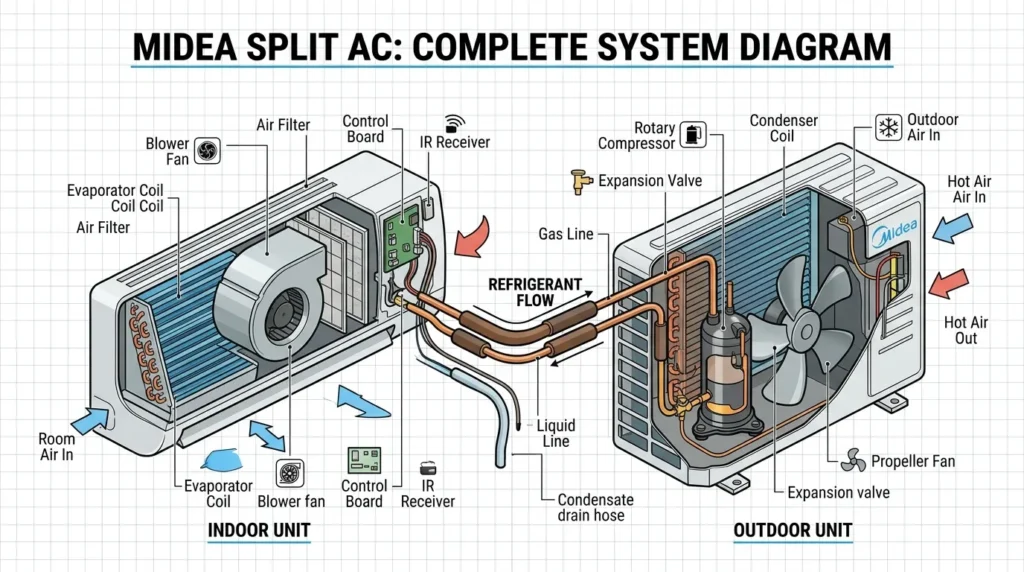
A Midea Split Air Conditioner is one of the most popular cooling solutions for homes and offices due to its excellent performance, energy efficiency, and affordable pricing. Manufactured by Midea Group, a globally recognized home appliance company, these air conditioners are designed to provide powerful cooling while maintaining comfort and reducing electricity consumption. Over the years, Midea has earned a strong reputation in the air conditioning industry by offering reliable products equipped with modern technologies and user-friendly features.
A Midea Split Air Conditioner consists of two main components: an indoor unit and an outdoor unit. The indoor unit is installed inside the room and is responsible for distributing cool air evenly throughout the space. The outdoor unit contains the compressor and condenser, which work together to remove heat from the indoor environment. This split design not only enhances cooling efficiency but also reduces indoor noise levels, making the system quieter and more comfortable than traditional window air conditioners.
One of the biggest advantages of many Midea Split AC models is the inclusion of Inverter Technology. Unlike conventional air conditioners that repeatedly turn the compressor on and off, inverter models adjust the compressor speed according to the room’s cooling requirements. This intelligent operation helps maintain a consistent temperature, reduces wear and tear on the compressor, and significantly lowers electricity consumption. As a result, users can enjoy a comfortable environment while saving money on energy bills.
Midea Split Air Conditioners are also equipped with several advanced features designed to improve convenience and comfort. The Turbo Cooling Mode enables the unit to cool a room rapidly during extremely hot weather, while the Sleep Mode automatically adjusts the temperature during the night to create a more comfortable sleeping environment and minimize energy usage. The Timer Function allows users to schedule when the unit should turn on or off, adding flexibility and helping to avoid unnecessary operation. Additionally, the Auto Restart feature ensures that the air conditioner resumes its previous settings automatically after a power interruption.
Another notable feature is the use of high-quality air filtration systems. These filters help capture dust, airborne particles, and other impurities, improving indoor air quality and creating a healthier living environment. This is particularly beneficial for households with children, elderly family members, or individuals who are sensitive to dust and allergens. Some premium Midea models also include self-cleaning technology, which helps prevent the buildup of moisture and bacteria inside the indoor unit.
Modern Midea Split Air Conditioners may also offer Wi-Fi connectivity and smart controls, enabling users to operate the unit through a smartphone application. This feature allows homeowners to adjust temperature settings, change operating modes, or switch the air conditioner on and off remotely, even when they are away from home. Such smart capabilities add convenience and support a more efficient lifestyle.
Midea manufactures split air conditioners in a variety of capacities, including 12,000 BTU, 18,000 BTU, and 24,000 BTU models. Smaller capacities are ideal for bedrooms and compact spaces, while larger units are suitable for living rooms, offices, and spacious areas. Choosing the correct BTU capacity is essential to achieve effective cooling and optimal energy efficiency.
In terms of maintenance, Midea Split Air Conditioners are relatively easy to care for. Regular cleaning of the filters and periodic professional servicing can help maintain peak performance and extend the lifespan of the unit. With proper maintenance, these air conditioners can provide reliable service for many years.
Overall, the Midea Split Air Conditioner is an excellent choice for anyone seeking a balance of performance, efficiency, affordability, and modern features. Its powerful cooling capabilities, energy-saving technologies, quiet operation, advanced filtration system, and smart functionality make it a dependable option for both residential and commercial use. Whether you need an air conditioner for a small bedroom or a larger office space, Midea offers a wide range of models designed to meet different cooling needs while delivering comfort and value for money.
Midea Window Air Conditioner
This type contains all components in a single unit.
Features include:
- Compact design
- Simple installation
- Suitable for small rooms
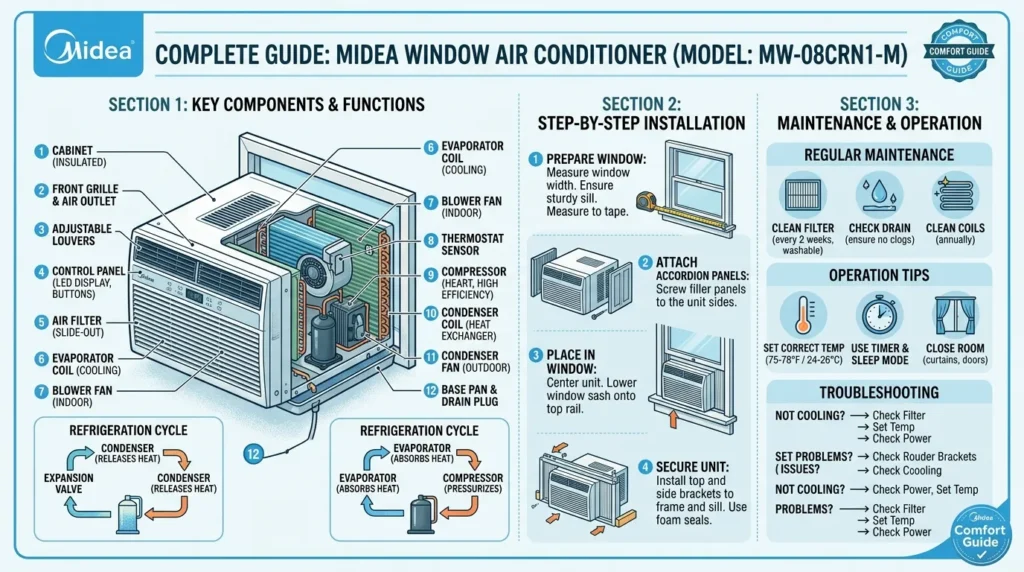
A Midea Window Air Conditioner is a practical and cost-effective cooling solution designed to provide comfort during hot weather conditions. Manufactured by Midea Group, one of the world’s leading home appliance companies, these air conditioners are known for their durability, efficient performance, and user-friendly features. Midea has built a strong reputation in the global market by producing reliable cooling systems that cater to the needs of both residential and commercial users. Among its wide range of products, the Midea Window Air Conditioner remains a popular choice for people looking for an affordable and easy-to-install air conditioning system.
A window air conditioner is a self-contained unit that combines all essential components, including the compressor, condenser, evaporator, and cooling coil, into a single compact body. Unlike split air conditioners, which require separate indoor and outdoor units, a Midea Window Air Conditioner is installed directly into a window frame or a specially designed wall opening. This simple installation process reduces setup costs and makes it an ideal option for apartments, small homes, offices, and rental properties.
One of the key advantages of the Midea Window Air Conditioner is its powerful cooling performance. The unit is designed to cool indoor spaces quickly and efficiently, even during extremely high temperatures. Midea offers window AC models in various capacities, such as 12,000 BTU, 18,000 BTU, and 24,000 BTU, allowing users to select the most suitable option based on room size. Smaller units are ideal for bedrooms and study areas, while larger models can effectively cool spacious living rooms and office environments.
Energy efficiency is another important feature of Midea Window Air Conditioners. Many models are designed to deliver excellent cooling performance while consuming less electricity compared to older conventional units. This helps homeowners reduce their monthly energy expenses without compromising comfort. Some models also include energy-saving modes, which automatically adjust cooling operation to maintain the desired temperature while minimizing power consumption.
Midea Window Air Conditioners come equipped with several convenient features that enhance the overall user experience. The Turbo Cooling Mode enables the unit to lower room temperature rapidly when immediate cooling is required. The Sleep Mode automatically adjusts temperature settings throughout the night to create a comfortable sleeping environment and improve energy efficiency. In addition, the 24-hour Timer Function allows users to schedule the operation of the air conditioner according to their daily routine, ensuring that the unit runs only when needed.
Another useful feature is the remote control system, which allows users to adjust settings such as temperature, fan speed, cooling modes, and timer functions without leaving their seat. Selected models also include an LED display, making it easy to monitor and modify operating conditions.
Indoor air quality is an essential aspect of modern cooling systems, and Midea addresses this through its built-in air filtration system. The washable and reusable filters help trap dust particles, lint, and other airborne impurities before they circulate throughout the room. Regular cleaning of these filters ensures optimal airflow and contributes to a cleaner and healthier indoor environment.
Maintenance of a Midea Window Air Conditioner is generally simple and straightforward. Since all components are housed within a single unit, servicing and cleaning are often easier than maintaining more complex systems. Users are advised to clean the air filters regularly and arrange periodic professional inspections to keep the unit operating efficiently and extend its lifespan.
One of the biggest reasons behind the popularity of Midea Window Air Conditioners is their affordability. Compared to split air conditioning systems, window units typically have lower purchase and installation costs. This makes them an attractive option for budget-conscious consumers who require dependable cooling without investing heavily in advanced systems.
In conclusion, the Midea Window Air Conditioner offers an excellent combination of performance, convenience, and value for money. Its compact design, easy installation, powerful cooling capability, energy-efficient operation, and practical features make it a dependable choice for a wide variety of cooling needs. Whether you are looking to cool a bedroom, office, apartment, or small commercial space, a Midea Window Air Conditioner provides reliable comfort and efficient performance throughout the hottest months of the year.
Midea Portable Air Conditioner
Portable air conditioners are movable units designed for temporary cooling.
Advantages include:
- Easy installation
- Mobility
- Ideal for rental spaces
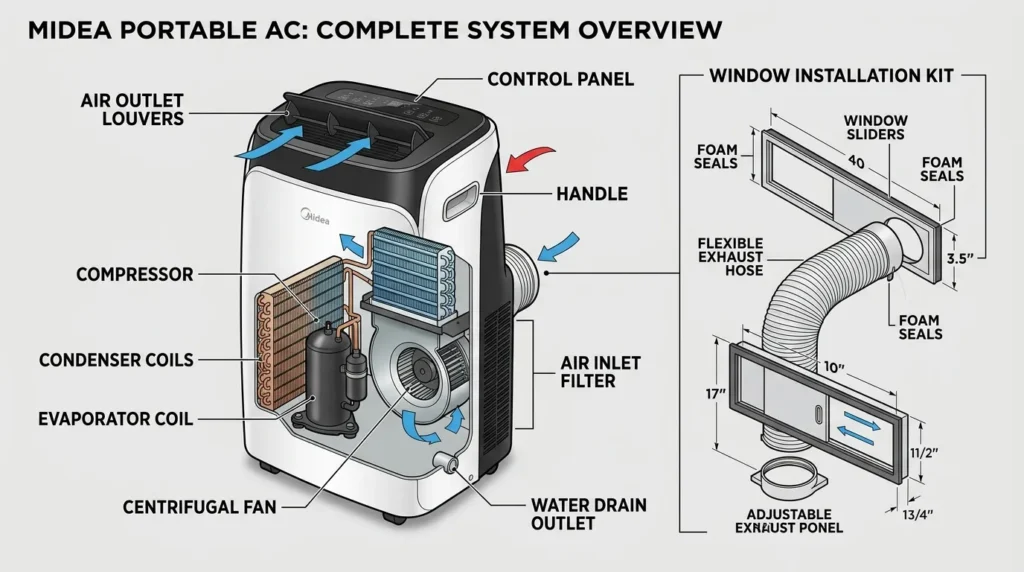
A Midea Portable Air Conditioner is a modern and convenient cooling solution designed for people who need flexibility without the permanent installation required by split or window air conditioners. Manufactured by Midea Group, one of the world’s leading appliance manufacturers, these portable units combine powerful cooling performance with mobility, making them ideal for apartments, bedrooms, offices, dormitories, and rental properties. Their compact design and easy setup have made them increasingly popular among homeowners looking for an efficient way to stay comfortable during hot weather.
One of the biggest advantages of a Midea Portable Air Conditioner is its portability. Unlike traditional air conditioning systems that remain fixed in one location, these units are equipped with built-in wheels that allow users to move them from one room to another with ease. Whether you need cooling in your bedroom at night or your home office during the day, a portable AC can adapt to your changing needs. The installation process is also simple. Most models include a window venting kit and an exhaust hose that can be installed within minutes without requiring professional assistance.
Midea Portable Air Conditioners are designed with 3-in-1 functionality, meaning they can operate as an air conditioner, dehumidifier, and fan. This versatility provides year-round comfort and convenience. During hot summer days, the cooling mode rapidly lowers room temperatures. The dehumidifier function helps remove excess moisture from the air, creating a more comfortable indoor environment, especially in humid climates. Meanwhile, the fan mode improves air circulation without activating the cooling system.
Many premium Midea portable models feature Inverter Technology, which adjusts compressor speed according to the room’s cooling requirements instead of continuously switching on and off. This intelligent operation can reduce energy consumption by more than 40 percent compared to conventional portable units while maintaining a consistent indoor temperature. The technology also contributes to quieter operation and improved efficiency.
Another standout feature is Midea’s innovative DUO Hose Design. Traditional portable air conditioners often use a single hose, which can reduce cooling efficiency. Midea’s dual-hose system simultaneously draws in fresh outdoor air and expels hot air, helping maintain cooling performance and reducing energy waste. This design enables faster cooling and improves overall efficiency.
Convenience is further enhanced through smart control features available in selected models. Users can operate the air conditioner through a smartphone application, voice assistants, or even compatible smart devices. This allows them to adjust temperatures, change operating modes, set timers, and monitor performance remotely. Some models also support integration with virtual assistants, offering hands-free control and a more connected home experience.
Midea Portable Air Conditioners are available in different cooling capacities, typically ranging from 8,000 BTU to 14,000 BTU. Smaller units are suitable for compact bedrooms and study areas, while larger models can effectively cool living rooms and office spaces up to approximately 550 square feet. Selecting the correct BTU capacity ensures optimal cooling performance and energy efficiency.
In conclusion, the Midea Portable Air Conditioner offers an excellent combination of mobility, convenience, energy efficiency, and advanced technology. Its easy installation, powerful cooling capability, multifunctional operation, smart controls, and innovative design make it an attractive option for modern households. Whether you need a temporary cooling solution or a versatile unit that can move with you from room to room, Midea Portable Air Conditioners provide reliable performance and exceptional value for money.
Midea Cassette Air Conditioner
Cassette systems are installed in the ceiling and distribute air in multiple directions.
They are commonly used in:
- Offices
- Restaurants
- Commercial buildings
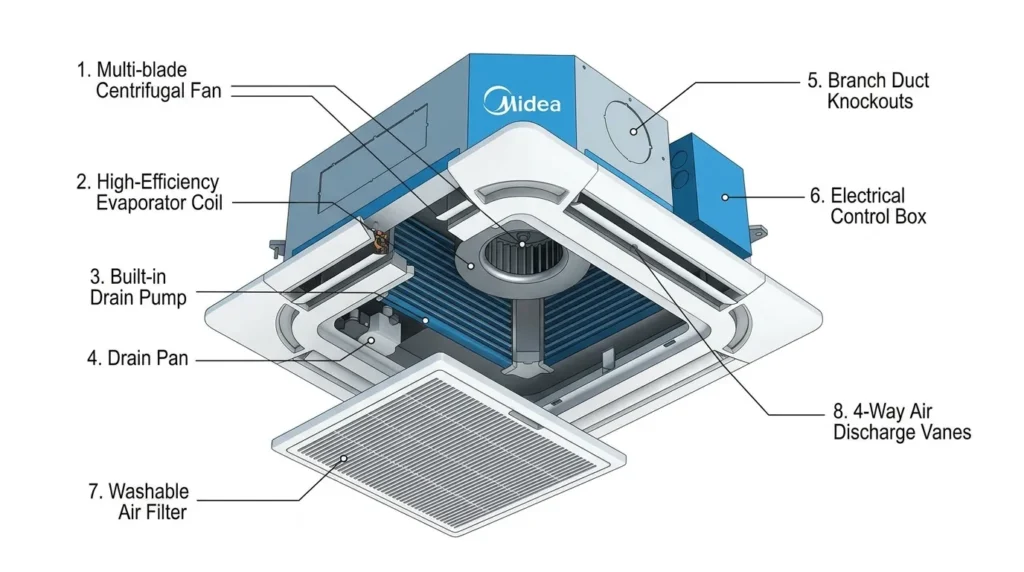
A Midea Cassette Air Conditioner is a powerful and elegant cooling system designed primarily for commercial spaces, offices, hotels, restaurants, conference rooms, and large residential areas. Manufactured by Midea Group, one of the world’s leading home appliance and HVAC companies, this type of air conditioner is known for its efficient performance, modern technology, and space-saving design. Unlike traditional wall-mounted air conditioners, cassette units are installed within the ceiling, leaving only the decorative panel visible. This concealed installation provides a clean and professional appearance while delivering powerful and uniform cooling throughout the room.
One of the most impressive features of the Midea Cassette Air Conditioner is its 360-degree airflow technology. The specially designed air outlet distributes cool air evenly in all directions, ensuring that every corner of the room receives the same level of comfort. This eliminates hot spots and creates a balanced indoor environment, making it ideal for larger spaces where ordinary air conditioners may struggle to provide consistent cooling. Midea’s seamless airflow louver design further enhances air circulation and improves overall cooling efficiency.
Another important advantage is its super slim design. Midea has redesigned the internal structure and heat exchanger of its cassette units to reduce the installation space required within the ceiling. This compact construction makes the unit suitable for modern buildings with limited ceiling depth. Despite its slim profile, the system delivers strong airflow capable of reaching distant areas of the room. Adjustable air vanes can direct airflow according to user preferences, providing personalized comfort for occupants. (Midea)
Many Midea Cassette Air Conditioner models feature advanced Inverter Technology, which automatically adjusts compressor speed based on the cooling demand of the room. Unlike conventional systems that repeatedly switch on and off, inverter units maintain a stable temperature while consuming less electricity. This intelligent operation not only reduces energy costs but also minimizes compressor wear and extends the lifespan of the equipment. Inverter models operate more quietly and provide smoother temperature control, making them suitable for environments where comfort and low noise levels are essential. (Midea)
Maintenance has also been simplified through Midea’s innovative engineering. The units include a built-in drain pump, which efficiently removes condensed water and allows greater flexibility during installation. The redesigned pump placement provides easier access for servicing, reducing maintenance time and improving convenience for technicians. This thoughtful design helps ensure long-term reliability and minimizes downtime.
Modern Midea cassette systems may also include SmartHome features and Wi-Fi connectivity, allowing users to control temperature settings, operating modes, and timers through a smartphone application. Some premium models support voice control integration, enabling users to manage their cooling systems more conveniently and efficiently from virtually anywhere. These smart features contribute to improved comfort and energy management in both residential and commercial settings.
Midea Cassette Air Conditioners are available in various capacities, typically ranging from 3.5 HP to 5.0 HP and above, making them suitable for different room sizes and cooling requirements. Smaller capacities are ideal for medium-sized offices and meeting rooms, while larger units can effectively cool restaurants, retail stores, and spacious halls. Choosing the appropriate capacity ensures optimal performance and energy efficiency.
In conclusion, the Midea Cassette Air Conditioner combines powerful cooling, elegant ceiling-mounted installation, energy-saving inverter technology, and advanced airflow management into a single system. Its 360-degree air distribution, slim design, quiet operation, built-in drain pump, and smart control options make it an excellent choice for businesses and homeowners seeking efficient cooling without compromising interior aesthetics. For anyone looking for a reliable and professional air conditioning solution for large spaces, Midea Cassette Air Conditioners offer outstanding performance, comfort, and long-term value.
Midea Central Air Conditioning Systems
These systems are designed for large buildings, hotels, shopping malls, and industrial facilities.
They use duct systems to distribute cooled air throughout the building.
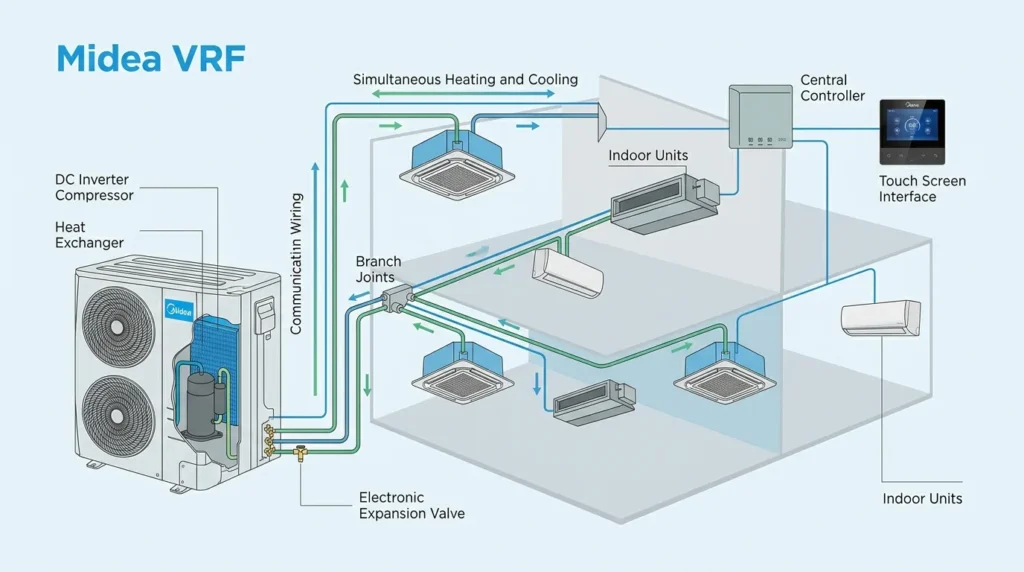
Midea Central Air Conditioning Systems are advanced cooling solutions designed to provide efficient temperature control for large residential properties, commercial buildings, hotels, shopping centers, hospitals, educational institutions, and office complexes. Manufactured by Midea Group, one of the world’s leading HVAC and home appliance companies, these systems are recognized for their reliability, energy efficiency, and innovative technologies. Unlike individual air conditioning units that cool a single room, central air conditioning systems distribute conditioned air throughout an entire building, ensuring consistent comfort in multiple areas simultaneously.
A Midea Central Air Conditioning System operates through a network of indoor and outdoor components connected by refrigerant lines and air ducts. The outdoor unit contains the compressor and condenser, while the indoor units handle air distribution within different zones of the building. This integrated design allows the system to cool large spaces efficiently while maintaining a clean and uncluttered appearance. Because most of the major mechanical components are located outside or hidden above ceilings, central systems also contribute to quieter indoor environments.
One of the most significant advantages of Midea Central Air Conditioning Systems is their use of Inverter Technology. Traditional systems often operate at a fixed speed, repeatedly turning on and off to maintain the desired temperature. In contrast, inverter-driven compressors continuously adjust their operating speed according to the cooling demand. This intelligent process reduces energy consumption, minimizes temperature fluctuations, and extends the lifespan of the equipment. As a result, users can enjoy greater comfort while lowering electricity costs.
Midea also offers advanced VRF (Variable Refrigerant Flow) technology in many of its central air conditioning systems. VRF systems can connect multiple indoor units to a single outdoor unit, allowing different rooms or zones to maintain individual temperature settings. This zoning capability improves comfort and prevents unnecessary energy use in unoccupied areas. For example, offices, hotel rooms, and conference halls can be cooled independently according to their specific requirements.
Modern Midea central systems are equipped with smart control features that enhance convenience and system management. Users can monitor and adjust operating conditions through centralized controllers, touch panels, or smartphone applications. Some models also support integration with building management systems, enabling facility managers to oversee performance, schedule operating times, and optimize energy usage across large buildings.
Another major benefit of Midea Central Air Conditioning Systems is their ability to improve indoor air quality. Advanced filtration technologies help capture dust, airborne particles, and certain pollutants before they circulate through occupied spaces. Proper ventilation and humidity control contribute to a healthier and more comfortable indoor environment, especially in locations where people spend extended periods indoors.
Despite their sophisticated technology, Midea central systems are designed with maintenance efficiency in mind. Regular servicing, filter cleaning, and professional inspections help maintain peak performance and extend the system’s operational life. With proper care, these systems can provide reliable cooling for many years.
In conclusion, Midea Central Air Conditioning Systems offer a complete climate-control solution for large spaces requiring dependable and efficient cooling. Their inverter technology, VRF zoning capabilities, smart controls, quiet operation, and enhanced air quality features make them an excellent investment for both residential and commercial applications. By combining innovative engineering with energy-saving performance, Midea continues to deliver central air conditioning systems that provide comfort, flexibility, and long-term value.
Main Components of a Midea Air Conditioner
Understanding the main components helps technicians maintain and repair the system effectively.
Compressor
The compressor is the heart of the air conditioner.
Functions include:
- Compressing refrigerant gas
- Increasing refrigerant pressure
- Circulating refrigerant through the system
Condenser Coil
The condenser coil releases heat from the refrigerant to the outdoor air.
A condenser fan improves heat transfer efficiency.
Evaporator Coil
The evaporator coil absorbs heat from indoor air.
As air passes over the coil, it becomes cooler before returning to the room.
Expansion Valve
The expansion valve reduces refrigerant pressure before it enters the evaporator.
This creates the low temperature required for cooling.
Indoor Fan
The indoor fan distributes cool air throughout the room.
Proper airflow ensures uniform cooling.
Air Filters
Air filters remove dust and particles from indoor air.
Clean filters improve air quality and system efficiency.
Electronic Control Board
Modern Midea air conditioners include electronic control systems that manage:
- Temperature settings
- Compressor operation
- Fan speed
- Safety protection functions
Midea Air Conditioner Advantages
Understanding Midea air conditioner advantages and disadvantages helps engineers evaluate their performance.
Key Advantages
- Energy-efficient operation
- Advanced inverter technology
- Quiet operation
- Modern design
- Reliable cooling performance
- Easy installation in many models
- Smart control options in newer systems
Real-World Benefits
Energy-efficient Midea air conditioners can significantly reduce electricity consumption compared to older systems.
Disadvantages / Limitations
Despite their advantages, Midea air conditioners also have some limitations.
Common Disadvantages
- Some models require professional installation
- Spare parts availability may vary by region
- Initial cost may be higher for inverter models
- Maintenance is required for optimal performance
- Incorrect installation can reduce efficiency
Understanding these limitations helps technicians maintain systems properly.
Midea Air Conditioner Applications
The Midea air conditioner applications cover a wide range of residential and commercial environments.
Residential Applications
Midea air conditioners are commonly used in:
- Bedrooms
- Living rooms
- Apartments
- Houses
Commercial Applications
In commercial spaces, they are used in:
- Offices
- Restaurants
- Retail stores
- Hotels
Industrial and Technical Applications
Midea systems may also be used for cooling:
- Server rooms
- Laboratories
- Equipment rooms
These spaces require stable temperature control to protect sensitive equipment.
Difference Between Midea Air Conditioner and Other Air Conditioner Brands
Understanding the difference between Midea air conditioner and other air conditioner brands helps buyers choose the right product.
| Feature | Midea Air Conditioner | Other Brands |
|---|---|---|
| Price | Generally affordable | Often higher |
| Technology | Advanced inverter systems | Similar technologies |
| Energy Efficiency | High efficiency models available | Varies by brand |
| Product Range | Wide variety of systems | Depends on manufacturer |
| Availability | Widely distributed globally | Depends on region |
Many customers choose Midea because it provides good performance at competitive prices.
Selection Guide
Choosing the right air conditioner requires more than simply selecting a model based on price. Consider the room size, cooling requirements, energy consumption, installation conditions, noise level, and available features before making a decision.
Cooling Capacity
Cooling capacity is usually measured in BTUs or tons. Choose a capacity that matches the size of the room. An undersized unit may struggle to cool the space, while an oversized unit can consume more energy and cycle on and off too frequently.
Energy Efficiency
Check the unit’s Energy Efficiency Ratio (EER) and other efficiency ratings. Inverter air conditioners can also help reduce electricity consumption by adjusting compressor speed according to the cooling demand.
Installation Requirements
Check the available space and installation conditions for both the indoor and outdoor units. Proper installation, ventilation, drainage, and adequate clearance are essential for efficient and reliable operation.
Noise Level
Noise level is especially important for bedrooms, offices, libraries, and other quiet spaces. Choose an air conditioner with a low-noise indoor and outdoor unit for greater comfort.
Smart Features
Modern air conditioners may include convenient features such as:
- Remote control
- Wi-Fi connectivity
- Smartphone app control
- Smart temperature adjustment
- Timer and scheduling functions
These features provide greater control, convenience, and flexibility in everyday use.
Common Problems and Solutions
Air conditioners can develop performance issues because of poor maintenance, restricted airflow, refrigerant problems, drainage blockages, electrical faults, or control-system issues. Some problems are simple to resolve, while others require inspection by a qualified HVAC technician. Regular cleaning and preventive maintenance can help identify minor problems before they affect cooling performance or increase energy consumption.
Why Is the Air Conditioner Not Cooling Properly?
Common causes include:
- Dirty or clogged air filters
- Low refrigerant charge
- Dirty evaporator or condenser coils
- Restricted airflow
Solution: Clean the filters and coils, check airflow, and have the refrigerant system inspected by a qualified technician if the charge may be low.
If the unit continues to provide weak cooling after cleaning, the technician should also check the evaporator and condenser fans, compressor operation, refrigerant pressure, and electrical connections. Running an air conditioner with a serious airflow or refrigerant problem for an extended period can reduce efficiency and place additional stress on the system.
Why Is Water Leaking From the Indoor Unit?
A blocked condensate drain, dirty drain pan, or improper drainage can cause water to leak from the indoor unit.
Solution: Inspect and clean the condensate drain line and drain pan, and verify that the drainage system has the correct slope.
Regularly cleaning the drain system is particularly important in humid environments because algae, dust, and other debris can gradually restrict condensate flow. If water continues to leak after the drain is cleaned, the indoor coil, drain pan, insulation, and installation level should be inspected for other possible causes.
Why Is the Air Conditioner Making Unusual Noise?
Unusual sounds may result from loose mounting components, a dirty or obstructed fan, worn bearings, or debris inside the unit.
Solution: Inspect the mounting hardware, fan assembly, and surrounding components. Disconnect power before carrying out physical inspections.
Different sounds can indicate different problems. Rattling may point to loose panels or fasteners, while grinding or squealing can indicate a mechanical problem with a fan motor or bearing. Clicking, buzzing, or repeated electrical sounds may require professional inspection of the electrical and control components. Do not ignore sudden or unusually loud noises, especially when they are accompanied by reduced cooling performance.
Why Does the Air Conditioner Frequently Start and Stop?
Frequent cycling can be caused by an incorrect temperature setting, a dirty filter, an improperly sized unit, or a faulty thermostat or sensor.
Solution: Check the filter and settings first. If the problem continues, inspect the temperature sensor, controls, and system sizing.
Frequent short cycling can reduce comfort and increase wear on the compressor and other components. A technician may need to check the thermostat or temperature sensor, airflow, refrigerant condition, compressor operation, and whether the cooling capacity is appropriate for the space. Correct diagnosis is important because replacing a component without identifying the underlying cause may not solve the problem.
Why Is the Air Conditioner Turning On but Not Starting Properly?
If the indoor unit operates but the outdoor unit does not start, possible causes include a tripped protection device, faulty wiring, a damaged capacitor on applicable systems, a control-board problem, or an issue with the outdoor fan or compressor.
Solution: Check the basic power supply and protection devices first. If the outdoor unit still does not operate, electrical and refrigeration components should be tested by a qualified technician rather than repeatedly restarting the system.
Why Does the Air Conditioner Have Weak Airflow?
Weak airflow is commonly associated with dirty filters, blocked return or supply vents, a dirty evaporator coil, or a problem with the indoor fan. Restricted airflow can reduce cooling performance and may cause the system to operate inefficiently.
Solution: Clean or replace the air filters as recommended by the manufacturer and make sure vents are unobstructed. If airflow remains weak, the indoor fan, coil, ductwork, and other airflow components should be inspected.
Future Trends
Air conditioning technology is moving toward greater energy efficiency, smarter controls, improved indoor comfort, predictive maintenance, and lower environmental impact. Manufacturers are also focusing on better sensors, advanced compressors, connected controls, and refrigerants with lower environmental impact.
Smart and Connected Air Conditioners
Modern systems are increasingly equipped with Wi-Fi connectivity, mobile-app control, remote diagnostics, scheduling, and smart-home integration. Users can monitor temperature settings, adjust operating modes, and manage schedules remotely. Connected systems can also provide alerts when maintenance may be required or when unusual operating conditions are detected.
AI-Based Energy Optimization
Advanced control systems can analyze operating conditions, temperature patterns, outdoor conditions, and occupancy information to optimize cooling. AI-assisted controls may help the system adjust operation according to actual cooling demand instead of running at a constant level. This can improve comfort while reducing unnecessary energy use.
Eco-Friendly Refrigerants
The HVAC industry is moving toward refrigerants with lower environmental impact while maintaining safe and efficient cooling performance. Refrigerant selection will remain an important part of sustainable air-conditioning design, and future equipment will increasingly be designed around modern refrigerant requirements and environmental regulations.
Higher Energy Efficiency
Improved inverter compressors, heat exchangers, motors, sensors, and electronic control systems are expected to increase efficiency and reduce operating costs. Better variable-speed technology can allow air conditioners to match output more closely to the actual cooling load, reducing unnecessary starts and stops.
Predictive Maintenance
Future air conditioners will increasingly use sensors and connected monitoring systems to identify abnormal temperatures, airflow changes, vibration, power consumption, and other operating conditions. Predictive maintenance can help technicians detect developing problems earlier and schedule service before a major breakdown occurs.
Improved Indoor Air Quality
Newer air conditioning systems are also expected to place greater emphasis on indoor air quality. Improved filtration, air circulation, humidity management, and monitoring technologies can help create a more comfortable indoor environment while maintaining efficient cooling.
These developments are helping make modern air conditioners more efficient, connected, reliable, easier to maintain, and environmentally responsible. As technology continues to advance, homeowners and businesses can expect air conditioning systems to provide better cooling control while using energy more intelligently.
Conclusion
Midea air conditioners have become an important part of modern HVAC solutions. Their combination of affordability, energy efficiency, and advanced technology makes them suitable for homes, offices, and commercial buildings.
In this article, we explored the Midea air conditioner working principle, types, components, advantages, disadvantages, and applications. Understanding these systems helps electrical students and technicians learn how refrigeration cycles, compressors, and electronic control systems work together to provide cooling.
We also discussed the difference between Midea air conditioner and other air conditioner brands, helping readers understand how these systems compare in terms of cost, technology, and performance.
For engineers and technicians, learning about air conditioning systems is essential because HVAC technology continues to play a major role in modern buildings. Proper selection, installation, and maintenance ensure reliable and efficient cooling for many years.