
Peak vs peek is a common English word confusion. The two words sound exactly the same, but they have different spellings, meanings, and uses. This makes them easy to mix up, especially when writing quickly.
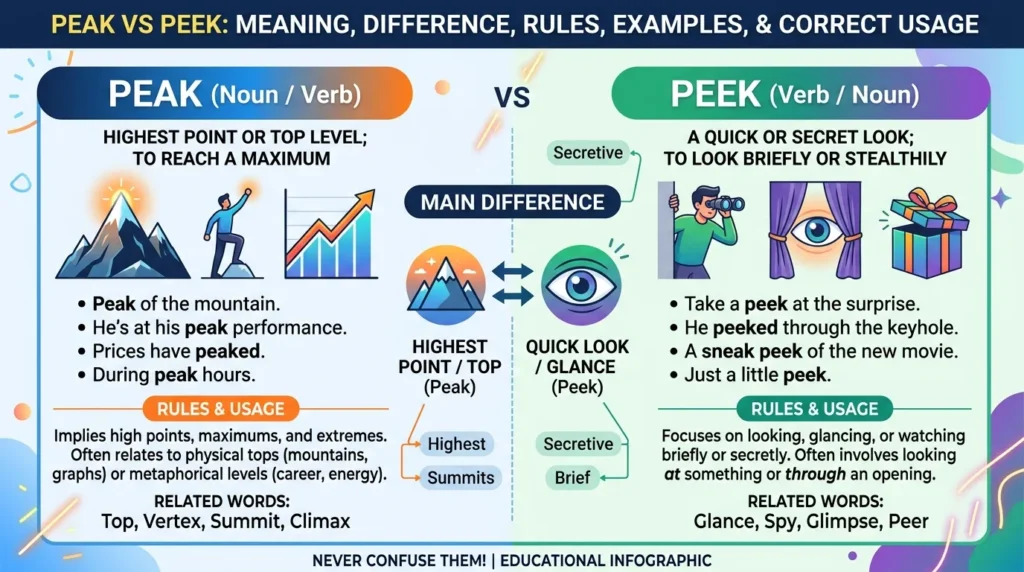
Peak usually refers to the highest point, level, or top of something. For example, “The mountain has a snowy peak” refers to the top of the mountain. It can also describe the highest level of success, activity, or performance, such as “The athlete reached her peak.”
Peek, on the other hand, means to look quickly or secretly at something. For example, “She took a peek inside the box” means she looked inside briefly.
People search for peak vs peek because the words are homophones. They sound the same but have different meanings. Choosing the wrong spelling can change the meaning of a sentence and make professional or academic writing look careless.
This guide explains peak vs peek in simple English. You will learn their meanings, origins, differences, common mistakes, everyday examples, and easy ways to remember which word to use.
Peak vs Peek – Quick Answer
The simplest difference is:
- Peak = the highest point or level.
- Peek = a quick or secret look.
Peak Examples
We reached the peak of the mountain.
Sales reached their peak in December.
He is performing at his peak.
In these examples, peak means the highest point or level.
Peek Examples
Take a peek inside the box.
She peeked through the window.
Don’t peek at my answers.
Here, peek means to look quickly or secretly.
Easy Memory Trick
Think:
Peak = top
Peek = look
If you are talking about a high point, use peak.
The mountain peak is covered with snow.
If you are talking about looking, use peek.
I took a peek inside.
The Origin of Peak vs Peek
Although peak and peek sound the same, they have different histories.
Origin of Peak
The word peak is related to words referring to a pointed top or summit. It developed in English as a word for the pointed or highest part of something.
Today, peak can refer to:
- The top of a mountain
- The highest point of an object
- The highest level of activity
- The best stage of performance
- The maximum value or amount
For example:
The mountain’s peak is covered with snow.
The company reached its sales peak.
Origin of Peek
Peek developed in English as a word connected with looking quickly or secretly. Its meaning is linked to taking a brief look at something.
For example:
She peeked through the door.
The action is quick and often secret or cautious.
Why Are They Confused?
The main reason is pronunciation.
Peak and peek are pronounced the same in standard English. They are called homophones.
However, their meanings are completely different.
| Word | Meaning | Memory |
|---|---|---|
| Peak | Highest point | Top |
| Peek | Quick look | Look |
British English vs American English Spelling
There is no major spelling difference between British and American English for peak and peek.
Both varieties use:
- peak for the highest point or level
- peek for a quick look
The meanings are also the same.
Comparison Table
| Meaning | British English | American English | Example |
|---|---|---|---|
| Highest point | peak | peak | We reached the mountain peak. |
| Highest level | peak | peak | Demand reached its peak. |
| Quick look | peek | peek | She took a peek inside. |
| Look secretly | peek | peek | He peeked through the door. |
| Highest performance level | peak | peak | She is at her peak. |
British English Examples
The climbers finally reached the peak.
Can I have a peek at your new phone?
American English Examples
The climbers finally reached the peak.
Can I have a peek at your new phone?
The spelling and grammar are the same in both forms of English.
Which Spelling Should You Use?
Your choice between peak and peek depends on the meaning of the sentence, not on your audience’s country.
Use Peak for the Highest Point
Use peak when talking about the top or highest level.
The mountain peak is difficult to reach.
Traffic reaches its peak at 8 a.m.
The athlete is at the peak of her career.
Use Peek for a Quick Look
Use peek when someone looks briefly or secretly.
I took a peek at the menu.
He peeked through the curtains.
She wanted to peek inside the room.
Peak as a Verb
Peak can also be used as a verb meaning to reach the highest level.
Sales peaked in December.
Temperatures peaked at 42°C.
Peek as a Verb
Peek can be used as a verb meaning to look quickly.
She peeked through the window.
He peeked inside the package.
For US Readers
American English uses peak and peek in the same ways.
For UK and Commonwealth Readers
British and Commonwealth English also use the same distinction.
For Global English
Remember the simple rule:
Peak = highest point.
Peek = quick look.
Common Mistakes with Peak vs Peek
Mistake 1: “Take a Peak”
Incorrect:
Can I take a peak at your phone?
Correct:
Can I take a peek at your phone?
You are talking about looking, so peek is correct.
Mistake 2: “Mountain Peek”
Incorrect:
We finally reached the mountain peek.
Correct:
We finally reached the mountain peak.
The sentence refers to the top of the mountain.
Mistake 3: “Sales Peeked”
Incorrect:
Sales peeked last month.
Correct:
Sales peaked last month.
The word means sales reached their highest level.
Mistake 4: “Peak Inside”
Incorrect:
Let me peak inside the box.
Correct:
Let me peek inside the box.
You are talking about looking inside.
Mistake 5: “Peek Performance”
Incorrect:
The car delivers peek performance.
Correct:
The car delivers peak performance.
The phrase means the highest or best level of performance.
Peak vs Peek in Everyday Examples
In Emails
Peak:
Sales reached their peak during the holiday season.
Peek:
Could I take a peek at the updated report?
In News
Peak:
Electricity demand reached its peak during the afternoon.
Peek:
The photographer captured a peek inside the historic building.
On Social Media
Peak:
Finally reached the peak! 🏔️
Peek:
Here’s a quick peek at my new project.
In Formal Writing
Peak:
The system operates at peak efficiency under normal conditions.
Peek:
The researchers were allowed to peek inside the testing facility.
In Everyday Conversation
We reached the peak before sunset.
Can I take a peek?
The temperature peaked at 40°C.
Don’t peek at the answers.
Peak vs Peek – Comparison Table
| Word | Part of Speech | Meaning | Example |
|---|---|---|---|
| Peak | Noun | Highest point | We reached the peak. |
| Peak | Noun | Highest level | Demand reached its peak. |
| Peak | Verb | Reach the highest level | Sales peaked in June. |
| Peak | Adjective | Maximum or highest | The system is running at peak capacity. |
| Peek | Noun | Quick look | Take a peek inside. |
| Peek | Verb | Look quickly | She peeked through the door. |
| Peeking | Verb form | Looking quickly | He is peeking through the window. |
| Peeked | Past tense | Looked quickly | She peeked inside. |
Peak vs Peek vs Pique
There is another word that sounds like peak and peek: pique.
These three words are often confused.
| Word | Meaning | Example |
|---|---|---|
| Peak | Highest point | We reached the peak. |
| Peek | Quick look | I took a peek. |
| Pique | Stimulate interest or curiosity | The story piqued my interest. |
Examples
The mountain has a high peak.
She took a peek inside.
The headline piqued my curiosity.
A useful memory trick is:
Peak = top
Peek = look
Pique = interest
How to Remember Peak vs Peek
The easiest memory trick is to connect each word with its meaning.
Peak = Top
Both peak and top describe the highest point.
mountain peak
peak performance
peak demand
Peek = Look
Think of peek as a quick look.
Take a peek.
Peek through the window.
Peek inside the box.
A Simple Question
Ask yourself:
Am I talking about the highest point?
Use peak.
Am I talking about looking?
Use peek.
This simple test works in most everyday situations.
Peak vs Peek – Google Trends & Usage Data
Search interest for peak vs peek is mainly related to English grammar, spelling, vocabulary, and homophones.
Both words are common in everyday English, but their uses are very different. Peak appears often in business, sports, science, weather, travel, energy, and performance-related content. Peek is common in casual conversation, social media, entertainment, and descriptions of quick or secret looks.
Searches for the phrase peak vs peek are especially useful for English learners because the two words sound identical but have different spellings and meanings.
Interest can vary by country and context. English-speaking countries and countries where English is widely taught may show strong interest in grammar and vocabulary questions.
Google Trends data changes over time and by location. For exact current search-volume numbers, it is best to check Google Trends directly rather than use fixed figures. The long-term search intent remains clear: users want to know whether peak or peek is correct in a sentence.
FAQs About Peak vs Peek
1. What is the difference between peak and peek?
Peak means the highest point or level. Peek means to look quickly or secretly.
The mountain has a high peak.
Take a peek inside.
2. Is it “take a peak” or “take a peek”?
The correct phrase is:
Take a peek.
It means to take a quick look.
3. Is it mountain peak or mountain peek?
The correct phrase is:
Mountain peak
A peak is the highest point of a mountain.
4. Is it peak performance or peek performance?
The correct phrase is:
Peak performance
It means the highest or best level of performance.
5. Can peak be used as a verb?
Yes.
Sales peaked in December.
It means sales reached their highest level.
6. Can peek be used as a noun and a verb?
Yes.
As a noun:
Take a peek.
As a verb:
She peeked through the door.
7. Are peak and peek pronounced the same?
Yes. In standard English, peak and peek are homophones. They have the same pronunciation but different meanings and spellings.
Conclusion
Understanding peak vs peek is easy once you connect each word with its meaning. Peak refers to the highest point, level, or stage of something. Peek means to take a quick, brief, or sometimes secret look.
For example, “We reached the peak of the mountain” describes the highest point. “She took a peek inside the box” describes a quick look. The words sound the same, but their meanings are completely different.
A simple memory trick can prevent most mistakes: peak = top and peek = look. When talking about performance, demand, temperature, mountains, or maximum levels, choose peak. When talking about looking through a door, checking something quickly, or seeing something briefly, choose peek.
British and American English use the same spellings and meanings, so there is no regional spelling issue to worry about. The important thing is to understand the context.
If you also confuse pique with these words, remember: peak = top, peek = look, pique = interest. With these three simple connections, choosing the correct word becomes much easier.