
Words like wow, oh, ouch, hey, hooray, and alas can make language more lively. They can show surprise, pain, joy, excitement, anger, or other strong feelings. These words are called interjections. But what exactly is an interjection, and how should you use one in a sentence?
People often search for “interjection” because this grammar term can be confusing. Unlike nouns, verbs, and adjectives, interjections often do not have a strong grammatical connection to the rest of the sentence. They usually express a sudden feeling or reaction. For example, “Wow!” shows surprise, while “Ouch!” shows pain.
Learning about interjections can help students understand English grammar and help writers make dialogue, stories, messages, and informal writing sound more natural. However, interjections are not always suitable for formal writing, so knowing when to use them matters.
This guide explains what an interjection is, where the word comes from, how British and American English treat the spelling, common mistakes, everyday examples, and the main types of interjections. You will also find a simple comparison table and answers to common questions.
Interjection – Quick Answer
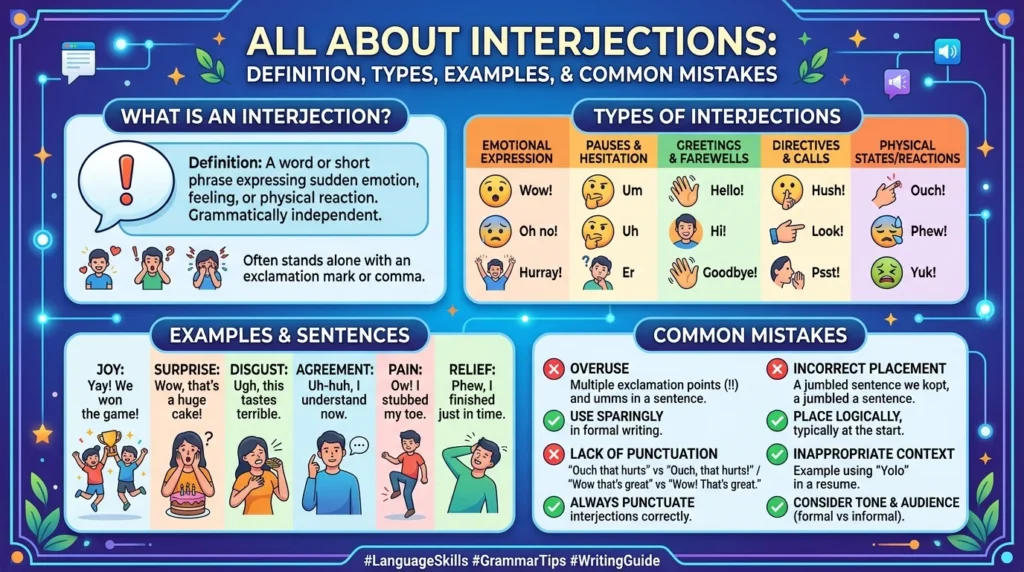
An interjection is a word or short expression that shows a sudden feeling, reaction, or emotion.
Common interjections include:
- Wow! — surprise or admiration
- Oh! — surprise or realization
- Ouch! — pain
- Hey! — attention or surprise
- Hooray! — joy
- Oops! — a small mistake
- Alas! — sadness or regret
- Yay! — happiness or excitement
- Hmm… — thought or uncertainty
- Ah! — understanding or relief
Examples
Wow! That is beautiful.
Ouch! That hurt.
Oops! I forgot my keys.
Hooray! We won the match.
Oh! Now I understand.
An interjection can stand alone:
Wow!
It can also appear at the beginning of a sentence:
Wow! You did a great job.
Interjections are often followed by an exclamation mark, especially when they express strong emotion. However, a comma, period, or no punctuation may also be appropriate depending on the context.
The Origin of Interjection
The word interjection comes from the Latin word interiectio, meaning “a throwing between” or “something thrown in.”
It comes from two Latin parts:
- inter = between
- iacere = to throw
The idea is that an interjection is a word or expression “thrown into” a sentence to express a feeling or reaction.
The term entered English through French and Latin grammatical tradition. It has been used for centuries to describe words that express emotions, reactions, commands, or sudden sounds.
The spelling interjection is standard in modern English. Unlike words such as colour/color or centre/center, there is no separate British and American spelling.
The word is also related to interject, which means to interrupt or insert something into a conversation.
For example:
She interjected, “Wait!”
Here, interjected is a verb. Interjection is the noun used for the grammatical category.
British English vs American English Spelling
The word interjection has the same spelling in British and American English.
| Feature | British English | American English |
|---|---|---|
| Singular | interjection | interjection |
| Plural | interjections | interjections |
| Related verb | interject | interject |
| Related adjective | interjective | interjective |
| Example | “Wow!” is an interjection. | “Wow!” is an interjection. |
| Spelling difference | None | None |
There is no standard British spelling such as interjecktion and no standard American alternative.
Interjection vs Interjections
The difference is simply singular and plural:
- Interjection = one
- Interjections = more than one
Examples:
Wow is an interjection.
Wow, ouch, and hooray are interjections.
Common Interjection Examples
| Interjection | Common feeling or purpose | Example |
|---|---|---|
| Wow! | Surprise | Wow! That is amazing. |
| Ouch! | Pain | Ouch! My finger hurts. |
| Oops! | Mistake | Oops! I sent the wrong file. |
| Yay! | Happiness | Yay! We finished the project. |
| Hey! | Attention | Hey! Wait for me. |
| Oh! | Surprise or realization | Oh! I understand now. |
| Alas! | Sadness | Alas! The plan failed. |
| Hmm… | Thought or doubt | Hmm… I need to think. |
| Hooray! | Celebration | Hooray! We won. |
| Ah! | Understanding or relief | Ah! Now I see the problem. |
Which Spelling Should You Use?
There is no British-versus-American spelling choice for interjection.
Use interjection in all forms of standard English.
For US English
Use:
interjection
This is the standard American spelling.
For UK and Commonwealth English
Use:
interjection
The same spelling is standard in British English and is also used throughout Commonwealth English.
For Global English
Use:
interjection
If you are writing for an international audience, students, English learners, or a global website, interjection is the correct spelling.
The important difference is not spelling. It is usage and punctuation.
For example:
Wow! That was amazing.
This works well in conversation, social media, and creative writing.
In formal writing, however, you may want to express the same idea without an interjection:
The result was impressive.
This sounds more neutral and professional.
Common Mistakes with Interjection
Interjections are easy to recognize, but writers can still make mistakes when using them.
Mistake 1: Using Too Many Interjections
Too many interjections can make writing feel unnatural.
❌ Wow! Oh! Hey! Amazing! Yay! We finished the report!
Better:
✅ Great! We finished the report.
Use interjections when they add meaning or emotion.
Mistake 2: Forgetting Punctuation
Strong interjections often need an exclamation mark.
Less clear:
Ouch That hurt.
Better:
Ouch! That hurt.
However, not every interjection needs an exclamation mark.
For example:
Well, I am not sure.
Here, a comma is more natural.
Mistake 3: Confusing Interjections With Regular Words
Some words can act as interjections in one sentence and have another grammatical role elsewhere.
For example:
Well! I did not expect that.
Here, well is an interjection.
But:
The water from the well is clean.
Here, well is a noun.
The role of a word depends on how it is used.
Mistake 4: Using Informal Interjections in Formal Writing
Words such as OMG, yay, and oops are common in casual communication.
They may not fit a formal report:
❌ OMG! The system failed again.
Better:
✅ The system experienced another failure.
Choose your language based on your audience.
Mistake 5: Confusing Interjections With Exclamations
An interjection is a type of word or expression that often expresses emotion.
An exclamation is a broader term for an emotional or forceful statement.
For example:
Wow!
is an interjection and also an exclamation.
But:
What a beautiful view!
is an exclamatory sentence, but it is not simply a single interjection.
Interjection in Everyday Examples
Interjections are common in everyday communication. They appear in conversations, emails, news writing, social media, stories, and dialogue.
In Emails
Interjections can appear in friendly or informal emails.
Hi! I hope you are doing well.
Great! Thank you for the update.
Oops! I attached the wrong document.
In a formal business email, it is often better to use neutral language:
Thank you for the update.
instead of:
Yay! Thank you for the update!
In News
News writing usually uses fewer interjections because it aims to sound objective.
However, interjections can appear when reporting direct speech:
“Wow! This is an incredible result,” the player said.
The interjection belongs to the speaker’s quoted words.
In Social Media
Interjections are very common on social media.
Wow! What a photo!
Yay! We finally did it!
Oops! Wrong post!
OMG! That was incredible!
They make short posts feel more emotional and personal.
In Formal Writing
Formal writing usually avoids unnecessary interjections.
Instead of:
Wow! The results are very impressive.
A formal report might say:
The results are highly impressive.
However, an interjection can still appear in a formal text when it is part of a quotation or when the writer is discussing language itself.
Types of Interjections
Interjections can express many different emotions and reactions.
1. Interjections of Joy
These show happiness or excitement.
Examples:
- Yay!
- Hooray!
- Wow!
Example:
Hooray! We passed the exam.
2. Interjections of Surprise
These show shock or sudden realization.
Examples:
- Oh!
- Wow!
- What!
- Really!
Example:
Oh! I did not know that.
3. Interjections of Pain
These express physical or emotional pain.
Examples:
- Ouch!
- Ow!
Example:
Ouch! I hurt my hand.
4. Interjections of Sadness
These show sorrow or regret.
Examples:
- Alas!
- Oh no!
Example:
Oh no! We missed the train.
5. Interjections of Attention
These are used to get someone’s attention.
Examples:
- Hey!
- Hello!
- Look!
Example:
Hey! Come over here.
6. Interjections of Doubt
These show uncertainty or thought.
Examples:
- Hmm…
- Um…
- Uh…
Example:
Hmm… I am not sure about that.
Interjection Variations Side by Side
| Keyword variation | Meaning | Example |
|---|---|---|
| interjection | Singular grammar term | “Wow” is an interjection. |
| interjections | Plural form | English has many interjections. |
| interject | Verb meaning to interrupt or insert | She interjected during the discussion. |
| interjected | Past form of interject | He interjected with a question. |
| interjecting | Present participle | She kept interjecting during the meeting. |
| interjectional | Related to interjections | The phrase has an interjectional function. |
Interjection – Google Trends & Usage Data
The keyword “interjection” has clear educational intent. Students, teachers, English learners, and writers may search for the term to understand its meaning, types, examples, and grammatical function.
It is an evergreen grammar topic, so its usefulness does not depend on a particular news event or season. Search interest can increase during school terms, exams, homework periods, and English-learning activities.
Users may search for related phrases such as:
- what is an interjection
- interjection definition
- interjection examples
- types of interjections
- interjection words
- examples of interjections in English
- interjection sentences
- list of interjections
Interest can vary by country and audience. English-learning markets may show strong demand for basic grammar explanations because students often need simple definitions and examples.
Google Trends does not provide one permanent worldwide search-volume figure for “interjection.” Results depend on the selected country, time period, search type, and comparison terms. Therefore, SEO writers should avoid presenting one fixed global number without specifying the exact research settings.
For content strategy, interjection is best treated as an informational, educational, and evergreen keyword.
FAQs About Interjection
1. What is an interjection in simple words?
An interjection is a word or short expression that shows a sudden feeling, reaction, or emotion.
Example:
Wow! That is amazing.
2. What are 10 examples of interjections?
Ten common examples are:
wow, oh, ouch, hey, hooray, oops, alas, yay, hmm, and ah.
3. What are the main types of interjections?
Common types include interjections that express:
- joy
- surprise
- pain
- sadness
- attention
- doubt
- excitement
- agreement or disagreement
4. Is “wow” an interjection?
Yes. Wow is a common interjection used to express surprise, admiration, or excitement.
Example:
Wow! That car looks great.
5. Is “oh” an interjection?
Yes. Oh can be an interjection when it expresses surprise, realization, disappointment, or another reaction.
Example:
Oh! I forgot my appointment.
6. Is “well” an interjection?
It can be. In:
Well, I do not know.
Well functions as an interjection or discourse marker.
But in:
He works well.
it is an adverb.
7. Is interjection spelled differently in British and American English?
No. Interjection has the same spelling in British and American English.
Conclusion
An interjection is a word or short expression that shows a feeling, reaction, or sudden response. Common examples include wow, oh, ouch, hey, hooray, oops, yay, and alas. These words can express emotions such as surprise, happiness, pain, sadness, excitement, or doubt.
Interjections are especially common in conversations, social media, dialogue, and informal writing. They can make language sound more natural and emotional. However, they should be used carefully in professional and formal writing. Too many interjections can make a text sound informal or dramatic.
The word interjection comes from Latin and relates to the idea of something being “thrown between” or inserted. There is no British or American spelling difference. Interjection is correct in both forms of English.
When using an interjection, pay attention to context and punctuation. Use an exclamation mark for strong emotion, but a comma or other punctuation may be better for softer expressions. Most importantly, choose words that fit your audience. With these simple rules, interjections are easy to understand and use correctly.