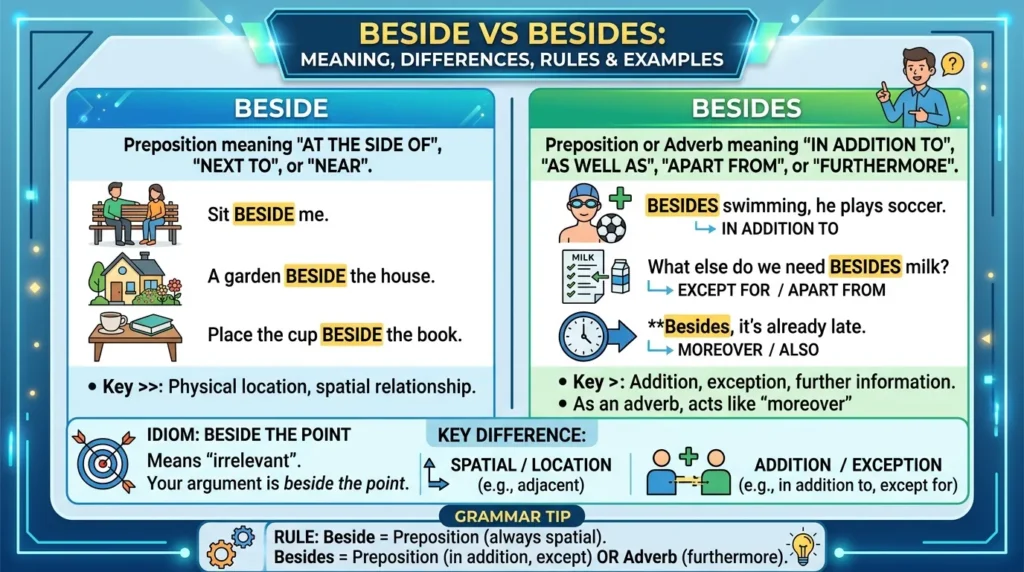

Beside vs besides is a common English grammar question because the two words look almost identical. They differ by only one letter, but their meanings are not the same. Choosing the wrong word can change the meaning of a sentence and may make your writing sound unclear.
Beside usually means next to or by the side of someone or something. For example, “The chair is beside the window” means the chair is next to the window. Besides usually means in addition to, apart from, or except for. For example, “Besides English, she speaks Arabic” means she speaks Arabic in addition to English.
People often search for beside vs besides because both words can be used as prepositions, and besides can also work as an adverb. The extra s changes the meaning, so understanding the difference is important for students, professionals, bloggers, and anyone learning English.
This guide explains beside vs besides with simple definitions, examples, common mistakes, usage rules, comparison tables, and practical advice for everyday and professional writing.
Beside vs Besides – Quick Answer
The easiest way to remember the difference is:
- Beside = next to or by the side of something.
- Besides = in addition to, apart from, or except for.
Beside Examples
She sat beside her mother.
The lamp is beside the bed.
He parked his car beside the building.
In each sentence, beside means next to.
Besides Examples
Besides English, he speaks French.
What did you buy besides the laptop?
Besides, we need more time.
Here, besides means in addition to or introduces another point.
Easy Memory Trick
Think:
Beside = by the side
Besides = in addition
If you can replace the word with next to, use beside.
The store is beside the bank.
The store is next to the bank.
If you can replace it with in addition to, use besides.
Besides English, she speaks Spanish.
In addition to English, she speaks Spanish.
The Origin of Beside vs Besides
The words beside and besides share a historical connection, which explains why they look so similar.
Origin of Beside
Beside developed from Old English expressions meaning by the side of. The word combines ideas related to being near or next to a side.
Its modern meaning still focuses on physical or figurative position.
For example:
The car is parked beside the house.
The car is next to the house.
The word can also be used in a figurative sense:
His actions were beside the point.
Here, beside the point means not relevant to the main subject.
Origin of Besides
Besides developed from beside with the addition of -s. Over time, its meaning expanded from the idea of being “by the side of” to meanings such as in addition to and apart from.
For example:
Besides mathematics, she studies physics.
This means she studies physics in addition to mathematics.
Why Are They Confused?
The words are closely related in spelling and history. Both begin with beside, but the additional s in besides gives the word a different modern meaning.
A useful rule is:
Beside → location
Besides → addition
British English vs American English Spelling
There is no major spelling difference between British and American English for beside and besides.
Both varieties use:
- beside
- besides
The meanings are also essentially the same.
Comparison Table
| Meaning | British English | American English | Example |
|---|---|---|---|
| Next to | beside | beside | She sat beside me. |
| By the side of | beside | beside | The house is beside the road. |
| In addition to | besides | besides | Besides John, Mary came too. |
| Apart from | besides | besides | Besides the cost, there are other problems. |
| Introducing another point | besides | besides | Besides, we have no time. |
British English Examples
The hotel is beside the river.
Besides English, he speaks German.
American English Examples
The hotel is beside the river.
Besides English, he speaks German.
The spelling and basic usage remain the same.
Which Spelling Should You Use?
Your choice between beside and besides depends on meaning, not on whether you write American or British English.
Use Beside for Location
Use beside when something is next to something else.
The phone is beside the computer.
She stood beside her friend.
Use Besides for Addition
Use besides when you mean in addition to.
Besides coffee, we serve tea.
Besides John, three other people attended.
Use Besides for “Apart From”
Besides can also mean apart from or except for.
Besides the weather, everything was perfect.
This means the weather was the one problem, while other things were good.
Use Besides as an Adverb
Besides can introduce an additional reason, fact, or idea.
I don’t want to go. Besides, it is raining.
Here, besides means something like also or in addition.
For US Readers
American English uses beside and besides in the same basic ways.
For UK and Commonwealth Readers
British and Commonwealth English also use the same distinction.
For Global English
The easiest rule is:
Beside = next to.
Besides = in addition to.
Common Mistakes with Beside vs Besides
Mistake 1: Using Besides for Physical Location
Incorrect:
She is standing besides me.
Correct:
She is standing beside me.
When you mean next to me, use beside.
Mistake 2: Using Beside for Addition
Incorrect:
Beside English, I speak French.
Correct:
Besides English, I speak French.
The sentence means in addition to English, so use besides.
Mistake 3: Confusing “Besides Me” and “Beside Me”
These sentences have different meanings.
She sat beside me.
She sat next to me.
Besides me, everyone attended.
Apart from me, everyone attended.
Mistake 4: Forgetting the Extra “S”
Incorrect:
Besides the cost, there are other problems.
If you mean in addition to the cost, the spelling must be besides.
Mistake 5: Misusing “Besides” as a Connector
Correct:
I don’t want to go. Besides, I am tired.
Here, besides adds another reason.
Beside vs Besides in Everyday Examples
In Emails
Beside:
Please place the documents beside the printer.
Besides:
Besides the attached report, I have included the updated figures.
In News
Beside:
The minister stood beside the president during the ceremony.
Besides:
Besides economic concerns, the government faces several other challenges.
On Social Media
Beside:
Sitting beside my best friend at the concert!
Besides:
Besides pizza, what should we order tonight?
In Formal Writing
Beside:
The equipment was placed beside the main control panel.
Besides:
Besides financial costs, the project involves several technical challenges.
In Everyday Conversation
Come and sit beside me.
Besides that, everything is fine.
What do you want besides coffee?
The supermarket is beside the bank.
Beside vs Besides – Comparison Table
| Word | Main Meaning | Part of Speech | Example |
|---|---|---|---|
| Beside | Next to | Preposition | The bag is beside the chair. |
| Beside | By the side of | Preposition | He stood beside his brother. |
| Besides | In addition to | Preposition | Besides tea, we serve coffee. |
| Besides | Apart from | Preposition | Besides the price, quality matters. |
| Besides | In addition / also | Adverb | Besides, we have another option. |
Beside vs Besides: A Simple Test
When you are unsure, replace the word with another phrase.
Test 1: Can You Say “Next To”?
The school is beside the park.
Replace it:
The school is next to the park.
The meaning stays the same, so beside is correct.
Test 2: Can You Say “In Addition To”?
Besides mathematics, she studies science.
Replace it:
In addition to mathematics, she studies science.
The meaning stays the same, so besides is correct.
Test 3: Can You Say “Also”?
Besides, we need more information.
Replace it:
Also, we need more information.
The meaning is similar, so besides is correct.
Beside vs Besides – Google Trends & Usage Data
Search interest for beside vs besides is mainly related to English grammar, vocabulary, spelling, and language learning.
Both words appear frequently in everyday English, but people often search for the exact phrase when they are unsure about the extra s in besides.
Search interest can be found in countries where English is taught as a first or second language. Students, teachers, bloggers, writers, and professionals may search for the difference when preparing assignments, articles, emails, or other forms of writing.
The words also appear in different contexts. Beside is common in descriptions of physical location, while besides is common in discussions, explanations, arguments, and lists of additional things.
Google Trends data changes by country and time period. For exact current search-volume figures, writers should check Google Trends directly. The consistent search intent is clear: users want to know whether they should use beside or besides in a particular sentence.
FAQs About Beside vs Besides
1. What is the difference between beside and besides?
Beside usually means next to. Besides usually means in addition to, apart from, or also.
2. Is it “beside me” or “besides me”?
Both can be correct, but they mean different things.
She sat beside me.
= She sat next to me.
Besides me, everyone attended.
= Apart from me, everyone attended.
3. Is “besides English” correct?
Yes.
Besides English, she speaks Spanish.
It means she speaks Spanish in addition to English.
4. Can besides be used at the beginning of a sentence?
Yes.
Besides, we have another option.
Here, besides introduces an additional point or reason.
5. Is beside the same as next to?
Usually, yes.
The chair is beside the table.
This means the chair is next to the table.
6. Is there a British-American spelling difference?
No. British and American English both use beside and besides with the same basic meanings.
7. What is an easy way to remember beside vs besides?
Remember:
Beside = next to.
Besides = in addition to.
If you can replace the word with next to, choose beside. If you can replace it with in addition to, choose besides.
Conclusion
The difference between beside vs besides is simple when you focus on meaning. Beside usually means next to or by the side of something. Besides usually means in addition to, apart from, or also.
For example, “The chair is beside the table” describes location. The chair is next to the table. In contrast, “Besides coffee, we serve tea” means tea is offered in addition to coffee.
The extra s in besides is a useful clue. When you are talking about physical position, think beside = by the side. When you are adding another person, thing, reason, or idea, think besides = in addition.
British and American English use the same spellings and basic rules. This makes the distinction easier for international writers and English learners. If you are unsure which word to choose, try replacing it with next to or in addition to. If next to works, use beside. If in addition to works, use besides. This simple test will help you avoid most common mistakes.