
Every time you speak or write, you use sentences. But not all sentences do the same job. Some give information, some ask questions, some give commands, and others show strong feelings. Learning the types of sentences helps you understand how English works and makes your writing clearer.
Many students and English learners search for “types of sentences” because they want to know how sentences are classified. The topic can be confusing because English grammar uses more than one way to classify sentences. Sentences can be grouped by purpose or by structure. For example, a sentence can be declarative because it makes a statement and simple because it has one independent clause.
Understanding these categories is useful for school, exams, writing, and everyday communication. It can also help you avoid sentence fragments, run-on sentences, and punctuation mistakes.
In this guide, you will learn the main types of sentences, their definitions, examples, British and American spelling differences, common mistakes, everyday uses, related keywords, and answers to frequently asked questions.
Types of Sentences – Quick Answer
The types of sentences are categories used to describe sentences based on their purpose or structure.
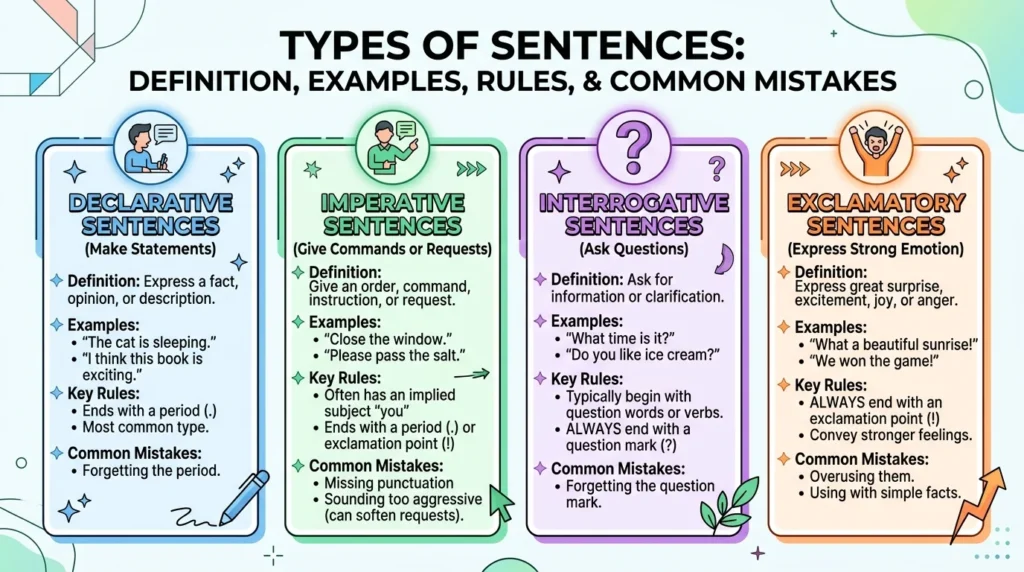
Four Types of Sentences by Purpose
The four main types are:
- Declarative sentence – makes a statement.
- Interrogative sentence – asks a question.
- Imperative sentence – gives a command, request, or instruction.
- Exclamatory sentence – expresses strong emotion.
Examples:
| Type | Example |
|---|---|
| Declarative | She works at a bank. |
| Interrogative | Does she work at a bank? |
| Imperative | Open the door. |
| Exclamatory | What a beautiful day! |
Types of Sentences by Structure
Sentences can also be classified by their structure:
- Simple sentence
- Compound sentence
- Complex sentence
- Compound-complex sentence
For example:
I like coffee. — Simple
I like coffee, and my brother likes tea. — Compound
I drink coffee because I am tired. — Complex
I drink coffee because I am tired, and my brother drinks tea because he likes it. — Compound-complex
The Origin of Types of Sentences
The word sentence comes from the Latin sententia, meaning “thought,” “opinion,” or “judgment.” It entered English through Old French and developed into its modern grammatical meaning.
The word type comes from the Greek typos, meaning “impression,” “form,” or “model.” Over time, it came to mean a particular kind or category.
The phrase types of sentences therefore refers to different categories or forms of sentences.
Grammar classification developed over many centuries as scholars studied how people use language. Modern English grammar commonly classifies sentences by their purpose and structure.
There is no British or American spelling difference in the phrase types of sentences.
The spelling is the same in both varieties:
types of sentences
British English vs American English Spelling
The phrase types of sentences is spelled the same in British and American English.
| Feature | British English | American English |
|---|---|---|
| Singular | type of sentence | type of sentence |
| Plural | types of sentences | types of sentences |
| Sentence | sentence | sentence |
| Example | Learn the types of sentences. | Learn the types of sentences. |
| Spelling difference | None | None |
Sentence vs Sentences
Use sentence when referring to one sentence.
This is a simple sentence.
Use sentences when referring to more than one.
These are different sentences.
Type vs Types
Use type for one category.
What type of sentence is this?
Use types for multiple categories.
What are the types of sentences?
Which Spelling Should You Use?
There is no British-versus-American spelling choice for types of sentences.
Use:
types of sentences
for both British and American English.
For US English
Use this spelling in:
- school assignments
- grammar lessons
- academic writing
- websites
- emails
- professional documents
For UK and Commonwealth English
Use the same spelling:
types of sentences
British English does not use a different spelling for this phrase.
For Global English
Types of sentences is also suitable for international English learners.
Some English words have different spellings in British and American English, such as colour/color and centre/center. However, types of sentences has no spelling variation.
Common Mistakes with Types of Sentences
Understanding sentence types is useful, but learners often make a few common mistakes.
Mistake 1: Confusing Declarative and Interrogative Sentences
A declarative sentence gives information.
You are coming to the meeting.
An interrogative sentence asks a question.
Are you coming to the meeting?
Do not use a question mark for a normal statement.
Mistake 2: Using an Exclamation Mark for Every Sentence
An exclamation mark is used to show strong emotion or emphasis.
❌ I went to the store!
This may be correct in a certain context, but a period is usually better for a neutral statement.
✅ I went to the store.
Mistake 3: Confusing Imperative Sentences With Questions
An imperative sentence gives an instruction or request.
Please close the window.
An interrogative asks:
Could you close the window?
The two can have similar meanings but different grammatical forms.
Mistake 4: Thinking a Sentence Has Only One Type
A sentence can be classified in more than one way.
For example:
Please close the door because it is cold.
This is imperative by purpose and complex by structure.
Mistake 5: Confusing Simple With Short
A simple sentence does not have to be very short.
The young students in the large classroom are studying for their final exams.
This is a simple sentence because it has one independent clause.
Mistake 6: Confusing Compound and Complex Sentences
A compound sentence has two or more independent clauses.
I called him, and he answered.
A complex sentence has an independent clause and at least one dependent clause.
I called him because I needed help.
Types of Sentences in Everyday Examples
We use different sentence types every day.
In Emails
Declarative:
I have attached the requested document.
Interrogative:
Could you please review it?
Imperative:
Please contact me if you need more information.
Exclamatory:
Thank you for your excellent support!
In professional emails, declarative and interrogative sentences are common. Imperative sentences should be polite.
In News
News writing often uses declarative sentences:
The company announced a new policy on Monday.
Questions may appear in headlines or interviews:
What will happen next?
News reports usually avoid excessive exclamation marks.
In Social Media
Social media often uses short and emotional sentences:
We finally won!
Who is joining us tonight?
Follow us for more updates.
What an amazing experience!
In Formal Writing
Formal writing often uses clear declarative sentences.
The results show an increase in customer demand.
Complex and compound sentences are also common when writers need to connect ideas.
Types of Sentences by Purpose
1. Declarative Sentence
A declarative sentence makes a statement or gives information.
Examples:
The store opens at nine.
She lives in London.
Water freezes at 0°C.
Declarative sentences usually end with a period.
2. Interrogative Sentence
An interrogative sentence asks a question.
Examples:
Where do you live?
Are you ready?
What time does the meeting start?
Interrogative sentences normally end with a question mark.
3. Imperative Sentence
An imperative sentence gives a command, request, instruction, or advice.
Examples:
Close the door.
Please sit down.
Take your time.
The subject you is often understood.
4. Exclamatory Sentence
An exclamatory sentence expresses strong emotion.
Examples:
That was amazing!
What a beautiful view!
I cannot believe it!
These sentences normally end with an exclamation mark.
Types of Sentences by Structure
Simple Sentence
A simple sentence has one independent clause.
The baby is sleeping.
It may contain a compound subject or compound verb and still remain simple.
Compound Sentence
A compound sentence contains two or more independent clauses.
I wanted to go, but I was busy.
The clauses are often joined by coordinating conjunctions such as and, but, or, so, for, nor, and yet.
Complex Sentence
A complex sentence contains one independent clause and at least one dependent clause.
I stayed home because it was raining.
The dependent clause explains the reason.
Compound-Complex Sentence
A compound-complex sentence contains at least two independent clauses and at least one dependent clause.
I stayed home because it was raining, and my brother watched a movie.
These sentences can express several connected ideas.
Types of Sentences Comparison Table
| Type | Main Feature | Example |
|---|---|---|
| Declarative | Makes a statement | She likes music. |
| Interrogative | Asks a question | Does she like music? |
| Imperative | Gives a command or request | Listen carefully. |
| Exclamatory | Shows strong emotion | What a great song! |
| Simple | One independent clause | She likes music. |
| Compound | Two independent clauses | She sings, and he plays guitar. |
| Complex | Independent + dependent clause | She sings because she enjoys music. |
| Compound-complex | Two independent + dependent clause | She sings because she enjoys music, and he plays guitar. |
Types of Sentences – Keyword Variations Side by Side
| Keyword Variation | Search Intent | Example |
|---|---|---|
| types of sentences | Learn sentence categories | Learn the types of sentences. |
| type of sentence | Identify one sentence | What type of sentence is this? |
| types of sentences in English | Learn English sentence types | Study types of sentences in English. |
| 4 types of sentences | Learn purpose-based types | Declarative, interrogative, imperative, exclamatory. |
| types of sentences examples | Find examples | Read these sentence examples. |
| sentence types | Alternative keyword | Sentence types are easy to learn. |
| simple sentence | Learn simple structure | She works here. |
| compound sentence | Learn compound structure | I called, and she answered. |
| complex sentence | Learn complex structure | I left because it was late. |
| compound-complex sentence | Learn advanced structure | He stayed because he was tired, and she left. |
Types of Sentences – Google Trends & Usage Data
The keyword “types of sentences” has strong educational search intent. Students, teachers, English learners, parents, and writers may search for it to understand sentence classification.
Related searches include:
- types of sentences
- types of sentences in English
- 4 types of sentences
- sentence types
- types of sentences with examples
- simple and compound sentences
- complex sentence
- declarative sentence
- interrogative sentence
- imperative sentence
- exclamatory sentence
The topic is evergreen, so people can search for it throughout the year. Interest may rise during school terms, examinations, homework periods, and English-learning courses.
Search interest can differ by country because English-learning needs vary around the world. Countries with large numbers of English learners may have strong interest in basic grammar topics.
Google Trends does not provide one permanent worldwide monthly search volume for “types of sentences.” The displayed interest depends on the selected location, date range, search type, and comparison keywords. Therefore, a reliable SEO article should avoid claiming a fixed global search volume without identifying the exact data settings.
For SEO purposes, the keyword has clear informational intent. A strong page should provide a quick answer first and then explain sentence types, examples, structure, mistakes, and related grammar terms.
FAQs About Types of Sentences
1. What are the 4 types of sentences?
The four main types by purpose are:
- Declarative
- Interrogative
- Imperative
- Exclamatory
2. What are the 4 types of sentences by structure?
The four common structural types are:
- Simple
- Compound
- Complex
- Compound-complex
3. What is a declarative sentence?
A declarative sentence makes a statement or gives information.
Example:
She works at a hospital.
4. What is an interrogative sentence?
An interrogative sentence asks a question.
Example:
Where do you live?
It normally ends with a question mark.
5. What is an imperative sentence?
An imperative sentence gives a command, request, instruction, or advice.
Example:
Please open the window.
6. What is an exclamatory sentence?
An exclamatory sentence expresses strong emotion.
Example:
That was fantastic!
7. Can one sentence have more than one type?
Yes. Sentence classification can use both purpose and structure.
For example:
Please stay inside because it is raining.
This sentence is imperative by purpose and complex by structure.
Conclusion
Learning the types of sentences is one of the best ways to improve your English grammar and writing. Sentences can be classified in two main ways: by purpose and by structure. By purpose, the four common types are declarative, interrogative, imperative, and exclamatory. By structure, sentences can be simple, compound, complex, or compound-complex.
Each type has a different role. Declarative sentences give information, interrogative sentences ask questions, imperative sentences give instructions or requests, and exclamatory sentences express strong feelings. Structural types show how clauses are arranged within a sentence.
Remember that one sentence can belong to two categories at the same time. For example, a sentence can be imperative by purpose and complex by structure. This is why it is important to understand both systems.
There is no British or American spelling difference in types of sentences. The phrase is spelled the same in both varieties of English.
With regular practice, you can quickly identify sentence types and use them correctly. This will help you write clearer emails, assignments, articles, social media posts, and professional documents.