
Fewer vs less is one of the most common English grammar questions. Both words describe a smaller amount, but they are normally used with different types of nouns. This simple difference can make a sentence sound correct or incorrect.
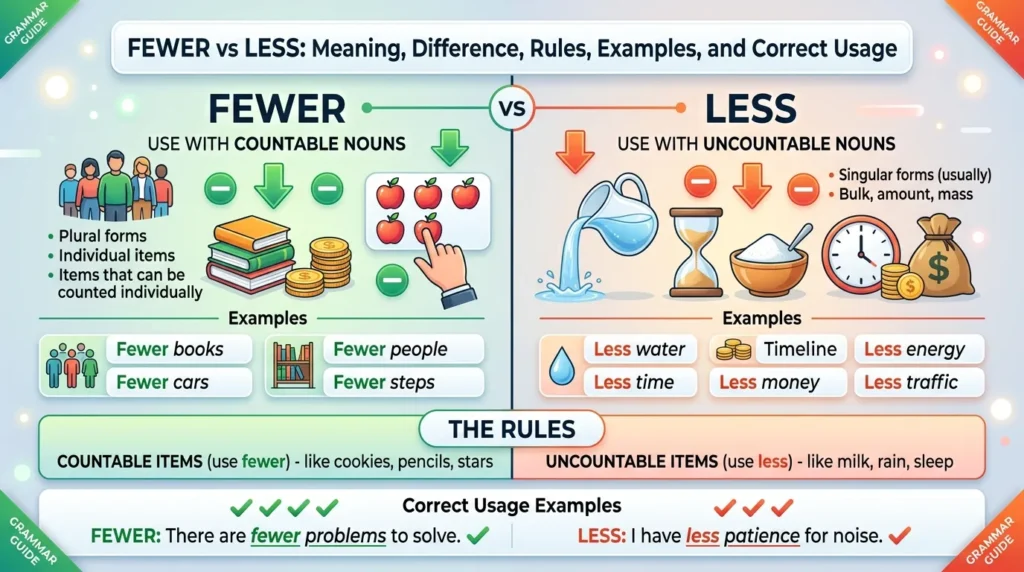
The basic rule is easy: use fewer with things you can count one by one, and use less with things you cannot normally count individually. For example, “There are fewer cars on the road” is correct because cars can be counted. “There is less traffic today” is correct because traffic is treated as an uncountable amount.
People often search for fewer vs less because everyday English contains many tricky cases. You may hear both forms in advertisements, signs, conversations, and professional writing. Some expressions also use less even when a noun appears countable.
This guide explains the difference between fewer and less in simple English. You will learn the basic rule, important exceptions, common mistakes, real-life examples, and practical advice for choosing the right word.
Fewer vs Less – Quick Answer
The easiest rule is:
- Fewer = used with countable nouns.
- Less = used with uncountable nouns.
Fewer Examples
Use fewer when you can count the items individually.
There are fewer students in the class today.
We received fewer complaints this month.
She bought fewer apples.
The company hired fewer workers this year.
You can count students, complaints, apples, and workers.
Less Examples
Use less with nouns that are usually treated as a mass or amount.
We need less water.
There is less traffic today.
I have less time.
The machine uses less energy.
You do not normally count water, traffic, time, or energy as individual items.
Quick Memory Trick
Remember:
Fewer = numbers
Less = amount
If you can say one, two, three, fewer is usually the better choice.
fewer books
fewer cars
fewer people
If you are talking about an amount or quantity, use less.
less water
less money
less time
The Origin of Fewer vs Less
The words fewer and less have very old roots in English.
Origin of Fewer
Fewer developed from the Old English word “fēawra,” which was related to the idea of a smaller number.
Over time, the word became fewer in modern English.
Its main role remains connected to countable nouns:
fewer people
fewer houses
fewer mistakes
Origin of Less
Less comes from Old English “lǣssa,” meaning smaller or lesser in amount or degree.
The word has retained this basic idea.
For example:
less water
less noise
less pressure
less stress
Why Are They Different?
English developed separate words for talking about smaller numbers and smaller amounts.
The distinction became a common grammar rule:
fewer → countable nouns
less → uncountable nouns
However, real-world English is more flexible than this simple rule. Some expressions use less with nouns that can technically be counted, especially when the noun refers to time, distance, money, or measurement as a single amount.
British English vs American English Spelling
There is no spelling difference between British and American English for fewer and less.
Both varieties use the same words and follow the same basic grammar rule.
Comparison Table
| Usage | British English | American English | Example |
|---|---|---|---|
| Countable nouns | fewer | fewer | Fewer people came. |
| Uncountable nouns | less | less | We need less water. |
| Time as an amount | less | less | It took less than an hour. |
| Money as an amount | less | less | I spent less money. |
| Distance as an amount | less | less | It is less than five miles away. |
| Countable items | fewer | fewer | There are fewer cars. |
British English Examples
There are fewer buses today.
We need less fuel.
American English Examples
There are fewer buses today.
We need less fuel.
The spelling and core grammar are the same.
Which Spelling Should You Use?
Your choice between fewer and less depends on the noun, not the country where your readers live.
Use Fewer With Countable Nouns
Use fewer with things that can be counted individually.
fewer books
fewer employees
fewer problems
fewer customers
fewer emails
Use Less With Uncountable Nouns
Use less with things treated as an amount.
less water
less information
less noise
less money
less equipment
less electricity
Use Less With Time
When time is treated as one amount, less is common.
The job took less than two hours.
I need less than ten minutes.
Use Less With Distance
Distance is often treated as a single measurement.
The station is less than five miles away.
Use Less With Money
Money is usually treated as an amount.
The product costs less than $50.
For US Readers
American English follows the same general distinction.
For UK and Commonwealth Readers
British and Commonwealth English also use fewer for countable nouns and less for uncountable amounts.
For Global English
The safest rule is:
Count individual items → fewer.
Describe an amount → less.
Common Mistakes with Fewer vs Less
Mistake 1: “Less People”
This is one of the most common errors in formal English.
Incorrect:
There are less people here today.
Better:
There are fewer people here today.
People can be counted individually, so fewer is normally preferred.
Mistake 2: “Fewer Water”
Incorrect:
We need fewer water.
Correct:
We need less water.
Water is normally treated as an uncountable noun.
Mistake 3: “Fewer Money”
Incorrect:
She spent fewer money.
Correct:
She spent less money.
Money is treated as an amount.
Mistake 4: “Less Books”
Incorrect:
I bought less books this month.
Correct:
I bought fewer books this month.
Books are countable.
Mistake 5: “Fewer Information”
Incorrect:
The report contains fewer information.
Correct:
The report contains less information.
Information is an uncountable noun.
Mistake 6: Ignoring Formal Writing
In casual speech, people often use less with plural countable nouns:
Less people are going there.
This is common in everyday speech, but fewer is usually better in formal writing.
Fewer vs Less in Everyday Examples
In Emails
Fewer:
We received fewer customer complaints this week.
Less:
We need less time to complete the project.
In News
Fewer:
Fewer people attended the event this year.
Less:
The city reported less traffic during the morning.
On Social Media
Fewer:
I made fewer mistakes this time!
Less:
I need less stress in my life.
In Formal Writing
Fewer:
The new process resulted in fewer production errors.
Less:
The new system requires less energy.
In Business Writing
Fewer:
The company received fewer orders than expected.
Less:
The new equipment uses less electricity.
Fewer vs Less – Comparison Table
| Noun or Situation | Correct Word | Example |
|---|---|---|
| Books | fewer | I read fewer books this year. |
| People | fewer | Fewer people attended. |
| Cars | fewer | There are fewer cars today. |
| Employees | fewer | We have fewer employees now. |
| Mistakes | fewer | She made fewer mistakes. |
| Water | less | Drink less water?* |
| Money | less | I spent less money. |
| Time | less | It took less time. |
| Traffic | less | There is less traffic. |
| Information | less | We need less information. |
| Energy | less | The machine uses less energy. |
| Distance | less | It is less than five miles away. |
*The correct choice can depend on the intended meaning. For example, fewer bottles of water is countable, while less water refers to the amount of water.
Special Cases: When “Less” Appears With Countable Nouns
The basic rule is useful, but there are important exceptions.
Time
less than five years
Here, years can be counted, but the phrase refers to one measurement of time.
Money
less than ten dollars
The dollars can be counted, but the phrase describes one amount of money.
Distance
less than ten miles
The miles are units of one measurement.
Weight
less than five kilograms
The kilograms represent a measurement of weight.
Percentages
Both forms may appear depending on the noun.
Less than 10% of the water was used.
Fewer than 10% of the students attended.
The noun following of helps determine the correct choice.
How to Remember Fewer vs Less
Try the one-two-three test.
Can you count the noun?
One car, two cars, three cars.
Yes → fewer cars
Can you count it as separate individual items?
One book, two books, three books.
Yes → fewer books
Now consider:
Water
You can measure water, but you do not normally count “one water, two water” when referring to the substance.
So:
less water
Another Easy Trick
Think:
Fewer = number
Less = amount
For example:
fewer customers
This focuses on the number of customers.
less customer traffic
This focuses on the amount of traffic.
Fewer vs Less – Google Trends & Usage Data
Search interest for fewer vs less is strongly connected to English grammar, education, proofreading, and writing improvement.
The two words are extremely common in everyday English. As a result, learners often encounter them while writing school assignments, emails, reports, blog posts, and business documents.
Search interest may be especially strong in countries where English is widely taught as a second language. Students and professionals often search for the phrase when they are unsure whether a noun is countable or uncountable.
The topic also receives attention because public signs and advertisements sometimes use less with plural countable nouns, creating debate about whether the grammar is correct.
Google Trends results can change by country, season, and time period. For exact current search data, check Google Trends directly before publishing numerical claims. The broader search intent remains clear: people want a simple rule for choosing between fewer and less.
FAQs About Fewer vs Less
1. What is the difference between fewer and less?
Use fewer with countable nouns and less with uncountable nouns.
fewer cars
less traffic
2. Is it fewer people or less people?
In standard formal English, fewer people is preferred because people can be counted.
Fewer people attended the meeting.
3. Is it less money or fewer money?
The correct phrase is less money because money is treated as an amount.
4. Is it fewer time or less time?
The correct phrase is less time.
We need less time to finish the work.
5. Is it fewer than or less than?
Both are correct, depending on the noun.
Fewer than 20 students attended.
Less than 20 minutes remained.
6. Can less be used with countable nouns?
Yes, in some cases. Less is common with measurements of time, money, distance, weight, and similar amounts. It is also common in some informal expressions.
7. What is an easy way to remember fewer vs less?
Remember:
Fewer = things you can count.
Less = an amount you cannot normally count individually.
Conclusion
The difference between fewer vs less is mainly about countable and uncountable nouns. Use fewer when you are talking about individual items that can be counted, such as people, books, cars, employees, or mistakes. Use less when you are talking about an amount or substance, such as water, money, time, traffic, information, or energy.
A simple memory rule is fewer = number and less = amount. For example, “fewer customers” focuses on the number of customers, while “less traffic” focuses on the amount of traffic.
There are some useful exceptions. Less is commonly used with measurements such as time, distance, money, and weight: “less than two hours,” “less than five miles,” and “less than $50.” In formal writing, fewer is generally preferred with plural countable nouns, even though less is common in casual speech.
British and American English follow the same basic rules. When in doubt, ask whether you are counting separate items or describing one amount. This simple test will help you choose the correct word in most situations.