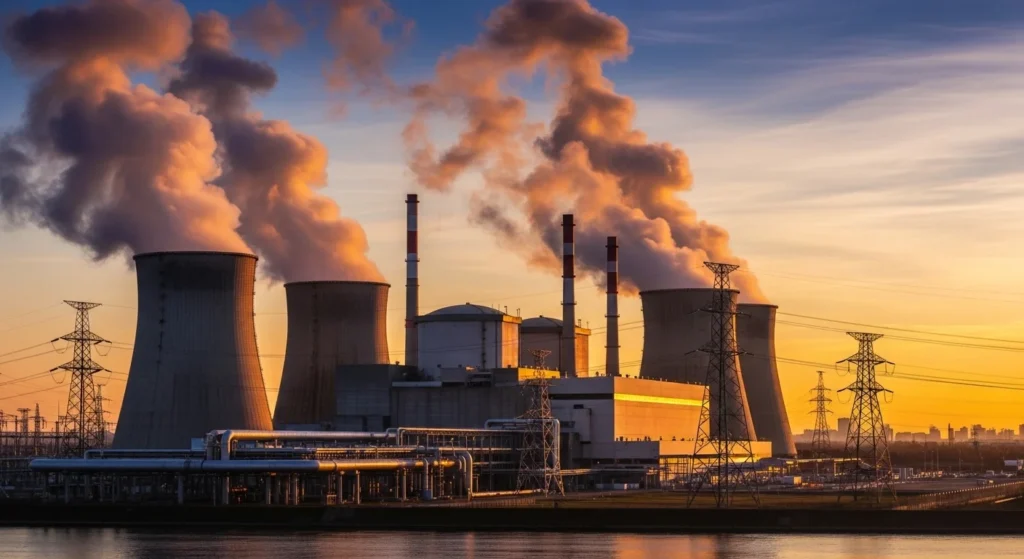

Imagine a large city that never sleeps — hospitals running 24/7, industries operating continuously, homes using electricity day and night. Supplying reliable power to such a city is a major engineering challenge. Coal plants create pollution, and renewable energy depends on weather conditions. So how do we produce large amounts of electricity continuously without burning fossil fuels?
The answer is nuclear power.
Nuclear power is one of the most powerful and reliable sources of electricity generation in the world. A small amount of nuclear fuel can produce enormous energy compared to traditional fuels. For electrical students and engineers, understanding nuclear power is important because it plays a major role in national grid systems and base-load power generation.
In this article, you will learn what nuclear power is, nuclear power working principle, types of nuclear reactors, nuclear power applications, advantages and disadvantages, comparison with other power plants, and future trends — explained clearly and practically.
2. What is Nuclear Power?
Clear Definition
Nuclear power is the electricity generated from energy released during nuclear reactions, mainly nuclear fission.
Simple Explanation
In nuclear power plants:
- Atoms are split into smaller parts.
- This process releases a huge amount of heat energy.
- The heat is used to produce steam.
- Steam rotates a turbine connected to a generator.
Finally, electrical energy is produced.
Practical Example
One nuclear power plant can produce hundreds or thousands of megawatts of electricity continuously for many months without refueling.
That is why nuclear power is used for base-load electricity generation.
3. Nuclear Power Working Principle
The nuclear power working principle is based on nuclear fission.
Let’s understand step-by-step.
Nuclear Fission
Nuclear Fission is a process in which the nucleus of a heavy atom splits into two or more smaller nuclei. This process releases a very large amount of energy, heat, and radiation. Nuclear fission usually occurs in heavy elements such as uranium and plutonium. When a neutron strikes the nucleus of a uranium atom, the nucleus becomes unstable and breaks apart. During this reaction, extra neutrons are also released. These neutrons can hit other atoms and continue the reaction in a chain process. Because of this chain reaction, nuclear fission can produce a huge amount of power from a very small amount of fuel.
Nuclear fission is mainly used in nuclear power plants to generate electricity. Inside a nuclear reactor, the heat produced by fission is used to boil water and create steam. The steam then turns large turbines connected to generators, which produce electricity for homes, industries, and cities. Nuclear power plants are considered efficient because they can generate a large amount of electricity without burning fossil fuels such as coal or oil. This helps reduce air pollution and greenhouse gas emissions.
The discovery of nuclear fission happened in 1938 when German scientists Otto Hahn and Fritz Strassmann conducted experiments on uranium. Later, scientist Lise Meitner explained the process scientifically. This discovery changed the world because it opened the door for both peaceful and destructive uses of nuclear energy. Today, nuclear fission is used in medicine, scientific research, submarines, and electricity production. However, it is also known for its use in atomic bombs during World War II.
Although nuclear fission provides many benefits, it also has some risks. Nuclear reactors produce radioactive waste that remains dangerous for many years. There is also the possibility of accidents if reactors are not managed carefully. Despite these challenges, many countries continue to use nuclear fission because it is a powerful and reliable energy source for the modern world.
- A heavy atom (like uranium) is split.
- Heat energy is released.
Heat Generation
Heat Generation is the process of producing heat energy from different natural or artificial sources. Heat is a form of energy that moves from a hotter object to a cooler object. It can be generated through many methods such as friction, electricity, chemical reactions, sunlight, and nuclear reactions. Heat generation is very important in daily life because it is used for cooking, heating homes, producing electricity, and operating industrial machines.
One common method of heat generation is burning fuels such as coal, natural gas, wood, or oil. When these fuels burn in the presence of oxygen, a chemical reaction takes place and releases heat energy. This process is called combustion. Many power plants use combustion to heat water and produce steam, which turns turbines to generate electricity. Vehicles also generate heat through fuel combustion inside engines. Another method is electrical heating, where electric current passes through a conductor and produces heat because of resistance. Electric irons, heaters, ovens, and kettles work on this principle.
Heat can also be generated through friction. When two objects rub against each other, mechanical energy changes into heat energy. For example, rubbing hands together creates warmth. Machines and moving engine parts also produce heat because of friction. In industries, controlling excess heat is important to prevent damage to equipment. Solar heat generation is another important method. The Sun provides natural heat energy that can be collected using solar panels and solar heaters. This renewable energy source is environmentally friendly and helps reduce pollution.
In modern science, nuclear heat generation is very powerful. In nuclear power plants, Nuclear Fission releases a huge amount of heat energy. This heat is used to produce steam and generate electricity. Heat generation is also important in human bodies because metabolic processes produce heat to maintain body temperature.
Although heat generation is useful, too much heat can be harmful. Excessive heat may damage machines, electronic devices, and even living organisms. Therefore, cooling systems and heat control methods are necessary in homes, industries, vehicles, and power plants. Overall, heat generation plays a major role in science, engineering, industry, and everyday life.
- The heat converts water into high-pressure steam.
Steam Turbine Rotation
Steam Turbine rotation is the process in which high-pressure steam turns the blades of a turbine to produce mechanical energy. A steam turbine is one of the most important machines used in power generation. It converts the thermal energy of steam into rotational mechanical energy. This rotating motion is then used to drive electrical generators, pumps, and other industrial equipment. Steam turbines are widely used in thermal power plants, nuclear power stations, and many industries because they are efficient and reliable.
The working process of steam turbine rotation begins when water is heated in a boiler. The heat source may come from coal, natural gas, oil, solar energy, or Nuclear Fission. As the water boils, it changes into high-pressure steam. This steam is directed toward the turbine blades through specially designed nozzles. The fast-moving steam strikes the blades and causes the turbine shaft to rotate. As the shaft spins, mechanical energy is produced. This rotational motion is connected to a generator, which converts mechanical energy into electrical energy.
Steam turbines operate on the principle of energy conversion. The heat energy stored in steam changes into kinetic energy when steam flows at high speed. The kinetic energy then changes into mechanical rotational energy as the blades move. Modern steam turbines can rotate at very high speeds, often thousands of revolutions per minute. Because of their high efficiency, steam turbines are commonly used in large electricity generation systems around the world.
There are different types of steam turbines, including impulse turbines and reaction turbines. In impulse turbines, steam pressure is converted into velocity before hitting the blades. In reaction turbines, both pressure and velocity changes occur as steam moves through the blades. Engineers choose turbine types based on power requirements and operating conditions.
Steam turbine rotation has many advantages. It produces large amounts of power, operates smoothly, and can run continuously for long periods. However, turbines require proper maintenance and cooling systems because high temperatures and pressure can damage parts over time. Despite these challenges, steam turbines remain one of the most important technologies for electricity production and industrial operations worldwide.
- Steam rotates a turbine.
Electricity Generation
Electricity Generation is the process of producing electrical energy from different energy sources. Electricity is one of the most important forms of energy in the modern world because it powers homes, industries, hospitals, schools, communication systems, and transportation. Electricity generation involves converting other forms of energy, such as mechanical, chemical, solar, thermal, or nuclear energy, into electrical power. Power plants and generators are mainly used for this purpose.
One common method of electricity generation is thermal power generation. In this process, fuels such as coal, natural gas, or oil are burned to produce heat. The heat converts water into steam, and the steam rotates a Steam Turbine. The turbine is connected to a generator, which converts mechanical energy into electrical energy using electromagnetic induction. Thermal power plants are widely used because they can produce large amounts of electricity continuously.
Hydroelectric power generation is another important method. In hydroelectric plants, flowing or falling water turns large turbines connected to generators. This method uses renewable energy and produces less pollution compared to fossil fuels. Similarly, wind turbines generate electricity by converting wind energy into mechanical rotation. Solar power plants use sunlight to generate electricity through solar panels or solar thermal systems. These renewable energy sources are becoming more popular because they are environmentally friendly and help reduce greenhouse gas emissions.
Nuclear power plants also generate electricity using Nuclear Fission. In this process, the nucleus of heavy atoms such as uranium splits and releases a large amount of heat energy. This heat is used to produce steam, which rotates turbines connected to generators. Nuclear energy can produce a huge amount of electricity from a small amount of fuel.
Electricity generation has greatly improved modern life by supporting technology, industries, and economic growth. However, some methods of electricity production can cause environmental pollution and climate change. For this reason, many countries are investing in renewable energy sources such as solar, wind, and hydroelectric power. Overall, electricity generation is a vital process that supports almost every part of modern civilization and continues to develop with new technologies and cleaner energy solutions.
- Turbine rotates generator shaft.
- Generator produces electrical power.
Easy Analogy
Analogy is a simple comparison between two different things that helps people understand an idea more easily. An analogy explains a difficult concept by comparing it to something familiar and easy to imagine. Teachers, writers, scientists, and speakers often use analogies to make learning simple and interesting. In everyday life, people also use analogies to explain emotions, situations, and problems clearly.
For example, a teacher may say that the human brain works like a computer. This analogy helps students understand that the brain processes and stores information just as a computer does. Another common analogy is comparing the heart to a pump because both move fluids from one place to another. These comparisons make complex scientific ideas easier for beginners to understand.
Analogies are very useful in education because they connect new knowledge with familiar experiences. In science, electricity is often compared to flowing water. Just as water flows through pipes, electric current flows through wires. In business, teamwork is compared to a sports team because success depends on cooperation and communication. These examples help learners remember information more effectively.
Easy analogies are also common in daily conversation. Someone may say, “Life is like a journey,” to explain that life has different stages, challenges, and goals. Another person may compare stress to carrying a heavy backpack because both become difficult over time. Such analogies create clear mental pictures and improve understanding.
There are many types of analogies, including verbal analogies, symbolic analogies, and scientific analogies. A verbal analogy compares words and relationships, such as “bird is to sky as fish is to water.” Scientific analogies explain technical ideas through simple examples. Writers often use analogies in stories, speeches, and articles to make their message more powerful and engaging.
Although analogies are helpful, they are not always perfect because two things may not match completely. Still, they remain one of the best tools for teaching and communication. Overall, easy analogies make learning faster, simpler, and more enjoyable by turning difficult ideas into familiar and understandable comparisons.
Think of nuclear power like a steam engine:
- Instead of burning coal, nuclear fuel produces heat.
- The rest of the process is similar to a thermal power plant.
This explains nuclear power working principle in simple words.
4. Types / Classification of Nuclear Power Reactors
Pressurized Water Reactor (PWR)
- Most common type.
- Uses high-pressure water as coolant and moderator.
- Water does not boil inside reactor.
Boiling Water Reactor (BWR)
- Water boils directly inside reactor.
- Steam directly drives turbine.
Heavy Water Reactor
- Uses heavy water as moderator.
- More efficient fuel utilization.
Fast Breeder Reactor
- Produces more fuel than it consumes.
- Advanced reactor technology.
Understanding difference between PWR and BWR is important for students.
5. Main Components of a Nuclear Power Plant
Nuclear Reactor
- Heart of the system.
- Where nuclear fission occurs.
Control Rods
- Control reaction speed.
- Absorb neutrons.
Fuel Rods
- Contain nuclear fuel.
- Produce heat energy.
Steam Generator
- Converts water into steam.
Turbine
- Converts steam energy into mechanical energy.
Generator
- Converts mechanical energy into electrical energy.
Cooling System
- Removes excess heat.
- Maintains safe operation.
6. Advantages of Nuclear Power
Let us discuss nuclear power advantages and disadvantages.
Advantages
- Produces large amount of electricity
- Low greenhouse gas emissions
- Reliable base-load power
- High energy density
- Long operating life
- Stable fuel cost
- Less land requirement compared to solar
Real-world benefit: Nuclear plants operate continuously regardless of weather.
7. Disadvantages / Limitations
- High initial construction cost
- Radioactive waste management
- Risk of accidents
- Complex safety systems
- Long approval and construction time
- Decommissioning cost
Engineers must focus strongly on safety and regulatory compliance.
8. Nuclear Power Applications
Nuclear power applications are mainly in large-scale electricity generation.
Grid Electricity Supply
- Base-load power plants
- National grid stability
Industrial Applications
- Large manufacturing industries
- Continuous power supply systems
Naval Applications
- Nuclear submarines
- Aircraft carriers
Modern Technology
- Research reactors
- Medical isotope production
9. Comparison Section
Nuclear Power vs Coal Power
| Feature | Nuclear Power | Coal Power |
| Fuel Type | Uranium | Coal |
| Emissions | Very low | High CO₂ |
| Energy Density | Very high | Moderate |
| Construction Cost | High | Medium |
| Fuel Quantity | Small | Large |
This comparison highlights difference between nuclear power and coal power.
10. Selection Guide
When deciding whether nuclear power is suitable:
- Consider energy demand scale
- Evaluate environmental impact
- Check financial investment capacity
- Review regulatory approval
- Analyze long-term fuel supply
Beginner Tips
- Nuclear power is ideal for base-load generation.
- It is not suitable for small-scale local generation.
- Strong safety infrastructure is mandatory.
11. Common Problems & Solutions
Why is nuclear power expensive to build?
Cause:
- Advanced safety systems
- Complex construction
Solution:
- Government support and long-term planning
How is radioactive waste managed?
Solution:
- Safe storage
- Shielded containment systems
Is nuclear power safe?
Modern plants use:
- Multiple safety barriers
- Automatic shutdown systems
- Strict monitoring systems
12. Future Trends
Nuclear technology is evolving.
Small Modular Reactors (SMRs)
- Smaller size
- Lower cost
- Faster installation
Advanced Safety Reactors
- Passive safety systems
- Automatic cooling
Nuclear Fusion Research
- Clean energy potential
- Still under development
Future nuclear power plants will be safer and more efficient.
13. Conclusion
Nuclear power is one of the most powerful and reliable electricity generation methods available today. It uses nuclear fission to produce massive heat energy, which is converted into electrical energy. Understanding nuclear power working principle, types of reactors, and nuclear power applications is essential for electrical engineers and students.
We discussed nuclear power advantages and disadvantages, components, comparison with coal plants, and future trends. While nuclear power requires high investment and strict safety measures, it provides stable and low-emission electricity.
As a junior engineer, focus on understanding reactor basics, safety systems, and power generation cycles. Strong knowledge of nuclear power helps you understand large-scale energy systems and modern grid infrastructure.
Keep learning and exploring advanced power generation technologies.