
When you switch on an electric motor, heater, fan, or air conditioner, electricity does more than simply flow through the wires. It performs useful work. The rate at which electrical energy is transferred or converted into another form of energy is called power.
Understanding power meaning is one of the first concepts every electrical student, technician, and engineer should learn. It helps you understand why a 100 W bulb uses more energy at the same operating time than a 10 W bulb, why motors are rated in kW or horsepower, and why electrical systems must be designed for the expected power demand.
Power is used throughout electrical engineering, from household appliances to industrial machines, transformers, generators, solar systems, and electric vehicles. It also helps technicians select suitable cables, circuit breakers, generators, and other equipment.
In this guide, you will learn what electrical power means, how it works, its main types, formulas, important components, advantages and limitations, practical applications, and common problems. You will also learn the difference between real power, reactive power, and apparent power.
2. What Is Power?
Power is the rate at which energy is transferred, consumed, or converted.
In electrical engineering, power tells us how quickly an electrical device uses or converts electrical energy.
The SI unit of power is the watt (W).
For a basic DC circuit, electrical power can be calculated using:
P = V × I
Where:
- P = Power in watts (W)
- V = Voltage in volts (V)
- I = Current in amperes (A)
For example, if a device operates at 230 V and draws 2 A:
P = 230 × 2 = 460 W
Therefore, the device is consuming approximately 460 watts of electrical power.
A Simple Real-Life Example
Consider two electric heaters:
- Heater A = 1,000 W
- Heater B = 2,000 W
If both operate for the same amount of time, Heater B transfers electrical energy at twice the rate of Heater A.
This does not automatically mean it will cost exactly twice as much because actual electricity cost also depends on operating time and the electricity tariff.
3. Power Working Principle
The power working principle is based on the relationship between energy, voltage, current, and time.
Electrical power describes how quickly electrical energy is transferred.
Step-by-Step Working Principle
- A source such as a battery, generator, or electrical grid provides voltage.
- The applied voltage creates the conditions for current to flow through a circuit.
- Electrical charges move through the circuit.
- Electrical energy is transferred to connected equipment.
- The equipment converts electrical energy into another form.
- The rate of this energy transfer is called electrical power.
For example, a motor converts electrical power into mechanical power, while an electric heater converts electrical power mainly into heat.
Power and Energy Are Different
Power and energy are closely related but should not be confused.
Power tells you the rate of energy use.
Energy tells you how much energy has been used or transferred over a period of time.
The relationship is:
Energy = Power × Time
For electricity billing, energy is commonly measured in kilowatt-hours (kWh).
For example, a 1 kW appliance operating for 3 hours uses:
1 kW × 3 h = 3 kWh
Water Flow Analogy
Imagine water flowing through a pipe.
- Voltage is similar to pressure.
- Current is similar to water flow.
- Power is related to how quickly useful work can be performed by that flow.
A larger flow under greater pressure can deliver more power, just as higher voltage and current can produce greater electrical power.
4. Types of Electrical Power
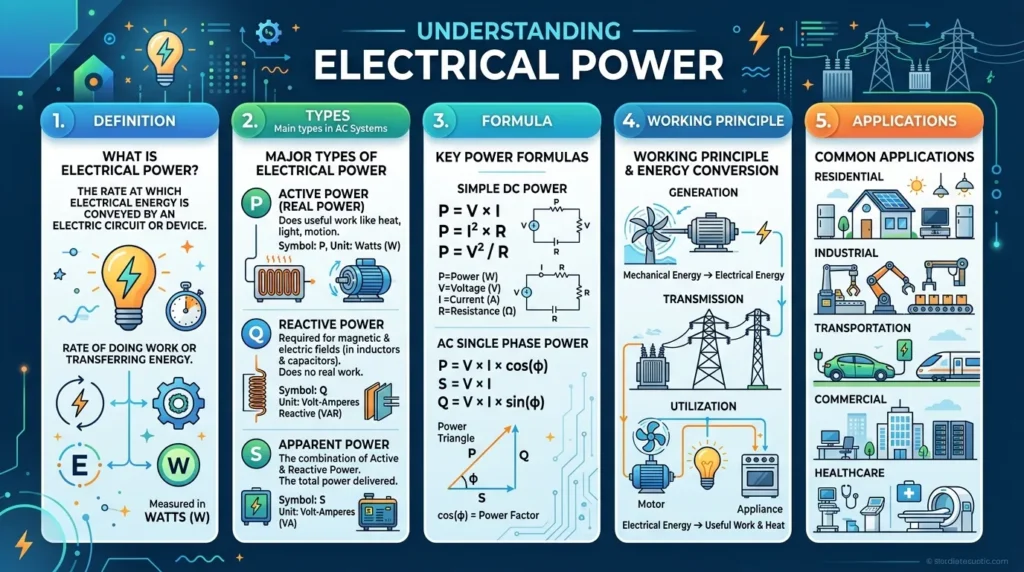
Electrical power is commonly divided into real power, reactive power, and apparent power in AC systems.
Real Power
Real power is the power that performs useful work or is converted into heat, light, mechanical motion, or another useful form.
It is measured in:
Watts (W)
Common examples include:
- Motor mechanical output
- Heater heat production
- Lamp light production
- Electronic equipment operation
For a single-phase AC circuit:
P = V × I × cos φ
Where cos φ is the power factor.
Reactive Power
Reactive power is associated with energy that moves back and forth between the source and reactive components such as inductors and capacitors.
It does not directly produce useful mechanical work in the same way as real power.
Reactive power is measured in:
Volt-amperes reactive (VAR)
It is important in AC systems because it affects current, voltage regulation, and equipment loading.
Motors and transformers commonly require reactive power because of their magnetic fields.
Apparent Power
Apparent power represents the combined effect of real and reactive power in an AC system.
It is measured in:
Volt-amperes (VA)
For a single-phase circuit:
S = V × I
The relationship among the three main types can be represented by the power triangle:
S² = P² + Q²
Where:
- P = Real power
- Q = Reactive power
- S = Apparent power
DC Power
In a simple DC circuit:
P = V × I
For a resistive load, you can also use:
P = I²R
or:
P = V²/R
AC Power
AC power calculations depend on whether the load is single-phase or three-phase and whether it contains resistance, inductance, or capacitance.
For a balanced three-phase system:
P = √3 × V × I × cos φ
Where:
- V = Line voltage
- I = Line current
- cos φ = Power factor
5. Main Components Related to Electrical Power
Electrical power does not exist as a single physical component. Instead, several parts of an electrical system determine how power is generated, transmitted, controlled, and consumed.
Power Source
A source provides electrical energy to the system.
Examples include:
- Generators
- Batteries
- Solar panels
- Utility grids
- Fuel cells
Conductors
Cables and wires carry electrical current between the source and load.
Their size must be appropriate for the expected current and installation conditions.
Load
A load consumes or converts electrical power.
Examples include:
- Motors
- Heaters
- Lamps
- Pumps
- Compressors
- Computers
Switchgear and Protection
Circuit breakers, fuses, contactors, and protective devices control and protect electrical systems.
They help prevent damage caused by faults or excessive current.
Transformers
Transformers transfer electrical energy between circuits and change AC voltage levels.
They are essential in electrical transmission and distribution systems.
Measuring Instruments
Power and related quantities can be measured using:
- Wattmeters
- Power analyzers
- Multimeters
- Clamp meters
- Energy meters
These instruments help technicians monitor system performance and diagnose problems.
6. Advantages of Electrical Power
Electrical power provides many benefits in homes, industries, transportation, and modern technology.
Easy Energy Conversion
Electrical power can be converted into:
- Mechanical energy
- Heat
- Light
- Sound
- Stored chemical energy
Efficient Transmission
Electrical energy can be transmitted over long distances using suitable voltage levels and transmission systems.
Precise Control
Power electronic devices allow engineers to control voltage, current, speed, and power accurately.
Wide Range of Applications
Electrical power supports almost every modern sector, including:
- Manufacturing
- Healthcare
- Communication
- Transportation
- Construction
- Information technology
Supports Automation
Industrial automation relies heavily on electrical power for motors, sensors, controllers, robots, and control systems.
7. Disadvantages and Limitations of Electrical Power
Electrical power is extremely useful, but electrical systems also have limitations.
Energy Losses
Resistance in conductors causes some electrical energy to be converted into heat.
Transmission and distribution systems therefore experience losses.
Electrical Hazards
Improperly designed or maintained systems can cause:
- Electric shock
- Burns
- Arc faults
- Equipment damage
- Electrical fires
Safe working procedures are essential.
Power Quality Problems
Poor power quality can result from:
- Voltage fluctuations
- Harmonics
- Voltage imbalance
- Low power factor
- Transients
These problems can affect sensitive equipment and industrial systems.
Dependence on Infrastructure
Large electrical systems require generators, transformers, cables, substations, protection equipment, and control systems.
Failures in these systems can interrupt power supply.
8. Electrical Power Applications
Power has an enormous range of applications.
Home Applications
Electrical power operates:
- Refrigerators
- Washing machines
- Air conditioners
- Fans
- Water pumps
- Televisions
- Computers
- Electric heaters
- Lighting systems
The power rating printed on an appliance helps users understand how quickly it consumes electrical energy.
Industrial Applications
Industrial facilities use electrical power for:
- Motors
- Pumps
- Compressors
- Conveyors
- Welding machines
- CNC equipment
- Industrial heaters
- Production lines
Large industrial installations may require sophisticated power monitoring and distribution systems.
Renewable Energy
Modern renewable energy systems use electrical power technology to integrate:
- Solar photovoltaic systems
- Wind turbines
- Battery storage
- Grid-connected inverters
- Energy management systems
Electric Vehicles
Electric vehicles use electrical power to charge batteries and operate electric motors.
Power electronics control the transfer of energy between the battery, inverter, motor, and charging equipment.
9. Difference Between Real, Reactive, and Apparent Power
Understanding the difference between real power, reactive power, and apparent power is essential for AC electrical systems.
| Feature | Real Power | Reactive Power | Apparent Power |
|---|---|---|---|
| Symbol | P | Q | S |
| Unit | W | VAR | VA |
| Main role | Performs useful work | Supports magnetic/electric fields | Total AC power requirement |
| Common loads | Heaters, motors, lamps | Motors, transformers | AC system loading |
| Formula | V I cos φ | V I sin φ | V I |
| Related factor | Power factor | Power factor | Power factor |
Power Factor
Power factor indicates how effectively apparent power is being converted into real power.
It is expressed as:
Power Factor = Real Power / Apparent Power
A higher power factor generally means a system uses current more effectively for a given amount of real power.
10. Power Selection Guide
Selecting electrical equipment based on power requires more than looking at a single number.
Determine the Load
First identify what equipment will be connected.
For example:
- Motor
- Heater
- Pump
- Lighting system
- Electronic equipment
Check Rated Power
Look at the equipment nameplate or manufacturer’s specifications.
For motors, check both electrical input requirements and mechanical output rating where applicable.
Consider Starting Current
Motors and some other equipment can draw significantly more current during startup than during normal operation.
Protection and supply equipment must be suitable for these conditions.
Consider Voltage
Always confirm that the equipment voltage matches the available electrical supply.
Consider Power Factor
For AC loads, especially industrial motors, power factor can affect current and system capacity.
Consider Continuous Operation
A device running continuously may have a much greater energy impact than one operating for only a few minutes each day.
11. Common Power Problems and Solutions
Why Is a Motor Drawing Too Much Power?
Possible causes include:
- Mechanical overload
- Low voltage
- Voltage imbalance
- Bearing problems
- Poor power factor
- Incorrect motor selection
Check the motor nameplate, operating voltage, current, load condition, and mechanical system.
Why Is a Circuit Breaker Tripping?
A breaker may trip because of:
- Overload
- Short circuit
- Earth fault
- Incorrect protection settings
- Equipment failure
Do not repeatedly reset a breaker without identifying the cause.
Why Is Power Consumption High?
High energy consumption may result from:
- Oversized or inefficient equipment
- Long operating hours
- Poor power factor
- High standby consumption
- Mechanical problems
- Poor maintenance
Energy monitoring can help identify where power is being consumed.
How Can Power Be Measured?
Different instruments are used for different measurements.
A wattmeter can measure electrical power, while a power analyzer can provide more detailed information such as voltage, current, power factor, real power, reactive power, and harmonics.
12. Future Trends in Electrical Power
Electrical power systems are rapidly changing as industries move toward cleaner energy and smarter electrical networks.
Smart Grids
Smart grids use digital monitoring, communication, automation, and advanced control to manage electricity more efficiently.
Battery Energy Storage
Battery systems are becoming increasingly important for storing electricity from renewable sources and supporting reliable power supply.
Power Electronics
Advanced inverters, converters, and semiconductor devices are improving the control and efficiency of electrical power.
Electric Transportation
The growth of electric vehicles is increasing demand for charging infrastructure, battery technology, and efficient power conversion.
Distributed Generation
Instead of relying only on large centralized power stations, modern systems increasingly integrate smaller sources such as rooftop solar, batteries, and local generation.
Energy Efficiency
Industries are focusing more strongly on efficient motors, variable-frequency drives, improved power factor, energy monitoring, and automated control.
These developments make a strong understanding of basic power concepts increasingly valuable for electrical professionals.
13. Conclusion
Electrical power describes the rate at which electrical energy is transferred or converted. It is measured in watts and is fundamental to understanding everything from household appliances to industrial power systems.
The most basic power formula is P = V × I, while AC systems require additional consideration of power factor and the relationship between real, reactive, and apparent power. Knowing these concepts helps electrical professionals calculate loads, select equipment, diagnose faults, and improve system efficiency.
The difference between real power, reactive power, and apparent power is especially important when working with motors, transformers, generators, and industrial distribution systems.
As electrical technology moves toward smart grids, renewable energy, battery storage, electric vehicles, and advanced power electronics, a strong understanding of power will remain essential. For beginners, mastering this basic concept is an important step toward becoming a skilled electrical technician or engineer.