
Imagine sitting in your home during a warm evening with the lights on. Within a few minutes, mosquitoes and flying insects start gathering around the light. Not only are these insects annoying, but they can also spread diseases such as malaria, dengue, and other infections. To solve this problem, many homes, restaurants, and industries use an insect killer device.
An insect killer is a simple but effective electrical device designed to attract and eliminate flying insects. These devices are commonly used in homes, offices, hospitals, food processing areas, and outdoor environments. For electrical students and technicians, understanding how insect killers work is useful because they combine basic electrical components with practical applications.
From an engineering perspective, insect killers demonstrate how electrical circuits, high-voltage grids, and light attraction technology work together to solve a real-world problem.
In this article, you will learn the insect killer working principle, its types, components, advantages and disadvantages, and various insect killer applications. The goal is to explain the technology in simple language so that beginners, technicians, and engineering students can clearly understand how these devices function.
What is an Electric Insect Killer?
An electric insect killer is an electrical device that attracts and eliminates flying insects such as mosquitoes, flies, moths, gnats, and other small pests. It works by using a special ultraviolet (UV) light to lure insects toward the device. Once they come close, they touch a high-voltage metal grid that delivers an electric shock, killing them instantly.
Electric insect killers are widely used because they control insects without the need for chemical sprays. They help create a cleaner, safer, and more hygienic environment in homes, offices, restaurants, hospitals, and industrial facilities.
Simple Explanation
In simple terms, an electric insect killer is a UV light-based device that attracts flying insects and eliminates them using a high-voltage electric grid. The UV light acts as a lure, while the electrified grid provides an instant electric discharge when insects make contact. This process is fast, efficient, and suitable for continuous insect control.
Practical Example
Electric insect killers are commonly installed in places where hygiene is important, including:
- Homes and apartments
- Restaurants and commercial kitchens
- Hospitals and healthcare facilities
- Food processing factories
- Warehouses and storage areas
- Offices and retail stores
These devices help reduce flying insect populations and improve cleanliness by preventing insects from contaminating food, equipment, and indoor spaces.
Electric Insect Killer Working Principle
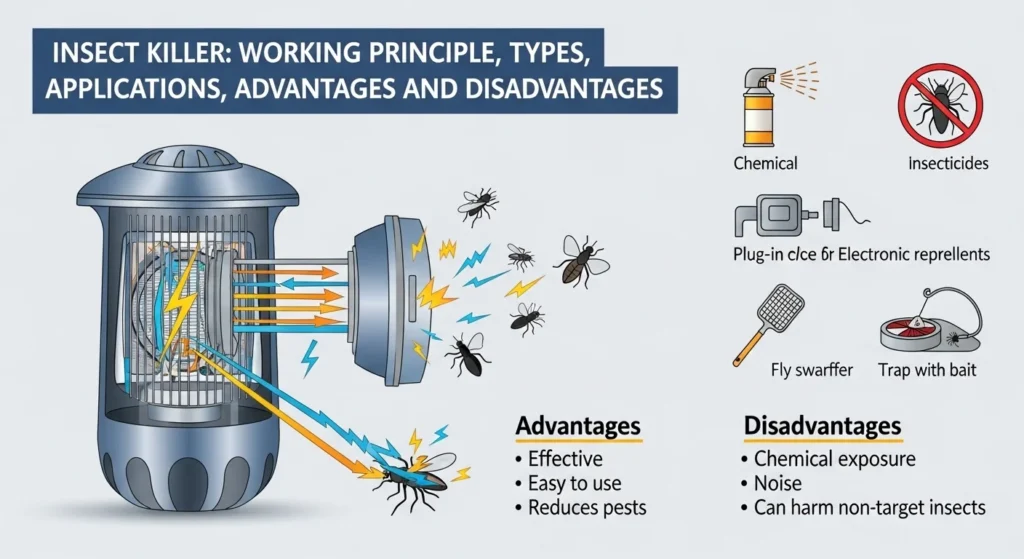
The electric insect killer working principle is based on two simple scientific concepts: ultraviolet (UV) light attraction and high-voltage electric discharge. Many flying insects naturally navigate toward UV light, making it an effective method for attracting them without using chemicals.
When insects fly toward the illuminated UV lamp, they eventually come into contact with two closely spaced metal grids carrying a high-voltage electrical potential. Touching both grids completes an electrical circuit, producing a powerful electric discharge that kills the insect instantly.
Step-by-Step Working Process
- UV Light Attraction
- The insect killer emits ultraviolet light that is highly attractive to flying insects.
- Insects naturally move toward the illuminated light source.
- Movement Toward the Device
- As insects approach the UV lamp, they enter the protective metal grid surrounding the light.
- Contact with the High-Voltage Grid
- The insect touches two energized metal grids at the same time.
- This creates a complete electrical path through the insect’s body.
- Instant Electric Discharge
- A high-voltage, low-current electrical discharge passes through the insect.
- The electric shock eliminates the insect immediately.
- Collection of Dead Insects
- The dead insects fall into a removable collection tray located beneath the grid.
- The tray can be emptied periodically to keep the device clean and operating efficiently.
Simple Analogy
Imagine an electric insect killer as a bright streetlight surrounded by a safe electric fence. The light attracts insects from a distance, and the electrified grid instantly eliminates them when they fly too close. This simple yet effective design allows the device to provide continuous, chemical-free control of flying insects in residential, commercial, and industrial environments.
Types / Classification of Insect Killers
Insect killers are available in several types depending on their design and working method.
Electric Grid Insect Killer
An electric grid insect killer is one of the most common and effective types of insect control devices used in homes, offices, restaurants, hospitals, warehouses, and industrial facilities. It is designed to eliminate flying insects such as mosquitoes, flies, moths, gnats, and other small pests by using a high-voltage electric grid. Unlike chemical insect sprays, an electric grid insect killer controls insects without releasing harmful fumes or leaving chemical residues, making it a cleaner and more environmentally friendly solution for indoor use. The device usually contains one or more ultraviolet (UV) lamps that attract insects naturally. As the insects fly toward the bright UV light, they pass through a protective outer guard and come into contact with two closely spaced metal grids carrying a high voltage. When an insect touches both grids simultaneously, it completes the electrical circuit, causing a quick electric discharge that kills the insect instantly. The dead insect then falls into a removable collection tray, which can be cleaned periodically to maintain the device’s efficiency. Modern electric grid insect killers are designed with safety features such as insulated outer covers and protective mesh to prevent accidental contact with the high-voltage grid while allowing insects to enter easily. They are available in various sizes, from compact models suitable for bedrooms and kitchens to heavy-duty commercial units capable of protecting large restaurants, food processing plants, supermarkets, and factories. Many advanced models also include energy-efficient LED UV lamps, low power consumption, quieter operation, and easy-to-clean removable trays. Because they provide continuous insect control without requiring chemicals or frequent maintenance, electric grid insect killers have become a preferred choice for maintaining hygiene and preventing insect-related contamination. Their reliable performance, simple operation, long service life, and cost-effective design make them an ideal solution for both residential and commercial environments where cleanliness, safety, and effective flying insect control are essential.
This is the most common type of insect killer used in homes and commercial areas.
Features
- Uses UV light to attract insects
- Contains a high-voltage electric grid
- Produces a small spark when insects touch the grid
Applications
- Restaurants
- Homes
- Food processing units
Sticky Trap Insect Killer
A sticky trap insect killer is a chemical-free insect control device that attracts flying insects and captures them on a strong adhesive board instead of killing them with an electric shock. This type of insect killer is commonly used in restaurants, bakeries, hospitals, food processing plants, supermarkets, offices, and other places where hygiene is extremely important. The device typically uses ultraviolet (UV) light to attract insects such as flies, mosquitoes, moths, and gnats. As the insects fly toward the UV light, they land on a specially coated sticky glue board positioned near the light source. Once they touch the adhesive surface, they become trapped and cannot escape. Unlike electric grid insect killers, sticky trap models operate silently because there is no electric discharge or zapping sound. This makes them ideal for quiet environments where noise should be minimized. Another major advantage is that trapped insects remain hidden on the adhesive board, reducing the risk of insect fragments becoming airborne and helping maintain a cleaner environment. The glue boards are removable and should be replaced regularly to ensure maximum trapping efficiency. Modern sticky trap insect killers are designed with energy-efficient UV lamps, durable housings, and easy-access panels for quick maintenance. They consume very little electricity and provide continuous insect control throughout the day and night. Because they do not use chemical pesticides or produce harmful fumes, they are considered safe for use around food preparation areas, healthcare facilities, schools, and commercial buildings. Their silent operation, hygienic design, low maintenance requirements, and environmentally friendly performance make sticky trap insect killers an excellent choice for locations that require effective, discreet, and continuous control of flying insects while maintaining high standards of cleanliness and safety.
Instead of electric shock, this type uses adhesive surfaces to trap insects.
Features
- UV light attraction
- Sticky glue board
- Silent operation
Applications
- Hospitals
- Laboratories
- Clean environments
Bug Zapper
A bug zapper is an electric insect control device that attracts and eliminates flying insects using ultraviolet (UV) light and a high-voltage electric grid. It is one of the most popular insect killers for both indoor and outdoor use because it provides fast, continuous, and chemical-free pest control. Bug zappers are commonly used to control mosquitoes, flies, moths, gnats, and other flying insects around homes, gardens, patios, restaurants, warehouses, farms, and commercial buildings. The device works by emitting UV light, which naturally attracts many species of flying insects. As the insects move toward the light source, they pass through a protective outer cage and touch the energized metal grid inside. Contact with two high-voltage wires completes an electrical circuit, producing a powerful electric discharge that kills the insect instantly. The dead insects then fall into a removable collection tray, making cleaning and maintenance simple. Modern bug zappers are designed with safety features such as insulated outer grills, durable weather-resistant housings, energy-efficient UV lamps, and low power consumption. Many models are suitable for outdoor environments and can withstand rain, dust, and varying weather conditions. Some advanced bug zappers also include LED UV technology, replaceable lamps, automatic timers, and hanging or wall-mounted designs for greater convenience. Since they do not rely on chemical insecticides, bug zappers provide an environmentally friendly solution for reducing flying insect populations while helping maintain a cleaner and more comfortable environment. Their ease of use, reliable performance, minimal maintenance, and ability to protect large areas make bug zappers an excellent choice for residential, commercial, agricultural, and industrial applications where effective flying insect control is essential.
Bug zappers are powerful outdoor insect killers designed for large areas.
Features
- Strong UV light
- High-voltage grid
- Wide coverage area
Applications
- Gardens
- Parks
- Outdoor restaurants
Solar Insect Killer
A solar insect killer is an eco-friendly insect control device that uses solar energy to attract and eliminate flying insects without relying entirely on electricity from the power grid. It is equipped with a small solar panel that captures sunlight during the day and stores the energy in a rechargeable battery. At night, the stored energy powers a UV light and, in many models, a high-voltage electric grid that attracts and kills mosquitoes, flies, moths, and other flying insects. Some solar insect killers use a sticky trap instead of an electric grid, depending on the design. These devices are ideal for outdoor areas where electrical outlets are not easily available. Solar insect killers are commonly installed in gardens, parks, farms, patios, campsites, walkways, parking areas, and outdoor restaurants. Because they operate on renewable solar energy, they help reduce electricity costs while providing continuous insect control after sunset. Most modern models include automatic light sensors that switch the device on at dusk and off at dawn, improving energy efficiency and battery life. They are also designed with weather-resistant housings to withstand rain, dust, and varying outdoor conditions. Maintenance is generally simple and involves cleaning the solar panel, removing dead insects or replacing the sticky board if required, and checking the rechargeable battery periodically. Since solar insect killers do not use chemical pesticides or emit harmful fumes, they offer a safe and environmentally friendly solution for controlling flying insects. Their energy efficiency, easy installation, low operating cost, and ability to work in remote locations make solar insect killers an excellent choice for residential gardens, agricultural fields, recreational areas, and commercial outdoor spaces where reliable and sustainable insect control is needed.
Solar insect killers use solar panels to power the device.
Features
- Energy-efficient
- Eco-friendly
- Works without electricity grid
Applications
- Outdoor areas
- Farms
- Remote locations
Main Components of an Electric Insect Killer
Each component of an electric insect killer plays an important role in attracting, eliminating, and collecting flying insects safely and efficiently. Understanding these parts helps users operate the device correctly and perform proper maintenance.
1. Ultraviolet (UV) Lamp
The ultraviolet (UV) lamp is the most important component of an electric insect killer because it attracts flying insects toward the device. Most insects, including mosquitoes, flies, moths, and gnats, are naturally drawn to ultraviolet light, especially during the evening and nighttime. The UV lamp emits light at a wavelength that is highly attractive to these insects but consumes relatively little electrical power. Modern insect killers often use energy-efficient UV fluorescent tubes or UV LED lamps, which provide longer service life and lower power consumption. The effectiveness of the insect killer largely depends on the brightness and quality of the UV light, so the lamp should be cleaned regularly and replaced when its brightness decreases.
Step-by-Step Function
- The insect killer receives electrical power.
- The UV lamp turns on and emits ultraviolet light.
- Flying insects detect the UV light from a distance.
- The insects fly toward the illuminated lamp.
- As they approach the light, they move into the electric grid area where they are eliminated.
2. High-Voltage Transformer
The high-voltage transformer is the electrical component responsible for generating the high voltage required by the electric grid. Household power supplies provide relatively low voltage, which is not sufficient to kill insects instantly. The transformer increases this voltage to several thousand volts while maintaining a very low current for safe and efficient operation. It continuously supplies high voltage to the metal grid whenever the device is switched on.
Step-by-Step Function
- The device receives AC power from the electrical outlet.
- The transformer converts the input voltage into a much higher voltage.
- The high voltage is delivered to the electric grid.
- The voltage remains available while the device is operating.
- When an insect touches the grid, the stored electrical energy produces an instant discharge.
3. Electric Grid
The electric grid is the killing mechanism of the insect killer. It consists of two closely spaced metal mesh layers or parallel wires connected to the high-voltage transformer. A protective gap is maintained between the grids so that electricity does not flow continuously. When an insect touches both metal grids simultaneously, it completes the electrical circuit, allowing a high-voltage electric discharge to pass through its body. This process eliminates the insect instantly.
Step-by-Step Function
- The transformer energizes the metal grid with high voltage.
- An insect flies toward the UV lamp.
- The insect enters the space between the metal grids.
- The insect touches both energized grids at the same time.
- The electrical circuit is completed.
- A high-voltage electric shock passes through the insect.
- The insect is eliminated instantly and falls into the collection tray.
4. Protective Outer Cage
The protective outer cage is a safety feature that surrounds the electric grid. It is designed with carefully spaced openings that allow small flying insects to enter while preventing people, children, and pets from accidentally touching the high-voltage grid. The cage is usually made of durable plastic or coated metal and also protects the internal components from accidental damage.
Step-by-Step Function
- The outer cage surrounds the electric grid.
- Small flying insects easily pass through the openings.
- Larger objects such as fingers or pets cannot reach the energized grid.
- The cage prevents accidental electric shock.
- It also protects the UV lamp and internal components from physical damage.
5. Collection Tray
The collection tray is located at the bottom of the insect killer and is designed to collect dead insects after they have been eliminated by the electric grid. Instead of allowing insects to scatter on the floor, the tray keeps them contained in one place, making cleaning simple and hygienic. Most collection trays are removable, allowing users to empty and clean them quickly without disassembling the entire device.
Step-by-Step Function
- The insect is eliminated by the electric grid.
- Gravity causes the dead insect to fall downward.
- The insect lands in the removable collection tray.
- The tray stores the dead insects until cleaning.
- The user removes, empties, washes, and reinstalls the tray for continued operation.
6. Power Supply and Switch
The power supply and ON/OFF switch provide electrical energy to the insect killer and allow the user to control its operation. Depending on the model, the device may operate from a standard AC power outlet, a rechargeable battery, or a solar-powered battery system. The power switch safely turns the insect killer on or off whenever needed.
Step-by-Step Function
- The device is connected to its power source.
- The user presses the ON switch.
- Electrical power flows to the UV lamp and transformer.
- The UV light begins attracting insects.
- The electric grid becomes energized and ready to eliminate insects.
- When finished, the user switches the device OFF for safe maintenance.
7. Housing or Body
The housing is the outer frame that supports and protects all internal components, including the UV lamp, transformer, electric grid, wiring, and collection tray. It is typically made from durable plastic, aluminum, or corrosion-resistant steel to ensure long service life. Many outdoor insect killers feature weather-resistant housings to withstand rain, dust, and sunlight.
Step-by-Step Function
- Holds all internal components securely in place.
- Protects electrical parts from dust and accidental impact.
- Provides ventilation for proper heat dissipation.
- Supports wall mounting, hanging, or tabletop installation.
- Ensures stable and safe operation in different environments.
Insect Killer Advantages and Disadvantages
Understanding the insect killer advantages and disadvantages helps homeowners, businesses, and industries choose the most suitable device for their specific needs. While insect killers are highly effective for controlling flying insects, selecting the right model depends on the installation location, insect type, and maintenance requirements. Knowing both the benefits and limitations ensures better performance, improved hygiene, and long-term value.
Advantages of an Insect Killer
An electric insect killer offers numerous benefits, making it one of the most popular solutions for controlling flying insects in residential, commercial, and industrial environments.
1. Highly Effective Against Flying Insects
Electric insect killers quickly eliminate mosquitoes, flies, moths, gnats, and other flying insects, helping maintain a cleaner and more comfortable environment.
2. Chemical-Free Operation
Unlike insect sprays and pesticides, insect killers do not use harmful chemicals. This makes them safer for homes, offices, restaurants, hospitals, and food preparation areas.
3. Improves Hygiene
By reducing the number of flying insects, insect killers help prevent food contamination and reduce the spread of bacteria and disease-causing organisms.
4. Continuous Protection
Once switched on, the device works continuously throughout the day or night without requiring constant supervision.
5. Easy to Operate
Most insect killers require only a power connection and an ON/OFF switch, making them simple to use for both beginners and professionals.
6. Low Maintenance
Maintenance is minimal and usually involves cleaning the collection tray, wiping the UV lamp, and replacing the lamp or sticky board when necessary.
7. Energy Efficient
Modern insect killers use low-power UV lamps or LED technology, allowing them to operate for long periods while consuming very little electricity.
8. Environmentally Friendly
Because they do not release chemical fumes or toxic residues, electric insect killers provide a cleaner and more eco-friendly method of insect control.
9. Suitable for Various Locations
They are available in different sizes and designs for homes, offices, restaurants, hospitals, warehouses, farms, factories, and outdoor recreational areas.
10. Long Service Life
High-quality insect killers are built with durable materials and can provide reliable performance for many years with proper maintenance.
Disadvantages / Limitations of an Insect Killer
Although insect killers offer many advantages, they also have some limitations that users should consider before purchasing one.
1. Less Effective Against Crawling Insects
Electric insect killers are designed primarily for flying insects and are generally ineffective against ants, cockroaches, termites, and other crawling pests.
2. Requires a Power Source
Most models require electricity, batteries, or solar power to operate, making them dependent on an available power source.
3. UV Lamp Replacement
The ultraviolet lamp gradually loses its brightness over time and must be replaced periodically to maintain maximum attraction efficiency.
4. Noise During Operation
Electric grid models produce a noticeable “zap” sound whenever an insect contacts the high-voltage grid, which may be distracting in very quiet environments.
5. Regular Cleaning Required
Dead insects accumulate in the collection tray or on sticky boards, requiring regular cleaning or replacement to maintain hygiene and performance.
6. May Attract Beneficial Insects
UV light can sometimes attract harmless or beneficial insects in addition to mosquitoes and flies.
7. Reduced Performance in Bright Areas
Strong sunlight or bright indoor lighting can reduce the effectiveness of UV attraction, especially during daytime operation.
8. Limited Coverage Area
Each insect killer is designed to protect a specific area. Large spaces may require multiple units for effective insect control.
Insect Killer Applications
There are numerous insect killer applications across residential, commercial, industrial, agricultural, and public environments. These devices help improve hygiene, reduce insect-related health risks, and create cleaner, more comfortable spaces.
Residential Applications
Electric insect killers are widely used in homes to reduce mosquitoes, flies, and other flying insects without using chemical sprays.
Common residential applications include:
- Bedrooms
- Living rooms
- Kitchens
- Dining areas
- Balconies
- Garages
- Home gardens
- Outdoor patios
These devices help families enjoy a cleaner and more comfortable living environment.
Commercial Applications
Businesses install insect killers to maintain cleanliness, improve customer comfort, and comply with hygiene regulations.
Common commercial applications include:
- Restaurants
- Hotels
- Cafés
- Supermarkets
- Shopping malls
- Offices
- Retail stores
- Bakeries
- Conference halls
- Schools and colleges
They help prevent flying insects from contaminating food and disturbing customers.
Industrial Applications
Many industries require strict insect control to protect products, equipment, and workplace hygiene.
Common industrial applications include:
- Food processing plants
- Pharmaceutical manufacturing facilities
- Beverage production units
- Dairy processing plants
- Packaging factories
- Cold storage warehouses
- Textile industries
- Chemical plants
- Electronics manufacturing facilities
- Logistics and distribution centers
Industrial insect killers help meet food safety and quality standards while improving workplace cleanliness.
Healthcare Applications
Hospitals and healthcare facilities use insect killers to reduce the presence of flying insects and maintain sanitary conditions.
Examples include:
- Hospitals
- Clinics
- Diagnostic laboratories
- Medical research centers
- Nursing homes
- Dental clinics
These environments require effective insect control to minimize contamination risks.
Agricultural Applications
In agriculture, insect killers help reduce flying insect populations around livestock, crops, and storage facilities.
Common applications include:
- Poultry farms
- Dairy farms
- Greenhouses
- Crop storage buildings
- Livestock shelters
- Fruit and vegetable storage areas
They contribute to healthier farming environments and reduce insect-related losses.
Outdoor Applications
Weather-resistant insect killers are designed to operate effectively in outdoor environments where flying insects are more common.
Typical outdoor applications include:
- Gardens
- Parks
- Camping sites
- Outdoor restaurants
- Farmhouses
- Walking trails
- Resorts
- Swimming pool areas
- Picnic areas
- Public parks
These devices provide reliable insect control while allowing people to enjoy outdoor spaces more comfortably.
Comparison: Insect Killer vs Mosquito Repellent
Understanding the difference between insect killer and mosquito repellent helps users choose the right solution.
| Feature | Insect Killer | Mosquito Repellent |
|---|---|---|
| Method | Electric shock | Chemical or fragrance |
| Target | Flying insects | Mostly mosquitoes |
| Maintenance | Requires cleaning | Replace liquid or mat |
| Coverage | Larger area | Limited area |
| Safety | Chemical-free | Contains chemicals |
Insect killers are better for long-term insect control, while repellents are mainly used for temporary mosquito protection.
Selection Guide: How to Choose the Right Insect Killer
Selecting the right insect killer ensures effective insect control, lower operating costs, and long-lasting performance. The best device depends on where it will be installed, the type of insects you want to control, and the size of the area that needs protection. Before purchasing an insect killer, consider the following important factors.
1. Area Coverage
Always choose an insect killer that matches the size of the space you want to protect. Manufacturers usually specify the maximum coverage area in square meters. A device designed for a small bedroom may not effectively protect a large warehouse or restaurant.
Tips:
- Small rooms: 10–20 m²
- Medium rooms: 20–50 m²
- Large halls or restaurants: 50–100 m²
- Factories and warehouses: 100 m² or more (multiple units may be required)
2. Type of Insect Killer
Different insect killers are designed for different environments. Select the type that best suits your application.
Electric Grid Insect Killer
- Best for homes, offices, warehouses, and factories
- Instantly kills insects using a high-voltage grid
Sticky Trap Insect Killer
- Ideal for restaurants, hospitals, bakeries, and food processing plants
- Captures insects silently without scattering insect fragments
Bug Zapper
- Suitable for gardens, patios, farms, and outdoor recreational areas
- Covers larger outdoor spaces
Solar Insect Killer
- Perfect for parks, farms, campsites, and remote locations
- Operates using renewable solar energy
3. Power Consumption
Energy-efficient insect killers reduce electricity costs while providing continuous operation. Modern models often use LED UV lamps that consume less power than traditional fluorescent lamps.
Tips:
- Choose low-wattage models for residential use.
- Select energy-efficient commercial models for continuous operation.
- Consider solar-powered units for outdoor installations.
4. UV Lamp Quality
The UV lamp is responsible for attracting insects. A high-quality UV lamp provides stronger attraction, longer operating life, and better overall performance.
Look for:
- High-intensity UV output
- Long lamp lifespan
- LED UV technology
- Easy replacement design
5. Safety Features
Safety should always be a priority, especially in homes with children or pets.
Choose insect killers with:
- Protective outer grills
- Insulated housing
- Shock-resistant construction
- Stable mounting brackets
- Overheating protection (if available)
6. Maintenance Requirements
A well-designed insect killer should be easy to clean and maintain. Regular maintenance helps maintain maximum efficiency and extends the life of the device.
Choose models with:
- Removable collection trays
- Easy-to-clean electric grids
- Replaceable UV lamps
- Washable sticky boards (where applicable)
- Tool-free maintenance access
7. Indoor or Outdoor Use
Not all insect killers are designed for outdoor conditions. Always select a model suitable for the intended environment.
Indoor Models
- Homes
- Offices
- Hospitals
- Restaurants
Outdoor Models
- Gardens
- Parks
- Farms
- Camping sites
- Outdoor dining areas
Outdoor models should have weather-resistant and waterproof construction.
8. Build Quality and Durability
High-quality materials increase the lifespan of the insect killer and reduce maintenance costs.
Look for:
- Stainless steel electric grids
- Corrosion-resistant housing
- Durable plastic or aluminum body
- UV-resistant materials
- Strong mounting hardware
9. Noise Level
If the insect killer will be installed in bedrooms, hospitals, libraries, or offices, consider its operating noise.
- Sticky trap insect killers operate almost silently.
- Electric grid models produce a “zap” sound when insects are eliminated.
10. Warranty and Brand Reputation
Purchasing from a reputable manufacturer ensures better product quality, reliable customer support, and easier availability of replacement parts.
Tips for Beginners
- Select the correct coverage area.
- Choose LED UV models for better energy efficiency.
- Buy products with safety certifications.
- Prefer removable collection trays for easier cleaning.
- Follow the manufacturer’s installation and maintenance instructions.
Common Problems & Solutions
Like any electrical device, insect killers may occasionally experience operational issues. Most problems are easy to identify and can be resolved with regular inspection and maintenance.
1. Why is the insect killer not attracting insects?
Possible Causes
- UV lamp has reached the end of its lifespan.
- Dust or dirt is covering the UV lamp.
- Strong surrounding lighting reduces UV attraction.
- The insect killer is installed in an unsuitable location.
Solution
- Clean the UV lamp using a soft, dry cloth.
- Replace the UV lamp if it has become dim.
- Turn off nearby bright lights during operation.
- Install the unit approximately 1.5–2 meters above the ground and away from competing light sources.
2. Why is there no electric spark?
Possible Causes
- High-voltage transformer failure.
- Loose or damaged wiring.
- Broken electric grid.
- Power supply interruption.
Solution
- Verify that the device is receiving power.
- Inspect electrical connections.
- Check the transformer output.
- Repair or replace damaged grid wires if necessary.
3. Why is the insect killer performing poorly?
Possible Causes
- Dirty electric grid.
- Dust-covered UV lamp.
- Low supply voltage.
- Collection tray is full.
Solution
- Clean the electric grid carefully.
- Wipe the UV lamp regularly.
- Ensure the correct supply voltage.
- Empty and clean the collection tray.
4. Why does the UV lamp turn on but insects are not being killed?
Possible Causes
- High-voltage grid is not energized.
- Transformer malfunction.
- Broken internal wiring.
Solution
- Test the transformer.
- Inspect the grid connections.
- Replace faulty electrical components.
5. Why does the device make unusual noises?
Possible Causes
- Loose internal components.
- Dirt trapped between the electric grids.
- Large insects causing louder electric discharges.
Solution
- Clean the grid thoroughly.
- Tighten loose components.
- Inspect for damaged parts.
6. Why does the insect killer stop working suddenly?
Possible Causes
- Blown fuse.
- Power outage.
- Overheated internal components.
- Faulty power switch.
Solution
- Check the power outlet.
- Inspect the fuse.
- Allow the device to cool if overheated.
- Replace the faulty switch if required.
7. How often should the UV lamp be replaced?
Most manufacturers recommend replacing the UV lamp every 6 to 12 months, depending on operating hours and environmental conditions. Regular replacement ensures maximum insect attraction and consistent performance.
Future Trends in Insect Killer Technology
The insect control industry is rapidly adopting smarter, safer, and more energy-efficient technologies. Future insect killers will focus on improving performance while reducing energy consumption and environmental impact.
Smart Insect Killers
Modern insect killers are becoming part of smart home and industrial automation systems.
Emerging Features
- Smart sensors for insect detection
- Automatic day and night operation
- Mobile app control
- Wi-Fi and Bluetooth connectivity
- Real-time performance monitoring
- Automatic maintenance reminders
These intelligent features improve convenience while reducing unnecessary energy consumption.
LED UV Attraction Technology
Traditional fluorescent UV lamps are gradually being replaced by advanced LED UV technology.
Benefits
- Longer operating life
- Lower electricity consumption
- Reduced heat generation
- Higher energy efficiency
- Lower maintenance costs
- Improved environmental performance
LED technology is expected to become the industry standard in future insect killers.
Solar-Powered Insect Killers
Solar-powered insect killers are becoming increasingly popular for outdoor applications.
Advantages
- Operate using renewable solar energy
- Lower electricity costs
- Suitable for remote locations
- Automatic charging during daylight
- Reduced carbon footprint
These models are ideal for gardens, parks, farms, and camping areas.
Eco-Friendly Designs
Manufacturers are developing environmentally responsible insect killers that minimize their impact on beneficial insects and the environment.
Future Improvements
- Reduced energy consumption
- Recyclable materials
- More selective insect attraction
- Lower impact on non-target insects
- Sustainable manufacturing processes
IoT and AI Integration
Next-generation insect killers are expected to incorporate the Internet of Things (IoT) and Artificial Intelligence (AI) for smarter pest management.
Expected Features
- Remote monitoring and control
- Predictive maintenance alerts
- Automatic performance optimization
- Data analysis for insect activity
- Integration with smart building management systems
These innovations will make insect killers more efficient, reliable, and easier to manage in residential, commercial, and industrial environments.
Conclusion
Insect killers are practical and efficient devices used to control flying insect populations in homes, businesses, and industrial environments. By combining ultraviolet light attraction with high-voltage electric grids, these devices provide a chemical-free method of insect control.
Understanding the insect killer working principle, internal components, and insect killer applications is useful for electrical students, technicians, and engineers. These devices demonstrate how basic electrical circuits, transformers, and high-voltage systems can be applied in everyday life.
While insect killers have some limitations, their advantages such as easy operation, hygienic insect control, and wide area coverage make them an important tool for maintaining clean environments.
For beginners entering the electrical field, studying insect killer technology offers valuable insight into practical electrical device design and maintenance.