
When you charge your mobile phone, switch on a fan, start an electric motor, or turn on a light, energy is involved. Without energy, none of these devices could perform useful work. In electrical engineering, understanding energy meaning is essential because electrical systems are designed to generate, transfer, store, convert, and consume energy.
Energy is different from power, although the two terms are closely connected. Power tells us how quickly energy is transferred or used, while energy tells us the total amount transferred or consumed over a period of time. This difference is important when calculating electricity consumption, equipment efficiency, battery capacity, and electricity bills.
Electrical students, technicians, and engineers use energy concepts when working with generators, motors, transformers, batteries, solar systems, and power distribution networks.
In this guide, you will learn what energy means, how electrical energy works, its major types, important components, advantages and limitations, practical applications, the difference between energy and power, common problems, and emerging energy technologies.
2. What Is Energy?
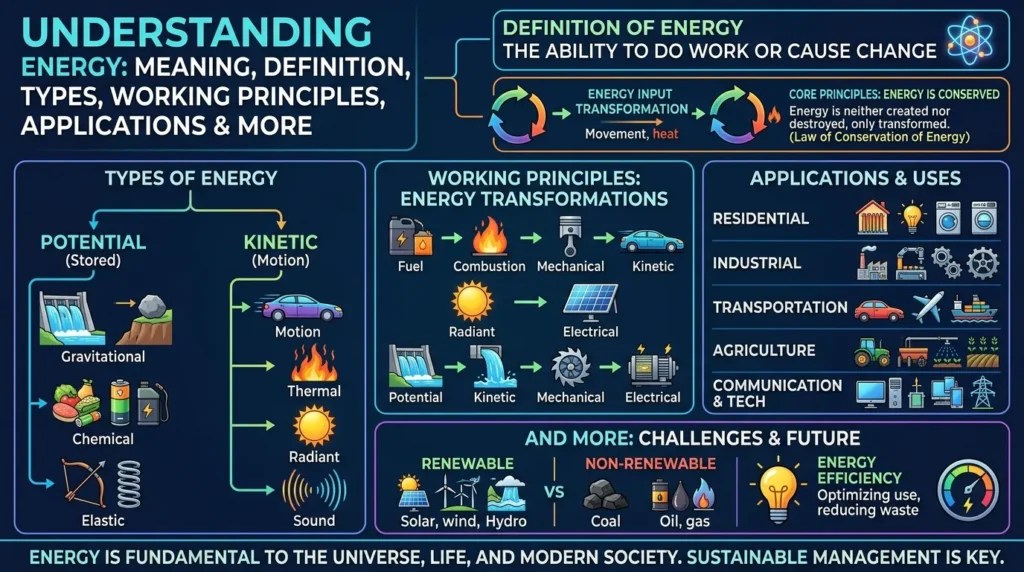
Energy is the capacity to do work or cause a change.
In electrical engineering, energy refers to the ability of an electrical system to perform useful work or transfer power from one location or form to another.
The SI unit of energy is the joule (J).
For electrical systems, energy is often measured in watt-hours (Wh) or kilowatt-hours (kWh).
The basic relationship between energy, power, and time is:
E = P × t
Where:
- E = Energy
- P = Power
- t = Time
For example, if a 1,000 W heater operates for 2 hours:
Energy = 1 kW × 2 hours = 2 kWh
Therefore, the heater consumes 2 kilowatt-hours of electrical energy during those two hours.
A Simple Practical Example
Think about a water tank.
The amount of water stored in the tank can be compared with the amount of energy stored in a system. The water can later be released and used to perform useful work.
Similarly, energy can be stored in batteries, fuel, elevated water, magnetic fields, electric fields, and other forms.
Energy vs Power
A common beginner mistake is treating energy and power as the same thing.
| Feature | Energy | Power |
|---|---|---|
| Meaning | Capacity to do work | Rate of energy transfer |
| Common units | J, Wh, kWh | W, kW, MW |
| Depends on time | Yes | Not directly |
| Example | 10 kWh consumed | 2 kW load |
A 2 kW appliance running for 5 hours uses 10 kWh of energy.
3. Energy Working Principle
The energy working principle is based on the idea that energy can be transferred or converted from one form into another.
Energy cannot simply disappear. In practical systems, it is transferred, stored, or converted.
For example, a generator converts mechanical energy into electrical energy. An electric motor performs the reverse type of conversion by converting electrical energy into mechanical energy.
How Electrical Energy Works
The process can be understood in simple steps:
- An energy source provides available energy.
- A generator, battery, solar panel, or other source makes electrical energy available.
- Voltage provides the electrical potential that drives current.
- Current transfers electrical energy through the circuit.
- The load receives the energy.
- The load converts electrical energy into another useful form.
- Some energy may also be lost as heat, sound, vibration, or other unwanted output.
Example: Electric Motor
An electric motor receives electrical energy.
Inside the motor, electromagnetic forces act on its components and produce rotation.
The energy conversion can be simplified as:
Electrical Energy → Mechanical Energy
Some energy is also converted into heat and sound because no practical machine is perfectly efficient.
Water Analogy
Imagine water flowing from a high tank through a pipe toward a water turbine.
- Stored water represents stored energy.
- Water pressure is similar to voltage.
- Water flow is similar to current.
- The turbine represents the load.
- Mechanical movement represents useful output.
This analogy helps beginners understand how energy moves through a system.
4. Types of Energy
Energy exists in many forms. Electrical engineering commonly deals with several important types.
Electrical Energy
Electrical energy is associated with the movement or presence of electric charge.
It powers:
- Motors
- Lights
- Computers
- Pumps
- Industrial machines
- Household appliances
Electrical energy is one of the most useful forms because it can be transferred and converted relatively easily.
Mechanical Energy
Mechanical energy is associated with the movement or position of an object.
It includes:
- Rotational motion
- Linear motion
- Stored mechanical potential
A rotating turbine contains mechanical energy that can be transferred to a generator.
Thermal Energy
Thermal energy is associated with the temperature and internal movement of particles.
Electrical systems commonly convert electrical energy into thermal energy.
Examples include:
- Electric heaters
- Ovens
- Irons
- Water heaters
Chemical Energy
Chemical energy is stored in chemical bonds.
Common examples include:
- Batteries
- Petrol
- Diesel
- Natural gas
- Hydrogen-based systems
A battery converts chemical energy into electrical energy during discharge.
Solar Energy
Solar energy comes from the Sun.
Solar photovoltaic systems convert sunlight into electrical energy.
The basic conversion is:
Solar Energy → Electrical Energy
Solar power is increasingly important in modern electrical systems.
Potential Energy
Potential energy is stored because of an object’s position or condition.
For example, water stored behind a hydroelectric dam has gravitational potential energy.
When the water flows downward, this stored energy can be converted into mechanical and then electrical energy.
Kinetic Energy
Kinetic energy is the energy of motion.
Moving air can rotate wind turbine blades, allowing kinetic energy from the wind to be converted into electrical energy.
5. Main Components Related to Energy Systems
Energy itself is not a physical component. However, many electrical components are responsible for generating, transferring, storing, converting, or consuming energy.
Energy Source
An energy source provides the initial energy.
Examples include:
- Solar radiation
- Wind
- Water
- Fuel
- Batteries
- Utility electricity
Generator
A generator converts mechanical energy into electrical energy.
Generators are widely used in power plants, backup systems, industrial facilities, and emergency power systems.
Transformer
A transformer transfers electrical energy between circuits and changes AC voltage levels.
It plays a major role in transmission and distribution.
Transmission Lines
Transmission lines transfer electrical energy over long distances.
High-voltage transmission helps reduce current for a given power level, which can reduce resistive losses in conductors.
Battery
A battery stores energy in chemical form and provides electrical energy when connected to a suitable circuit.
Batteries are important in:
- Mobile devices
- Vehicles
- UPS systems
- Solar storage
- Electric vehicles
- Backup power systems
Electrical Load
A load receives electrical energy and converts it into another form.
Examples include:
- Motors
- Lamps
- Heaters
- Pumps
- Compressors
- Electronic devices
Energy Meter
An energy meter measures electrical energy consumption.
In homes and commercial buildings, energy meters commonly record consumption in kilowatt-hours (kWh).
6. Advantages of Energy
Energy is essential for modern life and industrial development.
Supports Electrical Equipment
Almost every electrical device requires energy to operate.
Enables Industrial Production
Factories use energy for:
- Motors
- Pumps
- Compressors
- Heating systems
- Automation
- Material processing
Can Be Converted Into Different Forms
Electrical energy can be converted into:
- Mechanical energy
- Thermal energy
- Light
- Sound
- Chemical energy
Enables Modern Technology
Energy supports:
- Computers
- Telecommunications
- Data centers
- Medical equipment
- Electric vehicles
- Robotics
- Automation
Can Be Stored
Modern batteries allow electrical energy to be stored for later use.
This is particularly important for renewable energy systems.
Supports Renewable Technology
Solar, wind, hydroelectric, and other renewable technologies provide alternatives to conventional energy sources.
7. Disadvantages and Limitations of Energy
Energy itself is essential, but producing and using energy can create challenges.
Energy Losses
During generation, transmission, conversion, and consumption, some energy is lost.
For example, electrical resistance in cables converts part of electrical energy into heat.
Environmental Impact
Some energy sources can produce:
- Greenhouse gas emissions
- Air pollution
- Waste
- Environmental damage
The impact depends heavily on the energy source and technology used.
Storage Challenges
Large-scale energy storage can be technically and economically difficult.
Batteries, pumped hydro, thermal storage, and other technologies are being developed to address this issue.
Limited Resources
Some traditional energy resources, such as fossil fuels, are finite.
This encourages the development of renewable and more efficient energy systems.
Conversion Losses
Energy conversion is never perfectly efficient in practical systems.
For example:
Electrical Energy → Motor → Mechanical Energy
Some energy becomes heat and sound during this process.
8. Energy Applications
Energy has applications in almost every area of electrical engineering.
Home Applications
Electrical energy powers:
- Refrigerators
- Washing machines
- Fans
- Air conditioners
- Lighting
- Televisions
- Computers
- Water pumps
- Electric heaters
The energy consumed by these appliances contributes to the electricity bill.
Industrial Applications
Industries depend heavily on energy for:
- Motors
- Pumps
- Compressors
- Conveyor systems
- Welding
- Furnaces
- Machine tools
- Automation systems
Energy management is important because electricity can represent a significant operating cost.
Transportation
Energy is used in:
- Electric vehicles
- Trains
- Electric buses
- Charging stations
- Railway systems
Electric vehicles store electrical energy in batteries and convert it into mechanical output through electric motors.
Renewable Energy
Energy concepts are central to renewable systems.
Examples include:
- Solar photovoltaic systems
- Wind turbines
- Hydroelectric plants
- Battery energy storage
- Hybrid renewable systems
Modern Technology
Energy is increasingly important in:
- Data centers
- Artificial intelligence infrastructure
- Smart grids
- Battery storage
- Electric vehicles
- Robotics
- Industrial automation
9. Difference Between Energy and Power
The difference between energy and power is one of the most important concepts for beginners.
Power describes the rate at which energy is transferred or used.
Energy describes the total amount transferred or used.
Consider a 2 kW heater.
If it runs for 1 hour:
Energy = 2 kW × 1 h = 2 kWh
If it runs for 5 hours:
Energy = 2 kW × 5 h = 10 kWh
The heater’s power rating remains 2 kW, but its energy consumption increases with operating time.
Energy and Power Comparison
| Feature | Energy | Power |
|---|---|---|
| Definition | Capacity to perform work | Rate of energy transfer |
| SI unit | Joule | Watt |
| Electrical billing | kWh | Not normally billed directly |
| Time relationship | Depends on time | Rate quantity |
| Example | 20 kWh | 4 kW |
Understanding this difference makes electricity calculations much easier.
10. Energy Selection Guide
When choosing an energy source or energy system, several factors should be considered.
Determine the Required Load
First calculate how much power the equipment needs.
Then estimate how long it will operate.
This gives an approximate energy requirement.
Consider Operating Time
A small appliance running continuously may consume more energy than a larger appliance used for a few minutes.
Check Efficiency
Look at how efficiently the system converts available energy into useful output.
Higher efficiency generally means less wasted energy.
Consider Storage Requirements
If energy must be available when the main source is unavailable, consider:
- Battery storage
- UPS systems
- Generator backup
- Other storage technologies
Consider Reliability
Industrial and critical systems may require a highly reliable energy supply.
Hospitals, data centers, and essential industrial facilities often use backup systems.
Consider Environmental Impact
Where practical, compare conventional energy sources with renewable alternatives and evaluate their overall environmental impact.
11. Common Energy Problems and Solutions
Why Is Energy Consumption Increasing?
Higher energy consumption can be caused by:
- Longer operating hours
- Inefficient equipment
- Overloaded systems
- Poor maintenance
- Increased production
- Unnecessary standby loads
Energy meters and monitoring systems can help identify where energy is being consumed.
Why Is an Electrical System Wasting Energy?
Possible causes include:
- High cable losses
- Inefficient motors
- Poor power factor
- Poorly maintained equipment
- Excessive heating
- Old or inefficient appliances
Regular maintenance and energy audits can help identify major losses.
Why Does a Battery Lose Energy?
Battery performance can decline because of:
- Age
- Temperature
- Charging conditions
- Discharge cycles
- Internal resistance
- Improper maintenance
Battery management systems help monitor and control operating conditions.
How Can Energy Consumption Be Reduced?
Practical methods include:
- Use efficient motors.
- Replace inefficient lighting.
- Reduce unnecessary operating time.
- Maintain electrical equipment.
- Improve power factor where appropriate.
- Monitor energy consumption.
- Use automation to control loads.
- Consider renewable energy where suitable.
12. Future Trends in Energy
The energy industry is changing rapidly as demand for efficient and cleaner systems increases.
Renewable Energy
Solar and wind generation are expanding in many electrical systems.
Their integration requires improved grid management and energy storage.
Battery Energy Storage
Advanced batteries are becoming increasingly important for storing energy from renewable sources and supporting electrical grids.
Smart Grids
Smart grids combine sensors, communication, automation, and advanced control systems to monitor electricity flow more intelligently.
Electric Vehicles
Electric vehicles are increasing the importance of batteries, charging infrastructure, power electronics, and energy management.
Distributed Energy
Energy generation is moving beyond large centralized plants.
Rooftop solar, local batteries, microgrids, and other distributed resources can produce and store energy closer to consumers.
Energy Efficiency
Industries are increasingly using:
- High-efficiency motors
- Variable-frequency drives
- Smart controls
- Energy monitoring
- Automated systems
These technologies help reduce unnecessary energy consumption while maintaining productivity.
13. Conclusion
Energy is the capacity to perform work or cause a change, and it is fundamental to every electrical system. In electrical engineering, energy can be generated, transferred, stored, converted, and consumed. It is commonly measured in joules, watt-hours, or kilowatt-hours.
Understanding the difference between energy and power is especially important. Power represents the rate of energy transfer, while energy represents the total amount transferred over time.
Energy exists in many forms, including electrical, mechanical, thermal, chemical, solar, potential, and kinetic energy. Modern electrical systems use these forms through generators, motors, batteries, transformers, renewable sources, and power electronics.
As the industry moves toward renewable generation, smart grids, battery storage, and electric transportation, energy knowledge will become even more important. For an electrical student or technician, mastering these fundamentals provides a strong foundation for advanced electrical engineering concepts.