
The words defense and defence have exactly the same meaning, but their spelling depends on the variety of English you use. This small difference often causes confusion for students, writers, job seekers, bloggers, and English learners.
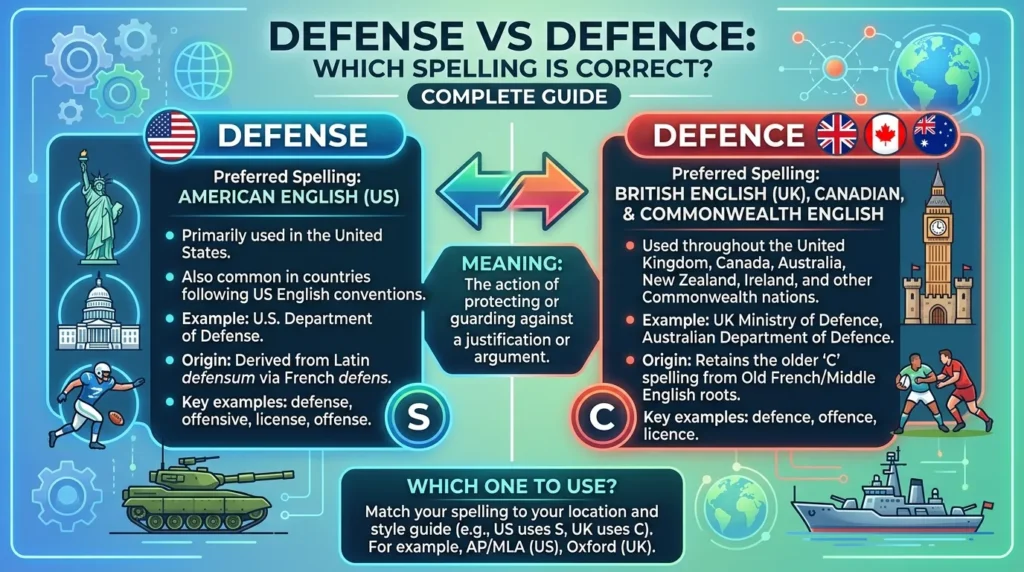
If you write for an American audience, defense is the standard spelling. If you write in British English, defence is normally correct. The same difference appears in words such as offense/offence and license/licence in some forms of English.
The good news is that there is no difference in meaning or pronunciation between defense and defence. The main difference is regional spelling.
In this guide, you will learn the difference between defense vs defence, where the two spellings came from, when to use each version, and how British and American English handle the spelling. You will also see practical examples from emails, news, sports, education, and formal writing. By the end, choosing the correct spelling for your audience will be simple.
Defense vs Defence – Quick Answer
Defense and defence are two spellings of the same English word.
- Defense = American English
- Defence = British English and commonly used in other varieties influenced by British English
Both mean protection against attack, harm, criticism, or danger.
Examples
American English:
The team needs a stronger defense.
British English:
The team needs a stronger defence.
Both sentences have the same meaning.
The word can be used in several contexts:
- Military: The country strengthened its defense.
- Sports: The team’s defense played well.
- Law: The defense presented its evidence.
- General: She spoke in defense of her friend.
In British English, these become:
- The country strengthened its defence.
- The team’s defence played well.
- The defence presented its evidence.
- She spoke in defence of her friend.
Defense vs Defence at a Glance
| Feature | Defense | Defence |
|---|---|---|
| Standard variety | American English | British English |
| Meaning | Protection | Protection |
| Pronunciation | Same | Same |
| Noun | Yes | Yes |
| Common in US | Yes | No |
| Common in UK | No | Yes |
| Sports usage | Common | Common |
| Military usage | Common | Common |
| Legal usage | Common | Common |
The Origin of Defense vs Defence
The difference between defense and defence comes from the history of English spelling.
Both forms can be traced to the Latin word defendere, meaning “to ward off” or “to protect.” The word entered English through Old French and developed into forms such as defense and defence.
Over time, English spelling developed differently in Britain and North America.
Why Does the S/C Difference Exist?
The main difference is the letter s in American spelling and c in British spelling:
- Defense → s
- Defence → c
This is not a difference in pronunciation. The two words are normally pronounced the same.
The spelling difference became more noticeable as American English developed its own spelling conventions.
American dictionaries and writers increasingly favored simpler or more standardized spellings in several areas. British English retained many traditional spellings influenced by French and historical usage.
Other Words With Similar Differences
The same regional pattern appears in several words:
| American English | British English |
|---|---|
| Defense | Defence |
| Offense | Offence |
| License | Licence |
| Practice | Practice |
| Analyze | Analyse |
| Organize | Organise |
However, not every word follows exactly the same pattern. For example, practice is normally the noun and verb in American English, while British English traditionally distinguishes practice as a noun and practise as a verb.
British English vs American English Spelling
The biggest difference between defense and defence is regional English.
American English generally uses -ense, while British English normally uses -ence for this pair.
American English
Use:
Defense
Examples:
- The defense was excellent.
- The defense lawyer questioned the witness.
- The country increased its defense budget.
- The football team’s defense stopped the attack.
British English
Use:
Defence
Examples:
- The defence was excellent.
- The defence lawyer questioned the witness.
- The country increased its defence budget.
- The football team’s defence stopped the attack.
Comparison Table
| Word | American English | British English |
|---|---|---|
| Defense/Defence | Defense | Defence |
| Offense/Offence | Offense | Offence |
| Defense system | Defense system | Defence system |
| Defense lawyer | Defense lawyer | Defence lawyer |
| Defensive | Defensive | Defensive |
| Defend | Defend | Defend |
Notice something important: not every related word changes spelling.
For example, both varieties normally use:
- Defend
- Defensive
- Defender
The main difference is the noun defense/defence.
Which Spelling Should You Use?
The correct spelling depends mainly on your audience.
Use “Defense” for American Audiences
Choose defense if you are writing for:
- The United States
- American schools
- American businesses
- US newspapers
- American websites
- US customers
- American sports audiences
For example:
The defense needs to improve before the next game.
Use “Defence” for British and Commonwealth Audiences
Choose defence when writing for audiences in places where British English is the standard or strongly established, including:
- United Kingdom
- Australia
- New Zealand
- Many Commonwealth contexts
For example:
The defence needs to improve before the next match.
What About Global Websites?
For a worldwide website, consistency is more important than choosing one spelling as universally “correct.”
If your website mainly targets American readers, use defense.
If it mainly targets British, Australian, or other British-English readers, use defence.
Do not switch randomly between the two forms within the same article.
Common Mistakes With Defense vs Defence
Many mistakes happen because writers know the meaning but are unsure about regional spelling.
Mistake 1: Mixing Both Spellings
❌ The team’s defence was strong, but its defense needs more training.
This can look inconsistent if both words refer to the same concept in the same variety of English.
Better:
✅ The team’s defense was strong, but its defense needs more training.
Or in British English:
✅ The team’s defence was strong, but its defence needs more training.
Mistake 2: Using “Defence” in American English
If your article is written specifically for a US audience, defense is the standard choice.
❌ The US defense department announced a new policy.
Actually, defense is the expected American spelling:
✅ The US defense department announced a new policy.
Mistake 3: Assuming One Spelling Is Wrong
It is incorrect to say that defence is simply a misspelling of defense, or vice versa.
Both are established English spellings.
The important question is:
Which English variety are you using?
Mistake 4: Changing Related Words Incorrectly
Some writers assume every word related to defense must change from s to c.
That is not correct.
Both British and American English use:
- Defend
- Defender
- Defensive
The major spelling difference here is defense vs defence.
Defense vs Defence in Everyday Examples
Understanding real examples makes the difference easier to remember.
In Emails
American English:
Our defense team will review the case.
British English:
Our defence team will review the case.
When writing professionally, use the spelling that matches your organization’s preferred English style.
In News Articles
American-style news writing may use:
The government announced a new defense policy.
British-style news writing may use:
The government announced a new defence policy.
Both sentences communicate the same idea.
In Sports
The difference is especially common in football and other sports.
American English:
The team’s defense made several important tackles.
British English:
The team’s defence made several important tackles.
The word defence is especially common in football writing influenced by British English.
In Legal Writing
American:
The defense presented its final argument.
British:
The defence presented its final argument.
The legal meaning remains the same.
In Social Media
Informal posts may contain either spelling depending on where the writer lives.
For example:
Our defense was incredible today!
or:
Our defence was incredible today!
The spelling often reflects the writer’s local English variety.
In Formal Writing
Always follow the style expected by your audience.
For a US academic paper:
The study examines national defense policy.
For a UK academic paper:
The study examines national defence policy.
Defense vs Defence – Google Trends & Usage Data
Search interest in defense vs defence comes largely from people trying to determine which spelling is correct.
The pattern generally follows regional English usage.
Where “Defense” Is Common
Defense is strongly associated with American English and is widely used in:
- United States
- American education
- US government writing
- American sports
- US business content
For example, searches involving American football often use defense, because American sports terminology follows American English spelling.
Where “Defence” Is Common
Defence is widely associated with British English and appears frequently in:
- United Kingdom
- British media
- British education
- Football writing
- Commonwealth English
Football articles often use defence because the sport’s terminology is strongly influenced by British English.
Search Context Matters
Someone searching for:
defense vs defence
may be looking for a simple spelling answer.
Another person may search:
defense or defence UK
because they specifically want to know which form is correct in British English.
Similarly:
defense or defence American English
usually points toward defense.
Usage Comparison
| Context | Preferred Spelling |
|---|---|
| US English | Defense |
| UK English | Defence |
| American football | Defense |
| British football writing | Defence |
| US legal writing | Defense |
| UK legal writing | Defence |
| American academic writing | Defense |
| British academic writing | Defence |
| Global content | Follow target audience |
| Formal business writing | Follow house style |
Defense vs Defence: Related Words
Learning related forms can help you remember the difference.
| Word | American English | British English |
|---|---|---|
| Noun | Defense | Defence |
| Verb | Defend | Defend |
| Adjective | Defensive | Defensive |
| Person | Defender | Defender |
| Opposite action | Offense | Offence |
| Related adjective | Offensive | Offensive |
The important point is that defend, defender, and defensive keep the same spelling in both major varieties.
Frequently Asked Questions About Defense vs Defence
Is defense or defence correct?
Both are correct. Defense is the standard American English spelling, while defence is the standard British English spelling.
Is defence British or American?
Defence is the standard British English spelling. It is also common in other varieties of English influenced by British usage.
Is defense American English?
Yes. Defense is the standard spelling in American English.
Do defense and defence have different meanings?
No. They have the same meaning and are pronounced the same in standard usage. The difference is mainly spelling.
Should I use defense or defence in an SEO article?
Use the spelling that matches your target audience. For US readers, use defense. For UK readers, use defence.
Is “defence” wrong in the United States?
It is not the standard American spelling, so defense is normally preferred in US writing.
Which spelling should I use in football articles?
It depends on your audience. Defence is common in British and international football writing, while defense is expected in American English.
Conclusion
The difference between defense vs defence is simple once you understand regional English spelling. Both words have the same meaning, pronunciation, and grammatical function. The main difference is where they are normally used.
Use defense when writing in American English, especially for readers in the United States. Use defence when following British English, including many British and Commonwealth contexts. Neither spelling is universally better or more correct than the other.
The most important rule is consistency. Once you choose an English variety for an article, website, school assignment, or business document, keep the spelling consistent throughout your work.
For SEO and professional writing, also consider your audience. If your readers are mainly American, defense is the natural choice. If they are mainly British, defence is better. Understanding this small spelling difference can make your writing look more accurate, polished, and professional.