
Imagine switching on an electric heater. Electrical current flows through its heating element, but the wire does not allow the current to pass freely. Instead, it opposes the flow of electric current, causing electrical energy to be converted into heat. This opposition is called resistance.
Understanding resistance meaning is essential for anyone studying or working with electricity. Electrical students need it to understand basic circuit analysis, while technicians and engineers use it when selecting cables, resistors, motors, heaters, and protective devices. Even beginners encounter resistance when using simple electrical appliances.
In electrical engineering, resistance helps control current, divide voltage, protect components, and convert electrical energy into useful forms. A resistor can prevent excessive current from damaging an LED, while the resistance of a heating element allows an appliance to produce heat.
In this guide, you will learn what resistance means, how it works, the different types of resistance, its important characteristics, advantages and disadvantages, applications, measurement methods, common problems, and modern developments. The goal is to make this basic but extremely important electrical concept easy to understand and apply.
2. What Is Resistance?
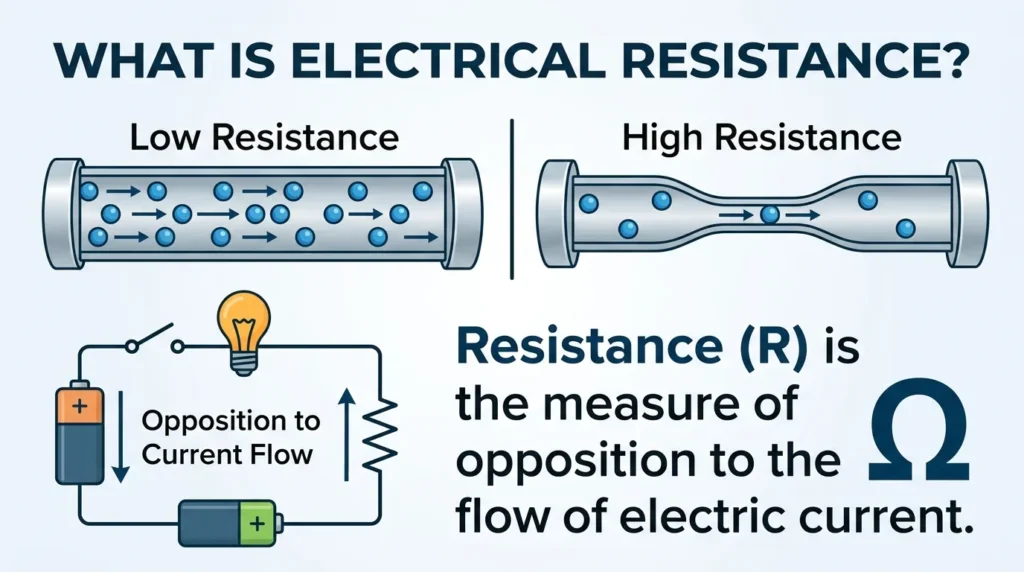
Resistance is the opposition offered by a material or electrical component to the flow of electric current.
The symbol used for resistance is R, and its SI unit is the ohm (Ω).
In simple words:
Resistance determines how difficult it is for electric current to flow through a circuit.
A material with high resistance restricts current more strongly, while a material with low resistance allows current to flow more easily.
Simple Practical Example
Consider two electrical wires.
One wire is made from copper, which has relatively low electrical resistance. Another wire is made from a material with much higher resistivity.
If the same voltage is applied across both wires, the wire with higher resistance will normally allow less current to flow.
This relationship is described by Ohm’s law:
V = I × R
Where:
- V = Voltage in volts (V)
- I = Current in amperes (A)
- R = Resistance in ohms (Ω)
The formula can also be rearranged:
R = V / I
For example, if a circuit has 12 V across a component and 2 A of current flows through it:
R = 12 / 2 = 6 Ω
Therefore, the resistance is 6 ohms.
3. Resistance Working Principle
The resistance working principle is based on the interaction between moving electrons and the material through which they travel.
When voltage is applied to a conductor, an electric field causes electrons to move. As electrons travel through the material, they interact with atoms and other particles. These interactions oppose the movement of charge and produce electrical resistance.
How Resistance Works Step by Step
- A voltage is applied to an electrical circuit.
- The voltage creates an electric field.
- Electrons begin moving through the conducting material.
- Electrons interact with atoms and imperfections in the material.
- These interactions oppose the movement of electrons.
- Electrical resistance limits the current.
- Some electrical energy is converted into heat.
This is why electrical components can become warm during operation.
A Simple Water Analogy
Think of electric current like water flowing through a pipe.
- Voltage is similar to water pressure.
- Current is similar to water flow.
- Resistance is similar to a restriction inside the pipe.
A wide, smooth pipe allows water to flow easily. A narrow or restricted pipe limits the flow.
Likewise, lower electrical resistance allows more current to flow for a given voltage, while higher resistance reduces current.
Resistance and Power
Resistance is also connected to electrical power.
The basic power equation is:
P = V × I
Using Ohm’s law, power can also be calculated as:
P = I²R
or
P = V²/R
These equations are important when selecting resistors, cables, heating elements, and other electrical components.
4. Types of Resistance
Resistance can be classified in several ways depending on the material, component, and electrical behavior.
Fixed Resistance
A fixed resistor has a resistance value that is designed to remain approximately constant during normal operation.
Examples include:
- 100 Ω resistor
- 1 kΩ resistor
- 10 kΩ resistor
Fixed resistors are commonly used for current limiting, voltage division, signal control, and circuit protection.
Variable Resistance
A variable resistor allows its resistance to be adjusted.
Common examples include:
- Potentiometers
- Rheostats
- Adjustable resistors
A potentiometer can be used to adjust voltage in an electronic circuit, while a rheostat is commonly used to control current.
Contact Resistance
Contact resistance occurs where two conductive surfaces meet.
For example, a switch, relay contact, terminal, or connector can have a small amount of resistance at its contact point.
Normally, this resistance should be very low. Poor connections, oxidation, dirt, or loose terminals can increase it.
High contact resistance can cause:
- Heating
- Voltage drop
- Power loss
- Equipment failure
Internal Resistance
Batteries and other electrical sources have internal resistance.
When current flows through a battery, some voltage is lost internally because of this resistance.
This explains why a battery’s terminal voltage can decrease when a heavy load is connected.
Resistance of Conductors
Every real conductor has some resistance.
The resistance of a conductor depends on several factors, including:
- Material
- Length
- Cross-sectional area
- Temperature
Copper and aluminum are commonly used as electrical conductors because their resistivity is relatively low.
5. Main Factors Affecting Resistance
Resistance does not depend only on the name of a material. Physical dimensions and temperature also matter.
The resistance of a uniform conductor can be calculated using:
R = ρL/A
Where:
- R = Resistance
- ρ = Resistivity of the material
- L = Length of conductor
- A = Cross-sectional area
Length
Resistance increases as conductor length increases.
A longer wire provides a longer path for electrons, resulting in greater resistance.
Cross-Sectional Area
Resistance decreases when the cross-sectional area increases.
A thicker conductor generally has lower resistance than a thinner conductor of the same material and length.
Material
Different materials have different resistivities.
For example, copper generally has much lower resistivity than many materials used specifically for resistance applications.
Temperature
For many metallic conductors, resistance increases as temperature rises.
This is important in motors, transformers, cables, heaters, and electrical panels because heating can affect electrical performance.
6. Main Components That Provide or Experience Resistance
Resistance is not a physical component by itself. It is an electrical property found in materials and components.
Resistor
A resistor is an electrical component specifically designed to provide a controlled amount of resistance.
Its functions include:
- Limiting current
- Dividing voltage
- Biasing electronic circuits
- Protecting sensitive components
- Producing controlled heat
Heating Element
Heating elements intentionally use resistance to convert electrical energy into heat.
They are found in:
- Electric heaters
- Ovens
- Water heaters
- Toasters
- Industrial heating equipment
Electrical Cable
A cable always has some resistance. Engineers must consider it when selecting conductor size because excessive resistance causes voltage drop and heating.
Switch and Contacts
Closed switches and electrical contacts should have very low resistance. Excessive contact resistance can indicate contamination, corrosion, mechanical wear, or a loose connection.
7. Advantages of Resistance
Resistance is not simply something that wastes electricity. Controlled resistance is extremely useful in electrical and electronic systems.
Current Control
Resistance can limit current to a safe value.
For example, a resistor can protect an LED from excessive current.
Voltage Division
Resistors can divide voltage into useful levels.
This principle is widely used in electronic circuits and measurement systems.
Electrical Protection
Properly selected resistance can help prevent excessive current from reaching sensitive components.
Heat Production
Resistance makes it possible to convert electrical energy into heat.
This is useful in heating appliances and industrial processes.
Circuit Control
Resistors are fundamental components in control, sensing, timing, and signal circuits.
Measurement
Resistance can be measured to identify the condition of wires, coils, heating elements, and other components.
8. Disadvantages and Limitations of Resistance
Resistance is useful, but unwanted resistance can cause problems.
Power Loss
Resistance causes electrical energy to be converted into heat.
In power systems, unnecessary resistance can result in energy losses.
Voltage Drop
A resistive cable can produce a voltage drop when current flows through it.
Large voltage drops can prevent equipment from operating correctly.
Heating
Excessive resistance can produce unwanted heat.
Loose electrical connections are a common example. A poor connection may develop high contact resistance and become dangerously hot.
Reduced Efficiency
In electrical distribution systems, conductor resistance contributes to energy losses.
Temperature Dependence
Resistance can change with temperature, making some measurements and circuits less stable.
9. Resistance Applications
Resistance has applications in almost every area of electrical engineering.
Home Applications
Resistance is used in:
- Electric heaters
- Ovens
- Toasters
- Water heaters
- Light circuits
- Electronic appliances
- Fan speed controls
- Battery-powered devices
Industrial Applications
Industry uses resistance in:
- Motor control
- Industrial heaters
- Welding equipment
- Control panels
- Testing equipment
- Electrical protection
- Automation systems
- Temperature measurement
Electronics
Electronic circuits use resistors for:
- Current limiting
- Voltage division
- Signal conditioning
- Transistor biasing
- Pull-up and pull-down circuits
- Timing networks
- Sensor circuits
Modern Technology
Resistance also plays an important role in:
- Battery management
- Electric vehicles
- Renewable energy systems
- Power electronics
- Semiconductor devices
- Smart sensors
- Automated industrial systems
10. Resistance vs Resistivity
Resistance and resistivity are related but they are not the same thing.
| Feature | Resistance | Resistivity |
|---|---|---|
| Symbol | R | ρ |
| Unit | Ohm (Ω) | Ohm-metre (Ω·m) |
| Depends on | Material and physical dimensions | Material property |
| Affected by length | Yes | No directly |
| Affected by area | Yes | No directly |
| Example | Resistance of a cable | Resistivity of copper |
Resistance describes how strongly a particular object opposes current.
Resistivity describes how strongly a material itself resists current.
This distinction is important when comparing different conductor materials.
11. Difference Between Resistance and Impedance
Resistance and impedance are often confused.
| Feature | Resistance | Impedance |
|---|---|---|
| Symbol | R | Z |
| Common unit | Ohm | Ohm |
| Used in | DC and AC circuits | Mainly AC circuits |
| Includes | Resistive opposition | Resistance plus reactance |
| Depends on frequency | Normally not for an ideal resistor | Often yes |
| Example | Heating element | AC motor winding |
In a simple DC resistive circuit, resistance is the main opposition to current.
In an AC circuit containing inductors or capacitors, the total opposition to current is described by impedance.
12. How to Choose the Right Resistance
Choosing the correct resistance depends on the application.
Before selecting a resistor or conductor, consider:
1. Resistance Value
Determine the required resistance using the appropriate circuit formula.
2. Power Rating
Check how much power the resistor will dissipate.
A resistor must have a suitable power rating to prevent overheating.
3. Voltage Rating
The component must withstand the voltage applied across it.
4. Tolerance
Tolerance indicates how much the actual resistance may differ from its rated value.
5. Temperature
Consider the operating temperature because resistance can change with temperature.
6. Physical Size
High-power resistors may require larger bodies or additional cooling.
Beginner’s Tip
Never select a resistor based only on its resistance value. Resistance, power rating, voltage rating, tolerance, and operating conditions should all be considered.
13. Common Resistance Problems and Solutions
Why Does a Wire Have High Resistance?
Possible causes include:
- Wire is too thin
- Wire is too long
- Poor material
- Damaged conductor
- High operating temperature
- Corroded connection
Use an appropriately sized conductor and inspect connections carefully.
Why Is an Electrical Connection Heating?
High contact resistance can produce heat.
Check for:
- Loose terminals
- Corrosion
- Damaged connectors
- Incorrect terminal size
- Poor crimping
Always isolate electrical equipment safely before inspecting connections.
Why Is There Excessive Voltage Drop?
Excessive voltage drop can result from:
- Long cable runs
- Undersized conductors
- High current
- Poor connections
- Excessive resistance
Selecting the correct cable size and maintaining good connections can reduce unwanted voltage drop.
How Is Resistance Measured?
A multimeter can measure resistance using its ohms function.
For a basic resistance measurement:
- Switch off and isolate the circuit.
- Make sure the component is not energized.
- Select the appropriate resistance range.
- Connect the meter probes across the component.
- Read the displayed resistance.
Never use resistance mode on a live circuit unless the instrument and procedure specifically permit it.
14. Future Trends in Resistance Technology
Resistance technology continues to develop alongside modern electronics and power systems.
Advanced materials are being developed for applications requiring:
- Higher temperature stability
- Greater precision
- Lower unwanted resistance
- Better thermal performance
- Smaller component sizes
- Improved reliability
Electric vehicles and renewable energy systems are also increasing demand for efficient power electronics and accurate sensing.
Modern battery systems use resistance measurements and related electrical parameters to monitor battery condition, temperature, charging behavior, and performance.
Smart sensors and industrial automation are further expanding the importance of precise resistance measurement.
For electrical professionals, the basic concept remains the same: understanding resistance provides a foundation for working with increasingly advanced electrical technology.
15. Conclusion
Resistance is one of the most fundamental concepts in electrical engineering. It describes the opposition to electric current and is measured in ohms (Ω). Understanding resistance helps electrical students and technicians analyze circuits, select components, diagnose faults, and design safer electrical systems.
Resistance depends on factors such as material, conductor length, cross-sectional area, and temperature. Controlled resistance is useful for current limiting, voltage division, heating, measurement, and circuit protection. Unwanted resistance, however, can cause voltage drop, energy loss, overheating, and equipment problems.
Learning the difference between resistance and resistivity, as well as resistance and impedance, is especially important as you move into advanced electrical subjects. Once these basic concepts become clear, topics such as motors, transformers, electronics, power systems, and control circuits become much easier to understand.