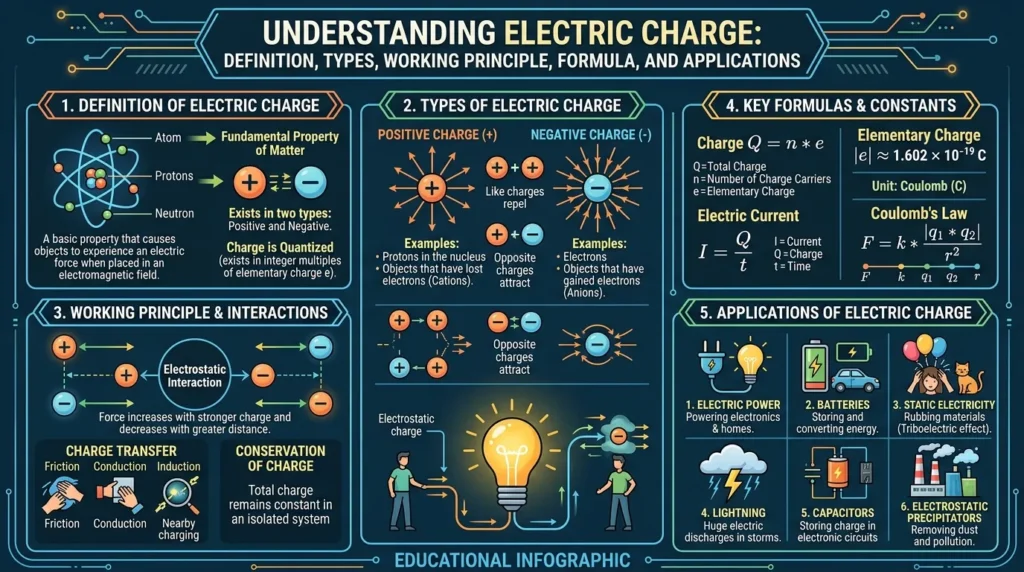

When you rub a plastic comb against dry hair, the comb may attract small pieces of paper. You may also notice a tiny spark after walking across a carpet and touching a metal object. These simple events happen because of electric charge.
Electric charge is one of the most basic concepts in electrical engineering. Before understanding voltage, current, resistance, capacitance, electric fields, or electrical circuits, it is important to understand what charge is and how it behaves.
In simple terms, electric charge is a physical property of matter that causes electrical attraction and repulsion. It exists in two forms: positive charge and negative charge. The movement of charge through a conductor is closely related to electric current.
For electrical students, technicians, and engineers, understanding electric charge provides the foundation for studying both static electricity and practical electrical systems. It also helps explain how batteries, capacitors, electronic devices, motors, and power systems operate.
In this article, you will learn the electric charge meaning, its types, working principle, formula, important properties, applications, advantages and limitations, common problems, and its role in modern electrical technology.
2. What Is Electric Charge?
Electric charge is a physical property of matter that causes it to experience electrical forces.
Electric charge is represented by the symbol Q and its SI unit is the coulomb (C).
There are two basic types of electric charge:
- Positive charge
- Negative charge
Particles such as protons carry positive charge, while electrons carry negative charge. In ordinary electrical conductors, electrons are the particles that move from one location to another.
A Simple Explanation
Imagine two objects carrying electrical charges.
If they have the same type of charge, they tend to repel each other.
If they have opposite charges, they tend to attract each other.
Therefore:
- Positive + Positive → Repulsion
- Negative + Negative → Repulsion
- Positive + Negative → Attraction
This attraction and repulsion are fundamental electrical effects.
Practical Example
When a balloon is rubbed against hair, electrons can transfer between the two materials. The balloon may become negatively charged and then attract hair or small pieces of paper.
This is an example of static electricity.
Electric Charge Formula
The basic relationship between charge and current is:
Q = I × t
Where:
- Q = Electric charge in coulombs
- I = Current in amperes
- t = Time in seconds
For example, if a current of 2 A flows for 5 seconds:
Q = 2 × 5 = 10 C
Therefore, 10 coulombs of charge have passed through the circuit during that period.
3. Electric Charge Working Principle
The electric charge working principle is based on the interaction and movement of charged particles.
Matter contains atoms. An atom normally contains:
- Protons
- Neutrons
- Electrons
Protons have positive charge, electrons have negative charge, and neutrons have no net electric charge.
How Charge Behaves
The process can be understood in simple steps:
- Matter contains charged particles.
- Protons normally remain within the atomic nucleus.
- Electrons can move more easily in many materials.
- When electrons move from one object to another, the objects can become electrically charged.
- Charged objects create electrical forces around them.
- These forces can attract or repel other charged objects.
Charge in a Conductor
In metals such as copper and aluminum, some electrons are relatively free to move.
When an electrical potential difference is applied across a conductor, these electrons acquire a net drift direction. This movement of charge produces electric current.
Water Analogy
A useful beginner analogy is water flowing through a pipe.
Think of electric charge as the quantity of water and electric current as the rate at which water flows.
This is not a perfect physical comparison, but it helps explain the relationship:
Current = Charge ÷ Time
Therefore:
I = Q/t
A higher current means more charge passes a point in a given amount of time.
4. Types and Classification of Electric Charge
Electric charge can be classified in several useful ways.
Positive Charge
An object is positively charged when it has a net deficiency of electrons.
A positive charge does not mean the object has created extra protons. In ordinary electrical processes, positive charging generally occurs because electrons have been removed.
Negative Charge
An object becomes negatively charged when it has a net excess of electrons.
For example, when an insulating material gains additional electrons through friction, it can become negatively charged.
Neutral Charge
An electrically neutral object has no net charge.
This does not mean the object contains no charged particles. It means its positive and negative charges balance overall.
Static Charge
Static charge is charge that remains accumulated on an object rather than continuously flowing through a conducting path.
Examples include:
- Static electricity on clothing
- A charged balloon
- Small sparks after walking on a carpet
Static charge can suddenly discharge when a suitable path becomes available.
Moving Charge
When electric charge moves through a conductive path, it produces electric current.
This is the type of charge movement commonly encountered in electrical circuits.
5. Main Components and Properties of Electric Charge
Electric charge itself is a property rather than a device or physical component. However, several particles and concepts are directly associated with it.
Electrons
Electrons carry negative electric charge.
In metallic conductors, electrons are primarily responsible for electrical conduction.
The charge of one electron is approximately:
−1.602 × 10⁻¹⁹ C
Protons
Protons carry positive electric charge.
The magnitude of a proton’s charge is approximately:
+1.602 × 10⁻¹⁹ C
Neutrons
Neutrons have no net electric charge.
They are located in the atomic nucleus along with protons.
Electric Field
A charged object produces an electric field around it.
The electric field describes how another charge would experience an electrical force at a particular location.
Coulomb’s Law
The force between two point charges can be described by Coulomb’s law:
F = k |Q₁Q₂| / r²
Where:
- F = Electrical force
- Q₁ and Q₂ = Charges
- r = Distance between the charges
- k = Coulomb’s constant
The equation shows that electrical force increases with charge magnitude and decreases rapidly as distance increases.
Conservation of Charge
One of the most important properties of electric charge is that electric charge is conserved.
Charge cannot simply be created or destroyed in ordinary electrical processes. It can be transferred from one object or location to another.
6. Advantages and Importance of Electric Charge
Electric charge is not normally described as having “advantages” in the same way as a device. However, its behavior makes modern electrical technology possible.
Enables Electric Current
The movement of charge forms the basis of electric current.
Makes Electrical Circuits Possible
Electrical circuits depend on controlled movement of charge through conductive paths.
Supports Energy Transfer
Moving charges allow electrical energy to be transferred from sources to loads.
Enables Electronic Devices
Charge behavior is fundamental to:
- Diodes
- Transistors
- Integrated circuits
- Sensors
- Microprocessors
Enables Energy Storage
Capacitors store electrical energy through charge separation.
Supports Communication
Electronic communication systems depend on controlled electrical charges and electromagnetic effects.
7. Disadvantages and Limitations of Electric Charge
Electric charge itself is fundamental to nature, but uncontrolled charge can create practical problems.
Static Electricity
Static charge can damage sensitive electronic components.
Electrostatic discharge, or ESD, is a major concern when handling circuit boards and semiconductor devices.
Electrical Shock
If charge moves through the human body under dangerous conditions, it can cause electric shock and injury.
Sparks and Ignition
Accumulated static charge can discharge suddenly and produce a spark.
In environments containing flammable gases, vapors, or dust, appropriate electrical safety controls are essential.
Insulation Problems
If unwanted charge movement occurs through damaged insulation, leakage current or electrical faults can develop.
Difficult Measurement at Very Small Scales
Individual electric charges are extremely small, so direct observation and measurement at microscopic scales require specialized equipment.
8. Electric Charge Applications
Electric charge is involved in almost every area of electrical and electronic technology.
Home Applications
Electric charge is involved whenever household devices operate, including:
- Lighting
- Fans
- Refrigerators
- Televisions
- Computers
- Chargers
- Electrical switches
When a circuit is completed, charge moves through the conductive path and allows the connected equipment to operate.
Industrial Applications
Industrial electrical systems use charge movement in:
- Motors
- Transformers
- Generators
- Control systems
- Sensors
- Automation equipment
- Power electronics
Capacitors
Capacitors store separated electric charges.
They are used for:
- Filtering
- Energy storage
- Power factor correction
- Motor starting
- Signal processing
Electronics
Charge behavior is central to semiconductor devices.
Transistors control electrical signals by controlling charge movement within semiconductor materials.
Electrostatic Applications
Controlled static charge is used in technologies such as:
- Photocopiers
- Laser printers
- Electrostatic painting
- Air filtration
- Particle separation
Modern Technology
Electric charge also plays an important role in:
- Batteries
- Electric vehicles
- Solar cells
- Sensors
- Microelectronics
- Nanotechnology
9. Difference Between Electric Charge and Electric Current
Beginners often confuse electric charge with electric current.
Electric charge is the quantity of electricity associated with charged particles.
Electric current is the rate at which electric charge flows.
The relationship is:
I = Q/t
| Feature | Electric Charge | Electric Current |
|---|---|---|
| Meaning | Quantity of electric charge | Rate of charge flow |
| Symbol | Q | I |
| Unit | Coulomb (C) | Ampere (A) |
| Time dependence | Can exist without continuous flow | Represents charge flow over time |
| Example | 20 C of charge | 4 A current |
For example, if 20 C of charge passes through a conductor in 5 seconds:
I = 20/5 = 4 A
Therefore, the current is 4 amperes.
10. Selection Guide: Understanding Charge in Practical Systems
You normally do not “select” electric charge like you select a cable or motor. Instead, electrical professionals evaluate charge-related quantities when designing and troubleshooting systems.
Identify the Circuit Type
Determine whether you are working with:
- DC
- AC
- Static electricity
- Electronic circuits
- High-voltage systems
Calculate Charge Flow
If current and time are known, use:
Q = I × t
This is useful when calculating charge transferred through a circuit.
Consider the Material
Different materials behave differently.
- Metals generally allow charge to move easily.
- Insulators strongly restrict charge movement.
- Semiconductors have controllable electrical behavior.
Consider Insulation
For practical systems, proper insulation prevents unwanted charge movement and helps protect people and equipment.
Consider Static Control
When working with sensitive electronics, use appropriate ESD protection such as grounding procedures and suitable anti-static equipment.
11. Common Problems and Solutions
Why Does Static Electricity Build Up?
Static charge often develops when two materials contact and separate or rub against each other, causing electrons to transfer.
Dry environments can make static effects more noticeable.
Why Does a Small Spark Occur?
A spark can occur when a voltage difference becomes large enough for the surrounding air to conduct temporarily.
The accumulated charge then discharges rapidly.
Why Does Current Flow in a Circuit?
Current flows when there is a suitable conductive path and an electrical potential difference that drives charge movement.
The actual behavior depends on the circuit components and their electrical properties.
Why Do Electronics Need ESD Protection?
Sensitive semiconductor devices can be damaged by electrostatic discharge even when the discharge is not obvious to a person.
Technicians therefore use grounding and ESD-safe handling procedures when working with sensitive components.
Can Electric Charge Be Destroyed?
In ordinary electrical processes, total electric charge is conserved.
Charge can move between objects, redistribute within a system, or be transferred through a circuit, but it is not simply destroyed.
12. Future Trends in Electric Charge Technology
The study and control of electric charge remain important as electrical and electronic technology becomes smaller, faster, and more efficient.
Advanced Semiconductors
Modern semiconductor devices increasingly depend on precise control of charge at very small scales.
Electric Vehicles
Electric vehicles rely on controlled movement and storage of electrical charge within batteries, inverters, charging systems, and motors.
Battery Technology
Research into new battery materials aims to improve charge storage, charging speed, safety, lifetime, and energy density.
Nanotechnology
At very small scales, engineers can manipulate charge to develop advanced sensors, electronic devices, and materials.
Smart Sensors
Modern sensors detect changes in electrical, physical, chemical, or environmental conditions through controlled charge behavior.
Power Electronics
Improved semiconductor technology allows engineers to control electrical charge more efficiently in converters, inverters, chargers, and motor drives.
These developments make a strong understanding of electric charge increasingly valuable for electrical and electronics professionals.
13. Conclusion
Electric charge is a fundamental property of matter and the foundation of electrical science. It exists as positive and negative charge, while electrically neutral objects have balanced positive and negative charges overall. The movement of charge through a conductor is closely related to electric current.
The basic relationship Q = I × t helps electrical students and technicians calculate the amount of charge transferred through a circuit. Understanding the difference between electric charge and electric current also prevents one of the most common beginner mistakes.
Electric charge is essential in batteries, capacitors, motors, generators, electronic circuits, sensors, semiconductor devices, and power systems. At the same time, uncontrolled charge can cause static discharge, electrical shocks, and equipment damage.
For anyone learning electrical engineering, mastering electric charge is an important first step toward understanding voltage, current, electric fields, capacitance, and more advanced electrical concepts.