
Imagine you are repairing a broken mobile charger or assembling a small electronic circuit for a college project. You connect the wires carefully, but they still need a strong electrical joint to work properly. This is where a soldering iron becomes an essential tool.
A soldering iron is one of the most commonly used tools in electrical and electronics work. It helps create reliable electrical connections between wires, components, and circuit boards. Without proper soldering, many electronic devices such as televisions, computers, and mobile phones would not function correctly.
For electrical students, engineers, technicians, and hobbyists, understanding the soldering iron working principle and proper usage is extremely important. A well-soldered joint ensures good electrical conductivity and mechanical strength.
In this article, you will learn everything about a soldering iron, including its definition, working principle, types, components, applications, advantages and disadvantages. You will also learn how to choose the right soldering iron and solve common problems during soldering work.advantages of using a portable soldering iron.Portable soldering irons are widely used in electronics and electrical work because they offer flexibility, convenience, and efficiency, especially when working outside a fixed workshop. One of the main advantages of using a portable soldering iron is its mobility. Unlike traditional soldering stations that require a constant power source, portable soldering irons can often run on batteries, USB power, or small adapters, allowing users to work anywhere. This makes them ideal for field repairs, on-site maintenance, and situations where electricity is not easily available.
Another important advantage is convenience and ease of use. Portable soldering irons are usually lightweight and compact, making them easy to carry in a toolbox or even a pocket. This is especially helpful for technicians, engineers, and hobbyists who need to move between different locations. Because of their small size, they are also easier to handle in tight spaces or when working on small electronic components like circuit boards.
Quick heating is another benefit. Many modern portable soldering irons heat up very fast, often within a few seconds. This saves time and improves productivity, especially when multiple soldering tasks need to be completed quickly. Some models also come with adjustable temperature control, allowing users to work safely on different types of components without damaging them.
Energy efficiency is also a key advantage. Portable soldering irons consume less power compared to larger soldering stations, which makes them suitable for battery operation and reduces overall energy usage. This is particularly useful for quick repairs and small tasks.
Safety features in many portable models add to their benefits. Features like automatic shut-off, temperature regulation, and insulated handles help reduce the risk of burns and accidents. Additionally, some portable soldering irons are designed to be environmentally friendly, using less energy and producing minimal heat waste.
Finally, portability encourages flexibility in work environments. Whether repairing wires, fixing electronic devices, or working on DIY projects, a portable soldering iron allows users to perform tasks anytime and anywhere without being limited to a specific workspace.
What is a Soldering Iron?
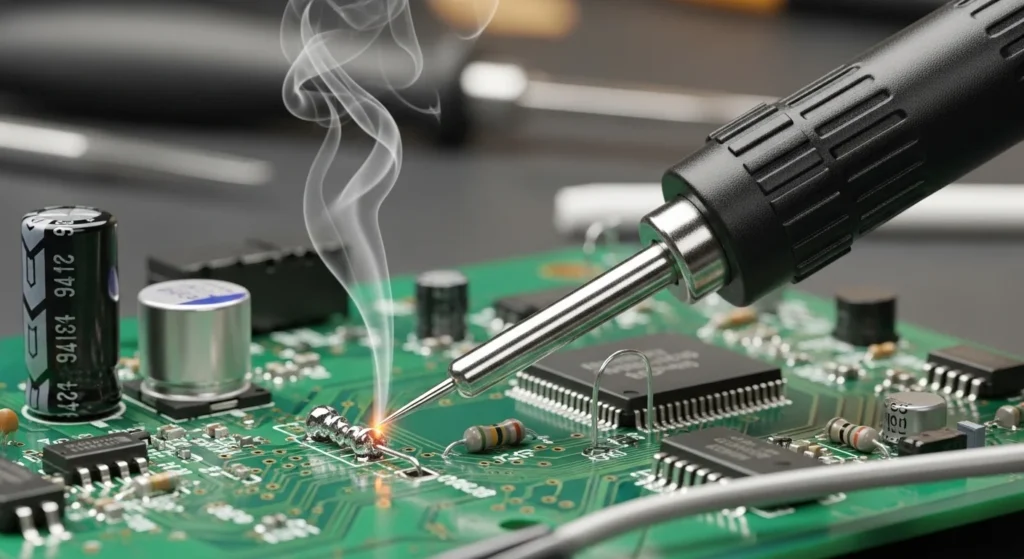
A soldering iron is a handheld electrical tool used to melt solder (a metal alloy) in order to join two or more electrical components together.
In simple terms, a soldering iron works like a small heated pen that melts solder so that electrical connections can be formed between wires or electronic components.
The solder melts when it touches the heated tip of the soldering iron. Once it cools down, it solidifies and forms a strong electrical and mechanical connection.
Practical Example
Suppose an electrical technician wants to connect a resistor to a printed circuit board (PCB). The technician heats the joint using a soldering iron and applies solder. The melted solder flows around the connection and creates a secure bond.
This is a basic example of how soldering irons are used in electronics repair and manufacturing.
Soldering Iron Working Principle
The soldering iron working principle is based on converting electrical energy into heat energy.
This heat melts solder, which then joins electronic components together.
Step-by-Step Working Process
- Electric power supplyThe soldering iron is connected to a power source, usually AC mains electricity.
- Heating element activationInside the soldering iron there is a heating element. When electricity flows through it, heat is produced due to electrical resistance.
- Heat transfer to tipThe heat generated by the heating element is transferred to the metal tip of the soldering iron.
- Melting the solderWhen the heated tip touches the solder wire, the solder melts and flows over the joint.
- Formation of solder jointAfter removing the soldering iron, the molten solder cools and solidifies, creating a strong electrical connection.
Simple Analogy
You can think of a soldering iron like a hot glue gun. Just as glue melts and sticks materials together, solder melts and connects electronic components.
Types of Soldering Iron
Different types of soldering irons are available depending on the application and level of precision required.
4.1 Pencil Soldering Iron: Features, Working, Advantages, and Applications (2026)
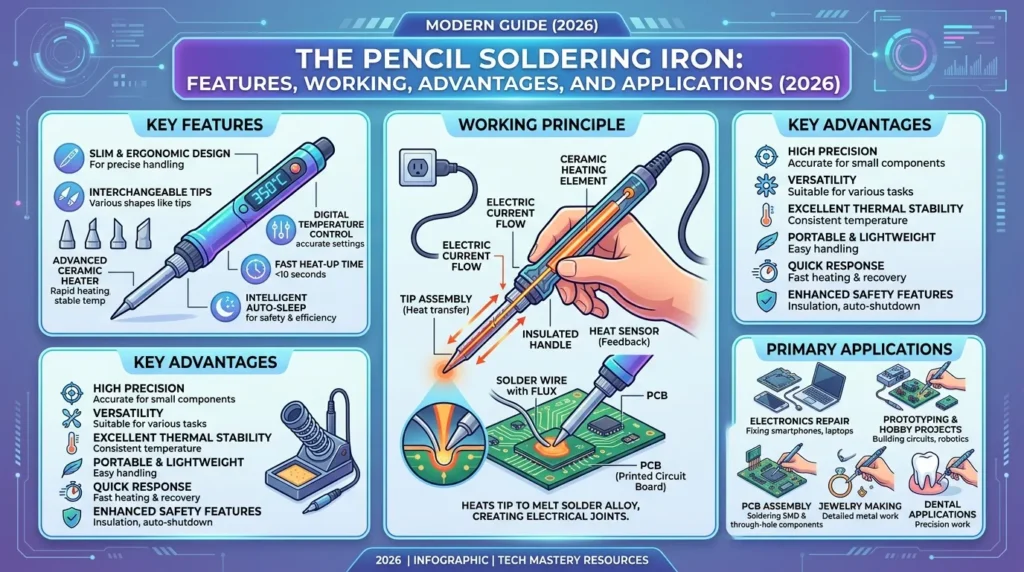
A Pencil Soldering Iron is the most common and widely used type of soldering iron for electronics, electrical repairs, and DIY projects. It is named after its slim, pencil-like shape, which makes it lightweight, comfortable to hold, and easy to control during soldering.
This type of soldering iron contains an internal heating element that continuously heats the metal tip when connected to an electrical power source. The heated tip melts solder, allowing it to flow between metal surfaces and create a strong electrical and mechanical connection.
Because of its simple design, low cost, and ease of use, the pencil soldering iron is an excellent choice for beginners, students, hobbyists, and professional technicians performing small to medium-sized soldering tasks.
Working Principle
When the soldering iron is plugged into a power supply, electricity flows through the internal heating element. The element converts electrical energy into heat, which is transferred to the metal tip. Once the tip reaches the required temperature, solder wire melts on contact and flows over the joint, creating a secure connection between electrical components.
The iron continues to heat as long as it remains connected to the power source, maintaining a constant operating temperature.
Key Features
A pencil soldering iron offers several practical features:
- Slim, lightweight, and easy-to-handle design.
- Continuous heating while connected to power.
- Quick heat-up time.
- Available in various power ratings (such as 20W, 30W, 40W, and 60W).
- Suitable for precision soldering work.
- Easy tip replacement on many models.
- Affordable and widely available.
Advantages
Pencil soldering irons provide several benefits:
- Simple operation for beginners.
- Low purchase cost.
- Lightweight and comfortable for extended use.
- Reliable performance for everyday soldering tasks.
- Suitable for repairing small electronic devices.
- Requires minimal maintenance.
- Available in different tip shapes for various applications.
Limitations
Despite its advantages, this type also has some limitations:
- Temperature is fixed on basic models.
- Can overheat delicate electronic components if used improperly.
- Requires time to cool after use.
- Not ideal for heavy-duty industrial soldering.
- Continuous heating increases power consumption.
Applications
Pencil soldering irons are widely used in many electrical and electronic applications.
Common applications include:
- PCB (Printed Circuit Board) soldering.
- Electronic circuit assembly.
- Mobile phone and computer repairs.
- DIY electronics projects.
- Electrical wiring repairs.
- Hobby and educational projects.
- School and engineering laboratories.
- Small household appliance repairs.
Key Takeaway
A Pencil Soldering Iron is a simple, affordable, and easy-to-use soldering tool that heats continuously while connected to an electrical power source. Its lightweight design, reliable performance, and suitability for electronic repairs, PCB assembly, educational training, and DIY projects make it one of the most popular soldering irons for beginners and professional technicians alike.
4.2 Temperature-Controlled Soldering Iron: Features, Working, Advantages, and Applications (2026)
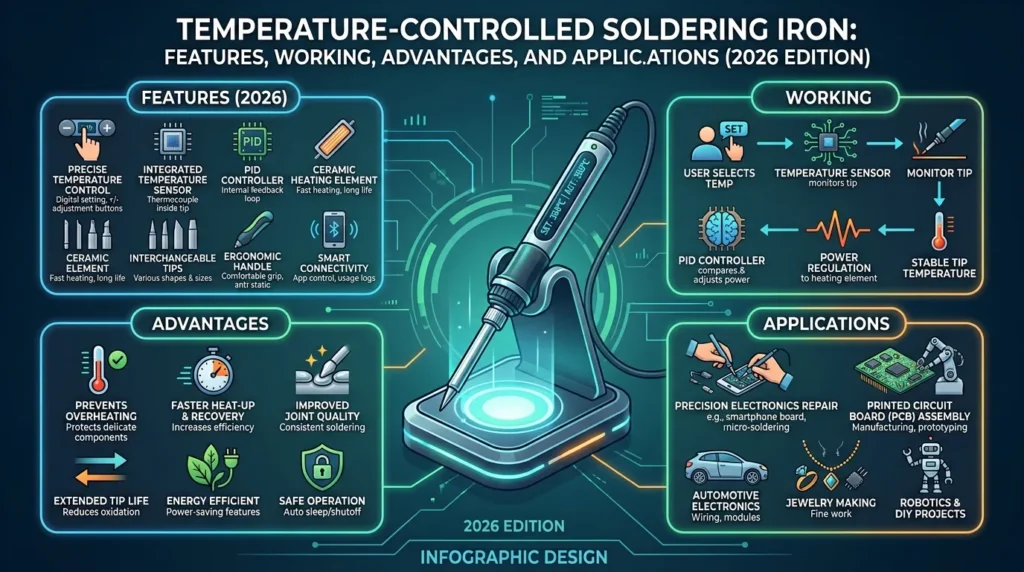
A Temperature-Controlled Soldering Iron is an advanced type of soldering iron that allows the user to adjust and maintain the tip temperature according to the soldering task. Unlike a standard pencil soldering iron, which heats continuously at a fixed temperature, this tool uses an electronic temperature control system to keep the tip at the selected temperature.
By maintaining a stable temperature, it prevents overheating and protects delicate electronic components from heat damage. This makes it an excellent choice for professional technicians, electronics engineers, repair centers, and precision soldering applications.
Working Principle
When the soldering iron is connected to a power source, the internal heating element begins to heat the soldering tip. A built-in temperature sensor (thermostat or electronic sensor) continuously monitors the tip temperature and sends feedback to the control circuit.
If the temperature drops while soldering, the controller automatically supplies more power to the heating element. Once the selected temperature is reached, it reduces or cuts the power to maintain a constant temperature. This automatic regulation ensures consistent soldering quality and protects sensitive components from excessive heat.
Key Features
A temperature-controlled soldering iron offers several advanced features:
- Adjustable temperature for different soldering tasks.
- Maintains a stable and accurate tip temperature.
- Prevents overheating of electronic components.
- Fast heating and quick temperature recovery.
- Suitable for precision soldering work.
- Available with digital or analog temperature controls.
- Compatible with various interchangeable soldering tips.
- Provides consistent soldering performance.
Advantages
Temperature-controlled soldering irons provide several important benefits:
- Excellent control over soldering temperature.
- Reduces the risk of damaging sensitive electronic parts.
- Produces cleaner and more reliable solder joints.
- Improves soldering accuracy and efficiency.
- Suitable for both leaded and lead-free solder.
- Extends the life of soldering tips.
- Ideal for continuous professional use.
Limitations
Despite its advantages, this type also has some limitations:
- More expensive than a standard pencil soldering iron.
- Slightly more complex to operate for beginners.
- Requires proper temperature settings for different applications.
- Electronic control circuits may require occasional maintenance.
- Higher initial investment compared to basic soldering irons.
Applications
Temperature-controlled soldering irons are widely used where precision and temperature accuracy are essential.
Common applications include:
- Printed Circuit Board (PCB) assembly.
- Electronic device manufacturing.
- Mobile phone and laptop repair.
- Computer motherboard repair.
- Surface Mount Device (SMD) soldering.
- Electrical maintenance work.
- Research and development laboratories.
- Engineering colleges and technical training institutes.
- Professional electronics repair centers.
Key Takeaway
A Temperature-Controlled Soldering Iron is a precision soldering tool that automatically regulates the tip temperature to provide consistent heating and prevent overheating. Its adjustable temperature settings, accurate control, and reliable performance make it ideal for PCB assembly, electronic repairs, SMD soldering, and professional electrical work. Although it costs more than a standard soldering iron, its superior precision, safety, and soldering quality make it the preferred choice for technicians and engineers.
4.3 Soldering Station: Features, Working, Advantages, and Applications (2026)
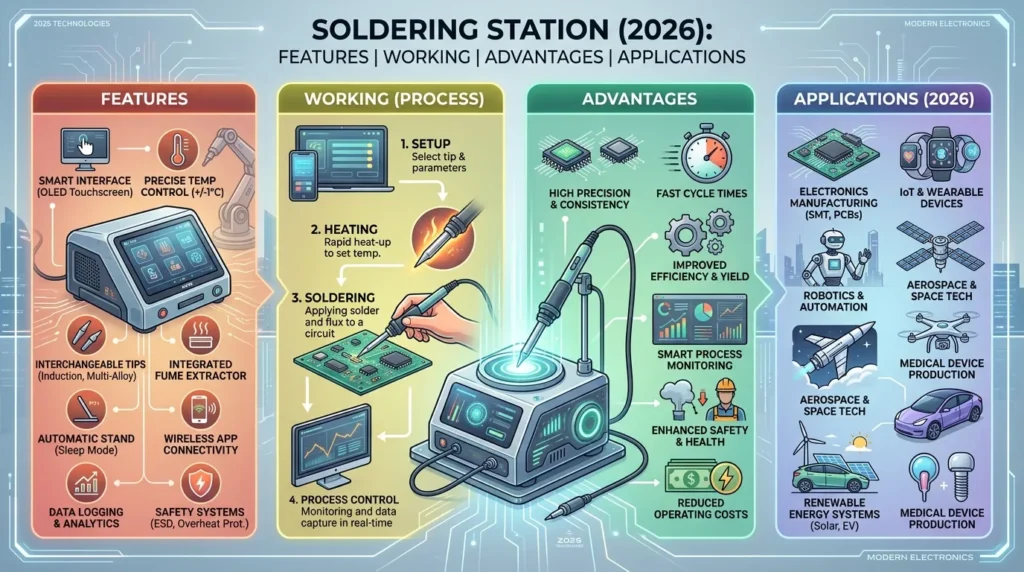
A Soldering Station is a professional soldering system that consists of a temperature-controlled soldering iron connected to a separate control unit (base station). The control unit allows users to accurately set, monitor, and maintain the desired tip temperature, providing greater precision than a standard soldering iron.
Because of its excellent temperature stability, fast heat recovery, and advanced features, a soldering station is widely used in electronics manufacturing, repair centers, engineering laboratories, research facilities, and industrial production. It is the preferred choice for professionals who require consistent, high-quality soldering results.
Working Principle
A soldering station operates by supplying electrical power from the control unit to the soldering iron’s heating element. The control unit contains an electronic temperature controller and a sensor that continuously monitors the tip temperature.
When the tip temperature falls below the selected value during soldering, the controller automatically increases power to the heating element. Once the desired temperature is reached, it reduces the power to maintain a constant temperature. This closed-loop control system ensures accurate heating and prevents overheating of sensitive electronic components.
Key Features
A soldering station offers several advanced features that improve soldering performance and user convenience.
- Adjustable and precise temperature control.
- Fast heating and rapid temperature recovery.
- Stable tip temperature during continuous operation.
- Digital or analog temperature display.
- Interchangeable soldering tips for different applications.
- Ergonomic and lightweight soldering iron.
- Built-in safety features on many models.
- Suitable for long hours of professional use.
Advantages
Soldering stations provide numerous benefits compared to ordinary soldering irons.
- Excellent temperature accuracy and stability.
- Produces clean, strong, and reliable solder joints.
- Prevents overheating of delicate electronic components.
- Improves soldering speed and efficiency.
- Extends the life of soldering tips.
- Suitable for precision electronic work.
- Comfortable for continuous use in professional environments.
- Supports a wide variety of soldering applications.
Limitations
Despite its many advantages, a soldering station also has some limitations.
- Higher purchase cost than standard soldering irons.
- Requires more workspace due to the control unit.
- Less portable than compact soldering irons.
- Beginners may need time to learn temperature settings.
- Some advanced models require periodic calibration.
Applications
Soldering stations are widely used in industries and technical environments where precision and reliability are essential.
Common applications include:
- Printed Circuit Board (PCB) assembly.
- Surface Mount Device (SMD) soldering.
- Mobile phone, laptop, and computer repair.
- Consumer electronics manufacturing.
- Industrial electronic equipment maintenance.
- Research and development laboratories.
- Engineering colleges and technical training institutes.
- Electrical repair workshops.
- Quality control and prototype development.
Key Takeaway
A Soldering Station is a professional temperature-controlled soldering system that provides accurate heat control, stable performance, and excellent soldering quality. Its adjustable temperature, rapid heat recovery, and precision make it ideal for PCB assembly, electronics manufacturing, repair work, laboratory applications, and industrial maintenance. Although it is more expensive than a basic soldering iron, its superior performance, safety, and reliability make it an essential tool for professional technicians and engineers.
4.4 Cordless Soldering Iron: Features, Working, Advantages, and Applications (2026)
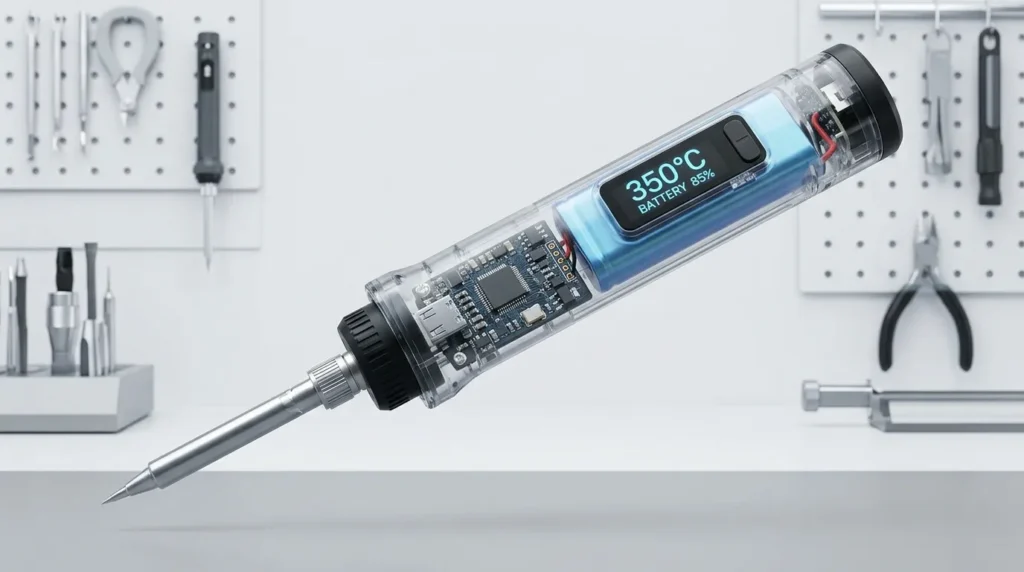
A Cordless Soldering Iron is a portable soldering tool that operates without a direct electrical power connection. Instead of using a power cord, it is powered by rechargeable batteries or butane gas, allowing users to perform soldering tasks in locations where electricity is unavailable.
Its lightweight, compact, and portable design makes it an excellent choice for field service engineers, electricians, technicians, automotive repairs, emergency maintenance, and DIY enthusiasts. Cordless soldering irons are especially useful for on-site repairs and outdoor applications where mobility is essential.
Working Principle
A cordless soldering iron generates heat using either a rechargeable battery-powered heating element or a butane gas heating system.
- Battery-powered models use rechargeable lithium-ion batteries to supply electricity to the heating element, which heats the soldering tip.
- Gas-powered models burn butane gas inside a small chamber to produce heat, which is transferred to the soldering tip.
Once the tip reaches the required temperature, solder melts and forms a strong electrical and mechanical connection between metal surfaces.
Key Features
Cordless soldering irons offer several practical features:
- Operates without a power cord.
- Powered by rechargeable batteries or butane gas.
- Lightweight and highly portable.
- Fast heating on most modern models.
- Easy to carry for fieldwork.
- Compact design for working in confined spaces.
- Suitable for emergency and outdoor repairs.
- Available in different power capacities and tip designs.
Advantages
Cordless soldering irons provide several important benefits:
- Excellent portability and convenience.
- Can be used where electrical power is unavailable.
- Ideal for outdoor and on-site repair work.
- Easy to transport in a toolbox.
- Quick setup without extension cords.
- Suitable for emergency maintenance.
- Provides greater freedom of movement during soldering.
Limitations
Despite their portability, cordless soldering irons also have some limitations:
- Limited operating time due to battery or gas capacity.
- Lower power compared to professional soldering stations.
- Rechargeable batteries require periodic charging.
- Gas models require butane refilling.
- Temperature control may be less precise on basic models.
- Not ideal for continuous heavy-duty industrial work.
Applications
Cordless soldering irons are widely used in situations where portability is more important than continuous operation.
Common applications include:
- Field electrical maintenance.
- Automotive electrical repairs.
- Outdoor electrical installations.
- Emergency repair work.
- Home appliance servicing.
- Telecommunications equipment maintenance.
- DIY electronics projects.
- Remote construction sites.
- Mobile repair services.
- Hobby and craft projects.
Key Takeaway
A Cordless Soldering Iron is a portable soldering tool powered by rechargeable batteries or butane gas, making it ideal for fieldwork, outdoor repairs, emergency maintenance, automotive servicing, and remote electrical installations. Its portability, ease of use, and independence from mains electricity make it a valuable tool for technicians and engineers who frequently work on-site, although it is generally less suitable for long-duration, heavy-duty soldering tasks than a soldering station.
4.5 Soldering Gun: Features, Working, Advantages, and Applications (2026)
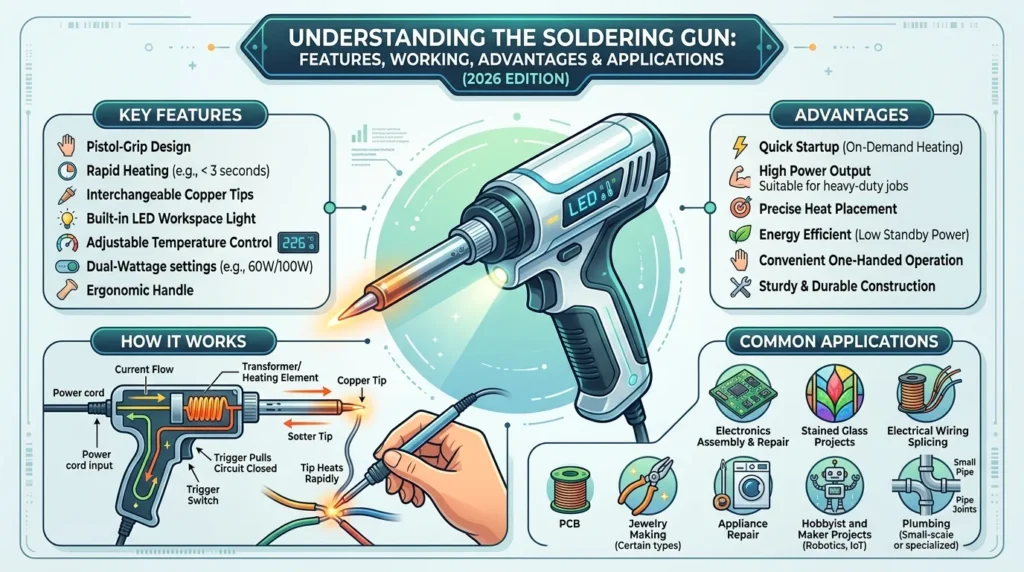
A Soldering Gun is a high-power soldering tool designed for heavy-duty electrical and metal soldering applications. Unlike a standard soldering iron, a soldering gun heats up within a few seconds after the trigger is pressed, allowing users to complete soldering tasks quickly and efficiently.
Its high heat output makes it ideal for soldering thick wires, large electrical connectors, metal terminals, stained glass work, automotive wiring, and heavy electrical components. Because it delivers a large amount of heat in a short time, it is commonly used by electricians, maintenance technicians, and industrial professionals.
Working Principle
A soldering gun operates using a built-in transformer and a trigger switch. When the trigger is pressed, electrical current flows through the transformer, which supplies a high current to the copper soldering tip.
The resistance of the copper tip causes it to heat rapidly, reaching the required soldering temperature within a few seconds. Once the trigger is released, the power is cut off, and the tip begins to cool. This quick heating and cooling cycle makes the soldering gun highly efficient for intermittent soldering tasks.
Key Features
A soldering gun offers several useful features:
- Rapid heating within a few seconds.
- High power output for heavy-duty soldering.
- Trigger-operated heating control.
- Comfortable pistol-grip design.
- Replaceable copper soldering tip.
- Suitable for thick wires and large terminals.
- Durable construction for frequent use.
- Available in various power ratings, such as 100W, 150W, and 200W.
Advantages
Soldering guns provide several important benefits:
- Heats up much faster than standard soldering irons.
- Produces high temperatures for heavy electrical work.
- Ideal for soldering large conductors and connectors.
- Saves time during repair and maintenance tasks.
- Easy to operate with trigger-controlled heating.
- Reduces unnecessary power consumption because it heats only when the trigger is pressed.
- Strong and durable for professional use.
Limitations
Despite its advantages, a soldering gun also has some limitations:
- Too powerful for delicate electronic components.
- Not suitable for precision PCB or SMD soldering.
- Heavier than a pencil soldering iron.
- Large tip limits work in confined spaces.
- Continuous heavy use may cause the tip to wear more quickly.
Applications
Soldering guns are widely used for heavy electrical and maintenance work.
Common applications include:
- Joining thick electrical wires.
- Soldering heavy-duty cable terminals.
- Automotive electrical repairs.
- Household electrical appliance repairs.
- Transformer and motor wiring.
- Stained glass soldering.
- Sheet metal and metal fabrication work.
- Industrial electrical maintenance.
- Workshop and field repair operations.
Key Takeaway
A Soldering Gun is a high-power, fast-heating soldering tool designed for heavy-duty electrical repairs and large soldering applications. Its trigger-operated heating system, rapid heat-up time, and ability to solder thick wires and large connectors make it an excellent choice for electricians, maintenance technicians, automotive mechanics, and industrial professionals. However, because of its high heat output, it is generally not recommended for delicate electronic circuit boards or precision soldering tasks.
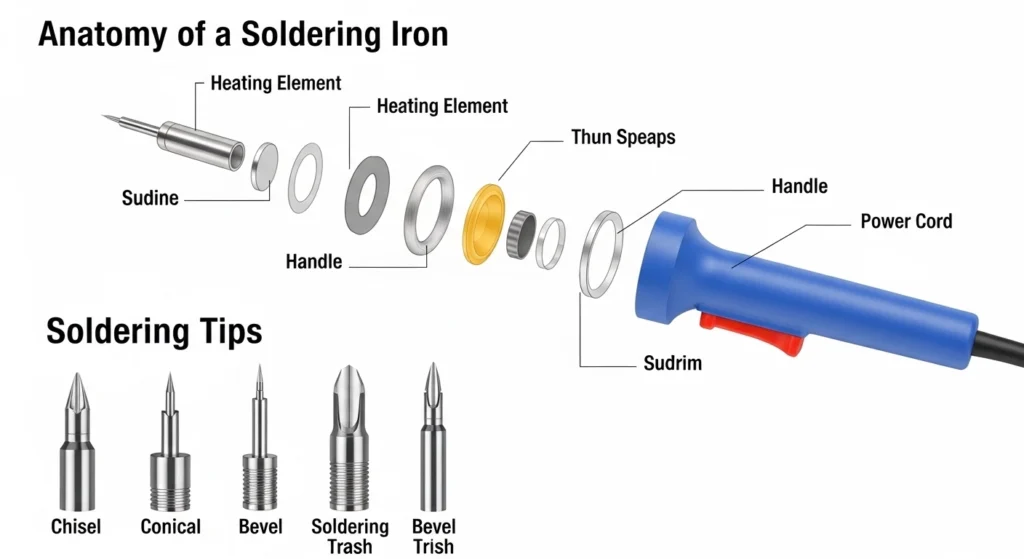
5. Main Components of a Soldering Iron (2026)
A soldering iron consists of several important components that work together to generate heat and create strong, reliable solder joints. Each part performs a specific function to ensure safe, efficient, and precise soldering. Understanding these components helps technicians, electricians, and beginners operate and maintain a soldering iron correctly.
5.1 Heating Element
The heating element is the core component of a soldering iron. It converts electrical energy into heat energy, which is then transferred to the soldering tip. Modern heating elements are typically made from high-resistance materials such as ceramic or nichrome wire, allowing them to withstand high temperatures and provide consistent heating.
Functions
- Converts electrical energy into heat.
- Heats the soldering tip rapidly.
- Maintains a stable operating temperature.
- Ensures efficient heat transfer during soldering.
Importance
A high-quality heating element provides faster heat-up time, better temperature stability, improved energy efficiency, and a longer service life.
5.2 Soldering Tip
The soldering tip is the metal end of the soldering iron that comes into direct contact with the solder and the workpiece. It transfers heat from the heating element to melt the solder and create a strong electrical and mechanical connection.
Soldering tips are usually made of copper with protective coatings such as iron plating, which improves durability and reduces corrosion.
Common Tip Shapes
- Conical tip for precision work.
- Chisel tip for general-purpose soldering.
- Bevel tip for larger solder joints.
- Knife tip for drag soldering.
- Fine-point tip for SMD components.
Functions
- Transfers heat to the solder.
- Melts solder efficiently.
- Creates accurate and reliable solder joints.
- Supports different soldering applications through interchangeable tip designs.
5.3 Handle
The handle is the part held by the user during soldering. It is designed to provide a comfortable grip while protecting the user from the high temperatures generated by the heating element.
Most handles are made from heat-resistant plastic, silicone, or rubber, ensuring safe and comfortable operation during long working hours.
Functions
- Provides a safe and comfortable grip.
- Insulates the user’s hand from heat.
- Improves control and precision.
- Reduces hand fatigue during extended use.
5.4 Power Cord
The power cord supplies electrical energy from the power outlet to the soldering iron. It must be durable, flexible, and properly insulated to ensure safe operation.
Some modern soldering stations use detachable cords for easier maintenance and replacement.
Functions
- Connects the soldering iron to the power supply.
- Delivers electrical power to the heating element.
- Provides reliable and continuous operation.
- Ensures safe transmission of electricity.
5.5 Temperature Controller
A temperature controller is found in advanced soldering irons and soldering stations. It allows users to set and maintain the desired tip temperature based on the type of soldering work being performed.
The controller continuously monitors the tip temperature and automatically adjusts the heating power to maintain a stable temperature, preventing overheating and protecting sensitive electronic components.
Functions
- Adjusts the operating temperature.
- Maintains constant tip temperature.
- Prevents overheating.
- Improves soldering quality and precision.
- Extends the life of soldering tips and heating elements.
5.6 Indicator Light (Optional)
Many modern soldering irons include an indicator light that shows when the tool is connected to power or actively heating.
Functions
- Indicates power status.
- Shows when the heating element is operating.
- Helps improve user safety.
- Makes operation more convenient.
5.7 Protective Stand (Accessory)
Although not a permanent part of the soldering iron, a soldering iron stand is an essential accessory used to safely hold the hot iron when it is not in use.
Functions
- Holds the hot soldering iron safely.
- Prevents accidental burns.
- Protects work surfaces from heat damage.
- Reduces the risk of fire or accidents.
Key Takeaway
The main components of a soldering iron include the heating element, soldering tip, handle, power cord, temperature controller, indicator light, and protective stand. Each component plays a vital role in ensuring safe operation, efficient heat transfer, precise soldering, and long-term reliability. Understanding these parts enables technicians and beginners to use, maintain, and troubleshoot soldering irons more effectively while achieving high-quality solder joints.
Advantages of a Soldering Iron
The soldering iron advantages and disadvantages should be understood before using the tool.
A soldering iron is one of the most important tools used in electrical and electronics work, especially for joining wires and components securely. One of the main advantages of a soldering iron is its ability to create strong and reliable electrical connections. When solder melts and cools, it forms a solid bond between components, ensuring proper current flow and long-lasting performance. This is very important in electronic circuits where loose connections can cause faults or complete system failure.
Another key advantage is precision and control. A soldering iron allows technicians to work on very small components, such as resistors, capacitors, and integrated circuits, without damaging nearby parts. This makes it ideal for circuit board work, repairs, and detailed electronic projects. It also provides a clean and professional finish, which improves both the appearance and reliability of the circuit.
Soldering irons are also easy to use and cost-effective. They are affordable tools and require minimal setup, making them suitable for beginners, students, and professionals alike. With basic training, anyone can learn to use a soldering iron effectively. Additionally, they are portable and lightweight, allowing technicians to carry them easily for on-site repairs and maintenance work.
Another important benefit is versatility. Soldering irons can be used in a wide range of applications, including repairing electronic devices, assembling circuit boards, fixing wires, and even in DIY projects. They are essential in industries such as electronics manufacturing, electrical maintenance, and telecommunications. Moreover, soldering provides low-resistance connections, which improves the efficiency of electrical circuits and reduces energy loss.
Safety is also improved when using a soldering iron correctly. Properly soldered joints reduce the risk of sparks, overheating, and short circuits. Finally, soldering irons support long-term durability of electrical connections. Once a joint is properly soldered, it can last for many years without needing frequent maintenance.
Overall, a soldering iron is a simple yet powerful tool that offers reliability, precision, affordability, and versatility. It plays a crucial role in modern electrical and electronic work, making it an essential tool for students, engineers, and technicians.
Advantages
- Provides strong electrical connections
- Simple and easy to use
- Affordable and widely available
- Essential for electronics repair
- Portable and lightweight
- Suitable for precise electronic work
- Used in both small repairs and large manufacturing
Because of these benefits, soldering irons are used by professionals and beginners alike.
Disadvantages / Limitations
A soldering iron, while very useful, also has several disadvantages and limitations that users should understand. One of the main drawbacks is the risk of burns and injuries. A soldering iron operates at high temperatures, usually between 300°C to 400°C, which can easily cause skin burns if handled carelessly. This makes it necessary to follow proper safety precautions, especially for beginners and students.
Another limitation is the requirement of skill and practice. Although soldering may look simple, creating strong and clean joints requires proper technique. Beginners often face problems like cold joints, excess solder, or weak connections. Poor soldering can lead to circuit failure, short circuits, or unreliable performance. Therefore, training and experience are important for effective use.
Soldering irons also have limited use on certain materials. They work well with electronic components and small wires, but they are not suitable for heavy-duty electrical connections or large industrial applications. In such cases, other methods like welding or crimping are more effective. Additionally, solder joints may become weak under mechanical stress or vibration, which can cause connections to break over time.
Another disadvantage is heat damage to components. Sensitive electronic parts such as integrated circuits can be damaged if exposed to excessive heat for too long. This requires careful temperature control and quick working techniques. Moreover, soldering produces fumes and gases, which can be harmful if inhaled continuously. Proper ventilation is necessary to avoid health risks.
Maintenance is also a concern. The soldering iron tip can wear out, oxidize, or become dirty, which affects performance. Regular cleaning and replacement are required to maintain efficiency. Furthermore, soldering irons depend on a power source, which can limit their use in areas without electricity unless battery-powered models are used.
Lastly, soldering is generally a permanent connection method, which means it is not easy to modify or remove components without reheating and reworking the joint. This can make repairs more time-consuming.
Overall, while soldering irons are essential tools, their limitations include safety risks, skill requirements, heat sensitivity, and maintenance needs. Understanding these disadvantages helps users work more safely and effectively.
Despite its usefulness, a soldering iron also has some limitations.
- Requires proper skill to avoid poor joints
- Risk of burns due to high temperature
- Overheating may damage electronic components
- Not suitable for very large metal joining tasks
- Requires ventilation due to solder fumes
Understanding these limitations helps technicians work safely and efficiently.
Applications of a Soldering Iron
A soldering iron is one of the most widely used hand tools in electronics, electrical work, manufacturing, and repair industries. It is designed to join metal components by melting solder, creating strong and reliable electrical or mechanical connections. From simple DIY projects to advanced industrial production, soldering irons play a vital role in countless applications.
Electronics Repair and Maintenance
One of the most common uses of a soldering iron is repairing electronic devices. Technicians use it to replace damaged components, reconnect broken circuits, and restore malfunctioning equipment.
Common Electronics Repairs Include:
- Mobile phones and smartphones.
- Desktop and laptop computers.
- Televisions and LED displays.
- Chargers and power adapters.
- Audio systems and speakers.
- Gaming consoles.
- Home appliances.
- Wearable electronic devices.
Printed Circuit Board (PCB) Assembly
Soldering irons are essential for assembling and repairing printed circuit boards (PCBs). Electronic components such as resistors, capacitors, integrated circuits (ICs), LEDs, and connectors are soldered securely onto the board to create functional electronic circuits.
PCB Applications:
- Prototype circuit development.
- PCB repair and modification.
- Educational electronics projects.
- Consumer electronics manufacturing.
- Embedded system development.
Electrical Wiring and Cable Connections
Electricians and technicians use soldering irons to create secure electrical connections between wires, terminals, switches, and connectors. Proper soldering improves electrical conductivity and helps prevent loose or unreliable connections.
Common Electrical Applications:
- Joining electrical wires.
- Repairing damaged cable connections.
- Soldering connectors and terminals.
- Automotive electrical repairs.
- Battery pack assembly.
- Sensor and control system wiring.
DIY Electronics and Hobby Projects
Students, hobbyists, and makers frequently use soldering irons to build and experiment with electronic circuits. Soldering is a fundamental skill for learning electronics and developing innovative projects.
Popular DIY Projects:
- Arduino and Raspberry Pi projects.
- Robotics and automation systems.
- LED lighting circuits.
- Electronic kits.
- RC cars, drones, and model electronics.
- Smart home prototypes.
Industrial Electronics Manufacturing
Large-scale electronics manufacturers use soldering equipment to assemble thousands of electronic products every day. While automated soldering machines handle mass production, manual soldering irons are still used for precision work, inspections, repairs, and quality control.
Industrial Applications:
- Consumer electronics manufacturing.
- Telecommunications equipment.
- Medical electronic devices.
- Industrial control systems.
- Aerospace and defense electronics.
- Automotive electronic modules.
Automotive Electronics
Modern vehicles contain numerous electronic systems that require reliable soldered connections. Technicians use soldering irons during diagnostics, repairs, and custom electrical installations.
Automotive Uses:
- Wiring harness repairs.
- Sensor replacement.
- ECU (Electronic Control Unit) repairs.
- Car audio system installation.
- LED lighting upgrades.
- Dashboard electronics maintenance.
Telecommunications and Networking
Soldering irons are widely used in communication systems to repair and assemble networking equipment, communication devices, and signal transmission components.
Examples Include:
- Network switches and routers.
- Communication modules.
- Fiber optic equipment.
- Radio communication devices.
- Signal processing circuits.
Educational and Training Laboratories
Schools, colleges, universities, and technical institutes use soldering irons to teach students practical electronics skills. Hands-on soldering experience helps learners understand circuit assembly, troubleshooting, and electrical safety.
Educational Applications:
- Electronics laboratory experiments.
- Engineering workshops.
- Vocational training.
- Technical certification programs.
- STEM education projects.
Renewable Energy Systems
Soldering irons are also used in renewable energy applications for assembling and maintaining electrical connections in modern energy systems.
Common Uses:
- Solar panel wiring.
- Charge controller repairs.
- Battery management systems.
- Small wind energy circuits.
- Energy monitoring devices.
Overall, the soldering iron is an indispensable tool used across electronics repair, PCB assembly, electrical wiring, automotive systems, telecommunications, education, industrial manufacturing, renewable energy, and DIY electronics, making it one of the most versatile tools in electrical and electronic engineering.
Difference Between Soldering Iron and Soldering Gun
Understanding the difference between soldering iron and soldering gun helps in selecting the correct tool.
| Feature | Soldering Iron | Soldering Gun |
|---|---|---|
| Shape | Pen-like design | Pistol-like design |
| Heating Time | Slower heating | Very fast heating |
| Power | Lower power | Higher power |
| Applications | Electronics work | Heavy electrical connections |
| Precision | High precision | Less precise |
Both tools are useful, but soldering irons are generally preferred for delicate electronic work.
Soldering Iron Buying Guide: How to Choose the Right Soldering Iron
Choosing the right soldering iron is essential for achieving clean, reliable, and professional solder joints. The best soldering iron depends on the type of work you perform, whether it’s electronics repair, PCB assembly, electrical wiring, DIY projects, or heavy-duty soldering. Factors such as power, temperature control, tip compatibility, comfort, and safety all play an important role in selecting the right tool.
Choose the Right Power Rating
Power rating determines how quickly a soldering iron heats up and how well it maintains temperature during use.
Recommended Power Ratings:
- 15W–30W: Small electronic components and delicate circuit boards.
- 30W–60W: General electronics repair, hobby projects, and PCB soldering.
- 60W–100W: Electrical wiring, connectors, and medium-duty soldering tasks.
- 100W and above: Heavy-duty industrial work, large cables, and metal soldering.
Selecting the correct wattage ensures efficient heat transfer without damaging the workpiece.
Look for Adjustable Temperature Control
A soldering iron with adjustable temperature control offers greater precision and versatility. Different solder types and electronic components require different temperatures, making temperature adjustment an essential feature for professional work.
Benefits of Temperature Control:
- Prevents overheating of sensitive electronic components.
- Produces stronger and cleaner solder joints.
- Extends the life of soldering tips.
- Suitable for a wide variety of soldering applications.
Select the Appropriate Soldering Tip
Different soldering jobs require different tip shapes and sizes. Using the correct tip improves heat transfer, accuracy, and overall soldering quality.
Common Tip Types:
- Conical (Pointed) Tip: Precision electronics and small components.
- Chisel Tip: General-purpose soldering and PCB work.
- Flat Tip: Larger terminals and wire connections.
- Bevel Tip: Surface-mount devices (SMD) and drag soldering.
- Knife Tip: Cutting, desoldering, and specialized applications.
Choose a soldering iron that supports easily replaceable tips for greater flexibility.
Consider Heating Technology
Modern soldering irons use advanced heating elements that provide faster heating and better temperature stability.
Popular Heating Technologies:
- Ceramic heating elements for quick heat-up and consistent performance.
- Induction heating systems for professional applications.
- Rapid heat recovery technology for continuous soldering.
Check Ergonomics and Comfort
Comfort is important, especially during long soldering sessions. A well-designed soldering iron improves control and reduces hand fatigue.
Features to Look For:
- Lightweight construction.
- Ergonomic, non-slip handle.
- Heat-resistant grip.
- Well-balanced design for precise control.
Evaluate Safety Features
Safety should always be a priority when working with high-temperature tools.
Important Safety Features:
- Heat-resistant insulated handle.
- Stable soldering iron stand.
- Automatic sleep mode or auto shut-off.
- Electrical insulation and grounding protection.
- Heat-resistant power cord.
- Protective tip cover for storage.
Corded vs Cordless Soldering Irons
Choose a soldering iron based on where and how you plan to work.
Corded Soldering Iron
- Continuous power supply.
- Ideal for workshops and professional use.
- Consistent temperature performance.
Cordless Soldering Iron
- Battery-powered and highly portable.
- Suitable for field repairs and remote work.
- Convenient for quick soldering jobs.
Choose a Trusted Brand
Well-known manufacturers typically provide better quality, durability, replacement tips, warranty support, and reliable temperature control. Investing in a reputable brand often results in better long-term performance and lower maintenance costs.
Consider Your Skill Level
Your experience level also influences the best soldering iron for your needs.
- Beginners: A 30W–60W soldering iron with adjustable temperature and interchangeable tips is usually the best choice.
- Intermediate Users: Temperature-controlled soldering stations offer improved precision and flexibility.
- Professionals: High-performance soldering stations with digital temperature control, rapid heat recovery, and advanced safety features provide the best results for continuous use.
By considering power rating, temperature control, tip compatibility, heating technology, comfort, safety, portability, and intended application, you can choose a soldering iron that delivers reliable performance, longer service life, and high-quality soldering results for both hobby and professional projects.
Common Soldering Problems and Their Solutions
Even experienced technicians can encounter soldering issues during electronics repair or circuit assembly. Most problems are caused by incorrect temperature settings, poor soldering techniques, contaminated tips, or improper maintenance. Understanding these common problems and their solutions helps create strong, reliable, and long-lasting solder joints.
Why Is the Solder Not Melting Properly?
If the solder does not melt easily, the soldering iron may not be transferring enough heat to the joint.
Possible Causes:
- Soldering iron temperature is too low.
- Dirty, oxidized, or worn-out soldering tip.
- Poor contact between the tip and the workpiece.
- Low-power soldering iron for a large component.
- Incorrect type of solder being used.
Solution:
- Increase the temperature to the recommended range for the solder type.
- Clean and tin the soldering tip before use.
- Ensure the tip touches both the component lead and PCB pad.
- Use a higher-wattage soldering iron for larger joints.
- Always use quality solder and compatible flux.
Why Does the Solder Joint Look Dull or Grainy?
A dull, rough, or grainy solder joint is commonly known as a cold solder joint. It forms when the solder does not melt and flow properly, resulting in a weak electrical and mechanical connection.
Possible Causes:
- Insufficient heating.
- Movement of the joint before the solder solidifies.
- Dirty or oxidized surfaces.
- Inadequate flux.
Solution:
- Reheat the joint until the solder flows smoothly.
- Allow the joint to cool naturally without movement.
- Clean the component leads and PCB pads before soldering.
- Apply fresh solder and flux if necessary.
Why Is the Soldering Tip Turning Black?
A black soldering tip is usually caused by oxidation, which reduces heat transfer and makes soldering more difficult.
Possible Causes:
- Continuous exposure to high temperatures.
- Failure to clean the tip regularly.
- Leaving the soldering iron on for long periods.
- Lack of proper tip maintenance.
Solution:
- Clean the tip using a brass wool cleaner or a damp sponge.
- Re-tin the tip with fresh solder after cleaning.
- Use the lowest effective working temperature.
- Replace the tip if oxidation becomes severe.
Why Are Electronic Components Overheating?
Sensitive electronic components can be damaged if exposed to excessive heat for too long during soldering.
Possible Causes:
- Temperature setting is too high.
- Prolonged heating of the component.
- Incorrect soldering technique.
- Poor heat transfer requiring extended contact time.
Solution:
- Use the recommended temperature for the component.
- Complete each solder joint within a few seconds.
- Use temperature-controlled soldering stations.
- Allow components to cool between repeated soldering attempts.
Why Is Solder Bridging Between PCB Pins?
Solder bridges occur when excess solder accidentally connects two adjacent pins or PCB tracks, creating an unwanted electrical short circuit.
Solution:
- Use the correct amount of solder.
- Apply a finer soldering tip for small components.
- Remove excess solder with desoldering braid or a solder sucker.
- Inspect the PCB carefully before powering it on.
Why Won’t the Solder Stick to the Metal Surface?
Sometimes solder beads up instead of bonding to the workpiece.
Possible Causes:
- Dirty or greasy surfaces.
- Oxidized component leads.
- Insufficient heating.
- Lack of flux.
Solution:
- Clean all metal surfaces before soldering.
- Apply suitable flux.
- Heat both joining surfaces evenly.
- Use high-quality solder designed for electronics.
Future Trends in Soldering Technology
As electronic devices become smaller, smarter, and more complex, soldering technology continues to evolve. Modern innovations are improving precision, safety, efficiency, and environmental sustainability across electronics manufacturing and repair industries.
Smart Digital Temperature Control
Modern soldering stations now feature digital temperature displays, intelligent heat regulation, and rapid temperature recovery. These systems maintain stable temperatures, improving solder joint quality while protecting sensitive electronic components from overheating.
Lead-Free Solder Technology
Environmental regulations such as RoHS (Restriction of Hazardous Substances) have accelerated the adoption of lead-free solder alloys. These environmentally friendly materials reduce health risks while maintaining reliable electrical connections in modern electronic devices.
Automated Robotic Soldering Systems
Large-scale electronics manufacturers increasingly rely on robotic soldering systems to produce consistent, high-quality solder joints. Automation improves production speed, reduces human error, and enhances quality control in mass manufacturing.
Portable and Cordless Soldering Tools
Advancements in battery technology have led to lightweight cordless soldering irons with fast heat-up times, adjustable temperatures, and longer operating life. These tools are ideal for field service engineers, maintenance technicians, and mobile repair professionals.
AI and Smart Manufacturing
Artificial intelligence and machine vision are beginning to improve soldering quality by automatically detecting defects, optimizing soldering parameters, and monitoring production processes in real time. This results in greater manufacturing efficiency and fewer defective products.
Miniaturization and Precision Soldering
As electronic devices continue to shrink, soldering equipment is becoming more precise. Modern soldering stations support the assembly and repair of tiny surface-mount devices (SMDs), microchips, and high-density printed circuit boards used in smartphones, medical equipment, and advanced computing systems.
Sustainable and Energy-Efficient Equipment
Future soldering tools are expected to consume less energy while delivering higher performance. Manufacturers are also developing recyclable materials, eco-friendly production methods, and energy-saving soldering stations to support sustainable electronics manufacturing.
The future of soldering technology is focused on greater precision, smarter automation, improved safety, environmental sustainability, and higher manufacturing efficiency, ensuring reliable electrical connections for the next generation of electronic products.
Conclusion
A soldering iron is an essential tool for anyone working with electrical or electronic systems. It allows technicians and engineers to create strong electrical connections between wires and electronic components.
Understanding the soldering iron working principle, types, components, and applications helps users perform soldering tasks more effectively. From simple electronic repairs to complex circuit board assembly, soldering irons play a critical role in modern technology.
While the tool offers many benefits, users must also understand the soldering iron advantages and disadvantages and follow proper safety practices. Choosing the correct soldering iron and maintaining it properly ensures reliable results.
For electrical students and beginners, learning proper soldering techniques is a valuable skill that will be useful in many technical fields and real-world applications.