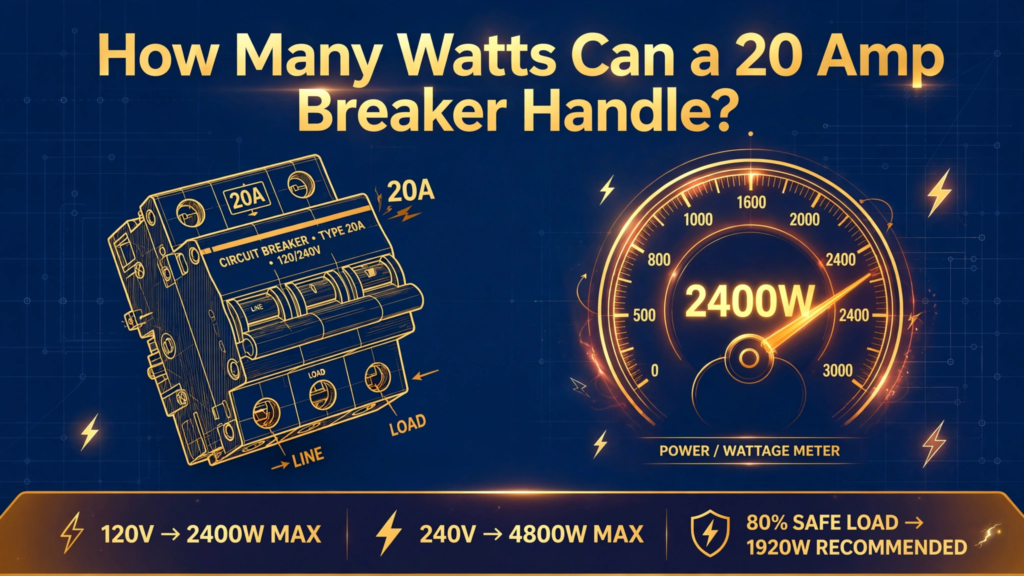

“How many watts can a 20 amp breaker handle?” is one of the most-searched electrical questions in the US — and the honest answer has two numbers, not one. There is the theoretical maximum, and then there is the number you should actually plan around. Mix them up and you get nuisance tripping at best and overheated wiring at worst.
Here is the math, the NEC rule behind it, and how to add up the loads on your own circuits.
The Short Answer: 2,400 Watts — But Plan for 1,920
Watts equal volts times amps. On a standard 120-volt US circuit:
20 amps × 120 volts = 2,400 watts.
That is the absolute ceiling — the point where the breaker is expected to eventually trip. But the National Electrical Code requires that continuous loads (anything expected to run 3 hours or more) be limited to 80% of the circuit rating. That comes from NEC 210.19(A) and 210.20(A): branch-circuit conductors and overcurrent devices serving continuous loads must be sized at 125% of the load — the flip side of the same 80% rule.
2,400 watts × 0.80 = 1,920 watts — the safe continuous limit on a 20-amp, 120-volt circuit (16 amps).
The reason is heat. A breaker and its conductors running at 100% for hours build up thermal stress that degrades insulation and causes nuisance trips. The 80% margin keeps everything in its comfort zone. For background on how breakers detect and interrupt overloads, see our guide to circuit breaker types and working.
Common Breaker Sizes at a Glance
| Breaker | Voltage | Maximum (W) | Safe Continuous (W) | Typical Wire |
|---|---|---|---|---|
| 15A | 120V | 1,800 | 1,440 | 14 AWG |
| 20A | 120V | 2,400 | 1,920 | 12 AWG |
| 30A | 120V | 3,600 | 2,880 | 10 AWG |
| 20A | 240V | 4,800 | 3,840 | 12 AWG |
| 30A | 240V | 7,200 | 5,760 | 10 AWG |
Notice the 240-volt row: doubling the voltage doubles the wattage on the same 20-amp breaker — one reason big appliances run on 240V. A 20-amp breaker never protects 14 AWG wire; match breaker to wire with our NEC wire size chart.
How to Add Up the Load on Your Circuit
Every device has a nameplate wattage (or amps — multiply amps × volts to get watts). Add up everything that can run at once on the same breaker:
- Space heater: 1,500W (12.5A) — continuous load, the classic circuit-killer
- Microwave: ~1,100W (9.2A)
- Hair dryer: ~1,800W (15A)
- Gaming PC: ~500–800W
- LED TV: ~100W
Example: a 1,500W space heater plus a 500W window AC on one 20-amp circuit totals 2,000 watts (16.7A). That is under the 2,400W ceiling but over the 1,920W continuous limit — and both of those loads run for hours. Expect trips. Move one to another circuit or add a dedicated one. For a whole-house view, work through our house load calculation guide.
Watch out for inrush current
Motors — refrigerators, air conditioners, power tools — draw a brief startup surge several times their running current. A fridge rated 800W running might pull 2,000W+ for a fraction of a second at startup. Breakers tolerate brief inrush (that is what the trip curves are for — see our MCB tripping curves explainer), but stacking several motor loads on one circuit invites nuisance trips.
Can You Get More Watts With a Bigger Breaker?
Not by swapping the breaker alone. The breaker size follows the wire and the load design — a bigger breaker on the same 12 AWG wire just lets the wire overheat before anything trips. Going from 20A to 30A means new 10 AWG wire, a 30-amp-rated receptacle, and a proper load calculation. If you are tempted, read up on what an MCB is and why protection must match the weakest link in the circuit.
Common Mistakes That Overload a 20-Amp Circuit
The most common mistake is treating 2,400 watts as usable capacity. A 20-amp circuit is not a 2,400-watt allowance: anything that runs for three hours or more — a space heater, a window air conditioner, a row of grow lights — must stay under 1,920 watts. Add a second continuous load on the same circuit and the breaker will trip, usually on the coldest or hottest day of the year, exactly when you need the heat or cooling most.
A second mistake is forgetting the loads you cannot see. A refrigerator, a freezer, or a sump pump may share the circuit with your kitchen or garage outlets, and their startup surges stack on top of whatever is already running. A third mistake is daisy-chaining power strips and extension cords to feed a space heater, a microwave, and a coffee maker from one receptacle. The breaker may hold for a while, but the strip, the cord, and the receptacle itself can overheat long before the breaker trips.
The fix is simple and cheap: add up the nameplate watts on each circuit, keep continuous loads under 1,920 watts, and give heavy appliances — space heaters, microwaves, window air conditioners — their own dedicated circuit. If the breaker still trips after that, the problem is likely a loose connection or a failing breaker, and an electrician should check it.
FAQs
How many watts can a 20 amp breaker handle?
2,400 watts maximum at 120 volts (4,800 watts at 240 volts). For continuous loads running 3+ hours, limit the circuit to 1,920 watts at 120V (3,840W at 240V) per the NEC 80% rule.
What is a continuous load?
Per the NEC’s Article 100 definition, a load where the maximum current is expected to continue for 3 hours or more — think lighting left on all evening, space heaters, or aquariums. Continuous loads must be sized at 125% for the conductor and breaker (NEC 210.19(A), 210.20(A)).
Will a 20 amp breaker trip at exactly 2,400 watts?
Not exactly. Breakers trip on a time-current curve: a small overload may take minutes or hours to trip, while a large overload or short circuit trips in milliseconds. Running right at the limit for a long time is exactly what the 80% rule is designed to avoid.
How many outlets can be on a 20 amp circuit?
The NEC does not set a fixed residential outlet count (commercial uses 180VA per receptacle per 220.14(I)). As a practical rule, 8–10 general receptacles per 20-amp circuit is common, but what matters is the actual load you plug in, not the outlet count.
Can I run a 1,500W space heater and a microwave on one 20A circuit?
Not safely at the same time. Together they draw roughly 2,600W (21.7A) — over the breaker’s rating — and both are heavy, heat-producing loads. Put them on separate circuits.
Conclusion
A 20-amp breaker handles 2,400 watts at 120 volts in theory, but the NEC’s 80% rule for continuous loads makes 1,920 watts the real planning number. Add up nameplate watts, respect the difference between continuous and intermittent loads, and never upsize a breaker without upsizing the wire to match. For anything beyond basic load math, consult a licensed electrician and follow your locally adopted NEC edition.
Source: NFPA 70 (National Electrical Code) — see https://www.nfpa.org/codes-and-standards/nfpa-70-standard-development/70


