
Imagine you are getting ready for work early in the morning. You turn the key in your car’s ignition, but instead of hearing the engine start, you only hear a clicking sound. One of the most common reasons behind this problem is a faulty starter solenoid. Although it is a small electrical component, it plays a vital role in starting almost every gasoline and diesel vehicle.
A starter solenoid acts as a powerful electrical switch that connects the battery to the starter motor. Without it, the starter motor cannot receive enough current to crank the engine. This makes the starter solenoid one of the most important components in an automotive electrical system.
Whether you are an electrical engineering student, an automotive technician, or someone learning basic electrical systems, understanding the starter solenoid will help you diagnose starting problems more effectively. In this guide, you will learn the starter solenoid working principle, its types, components, applications, advantages and disadvantages, troubleshooting methods, and practical selection tips using simple and easy-to-understand language.
What is a Starter Solenoid?
A starter solenoid is an electromagnetic switch that controls the flow of high electrical current from the battery to the starter motor. It also pushes the starter gear into contact with the engine’s flywheel before the motor begins rotating.
In simple words, the starter solenoid works like an electrically operated switch. When you turn the ignition key or press the start button, a small electrical current activates the solenoid. The solenoid then connects the battery directly to the starter motor, allowing the engine to crank.
Simple Practical Example
Think of a starter solenoid like a door controlled by a security guard.
- The ignition switch is the person requesting entry.
- The solenoid is the security guard.
- The battery is the power source.
- The starter motor is the worker waiting to begin the job.
Only after the security guard opens the door can power reach the worker.
Without the starter solenoid, the starter motor would never receive the high current needed to start the engine.
How Does a Starter Solenoid Work? Step-by-Step Working Principle
The starter solenoid working principle is based on electromagnetism. It acts as both an electromagnetic actuator and a high-current switch that helps connect the battery to the starter motor and, in many starter designs, engages the starter pinion gear with the engine flywheel.
When the ignition switch or start button is activated, a relatively small control current energizes the solenoid coil. The resulting magnetic field pulls a movable plunger, which closes heavy electrical contacts and operates the mechanism that engages the starter gear. This allows high current to flow from the battery to the starter motor, causing the motor to rotate the engine until it starts.
Step 1: The Starting Circuit Is Activated
When the driver turns the ignition key to the START position or presses the engine start button, the vehicle’s starting control circuit sends an electrical signal to the starter solenoid.
The solenoid receives this control signal through the vehicle’s starting circuit. Depending on the vehicle design, the circuit may also include a starter relay, neutral-safety switch, clutch switch, or electronic control module.
Step 2: The Solenoid Coil Becomes Energized
When current flows through the solenoid coil, it produces a magnetic field around the coil.
This magnetic field creates the force required to move the solenoid’s internal plunger. The coil itself does not normally carry the extremely high current required by the starter motor; instead, it controls the heavy switching mechanism.
Step 3: The Plunger Moves
The magnetic field pulls the metal plunger into the solenoid.
As the plunger moves, it performs two important functions. It operates the starter engagement mechanism and moves toward the heavy electrical contacts that supply power to the starter motor.
This mechanical movement is what allows the solenoid to perform its dual role as an actuator and electrical switch.
Step 4: The Starter Pinion Gear Engages
In many conventional starter assemblies, movement of the solenoid plunger operates a shift lever or engagement mechanism.
This mechanism moves the starter pinion gear toward the engine’s flywheel or flexplate ring gear. The pinion gear must engage correctly with the engine’s ring gear before the starter can crank the engine.
The exact engagement mechanism varies depending on the starter design.
Step 5: The High-Current Contacts Close
As the plunger completes its movement, it closes the solenoid’s heavy-duty electrical contacts.
These contacts connect the battery’s positive supply to the starter motor.
The starter motor requires a very large current compared with ordinary vehicle electrical loads, so the solenoid provides a controlled way to switch this high-current circuit using a much smaller control current.
Step 6: The Starter Motor Cranks the Engine
Once the high-current circuit is closed, electrical power flows from the battery through the solenoid contacts to the starter motor.
The starter motor converts electrical energy into mechanical rotation. Through the starter’s gear system, this rotation turns the engine crankshaft.
The engine then begins its normal combustion cycle. Once the engine starts running under its own power, the starter is no longer needed.
Step 7: The Starter Solenoid Disengages
When the driver releases the ignition key or the starting command is removed, current to the solenoid coil is interrupted.
The magnetic field decreases, allowing the return spring and engagement mechanism to move the plunger back to its original position.
The heavy electrical contacts open, cutting power to the starter motor, while the starter pinion gear disengages from the engine’s ring gear.
Step 8: The System Returns to Standby
After the engine starts, the starter solenoid remains de-energized until another starting command is given.
The starter motor is therefore disconnected from the battery’s high-current supply, and the pinion gear remains disengaged from the engine’s ring gear during normal engine operation.
Simple Working Flow
The complete working sequence of a starter solenoid can be summarized as:
Start Command → Coil Energized → Magnetic Field Created → Plunger Moves → Starter Gear Engages → Heavy Contacts Close → Starter Motor Runs → Engine Cranks → Start Command Released → Solenoid Disengages
This simple electromagnetic process allows the starter system to safely control the large current required to crank an engine while coordinating the electrical connection and mechanical engagement of the starter.
Types of Starter Solenoids and Their Main Components
Starter solenoids are available in different designs depending on the vehicle, starter motor configuration, available space, and starting requirements. Some solenoids are mounted directly on the starter motor, while others are installed separately. Although their construction can vary, most perform the same basic functions: receiving a starting signal, moving an internal mechanism, closing a high-current circuit, and helping engage the starter drive.
Pull-In Starter Solenoid
A pull-in starter solenoid uses electromagnetic force to pull an internal plunger when the starting circuit is energized. The plunger movement operates the starter engagement mechanism and, depending on the design, closes the high-current contacts.
Key Features
- Provides strong electromagnetic pulling force
- Enables rapid starter engagement
- Used in many conventional starter systems
- Designed for repeated starting cycles
- Works with a mechanical starter engagement mechanism
Push-Type Starter Solenoid
A push-type solenoid is designed so that the electromagnetic action produces an outward movement of the plunger or actuator. The exact arrangement depends on the starter design.
Key Features
- Produces linear mechanical movement
- Can be used where the installation requires outward actuation
- Relatively straightforward mechanical construction
- Found in certain specialized or older starter applications
The terms pull-type and push-type primarily describe the direction of the actuator movement; they do not by themselves indicate the overall performance or quality of the solenoid.
Integrated Starter Solenoid
An integrated starter solenoid is mounted directly on the starter motor assembly. This is a common arrangement in modern automotive starter systems.
Key Features
- Compact overall installation
- Short high-current connection between the solenoid and starter motor
- Combines starter switching and engagement functions
- Reduces the need for long high-current wiring
- Conveniently packaged with the starter assembly
Remote Starter Solenoid
A remote starter solenoid is installed separately from the starter motor, usually at a suitable location within the vehicle or equipment.
This arrangement can be useful when the starter design or vehicle layout requires the switching device to be positioned away from the starter motor.
Key Features
- Separate mounting location
- Easier access for inspection or replacement
- Can help simplify certain electrical layouts
- Used in some heavy-duty vehicles, machinery, and specialized equipment
- May reduce exposure of the solenoid to direct starter-motor heat
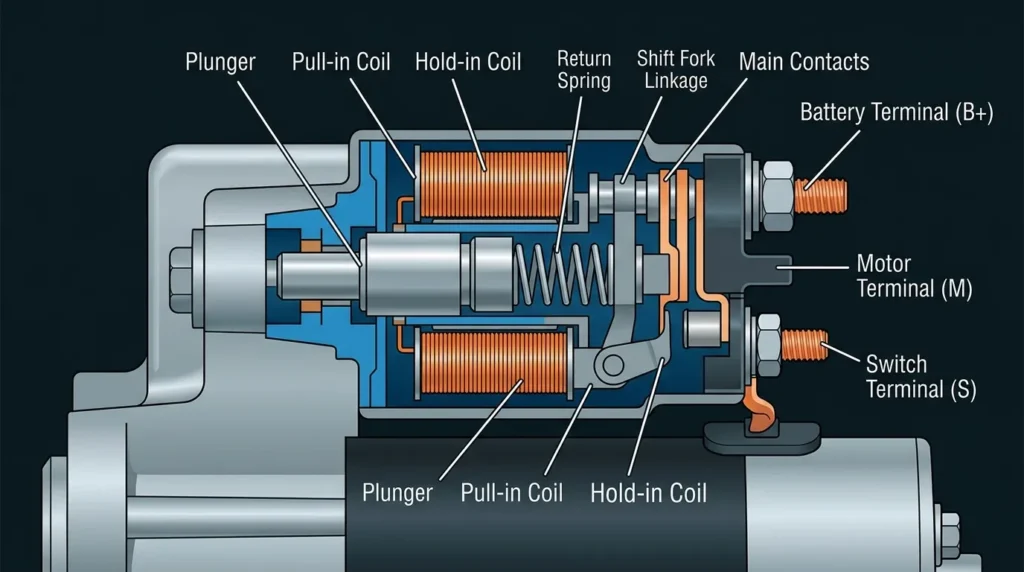
Main Components of a Starter Solenoid
Understanding the main components makes it easier to understand how a starter solenoid converts a small electrical control signal into mechanical movement and high-current switching.
Solenoid Coil
The solenoid coil consists of insulated wire wound around a suitable core or former. When electrical current flows through the coil, it creates a magnetic field.
Functions
- Produces the electromagnetic force
- Moves the plunger
- Initiates the starter engagement process
- Controls the high-current switching mechanism
Plunger
The plunger is a movable ferromagnetic component positioned inside the solenoid.
When the coil is energized, the magnetic field pulls or otherwise moves the plunger, depending on the solenoid design.
Functions
- Converts electromagnetic force into linear movement
- Operates the starter engagement mechanism
- Moves the electrical contact mechanism
- Returns to its normal position when the solenoid is de-energized
Return Spring
The return spring pushes the plunger back toward its resting position after the starting signal is removed.
Functions
- Returns the plunger to its normal position
- Helps open the high-current contacts
- Allows the starter drive to disengage
- Prevents unintended continuous starter operation
Heavy-Duty Electrical Contacts
The heavy-duty contacts are designed to handle the high current required by the starter motor. When the solenoid completes its movement, these contacts close the high-current circuit between the battery and starter motor.
Functions
- Connect battery power to the starter motor
- Carry high starting current
- Provide a low-resistance electrical path
- Disconnect the starter motor when the starting command ends
Because these contacts handle substantial current, wear, arcing, corrosion, or burning can eventually affect starter performance.
Solenoid Housing
The housing surrounds and supports the internal components of the solenoid. It may be made from metal or engineered material depending on the application.
Functions
- Protects internal components
- Provides mechanical support
- Helps resist vibration and environmental conditions
- Maintains the alignment of internal moving parts
Electrical Terminals
The solenoid has electrical terminals that provide connections to the battery, starter motor, and starting control circuit. The exact number and arrangement vary by design.
Functions
- Provide secure electrical connections
- Carry control and high-current electrical paths
- Connect the solenoid with the vehicle’s starting system
- Allow the solenoid to be tested and serviced
Shift Lever or Engagement Mechanism
In many starter designs, the solenoid is mechanically connected to a shift lever or starter engagement mechanism.
When the plunger moves, this mechanism pushes or pulls the starter drive so that the pinion gear engages with the engine’s ring gear.
Functions
- Transfers plunger movement to the starter drive
- Helps engage the pinion gear
- Helps disengage the starter after the engine starts
- Coordinates mechanical engagement with electrical switching
Starter Solenoid Component Summary
The basic operating relationship can be summarized as:
Coil → Magnetic Field → Plunger Movement → Engagement Mechanism → Electrical Contacts → Starter Motor
Together, these components allow the starter solenoid to perform its two main jobs: controlling high-current power to the starter motor and operating the starter engagement mechanism.
Advantages of a Starter Solenoid
The starter solenoid advantages and disadvantages should be understood before studying automotive starting systems.
Advantages
- Provides safe switching of very high current.
- Allows a small ignition current to control a large starter current.
- Improves driver safety.
- Ensures smooth engine starting.
- Automatically engages the starter gear.
- Reduces wear on the ignition switch.
- Compact and reliable.
- Requires little maintenance.
- Works efficiently in various weather conditions.
- Long service life under normal use.
Disadvantages of a Starter Solenoid
Like every electrical device, the starter solenoid also has limitations.
- Contacts wear over time.
- Coil may burn due to overheating.
- Dirt and corrosion affect operation.
- Produces clicking noise when faulty.
- Mechanical parts may stick.
- High temperatures reduce lifespan.
- Cannot repair some sealed models easily.
- Requires battery voltage to operate properly.
Starter Solenoid Applications: Where Are They Used?
Starter solenoids are widely used in vehicles, machines, generators, and engine-driven equipment that rely on an electric starting system. Their main purpose is to control the high electrical current required by the starter motor and, in many designs, help move the starter pinion gear into engagement with the engine’s ring gear.
A starter solenoid allows a relatively small control signal from the ignition switch, start button, or control system to operate a much larger electrical circuit. This makes it possible to start large engines without routing the full starter current through the ignition switch or control device.
The design and current capacity of a starter solenoid depend on the engine size, starter motor requirements, operating environment, and starting-system configuration.
Passenger Cars
Starter solenoids are commonly used in gasoline and diesel passenger cars. When the driver turns the ignition key or presses the start button, the vehicle’s starting circuit sends a control signal to the solenoid.
The solenoid then operates its internal mechanism and closes the high-current contacts, allowing battery power to reach the starter motor. In many starter designs, the same movement also helps engage the starter pinion with the engine’s ring gear.
A reliable solenoid is important because repeated starting attempts can place significant electrical and mechanical demands on the starting system.
Motorcycles
Many motorcycles equipped with electric-start systems use compact starter solenoids. The solenoid connects the motorcycle battery to the starter motor when the rider activates the start switch.
Motorcycle solenoids are generally smaller than those used in heavy-duty vehicles because motorcycle starter motors typically require less current. However, they must still withstand vibration, temperature changes, moisture, and repeated starting cycles.
A faulty motorcycle solenoid can cause symptoms such as clicking sounds, slow cranking, or no starter-motor operation.
Trucks and Heavy-Duty Vehicles
Heavy-duty trucks often require powerful starting systems because diesel engines can have high compression ratios and require substantial cranking torque.
Starter solenoids used in trucks are therefore designed to handle high current levels and demanding operating conditions. They may be integrated with the starter motor or installed separately, depending on the vehicle design.
Reliable starter solenoid operation is particularly important for commercial trucks because starting-system problems can result in vehicle downtime and interrupted transportation operations.
Agricultural Equipment
Starter solenoids are widely used in agricultural machinery such as:
- Tractors
- Combine harvesters
- Crop sprayers
- Irrigation equipment
- Agricultural loaders
- Harvesting machines
Agricultural equipment often operates in dusty, muddy, humid, and outdoor environments. Starter solenoids used in these machines must therefore be suitable for vibration and environmental exposure.
Reliable starting is especially important during planting and harvesting seasons when equipment may need to operate for long hours.
Construction Machinery
Construction machinery such as excavators, wheel loaders, bulldozers, cranes, skid-steer loaders, and backhoe loaders commonly uses electric starting systems.
These machines often have large diesel engines that require high cranking current. The starter solenoid controls the high-current connection between the battery and starter motor and may also operate the starter engagement mechanism.
Construction equipment frequently operates in harsh environments with dust, vibration, heat, and moisture. For this reason, the starter solenoid and its electrical connections must be properly protected and maintained.
Marine Engines
Starter solenoids are also used in boats and other marine equipment equipped with electric engine starting systems.
Marine environments can expose electrical components to moisture, humidity, vibration, and salt-containing air, which can accelerate corrosion. Therefore, marine starting components should be selected for the specific environmental conditions in which they will operate.
A properly functioning marine starter solenoid ensures that the starter motor receives the required battery current when the engine-start command is activated.
Backup and Standby Generators
Backup generators use starter solenoids to start their engines when electrical power is required.
In an automatic standby generator system, a controller can detect a utility power failure and initiate the engine-start sequence. The control system sends a signal to the starter circuit, causing the solenoid to operate and connect battery power to the starter motor.
Once the engine starts and reaches the required operating condition, the starter circuit is disengaged.
Reliable starter solenoid operation is particularly important for emergency generators because the generator may need to start automatically when normal utility power is unavailable.
Industrial Equipment
Starter solenoids are used in various industrial machines powered by gasoline or diesel engines. These may include:
- Engine-driven pumps
- Industrial compressors
- Material-handling equipment
- Diesel power units
- Mobile generators
- Specialized machinery
- Engine-driven hydraulic systems
In industrial applications, starting-system reliability can directly affect productivity. A defective solenoid may prevent an engine from starting, resulting in equipment downtime.
Mining Equipment
Large mining machines often use heavy-duty diesel engines and high-capacity starting systems. Equipment such as haul trucks, drilling machines, loaders, and other mobile mining machinery may use starter solenoids designed for demanding operating conditions.
These applications can involve extreme dust, vibration, temperature changes, and long operating hours. Heavy-duty starting components therefore need to be correctly rated and maintained.
Recreational and Utility Vehicles
Starter solenoids can also be found in recreational and utility vehicles such as ATVs, UTVs, motorhomes, and certain off-road vehicles.
These vehicles may operate in environments where vibration, dust, moisture, and temperature changes are common. A suitable starter solenoid provides dependable switching of starter-motor current while helping protect the starting circuit.
Why Starter Solenoids Are Important
Across all these applications, the starter solenoid performs an important electrical and mechanical role. It allows a relatively small control circuit to operate the high-current starter circuit without requiring the ignition switch or electronic control device to carry the full starter current.
In many starter assemblies, the solenoid also helps engage the starter pinion with the engine’s ring gear. This coordination between electrical switching and mechanical movement allows the starter motor to crank the engine effectively.
Overall, starter solenoids are essential components in cars, motorcycles, trucks, agricultural machinery, construction equipment, marine engines, backup generators, mining equipment, and industrial machines. Proper selection, installation, and maintenance help ensure dependable engine starting and reduce the risk of unnecessary equipment downtime.
Difference Between Starter Solenoid and Starter Relay
Many beginners confuse these two components. Understanding the difference between starter relay and starter solenoid is important.
| Feature | Starter Solenoid | Starter Relay |
|---|---|---|
| Main Function | Connects battery to starter motor | Controls solenoid circuit |
| Current Handling | Very high current | Low current |
| Mechanical Movement | Yes | Usually No |
| Gear Engagement | Yes | No |
| Location | On or near starter motor | Fuse box or relay panel |
| Size | Larger | Smaller |
| Purpose | Powers starter motor | Activates solenoid |
The relay controls the solenoid, while the solenoid controls the starter motor.
How to Choose the Right Starter Solenoid: Complete Selection Guide
Choosing the correct starter solenoid is important for reliable engine starting, safe electrical operation, and long service life. A solenoid that does not match the vehicle or equipment can cause problems such as clicking without cranking, excessive voltage drop, overheating, premature contact wear, or complete starter failure.
When selecting a replacement, do not choose a solenoid based only on its physical appearance. Consider the vehicle specifications, operating voltage, current requirements, mounting arrangement, terminal configuration, environmental conditions, and manufacturer recommendations.
Match the Vehicle or Equipment Specifications
The first step is to select a starter solenoid that is specifically compatible with the vehicle, engine, and starter assembly.
Check the vehicle manufacturer’s specifications, starter part number, or the original solenoid’s identification information. Important details may include:
- Vehicle make and model
- Engine type and size
- Starter motor model
- Original equipment part number
- Solenoid mounting arrangement
- Terminal configuration
- Electrical specifications
Using a compatible replacement helps ensure that the solenoid fits correctly and operates as intended.
Check the Correct Voltage Rating
Starter solenoids are designed for specific electrical system voltages. Common vehicle electrical systems include 12 V and 24 V, although the actual operating voltage can vary depending on the application.
Before purchasing a solenoid, verify the electrical system voltage and make sure the replacement is designed for it.
Using an incorrectly rated solenoid can result in improper operation, excessive heating, or component damage.
Consider the Current Capacity
The starter motor can draw a very high current, especially during cold starts or when starting large diesel engines. Therefore, the solenoid’s high-current contacts must be capable of handling the starter’s electrical demand.
Consider:
- Starter motor current requirements
- Engine size
- Starting conditions
- Continuous and peak current capability
- Manufacturer’s specifications
For heavy-duty trucks, agricultural machinery, generators, and industrial equipment, a higher-capacity solenoid may be required.
Check Terminal Configuration
The terminal arrangement should match the original starter solenoid and the vehicle’s wiring system.
Depending on the design, a solenoid may have separate terminals for:
- Battery positive connection
- Starter motor connection
- Control or ignition signal
- Ground or additional control connections
Incorrect terminal configuration can prevent the starter system from operating correctly and may create an electrical hazard.
Evaluate Build Quality and Materials
The quality of the internal contacts, coil, housing, terminals, insulation, and mechanical components affects the service life of a starter solenoid.
Look for a solenoid with:
- Durable electrical contacts
- Quality conductive materials
- Heat-resistant insulation
- Strong mechanical construction
- Corrosion-resistant terminals
- Properly sealed housing where required
High-quality construction is particularly important for vehicles and machines that experience frequent starting cycles or harsh operating conditions.
Consider the Operating Environment
The environment in which the starter solenoid will operate should also influence the selection.
For example, a solenoid used in a normal passenger vehicle may have different environmental requirements from one installed on a boat, tractor, construction machine, or outdoor generator.
For demanding environments, consider features such as:
- Moisture resistance
- Dust protection
- Corrosion resistance
- Vibration resistance
- Temperature tolerance
- Sealed construction
Marine and outdoor applications may require components specifically designed to withstand moisture and corrosion.
Choose a Reliable Manufacturer
The manufacturer is another important consideration when purchasing a starter solenoid. Established automotive electrical manufacturers generally provide products with clearly defined specifications and compatibility information.
When comparing brands, consider:
- Product specifications
- Compatibility information
- Manufacturing quality
- Customer reviews from reliable sources
- Availability of technical support
- Replacement-part availability
Avoid selecting a product based only on the lowest price, particularly when the solenoid is used in critical equipment.
Check Warranty and Support
A manufacturer’s warranty can provide additional protection if the component fails prematurely because of a manufacturing defect.
Before purchasing, check:
- Warranty period
- Warranty conditions
- Return policy
- Manufacturer or supplier support
- Availability of replacement parts
A clear warranty does not guarantee that a product will never fail, but it can provide useful protection and indicate that the manufacturer stands behind its product.
Consider the Mounting and Physical Dimensions
The replacement solenoid should physically fit the intended installation location.
Check:
- Mounting holes
- Overall dimensions
- Terminal positions
- Connector type
- Cable clearance
- Orientation requirements
A solenoid that has the correct voltage and current rating but does not physically fit or connect correctly may still be unsuitable.
Select the Solenoid According to the Application
Different applications may require different types of starter solenoids.
For example:
- Passenger cars: Compact, vehicle-specific solenoids
- Motorcycles: Small solenoids designed for motorcycle starting systems
- Trucks: High-current heavy-duty solenoids
- Agricultural machinery: Durable solenoids suitable for outdoor conditions
- Marine engines: Corrosion-resistant and environmentally protected designs
- Generators: Reliable solenoids suitable for repeated or automatic starting
- Industrial equipment: Heavy-duty units matched to the engine and starter system
Check the Manufacturer’s Specifications
Before installation, compare the replacement solenoid with the original component and verify its specifications.
Important specifications may include:
| Specification | What to Check |
|---|---|
| Voltage | Match the vehicle electrical system |
| Current capacity | Match the starter motor requirements |
| Terminal arrangement | Match the existing wiring |
| Mounting | Confirm physical compatibility |
| Temperature rating | Suitable for the operating environment |
| Protection | Consider dust, moisture, and corrosion |
| Part number | Confirm compatibility with the starter system |
Final Selection Checklist
Before purchasing a starter solenoid, make sure you have confirmed:
- Correct vehicle or equipment compatibility
- Correct voltage rating
- Adequate current capacity
- Correct terminal configuration
- Suitable mounting dimensions
- Appropriate environmental protection
- Good construction quality
- Reliable manufacturer
- Suitable warranty and support
Choosing a starter solenoid based on these factors can help ensure reliable engine starting, proper electrical performance, and longer component life. For the most accurate replacement, the original equipment manufacturer’s specifications or the starter manufacturer’s part number should take priority over appearance alone.
Common Problems & Solutions
Starter Solenoid Troubleshooting: Common Problems, Causes, and Solutions
A faulty starter solenoid can cause several starting problems, ranging from a single clicking sound to complete starter failure. Because the solenoid controls the high-current connection between the battery and starter motor, problems with the battery, wiring, terminals, solenoid contacts, or starter motor can produce similar symptoms.
The following troubleshooting guide covers some of the most common starter solenoid problems and practical ways to identify them.
Why Does the Starter Solenoid Click but the Engine Does Not Crank?
A clicking sound usually indicates that the solenoid is receiving a starting signal and attempting to operate, but the starter motor is not receiving sufficient power or cannot rotate the engine.
Possible Causes
- Weak or discharged battery
- Corroded or loose battery terminals
- Damaged high-current solenoid contacts
- Faulty starter motor
- Loose or damaged battery cable
- Poor engine or chassis ground connection
Solution
Start by checking the battery condition and terminal connections. Inspect the positive and ground cables for corrosion, looseness, or damage. If the battery and cables are in good condition, the solenoid’s high-current circuit and the starter motor should be tested.
Why Is There No Clicking Sound From the Solenoid?
If there is no clicking sound when the start command is activated, the solenoid may not be receiving the required control signal.
Possible Causes
- Weak or discharged battery
- Faulty ignition switch or start button
- Damaged starter relay
- Broken or disconnected wiring
- Faulty neutral-safety or clutch switch
- Open solenoid coil
- Electrical control-system fault
Solution
Check the battery voltage first, then inspect the starting circuit. A qualified technician can test whether the solenoid receives the correct control voltage when the start command is activated.
Why Does the Starter Keep Running After the Engine Starts?
A starter that continues running after the starting command has been released can indicate a serious electrical or mechanical fault.
Possible Causes
- Welded or stuck solenoid contacts
- Sticking plunger
- Damaged return spring
- Faulty starter relay
- Fault in the ignition or control circuit
- Mechanical problem in the starter engagement mechanism
Solution
The starting system should be disconnected as soon as it is safe to do so to prevent starter or wiring damage. The solenoid, starter relay, ignition circuit, and engagement mechanism should then be inspected and the defective component repaired or replaced.
Why Does the Starter Crank the Engine Slowly?
Slow cranking does not always mean the solenoid itself is faulty. The battery and high-current connections should be checked first.
Possible Causes
- Weak or discharged battery
- Corroded battery terminals
- Damaged battery cables
- Poor ground connection
- Excessive resistance in the starting circuit
- Worn starter motor
- Damaged solenoid contacts
- Engine mechanical resistance
Solution
Check battery condition and inspect all high-current connections. A voltage-drop test can help identify excessive resistance in the positive and ground sides of the starting circuit.
Why Does the Solenoid Click Repeatedly?
Repeated clicking while attempting to start the engine is commonly associated with insufficient voltage reaching the solenoid or starter circuit.
Possible Causes
- Weak battery
- Poor battery terminal connection
- Loose ground connection
- Damaged battery cable
- Charging-system problem
- Excessive electrical resistance
Solution
Check the battery state of charge and inspect the battery terminals and ground connections. If the problem continues with a properly charged battery, the starting and charging systems should be tested.
How Can You Test a Starter Solenoid?
A starter solenoid can be checked using several basic electrical tests. The exact procedure depends on the vehicle and starter design.
Basic Testing Steps
- Check battery voltage: Make sure the battery has sufficient charge.
- Inspect the connections: Look for loose, damaged, or corroded terminals and cables.
- Listen for solenoid operation: A click can indicate that the solenoid is responding to the start command, but it does not prove that the high-current contacts are good.
- Check control voltage: Verify that the solenoid receives the appropriate starting signal.
- Check high-current voltage: Test the voltage on the battery and starter terminals during the starting attempt.
- Perform a voltage-drop test: Check for excessive resistance across cables, connections, and solenoid contacts.
- Test coil resistance when appropriate: A multimeter can be used to check the solenoid coil according to the manufacturer’s specified resistance range.
Always follow the vehicle or equipment manufacturer’s testing procedure because starter circuits differ between applications.
How Long Does a Starter Solenoid Last?
There is no universal mileage or time limit for a starter solenoid. Its service life depends on factors such as vehicle design, starting frequency, battery condition, electrical connections, operating temperature, environmental exposure, and solenoid quality.
A well-maintained solenoid may operate for many years, while repeated high-current operation, corrosion, poor battery connections, or other electrical problems can shorten its service life.
Instead of replacing a solenoid based on mileage alone, it is better to inspect and test it when starting symptoms appear.
Future Trends in Starter Solenoid Technology
Automotive starting systems are evolving as vehicles adopt more sophisticated electronic controls, hybrid powertrains, and energy-management systems. These changes are influencing the design of conventional starter components as well as the development of alternative starting technologies.
Smart Electronic Starting Systems
Modern vehicles increasingly use electronic control modules to manage starting operations. These systems can communicate with immobilizers, engine-control modules, battery-management systems, and other vehicle electronics before allowing the starter to operate.
This improves control, security, diagnostics, and energy management.
Integrated Starter-Generator Systems
Hybrid vehicles may use integrated starter-generator (ISG) or related systems instead of a conventional starter motor and solenoid arrangement.
These systems can perform both engine-starting and electrical-generation functions. They can also support features such as regenerative braking and automatic engine stop-start operation.
Improved Contact and Coil Materials
Starter solenoid manufacturers continue to improve materials used in electrical contacts, coils, insulation, and mechanical components.
Improved contact materials can help reduce electrical resistance and wear, while better insulation and magnetic materials can support reliable operation under demanding temperature and electrical conditions.
Better Corrosion and Environmental Protection
Starter systems used in marine, agricultural, construction, and outdoor applications may require improved protection against moisture, dust, vibration, and corrosion.
Modern sealing methods, protective coatings, and corrosion-resistant materials can help extend component life in harsh environments.
Compact and Efficient Designs
Automotive manufacturers continue to seek smaller, lighter, and more efficient starting components. Modern starter systems are designed to provide the required performance while reducing unnecessary weight and installation space.
Hybrid and Start-Stop Vehicles
Start-stop and hybrid vehicles place different demands on engine-starting systems because the engine may be started and stopped much more frequently than in conventional vehicles.
These applications use specially designed starter motors, starter-generators, or other starting technologies capable of handling frequent operating cycles.
Electric Vehicles
Fully electric vehicles generally do not require a conventional starter solenoid because they do not have an internal combustion engine that needs to be cranked by a starter motor.
However, hybrid and plug-in hybrid vehicles still contain internal combustion engines and therefore may use advanced engine-starting systems, depending on their design.
Overall, the future of engine starting is moving toward electronically controlled, highly integrated, efficient, and durable systems, while conventional starter solenoids will continue to be used in many gasoline and diesel vehicles and engine-driven machines.
Conclusion
The starter solenoid is a small but essential part of every conventional vehicle’s starting system. It acts as both an electromagnetic switch and a mechanical actuator, allowing a low-current ignition signal to control the high current needed by the starter motor while engaging the starter gear with the engine flywheel. Understanding the starter solenoid working principle, components, applications, and advantages and disadvantages makes it easier to diagnose common starting problems and select the correct replacement. Whether you are studying automotive electrical systems, maintaining industrial equipment, or troubleshooting vehicle faults, learning how the starter solenoid works builds a strong foundation for understanding engine starting technology. As automotive systems continue to evolve, starter solenoids are becoming more reliable, efficient, and durable.