
Imagine you connect a 230 V AC supply to a heater at home. The voltage does not stay at 230 V every moment. Instead, it rises, falls, and changes direction many times every second. Yet the heater produces the same heating effect as a suitable DC voltage.
So, how do electrical engineers describe the useful value of an AC voltage or current?
This is where RMS value becomes important.
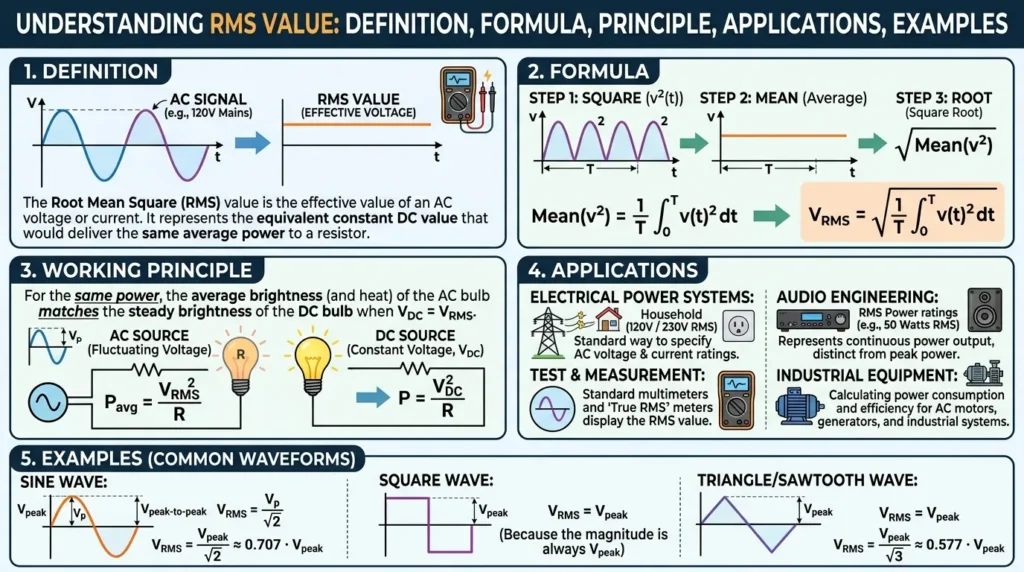
RMS stands for Root Mean Square. It gives the effective value of an alternating voltage or current. In simple terms, RMS tells us how much useful power an AC quantity can deliver compared with an equivalent DC quantity.
RMS values are used every day in electrical systems. The 230 V shown for many AC power systems is an RMS voltage, not the maximum voltage of the waveform.
In this guide, you will learn what RMS value means, its formula, working principle, types, advantages and limitations, applications, and the difference between RMS and peak values. You will also see practical examples that make the concept easier for beginners and electrical students.
2. What Is RMS Value?
RMS value is the effective value of an alternating voltage or current that produces the same heating effect in a resistor as an equivalent DC voltage or current.
RMS stands for:
Root → Square → Mean → Square Root
The name comes directly from the mathematical process used to calculate it.
For an AC current, the RMS value is:
[
I_{RMS}=\sqrt{\frac{1}{T}\int_0^T i^2(t),dt}
]
For an AC voltage:
[
V_{RMS}=\sqrt{\frac{1}{T}\int_0^T v^2(t),dt}
]
Where:
- (T) = one complete cycle
- (i(t)) = instantaneous current
- (v(t)) = instantaneous voltage
For a pure sinusoidal waveform, the formulas become much simpler.
RMS Formula for a Sine Wave
For sinusoidal AC:
[
V_{RMS}=\frac{V_{Peak}}{\sqrt{2}}
]
Therefore:
[
V_{RMS}\approx0.707V_{Peak}
]
Similarly:
[
I_{RMS}=\frac{I_{Peak}}{\sqrt{2}}
]
or:
[
I_{RMS}\approx0.707I_{Peak}
]
Simple Example
Suppose an AC voltage has a peak value of 325 V.
[
V_{RMS}=\frac{325}{1.414}
]
[
V_{RMS}\approx230V
]
Therefore, a 230 V RMS supply has a peak voltage of about 325 V.
This is why the voltage measured in an AC electrical system can be lower than the highest instantaneous voltage.
3. RMS Value Working Principle
The RMS value working principle is based on comparing AC with an equivalent DC quantity.
The process has four basic steps:
- Square each instantaneous value.
- Find the average of those squared values.
- Take the square root of the average.
- The result is the RMS value.
Step 1: Square the Instantaneous Values
An AC waveform changes from positive to negative.
If we simply calculated its average over one complete cycle, the positive and negative portions could cancel.
For a symmetrical sine wave:
[
Average = 0
]
That does not mean the AC supply has no useful effect.
To avoid cancellation, each value is squared.
Step 2: Find the Mean
After squaring the values, calculate their average over one complete cycle.
This is the mean square value.
Step 3: Take the Square Root
Finally, take the square root of the mean-square value.
That gives the Root Mean Square, or RMS, value.
An Easy Analogy
Think of an AC waveform as a person walking forward and backward.
If you only calculate total movement from the starting point, the forward and backward movements may cancel.
But if you want to know how much effort the person actually used, you need a method that treats both directions as useful movement.
RMS performs a similar job for AC electrical quantities.
4. RMS Value of a Sinusoidal Waveform
A sinusoidal AC waveform can be represented as:
[
v(t)=V_{Peak}\sin(\omega t)
]
Where:
- (V_{Peak}) = maximum voltage
- (\omega) = angular frequency
- (t) = time
For a sine wave:
[
V_{RMS}=\frac{V_{Peak}}{\sqrt{2}}
]
Therefore:
[
V_{RMS}=0.707V_{Peak}
]
The same relationship applies to current:
[
I_{RMS}=0.707I_{Peak}
]
Peak-to-Peak Voltage
Peak-to-peak voltage is:
[
V_{P-P}=2V_{Peak}
]
Therefore:
[
V_{RMS}=\frac{V_{P-P}}{2\sqrt{2}}
]
For example, if:
[
V_{P-P}=650V
]
then:
[
V_{Peak}=325V
]
and:
[
V_{RMS}\approx230V
]
5. Types / Classification of RMS Values
RMS values can be discussed according to the waveform being measured.
5.1 RMS Value of AC Voltage
AC voltage continuously changes its magnitude and direction.
The RMS voltage gives the effective voltage for power calculations and equipment ratings.
Examples include:
- Household AC supply
- Industrial three-phase supply
- Transformer output
- Generator output
5.2 RMS Value of AC Current
RMS current represents the effective heating or power-producing value of alternating current.
For a sinusoidal current:
[
I_{RMS}=\frac{I_{Peak}}{\sqrt{2}}
]
This value is important when selecting:
- Cables
- Circuit breakers
- Transformers
- Motors
- Switchgear
5.3 RMS Value of DC
For a constant DC quantity:
[
V_{RMS}=V_{DC}
]
and:
[
I_{RMS}=I_{DC}
]
This is because the DC voltage or current does not change with time.
For example, a constant 12 V DC supply has an RMS voltage of:
[
12V
]
5.4 RMS Value of Non-Sinusoidal Waveforms
Modern electrical systems often contain distorted waveforms.
Examples include:
- Square waves
- Triangular waves
- PWM waveforms
- Converter waveforms
- Variable-frequency drive waveforms
For these waveforms, the simple 0.707 relationship may not apply.
The general RMS formula must be used.
6. Main Components of RMS Calculation
RMS is not a physical component like a transformer or motor. It is a calculated electrical quantity.
However, several important factors are involved in RMS measurement.
Instantaneous Value
This is the voltage or current at a specific moment.
Because AC changes continuously, its instantaneous value changes with time.
Peak Value
The peak value is the maximum magnitude reached by the waveform.
It is important because RMS is directly related to peak value for a sine wave.
Time Period
The time period is the time required for one complete AC cycle.
It is represented by:
[
T
]
Frequency and time period are related by:
[
f=\frac{1}{T}
]
Waveform
The waveform determines the relationship between peak and RMS values.
For a sine wave:
[
V_{RMS}=0.707V_{Peak}
]
For other waveforms, the relationship can be different.
7. RMS Value and Electrical Power
RMS is especially important because electrical power calculations use RMS values for AC circuits.
For a purely resistive AC circuit:
[
P=V_{RMS}I_{RMS}
]
For a resistor:
[
P=I_{RMS}^2R
]
or:
[
P=\frac{V_{RMS}^2}{R}
]
Example
Suppose a 230 V RMS supply is connected to a 46 Ω resistor.
[
P=\frac{230^2}{46}
]
[
P=1150W
]
So the resistor consumes approximately 1.15 kW.
This shows why RMS is more useful than simply using the peak voltage for ordinary power calculations.
8. RMS Value Advantages
Understanding the RMS value advantages and disadvantages is important for practical electrical work.
Main Advantages
- Gives the effective value of AC voltage and current.
- Makes AC and DC quantities easier to compare.
- Helps calculate electrical power.
- Supports cable and equipment selection.
- Used in electrical meter readings.
- Important for transformer and generator ratings.
- Helps evaluate heating effects.
- Useful in motor and industrial power calculations.
- Supports accurate analysis of AC circuits.
- Can be applied to distorted waveforms using the general formula.
Practical Benefit
When an electrician measures a 230 V AC supply using a suitable true-RMS meter, the reading represents the effective voltage of the supply.
This makes RMS highly useful in real electrical maintenance work.
9. Disadvantages and Limitations of RMS
RMS is extremely useful, but it has some limitations.
It Does Not Show the Complete Waveform
Two different waveforms can have the same RMS value but behave differently at particular moments.
RMS provides one effective number rather than the complete waveform shape.
Peak Information Is Lost
Knowing the RMS value alone does not always tell you the peak voltage.
For a sine wave, you can calculate the peak easily, but this may not work for a distorted waveform.
Non-Sinusoidal Waveforms Need More Care
The formula:
[
V_{RMS}=\frac{V_{Peak}}{\sqrt{2}}
]
is only valid for a sinusoidal waveform.
It should not automatically be used for:
- Square waves
- Triangular waves
- Distorted voltage
- PWM signals
Meter Accuracy Matters
A basic average-responding AC meter may not accurately measure distorted waveforms.
A true-RMS meter is better when waveform distortion is present.
10. RMS vs Peak Value
One of the most common questions is the difference between RMS and peak value.
| Feature | RMS Value | Peak Value |
|---|---|---|
| Meaning | Effective value | Maximum instantaneous value |
| Main use | Power and equipment calculations | Maximum voltage/current analysis |
| Sine-wave relationship | 0.707 × peak | Maximum value |
| Example | 230 V | 325 V |
| Used for equipment ratings | Very common | Also important |
| Represents maximum level? | No | Yes |
Example
For a 230 V RMS sine wave:
[
V_{Peak}=230\times1.414
]
[
V_{Peak}\approx325V
]
Therefore:
RMS voltage = 230 V
Peak voltage = 325 V
11. RMS vs Average Value
RMS and average value are not the same.
For a symmetrical sine wave, the average value over a complete cycle is zero.
But the RMS value is:
[
0.707V_{Peak}
]
Therefore, a sine wave can have:
- Average value over a full cycle = 0 V
- RMS value = 0.707 × peak value
This is why using average value alone cannot describe the useful heating effect of AC.
12. RMS Value Applications
The RMS value applications cover almost every area of AC electrical engineering.
Home Electrical Systems
RMS values are used for:
- Household voltage
- Appliance ratings
- Heaters
- Air conditioners
- Refrigerators
- Washing machines
- Lighting systems
For example, a household supply rated at 230 V is normally specified using its RMS value.
Industrial Systems
RMS values are important in:
- Motors
- Transformers
- Generators
- Industrial heaters
- Switchgear
- MCC panels
- PCC panels
- Distribution systems
Engineers use RMS current when evaluating conductor loading and equipment capacity.
Power Distribution
Power utilities use RMS voltage and current for system measurements and equipment ratings.
Protection devices also depend on current values and fault levels that are analyzed using RMS quantities.
Electrical Testing
Technicians use RMS measurements when testing:
- AC voltage
- AC current
- Motor circuits
- Generator outputs
- Transformer circuits
- Power quality
Modern Power Electronics
RMS calculations are increasingly important in systems containing:
- Solar inverters
- UPS systems
- Variable-frequency drives
- Battery inverters
- EV chargers
- Switching converters
These systems may generate non-sinusoidal waveforms, making true-RMS measurement especially useful.
13. RMS in Three-Phase Systems
RMS values are also widely used in three-phase power systems.
For a balanced three-phase system:
[
P=\sqrt{3}V_LI_L\cos\phi
]
Where:
- (P) = real power
- (V_L) = line voltage RMS
- (I_L) = line current RMS
- (\cos\phi) = power factor
For example, if a three-phase motor operates at a particular RMS voltage and current, engineers can use these values to estimate real power consumption.
This is one reason RMS is fundamental in industrial electrical engineering.
14. How to Measure RMS Value
RMS voltage or current can be measured using an appropriate electrical meter.
Standard AC Meter
A basic AC meter may be designed for sinusoidal waveforms.
It can provide acceptable readings when the waveform is close to a pure sine wave.
True-RMS Meter
A true-RMS meter calculates the effective value more accurately for many non-sinusoidal or distorted waveforms.
It is particularly useful for technicians working with:
- Variable-frequency drives
- UPS systems
- Inverters
- Switching power supplies
- Computer loads
- Industrial control systems
Safety Note
When measuring electrical voltage or current, always use a properly rated meter and correct measurement procedure. High-voltage AC can cause severe injury or death.
15. Selection Guide
There is no separate “RMS device” to select. Instead, you normally select the correct RMS measurement method or meter.
For Basic Household AC
A suitable AC meter is normally enough when the supply is a clean sinusoidal waveform.
For Industrial Equipment
Consider a true-RMS meter when working with:
- VFDs
- UPS systems
- Inverters
- Electronic power supplies
- Variable-speed equipment
For Beginners
Remember these points:
- Check the meter’s voltage and current rating.
- Understand RMS before comparing AC and DC.
- Learn peak, average, and RMS values together.
- Do not use the sine-wave formula for every waveform.
- Follow electrical safety procedures.
16. Common Problems and Solutions
Why is 230 V AC actually higher than 230 V?
Because 230 V is the RMS value for a typical sinusoidal supply. Its peak value is approximately:
[
230\times1.414=325V
]
Why is the average value of AC zero?
For a symmetrical sine wave, positive and negative halves cancel when averaged over one complete cycle.
Is RMS the same as peak value?
No.
For a sine wave:
[
V_{RMS}=0.707V_{Peak}
]
Therefore, RMS is lower than peak.
Is RMS the same as average value?
No. RMS measures effective electrical value, while average value measures the mathematical average.
Can RMS be used for DC?
Yes. For constant DC:
[
V_{RMS}=V_{DC}
]
Why does my meter show a different value from my calculation?
Possible reasons include:
- Waveform distortion
- Meter type
- Measurement error
- Incorrect assumed waveform
- Incorrect peak value
- Equipment limitations
For distorted waveforms, use a suitable true-RMS meter.
17. Future Trends in RMS Measurement
Electrical systems are becoming more complex.
Modern equipment often uses power electronics, which can create distorted or rapidly changing waveforms.
Smart Electrical Meters
Modern meters can measure electrical quantities more accurately and provide digital information for monitoring systems.
Power Quality Monitoring
Advanced monitoring equipment can evaluate:
- RMS voltage
- RMS current
- Harmonics
- Voltage variations
- Current distortion
- Power factor
Renewable Energy
Solar and wind systems use power electronic converters that require accurate electrical measurements.
RMS measurement is important for checking inverter output and system performance.
Electric Vehicles
EV chargers contain sophisticated power electronics. Accurate RMS measurement helps engineers monitor current, voltage, and power.
Industrial Automation
Factories increasingly use variable-speed drives, robotics, and electronic controllers. These systems make accurate RMS measurement more important for troubleshooting and maintenance.
18. Important RMS Formulas
Here are the key formulas to remember.
Sinusoidal Voltage
[
V_{RMS}=\frac{V_{Peak}}{\sqrt{2}}
]
Sinusoidal Current
[
I_{RMS}=\frac{I_{Peak}}{\sqrt{2}}
]
Peak From RMS
[
V_{Peak}=V_{RMS}\sqrt{2}
]
Peak-to-Peak
[
V_{P-P}=2V_{Peak}
]
Resistive Power
[
P=V_{RMS}I_{RMS}
]
or:
[
P=I_{RMS}^2R
]
or:
[
P=\frac{V_{RMS}^2}{R}
]
These formulas are especially useful for electrical students when solving AC circuit problems.
19. Conclusion
RMS value is one of the most important concepts in AC electrical engineering. RMS means Root Mean Square, and it represents the effective value of an AC voltage or current.
For a sinusoidal waveform, the RMS value is approximately 70.7% of the peak value. For example, a 230 V RMS sine wave reaches a peak of about 325 V.
RMS values are used in power calculations, electrical equipment ratings, motors, transformers, generators, distribution systems, meters, and modern power electronics.
The key point is simple: RMS tells us the useful electrical value of an AC quantity. It allows engineers and technicians to compare AC with equivalent DC heating effects and make practical decisions about electrical systems.
Once you understand the relationship between RMS, peak, average, and peak-to-peak values, AC circuit analysis becomes much easier. For electrical students and technicians, mastering RMS is an important step toward understanding real-world power systems.