
Have you ever typed “I don’t want to loose my keys” and wondered if it was correct? You’re not alone. The confusion between lose vs loose is one of the most common English spelling mistakes. Even native English speakers mix them up because they look similar, but they have very different meanings.
People search for lose vs loose because they want to know which word is correct in emails, school assignments, business writing, social media posts, and everyday conversations. Using the wrong word can change the meaning of a sentence and make your writing look less professional.
The good news is that the difference is very easy to remember once you know the meaning, pronunciation, and spelling rules. In this guide, you’ll learn the quick answer, the history of both words, British and American English usage, common mistakes, real-life examples, and helpful tips to avoid confusion forever.
By the end of this article, you’ll confidently know when to use lose and when to use loose.
Lose vs Loose – Quick Answer
The difference is simple:
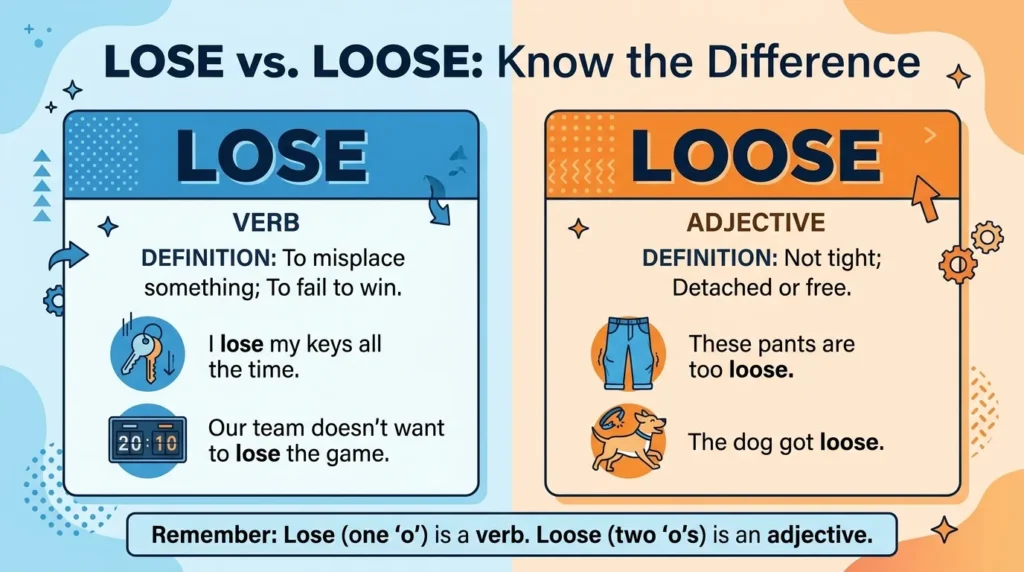
- Lose is a verb. It means to fail to keep something, fail to win, or no longer have something.
- Loose is usually an adjective. It means not tight, free, or not securely attached.
Examples
✅ I don’t want to lose my wallet.
❌ I don’t want to loose my wallet.
✅ These shoes are too loose.
❌ These shoes are too lose.
Quick Comparison
| Word | Part of Speech | Meaning | Example |
|---|---|---|---|
| Lose | Verb | To misplace or fail to win | We may lose the game. |
| Loose | Adjective | Not tight or free | The bolt is loose. |
Easy Trick:
- Lose = Missing something
- Loose = Not tight
The Origin of Lose vs Loose
Although the words look alike today, they come from different historical roots.
Origin of Lose
The word lose comes from the Old English word losian, meaning:
- perish
- be destroyed
- fail
- be deprived of something
Over time, it became the modern English verb lose, meaning to no longer have something or to fail.
Example:
- Lose money
- Lose a game
- Lose your phone
Origin of Loose
The word loose comes from the Old Norse word lauss, meaning:
- free
- unattached
- not fixed
- untied
Its meaning has stayed almost the same for hundreds of years.
Example:
- Loose clothing
- Loose rope
- Loose screw
Why the Spellings Are Different
The confusion happens because:
- Both words begin with loo-
- Their pronunciation is similar.
- Only one extra “o” changes the meaning completely.
Remember:
- Lose = one “o”
- Loose = two “o”s” because something has extra space.
British English vs American English Spelling
Unlike words such as color/colour or center/centre, lose and loose are spelled the same in both British English and American English.
Only the pronunciation may vary slightly depending on accent.
Comparison Table
| Meaning | American English | British English |
|---|---|---|
| Misplace something | Lose | Lose |
| Fail to win | Lose | Lose |
| Not tight | Loose | Loose |
| Free or unattached | Loose | Loose |
American English Examples
- Don’t lose your passport.
- My shirt is loose.
British English Examples
- Don’t lose your umbrella.
- Your jumper is loose.
There is no spelling difference between US and UK English for these words.
Which Spelling Should You Use?
The correct spelling depends on the meaning, not your location.
If you’re writing for US readers
Use:
- Lose for failing, missing, or not winning.
- Loose for something that is not tight.
If you’re writing for UK readers
The same rule applies.
If you’re writing for international readers
Again, use the same spellings.
Audience Guide
| Audience | Correct Spelling |
|---|---|
| United States | Lose / Loose |
| United Kingdom | Lose / Loose |
| Canada | Lose / Loose |
| Australia | Lose / Loose |
| New Zealand | Lose / Loose |
| International English | Lose / Loose |
The meaning determines the correct word.
Common Mistakes with Lose vs Loose
Many people accidentally replace one word with the other.
Mistake 1
❌ I don’t want to loose my job.
✅ I don’t want to lose my job.
Mistake 2
❌ These pants are lose.
✅ These pants are loose.
Mistake 3
❌ We will loose the match.
✅ We will lose the match.
Mistake 4
❌ The dog is lose.
✅ The dog is loose.
Mistake 5
❌ Don’t loose hope.
✅ Don’t lose hope.
Easy Memory Trick
Think:
Loose has two O’s because loose things have extra room.
Lose has one O because you’ve already lost one.
Lose vs Loose in Everyday Examples
Here are examples from daily life.
In Emails
Correct:
Please don’t lose the attached document.
Incorrect:
Please don’t loose the attached document.
In News Articles
Correct:
The team may lose the championship.
Correct:
A loose cable caused the power outage.
On Social Media
Correct:
Never lose confidence.
Correct:
My hoodie feels loose after washing.
In School Writing
Correct:
Plants lose water through their leaves.
Correct:
The wheel became loose.
In Business Writing
Correct:
The company could lose customers.
Correct:
Tighten any loose connections before operating the machine.
Lose vs Loose – Google Trends & Usage Data
Search interest for lose vs loose remains high because it is one of the most commonly confused word pairs in English.
Why People Search It
- Homework help
- Grammar correction
- Email writing
- Professional writing
- Social media posts
- Job applications
Countries Where the Search Is Popular
- United States
- United Kingdom
- Canada
- Australia
- India
- South Africa
The mistake appears frequently in online writing because spell checkers do not always catch correctly spelled but incorrectly used words.
Lose vs Loose Comparison Table
| Feature | Lose | Loose |
|---|---|---|
| Part of speech | Verb | Adjective (sometimes verb) |
| Meaning | Misplace or fail | Not tight |
| Pronunciation | /luːz/ | /luːs/ |
| Used for | Games, money, objects | Clothes, screws, ropes |
| Example | Don’t lose your keys. | My jacket is loose. |
| Opposite | Find / Win | Tight |
FAQs
1. Is it lose or loose weight?
The correct phrase is lose weight because lose means to reduce or no longer have something.
2. Is it lose my keys or loose my keys?
The correct expression is lose my keys.
3. Why do people confuse lose and loose?
They have similar spellings and similar pronunciation, making them easy to mix up.
4. Is loose ever used as a verb?
Yes. It can mean to release or set free, but this use is much less common.
Example:
The farmer loosed the horses.
5. Is lose always a verb?
Yes. Lose is used as a verb.
Examples:
- Lose money
- Lose time
- Lose a match
6. Which word means “not tight”?
The correct word is loose.
Example:
The lid is loose.
7. How can I remember the difference?
Remember this simple rule:
- Lose = fail or misplace
- Loose = not tight
Also remember:
Loose has an extra “O” because it has extra room.
Conclusion
The difference between lose vs loose is simple once you know their meanings. Lose is a verb that means to misplace something, fail to win, or no longer have something. Loose is an adjective that describes something that is not tight, fixed, or secure. Even though the two words look similar, they are never interchangeable.
Whether you’re writing an email, a school assignment, a business report, or a social media post, choosing the correct word helps make your writing clear and professional. A simple spelling mistake can completely change the meaning of a sentence, so it is worth taking a moment to check which word fits your message.
A helpful memory trick is that loose has two “O”s, just like something with extra space, while lose has only one “O.” With regular practice and the examples in this guide, you’ll avoid this common grammar mistake and use both words correctly every time. Remember: lose means to misplace or fail, and loose means not tight.