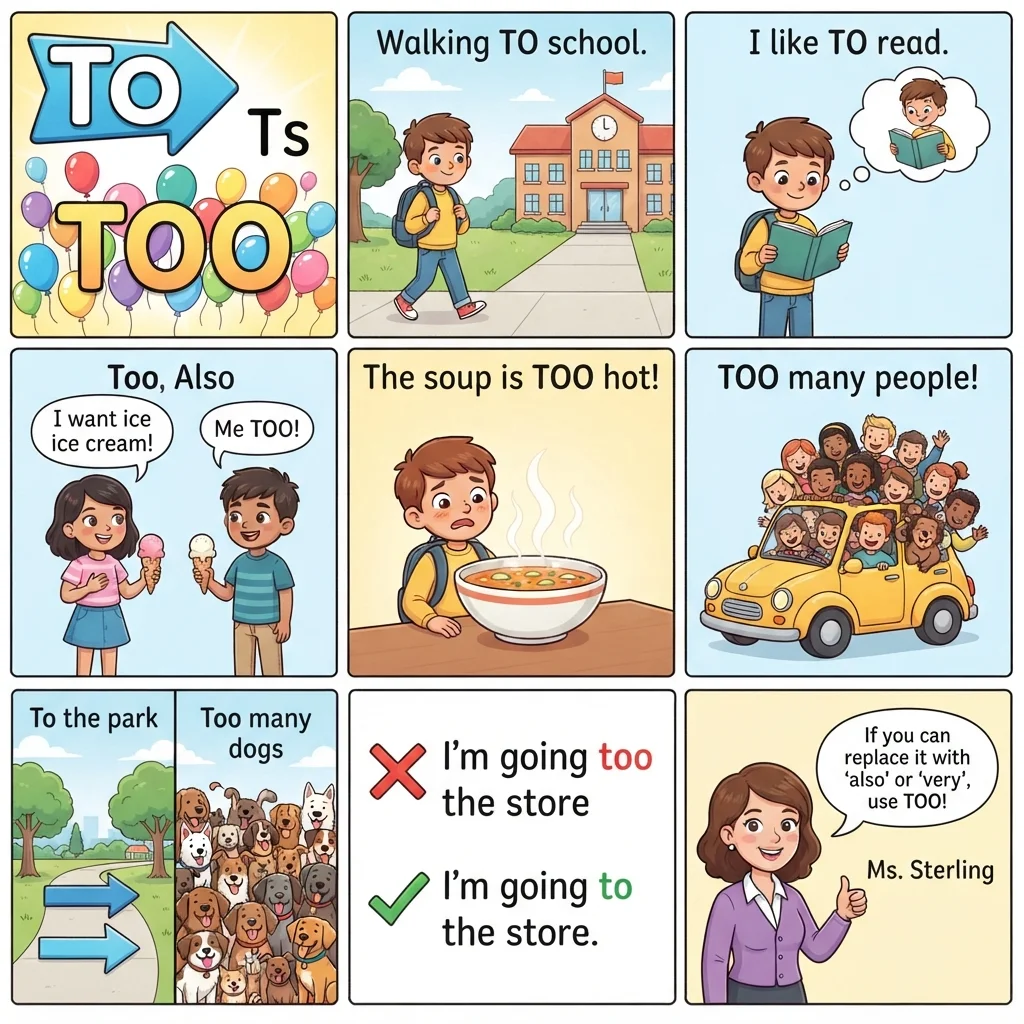

To vs Too – Quick Answer
To and too sound almost the same, but they have different meanings and uses.
To is mainly used as a preposition or before a verb in the infinitive form.
Examples:
- I am going to school.
- She wants to learn English.
- Give the book to John.
Too usually means also or more than needed.
Examples:
- I want to go too.
- This bag is too heavy.
- The coffee is too hot.
The easiest way to remember the difference is:
To = direction, connection, or before a verb
Too = also or excessively
Compare:
I want to go too.
The first to introduces the verb “go.” The second too means “also.”
This small spelling difference causes many mistakes because to and too have similar sounds. However, their grammar roles are different. Learning where each word belongs can quickly improve emails, school assignments, social media posts, and professional writing.
The Origin of To vs Too
The words to and too have different histories, even though modern English speakers often pronounce them in similar ways.
Origin of “To”
To comes from Old English tō. It was used to show movement, direction, relationship, or purpose.
Over time, its uses expanded.
For example:
- go to London
- give it to me
- want to eat
- listen to music
The word remained short because it became one of the most common words in English.
Origin of “Too”
Too also comes from Old English. It developed from words related to the meaning “also” and “in addition.”
Later, too also developed the meaning “excessively” or “more than is wanted.”
For example:
- I want to come too. → also
- It is too expensive. → excessively
The extra o helps modern readers distinguish it from to.
Why Do To and Too Sound Similar?
English pronunciation changed over many centuries. Some short words became pronounced in similar ways.
Today, to is often pronounced weakly in normal speech, while too usually has a stronger /uː/ sound.
For example:
I want to go too.
In natural speech, the first word may sound like “tuh,” while too sounds like “too.”
This difference between spelling, pronunciation, and grammar is one reason learners often confuse the two words.
British English vs American English Spelling
There is no spelling difference between British English and American English for “to” and “too.”
Both varieties use:
- to
- too
The meanings and basic grammar rules are also the same.
Comparison Table
| Feature | British English | American English |
|---|---|---|
| Direction | to | to |
| Infinitive | to | to |
| Also | too | too |
| Excessively | too | too |
| “I want to go.” | Correct | Correct |
| “I want to go too.” | Correct | Correct |
| “It is too cold.” | Correct | Correct |
For example:
British English:
I am going to London too.
American English:
I am going to New York too.
The rules are identical.
Unlike words such as colour/color or centre/center, to and too do not have British and American spelling variants.
Pronunciation Can Vary
Accent can affect pronunciation, but the written forms remain the same.
This means you do not need to choose between British and American spelling when writing to vs too.
Which Spelling Should You Use?
The correct word depends on meaning, not the country where your reader lives.
Use “To” When Showing Direction
Use to when someone or something moves toward a place or person.
Examples:
- We went to school.
- She drove to work.
- Give this letter to Sarah.
Use “To” Before a Verb
Use to before the base form of many verbs.
Examples:
- I want to learn.
- They plan to travel.
- He needs to study.
This is called the infinitive form.
Use “Too” for “Also”
Use too when you mean also or as well.
Examples:
- I like coffee too.
- She is coming too.
- Can I come too?
Use “Too” for “Excessively”
Use too when something is more than necessary, wanted, or suitable.
Examples:
- The box is too heavy.
- The water is too cold.
- This shirt is too expensive.
For US Readers
Use the same rules.
For UK and Commonwealth Readers
Use the same rules.
For Global Readers
Use the same rules.
The important point is not regional spelling. It is meaning and grammar.
Common Mistakes with To vs Too
Mistake 1: Writing “Too” Before a Verb
Incorrect:
I want too eat.
Correct:
I want to eat.
Here, to comes before the verb “eat.”
Mistake 2: Using “To” for “Also”
Incorrect:
I want to come to.
Correct:
I want to come too.
Here, too means “also.”
Mistake 3: Confusing “Too Much” and “To Much”
Incorrect:
There is to much noise.
Correct:
There is too much noise.
Use too when you mean “more than necessary.”
Mistake 4: Confusing “Too Many” and “To Many”
Incorrect:
There are to many people here.
Correct:
There are too many people here.
Use too many for an excessive number.
Mistake 5: Writing “To” Instead of “Too” at the End
Incorrect:
I want one to.
Correct:
I want one too.
If you mean also, use too.
Quick Memory Trick
Remember:
Too has two O’s because it can mean “two” extra ideas:
- also
- excessively
Examples:
I want to go too. → also
It is too hot. → excessively
To vs Too in Everyday Examples
These words appear constantly in everyday English.
In Emails
To:
I am writing to ask about the meeting.
Too:
I would like to attend too.
Here, the first to introduces the purpose, while too means “also.”
In News
The minister traveled to London.
The new policy is too expensive for some businesses.
The first sentence shows destination. The second expresses excess.
On Social Media
I want to see this movie too!
It is too funny!
Social media often uses both words in short sentences.
In Formal Writing
The company plans to expand its operations.
The proposed cost may be too high for smaller businesses.
Both words are correct in professional writing when their meanings fit the sentence.
In Questions
Are you going to the party?
Are you coming too?
The first sentence asks about destination. The second asks whether the person is also coming.
To vs Too – Google Trends & Usage Data
To vs Too is a common English-learning search topic because the two words sound similar but have different meanings.
People often search for:
- to vs too
- difference between to and too
- when to use to or too
- to and too examples
- to vs too grammar
- too meaning
- to meaning
Search interest usually comes from students, English learners, teachers, parents helping with homework, and people checking their writing.
Countries with large English-learning populations can generate strong interest in grammar questions. These include India, Pakistan, the Philippines, Nigeria, the United States, and the United Kingdom.
However, Google Trends measures relative search interest, not a fixed number of searches. Interest can also change because of school terms, exams, educational content, and seasonal learning patterns.
For SEO, To vs Too has strong informational intent. Users normally want a quick answer first, followed by examples and a clear rule.
That makes a page with a short definition, comparison table, examples, mistakes, and FAQs useful for searchers.
To vs Too: Comparison Table
| Word | Main Meaning | Grammar Use | Example |
|---|---|---|---|
| To | Direction | Preposition | Go to school. |
| To | Connection | Preposition | Give it to me. |
| To | Purpose/action | Infinitive marker | I want to learn. |
| Too | Also | Adverb | I want it too. |
| Too | Excessively | Adverb | It is too hot. |
| Too much | Excessive amount | Adverb + determiner | It costs too much. |
| Too many | Excessive number | Adverb + determiner | There are too many cars. |
Side-by-Side Examples
| To | Too |
|---|---|
| I went to work. | I went too. |
| I want to eat. | I want some too. |
| Give it to John. | John wants it too. |
| She moved to Canada. | It is too cold. |
| We need to leave. | We are too late. |
FAQs About To vs Too
1. What is the difference between “to” and “too”?
To usually shows direction, connection, or comes before a verb. Too usually means “also” or “excessively.”
2. Is it “I want to go” or “I want too go”?
The correct sentence is:
I want to go.
Use to before the verb “go.”
3. Is it “me too” or “me to”?
The correct phrase is:
Me too.
It means “me also.”
4. Is “too much” correct?
Yes.
This costs too much.
Here, too means more than is wanted or needed.
5. Is “too many” correct?
Yes.
There are too many people here.
Use too many when there is an excessive number of something countable.
6. Do British and American English use “to” and “too” differently?
No. The basic spelling and grammar rules are the same in both British and American English.
7. How can I remember the difference between to and too?
Remember:
To = direction or before a verb.
Too = also or more than enough.
For example:
I want to go too.
8. Can “too” come at the beginning of a sentence?
Yes, but its meaning depends on context. In normal conversation, too often appears after the subject or at the end.
Example:
Too much noise can make it hard to work.
Here, too much means an excessive amount.
Conclusion
Understanding To vs Too is easy once you focus on meaning. To is mainly used for direction, connection, or before a verb. For example, we say go to school, give it to me, and want to learn. Too has two common meanings: also and more than necessary. We say I want to come too and the bag is too heavy.
There is no British or American spelling difference between these two words. Both English varieties use to and too in the same basic way. The correct choice depends on the role of the word in the sentence.
When you are unsure, ask yourself a simple question. Does the word mean “also” or “more than enough”? If yes, use too. If it shows direction or comes before a verb, use to.
Learning this small rule can prevent common grammar errors and make your everyday, academic, and professional writing much clearer.