
Have you ever written gray and wondered if grey was the correct spelling? Or have you seen both forms and wondered why English uses two spellings for the same color?
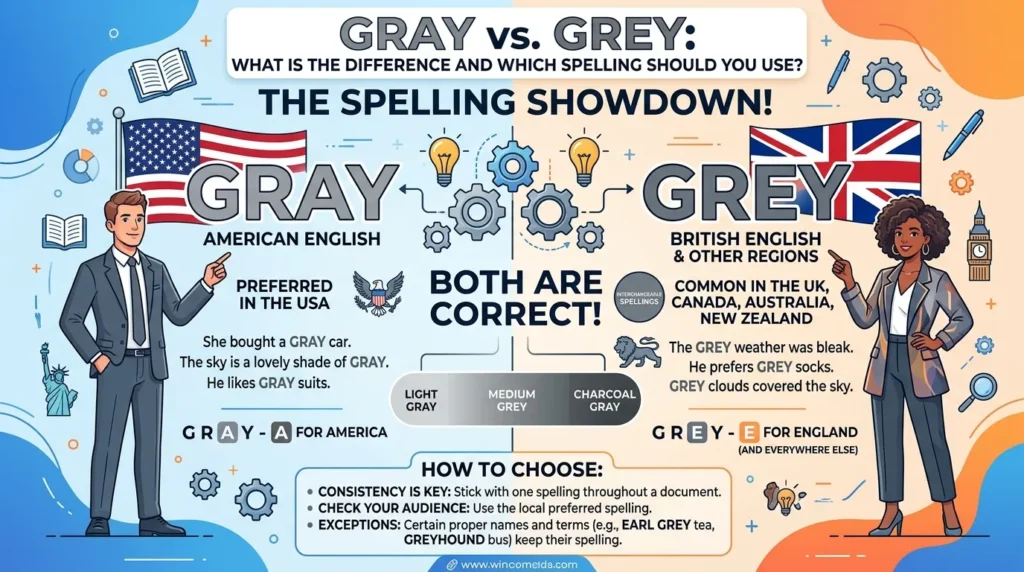
The good news is simple: gray and grey mean exactly the same color. The main difference is regional spelling. Gray is more common in American English, while grey is more common in British English and many other varieties of English.
People often search for “gray vs grey” because both spellings appear in books, websites, product descriptions, emails, and everyday writing. The difference can be confusing, especially when writing for an international audience.
This guide explains the meaning, history, pronunciation, regional usage, common mistakes, and practical examples of gray vs grey. You will also learn which spelling to use in American, British, Commonwealth, and global English.
By the end, you will know when to use gray, when to use grey, and why both spellings are correct.
Gray vs Grey – Quick Answer
Gray and grey are two spellings of the same word. Both describe a color between black and white.
- Gray → more common in American English
- Grey → more common in British English and many Commonwealth varieties
Examples
American English:
The gray sky looked cloudy.
British English:
The grey sky looked cloudy.
Both sentences have the same meaning.
Quick Comparison
| Word | Main Usage | Example |
|---|---|---|
| Gray | American English | a gray shirt |
| Grey | British English | a grey shirt |
There is usually no difference in pronunciation. Both are generally pronounced /ɡreɪ/, like the word day with a “gr” sound.
The Origin of Gray vs Grey
The word gray/grey has a long history in English and other Germanic languages.
The modern English word is related to Old English grǣg, which referred to the color gray. Similar forms appeared in other Germanic languages.
Over time, English developed different spelling traditions. Both gray and grey survived.
Why Are There Two Spellings?
English spelling was not always standardized. Before modern dictionaries and spelling systems became common, writers used different forms of many words.
The spelling grey became strongly associated with British English.
The spelling gray became especially common in American English.
The difference is therefore mainly a matter of regional spelling preference, not meaning.
Is One Spelling Older?
Both forms have historical roots, but grey has traditionally been more common in British English, while gray became especially established in American English.
Neither spelling is incorrect.
British English vs American English Spelling
The biggest difference between gray vs grey is regional usage.
American English
American English generally prefers:
gray
Examples:
- gray hair
- gray suit
- gray building
- gray clouds
- gray matter
British English
British English generally prefers:
grey
Examples:
- grey hair
- grey suit
- grey building
- grey clouds
- grey matter
Comparison Table
| Usage | American English | British English |
|---|---|---|
| Color | gray | grey |
| Hair | gray hair | grey hair |
| Sky | gray sky | grey sky |
| Suit | gray suit | grey suit |
| Animal | gray wolf | grey wolf |
| Adjective | gray | grey |
| Noun | gray | grey |
The meaning remains the same.
Important Exception: Proper Names
Some names and official terms use one particular spelling regardless of the variety of English.
For example, a company, organization, person, place, or product may officially use Gray or Grey.
When writing a proper name, keep its official spelling.
Which Spelling Should You Use?
The best spelling depends on your audience.
For American English
Use gray if your audience is mainly in the United States.
Example:
The walls are painted gray.
This is the standard American spelling.
For British English
Use grey if your audience is mainly in the United Kingdom.
Example:
The walls are painted grey.
For Commonwealth English
Grey is generally preferred in many Commonwealth varieties, including British-influenced English usage in countries such as Australia and New Zealand.
However, local style guides can vary.
For Global English
Both forms are widely understood.
If you are writing for a worldwide audience, choose one spelling and use it consistently.
For an American-focused website, use gray.
For a British-focused website, use grey.
Common Mistakes With Gray vs Grey
Mistake 1: Thinking They Have Different Meanings
Incorrect idea:
Gray and grey describe different colors.
Correct:
Gray and grey normally describe the same color.
The difference is mainly spelling.
Mistake 2: Mixing Styles in the Same Article
You might write:
The gray car has a grey interior.
This is not automatically grammatically wrong, but if both words are being used simply for the same color, consistency is usually better.
Choose one style based on your audience.
Mistake 3: Changing a Proper Name
Suppose a person’s official name is Grey.
Do not change it to Gray simply because you are writing American English.
Proper names should keep their official spelling.
Mistake 4: Assuming “Grey” Is Wrong in America
This is not true.
Gray is the more common American spelling, but grey is still recognizable and can appear in proper names, titles, historical terms, and other contexts.
Mistake 5: Assuming “Gray” Is Wrong in Britain
Likewise, gray can be seen in British English, especially in names and specific terms.
However, grey is the normal British spelling for the color.
Gray vs Grey in Everyday Examples
Both forms are used as adjectives and can describe the same color.
In Emails
American English:
Please use the gray template for the report.
British English:
Please use the grey template for the report.
In News
American style:
Heavy gray clouds covered the city.
British style:
Heavy grey clouds covered the city.
On Social Media
American:
I love this gray jacket!
British:
I love this grey jacket!
In Formal Writing
American:
The study examined changes in gray matter.
British:
The study examined changes in grey matter.
The spelling may change, but the meaning does not.
Gray vs Grey as a Noun and Adjective
The word can function as an adjective or noun.
As an Adjective
It describes something.
She wore a gray dress.
She wore a grey dress.
As a Noun
It can refer to the color itself.
Gray is a popular neutral color.
Grey is a popular neutral colour.
Again, the regional spelling changes, but the meaning remains the same.
Gray vs Grey in Science and Technical Writing
The spelling difference also appears in technical language.
One important example is the SI unit gray, symbol Gy, which measures absorbed dose of ionizing radiation.
In this technical context, gray is the standardized spelling of the unit name, regardless of whether the surrounding text follows British or American English.
This is a useful example of why writers should not automatically change every gray to grey in technical documents.
Example
The absorbed dose was measured in gray (Gy).
The unit is written gray, not grey.
Gray vs Grey – Google Trends & Usage Data
Searches for “gray vs grey” are common because both spellings are correct but their regional use differs.
The main pattern is:
- Gray is strongly associated with the United States.
- Grey is strongly associated with the United Kingdom.
- Grey is also common in many Commonwealth English contexts.
- Both forms are widely understood around the world.
People often search for the comparison when writing:
- School assignments
- Blog posts
- Business documents
- Product descriptions
- Websites
- Emails
- Social media posts
- English-learning materials
Search interest can also increase when people are unsure which spelling to use for an international audience.
Related Searches
Common related searches include:
- gray vs grey spelling
- gray or grey
- is gray or grey correct?
- gray meaning
- grey meaning
- gray American spelling
- grey British spelling
- gray vs grey color
Gray vs Grey Comparison Table
| Feature | Gray | Grey |
|---|---|---|
| Meaning | Color between black and white | Same |
| American English | Common | Less common |
| British English | Less common | Common |
| Commonwealth English | Used, but less common | Generally common |
| Pronunciation | /ɡreɪ/ | /ɡreɪ/ |
| Adjective | Yes | Yes |
| Noun | Yes | Yes |
| Correct spelling | Yes | Yes |
| Technical SI unit | Yes | No |
| Basic color meaning | Same | Same |
Gray vs Grey: Easy Memory Trick
If you often forget which spelling belongs to which variety of English, use this simple trick:
A = America
Think:
GrAy = America
The letter A in gray can remind you of America.
E = England
Think:
GrEy = England
The letter E in grey can remind you of England.
This is not a grammar rule. It is simply an easy memory aid.
FAQs About Gray vs Grey
Is gray or grey correct?
Both gray and grey are correct. Gray is more common in American English, while grey is more common in British English.
Is grey British or American?
Grey is traditionally the standard spelling in British English. It is also widely used in many Commonwealth varieties of English.
Is gray American English?
Yes. Gray is the standard and more common spelling in American English.
Do gray and grey mean the same thing?
Yes. In normal use, they describe the same color between black and white.
Are gray and grey pronounced differently?
No. They are normally pronounced the same: /ɡreɪ/.
Which spelling should I use for an American website?
Use gray if your website is aimed mainly at American readers.
Which spelling should I use for a British website?
Use grey for a British-focused website.
Is gray wrong in British English?
No. Gray can appear in British English, especially in proper names and specific terms. However, grey is the normal British spelling for the color.
Is grey wrong in American English?
No. Grey is understood in American English and may appear in names or specific expressions. However, gray is the usual American spelling.
Conclusion
The difference between gray vs grey is simple: they are two spellings of the same color. There is no major difference in meaning or pronunciation.
The main distinction is regional. Gray is the standard and more common spelling in American English, while grey is the standard and more common spelling in British English and many Commonwealth varieties.
If you are writing for American readers, choose gray. If your audience is mainly British, choose grey. For international readers, either spelling is widely understood, but consistency is important.
There are also exceptions. Proper names should keep their official spelling, and the SI unit for absorbed radiation dose is spelled gray everywhere.
The easiest memory trick is “A for America” and “E for England.” Once you remember this, choosing between gray and grey becomes much easier. Most importantly, do not worry about meaning: both words refer to the same color.