
Have you ever written “I am taller then my brother” or “Finish your homework than watch TV”? These are common mistakes because than and then look and sound similar. However, they have completely different meanings. Using the wrong word can confuse readers and make your writing look less accurate.
Many people search for than vs then because they want to improve their grammar for school, work, emails, social media, or professional writing. English learners and native speakers alike often mix up these two words since only one letter changes their spelling. The good news is that learning the difference is easy once you understand when each word is used.
This guide explains than vs then in simple English with clear examples, helpful memory tricks, comparison tables, and everyday usage. You’ll also learn about the history of these words, British and American English usage, common mistakes, and answers to frequently asked questions.
By the end of this article, you’ll know exactly when to use than and when to use then with confidence.
Than vs Then – Quick Answer
The difference is simple:
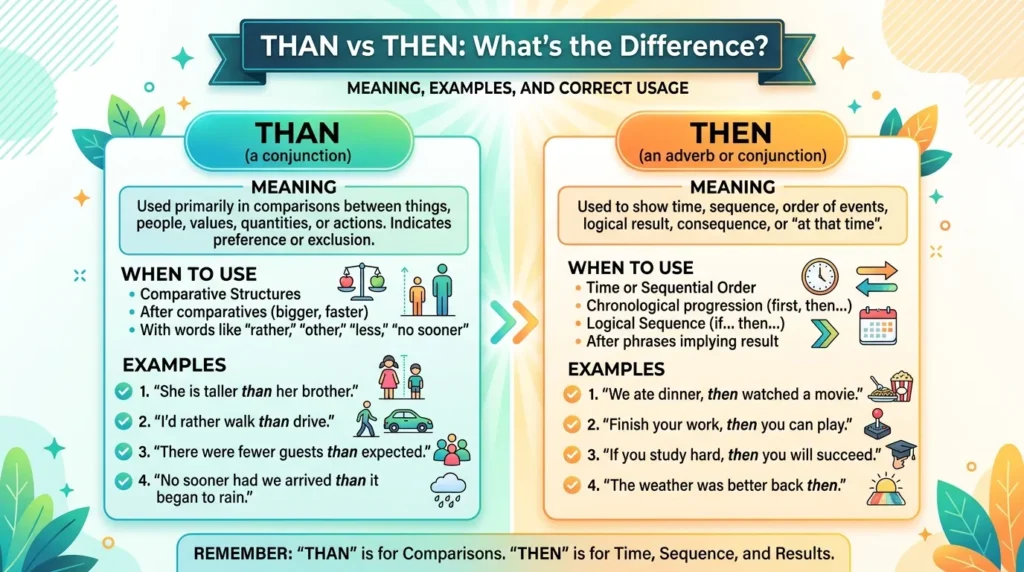
- Than is used for comparison.
- Then is used for time, order, or what happens next.
Examples
✅ She is taller than her sister.
❌ She is taller then her sister.
✅ Finish your homework, then watch TV.
❌ Finish your homework, than watch TV.
Quick Comparison
| Word | Part of Speech | Meaning | Example |
|---|---|---|---|
| Than | Conjunction/Preposition | Used for comparison | Cats are smaller than dogs. |
| Then | Adverb/Noun | Refers to time or sequence | We ate dinner, then went home. |
Easy Rule:
- Than = Compare
- Then = Time
The Origin of Than vs Then
Although than and then look similar today, they developed different meanings over time.
Origin of Than
The word than comes from the Old English word þonne, which was used when making comparisons.
Examples:
- Better than
- More than
- Less than
Over time, English grammar changed, and than became the standard word for comparisons.
Origin of Then
The word then also comes from the Old English word þonne, but it kept its meaning of at that time or next.
Examples:
- Then we left.
- I was younger then.
Today, then is mainly used to talk about time or sequence.
Why Are They Different?
As English evolved, the single Old English word developed into two separate words:
- Than for comparisons
- Then for time and sequence
Although they share a common origin, they now serve different grammar purposes.
British English vs American English Spelling
Unlike words such as colour/color or centre/center, than and then have the same spelling in both British and American English.
The only differences you may notice are in pronunciation due to regional accents.
Comparison Table
| Meaning | American English | British English |
|---|---|---|
| Comparison | Than | Than |
| Time or sequence | Then | Then |
American English Examples
- This book is better than that one.
- We finished lunch, then went shopping.
British English Examples
- Tea is stronger than coffee.
- We arrived, then checked in.
There is no spelling difference between British and American English.
Which Spelling Should You Use?
The correct word depends on the meaning of your sentence—not on the country you’re writing for.
For US Readers
Use:
- Than for comparisons.
- Then for time and sequence.
For UK Readers
The same grammar rules apply.
For Commonwealth Countries
Writers in Canada, Australia, New Zealand, and other English-speaking countries also use the same spellings.
Audience Guide
| Audience | Correct Usage |
|---|---|
| United States | Than / Then |
| United Kingdom | Than / Then |
| Canada | Than / Then |
| Australia | Than / Then |
| New Zealand | Than / Then |
| International English | Than / Then |
Meaning—not location—determines which word you should use.
Common Mistakes with Than vs Then
Many writers accidentally replace one word with the other.
Mistake 1
❌ She is smarter then me.
✅ She is smarter than me.
Mistake 2
❌ Eat dinner than go to bed.
✅ Eat dinner then go to bed.
Mistake 3
❌ I’d rather walk then drive.
✅ I’d rather walk than drive.
Mistake 4
❌ Finish your work than call me.
✅ Finish your work then call me.
Mistake 5
❌ This laptop costs more then mine.
✅ This laptop costs more than mine.
Memory Trick
Remember:
- Than has the letter A for Comparison (“A” reminds you of compArison).
- Then has the letter E for Next Event.
Than vs Then in Everyday Examples
Here are common real-life examples.
In Emails
Correct:
Please review the report, then send it to me.
Correct:
This option is better than the previous one.
In News Articles
Correct:
Inflation is higher than last year.
Correct:
The meeting ended, then the announcement was made.
On Social Media
Correct:
Work hard, then relax.
Correct:
Summer is hotter than spring.
In School Writing
Correct:
Gold is heavier than aluminum.
Correct:
Mix the chemicals, then record the results.
In Business Writing
Correct:
Sales were higher than expected.
Correct:
Sign the agreement, then submit the documents.
Than vs Then – Google Trends & Usage Data
The keyword than vs then is searched thousands of times every month because it is one of the most common grammar questions in English.
Why People Search It
- Grammar lessons
- School homework
- Professional writing
- Email proofreading
- Social media posts
- Competitive exams
- English learning
Countries Where It Is Popular
- United States
- United Kingdom
- Canada
- Australia
- India
- Philippines
People often search this keyword because spell checkers may not catch the mistake. Both words are spelled correctly, but only one fits the sentence.
Than vs Then Comparison Table
| Feature | Than | Then |
|---|---|---|
| Main Use | Comparison | Time or sequence |
| Part of Speech | Conjunction/Preposition | Adverb/Noun |
| Meaning | Compare two things | What happens next |
| Example | Faster than a bike | Then we went home |
| Common Question | Better than? | What happened then? |
| Memory Tip | A = Comparison | E = Next Event |
FAQs
1. What is the difference between than and then?
Than is used for comparisons, while then is used to describe time or the next event.
2. Is it “better than” or “better then”?
The correct phrase is better than because it compares two things.
3. Is it “and then” or “and than”?
The correct phrase is and then because it shows the next action.
4. How can I remember the difference?
Use this simple trick:
- Than = Compare
- Then = Time
5. Can than and then be used interchangeably?
No. They have different meanings and grammar rules.
6. Do British and American English spell them differently?
No. Both countries use the same spellings: than and then.
7. Why do people confuse than and then?
They look similar, sound alike in some accents, and differ by only one letter, making them easy to mix up.
Conclusion
Understanding than vs then is easier than many people think. Although these words look almost the same, they have very different jobs in English. Than is used whenever you compare two people, objects, ideas, or amounts. Then is used when talking about time, order, or the next step in a sequence. Choosing the correct word makes your writing clearer and more professional.
Whether you’re writing an email, a report, a social media post, or a school assignment, using than and then correctly helps readers understand your message without confusion. A simple memory trick can make all the difference: than is for comparison, while then is for time or what happens next.
Practice using these words in everyday sentences, and you’ll quickly build confidence. With the examples, comparison tables, and tips in this guide, you’ll avoid one of the most common English grammar mistakes and communicate more clearly in every situation.