
If you’re starting your programming journey, one of the first questions you’ll probably ask is Python vs Java—which language should I learn? It’s one of the most searched programming comparisons because both languages are powerful, popular, and used by millions of developers worldwide.
The confusion usually comes from the fact that Python and Java can both build websites, desktop software, mobile apps, games, and business applications. However, they have different strengths, learning curves, and career opportunities. Beginners often struggle to decide which language fits their goals, while experienced developers compare them for performance, scalability, and real-world use.
This guide explains Python vs Java in simple English. You’ll learn the key differences, history, popularity, advantages, and practical uses of each language. We’ll also clear up common misconceptions, compare British and American English terminology where relevant, provide real-world examples, answer frequently asked questions, and help you choose the right language based on your needs.
Python vs Java – Quick Answer
Python is a high-level programming language known for its simple syntax, readability, and fast development.
Java is a high-level, object-oriented programming language designed for performance, portability, and large-scale applications.
Quick Comparison
| Feature | Python | Java |
|---|---|---|
| Learning Difficulty | Easy | Moderate |
| Syntax | Simple | More detailed |
| Speed | Slower | Faster |
| Mobile Apps | Limited | Excellent (Android) |
| AI & Machine Learning | Excellent | Good |
| Enterprise Software | Good | Excellent |
| Web Development | Excellent | Excellent |
Example
If you want to build an AI chatbot quickly, Python is often the better choice.
If you want to build a large banking system or Android application, Java is usually preferred.
The Origin of Python vs Java
Although people search for Python vs Java as if they are competing products, they were created for different purposes and at different times.
Python
Python was created by Guido van Rossum in 1991.
The name Python comes from the British comedy show “Monty Python’s Flying Circus,” not from the snake.
Its main goal was to make programming simple and readable.
Java
Java was developed by James Gosling and his team at Sun Microsystems in 1995.
It was originally called Oak, named after an oak tree near Gosling’s office.
Later, it was renamed Java, inspired by Java coffee.
Why There Are No Spelling Differences
Unlike words such as “color” and “colour,” Python and Java are official product names.
Their spelling never changes in British English or American English.
British English vs American English Spelling
Unlike many English words, Python and Java have identical spelling worldwide.
The only differences you may notice are in surrounding English words.
Examples
British English:
- Optimise Python code
- Analyse Java performance
- Organise your project
American English:
- Optimize Python code
- Analyze Java performance
- Organize your project
The programming language names themselves never change.
Comparison Table
| British English | American English |
|---|---|
| Python | Python |
| Java | Java |
| Optimise | Optimize |
| Analyse | Analyze |
| Organise | Organize |
| Programme | Program (software) |
Which Spelling Should You Use?
For Python and Java, always use the official spelling.
However, the surrounding English depends on your audience.
For US Readers
Use American English.
Example:
- Optimize your Python code.
- Java program.
For UK Readers
Use British English.
Example:
- Optimise your Python code.
- Java programme (when referring to a software program in British style).
For a Global Audience
Choose one style and stay consistent throughout your article.
Most technology websites use American English because it is common in programming documentation.
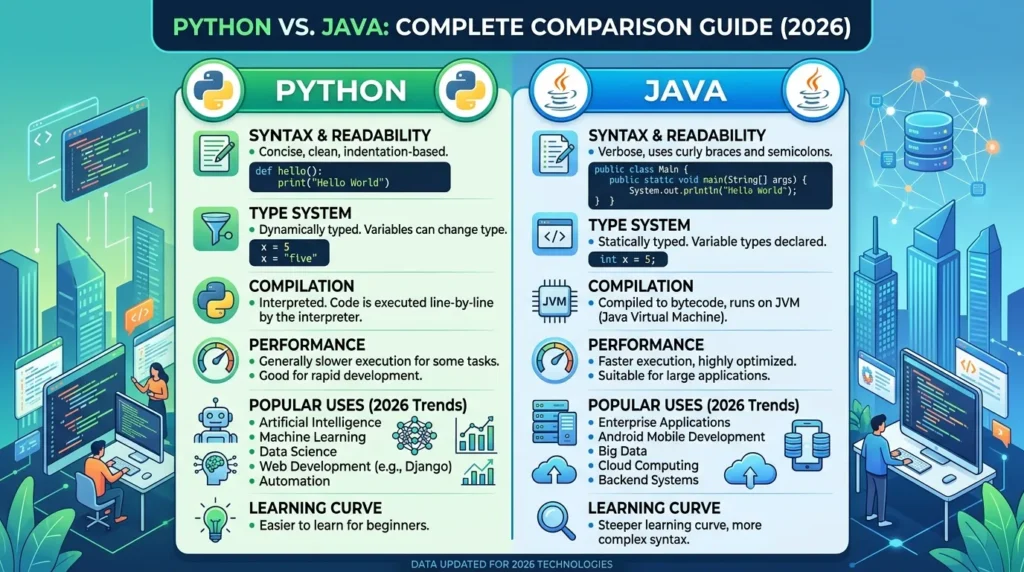
Python vs Java: Key Differences
Syntax
Python uses fewer lines of code.
Example:
Python
print("Hello World")
Java
public class Main {
    public static void main(String[] args) {
        System.out.println("Hello World");
    }
}
Python is easier for beginners because its syntax is cleaner.
Performance
Java is generally faster because it runs on the Java Virtual Machine (JVM) with advanced optimization.
Python is interpreted, making it slower for many tasks.
Ease of Learning
Python is widely considered one of the easiest programming languages.
Java requires understanding classes, objects, and stronger typing from the beginning.
Object-Oriented Programming
Java is fully object-oriented.
Python supports object-oriented programming but also allows procedural and functional programming.
Memory Management
Both languages include automatic garbage collection.
Developers do not need to manage memory manually in most situations.
Platform Support
Both languages work on:
- Windows
- macOS
- Linux
Java follows the principle:
“Write Once, Run Anywhere.”
Python also runs on multiple operating systems with minimal changes.
Python vs Java Comparison Table
| Feature | Python | Java |
|---|---|---|
| Release Year | 1991 | 1995 |
| Creator | Guido van Rossum | James Gosling |
| Learning Curve | Easy | Moderate |
| Execution | Interpreted | Compiled to JVM Bytecode |
| Performance | Moderate | High |
| Readability | Excellent | Good |
| AI & Data Science | Excellent | Good |
| Android Development | Limited | Excellent |
| Enterprise Applications | Good | Excellent |
| Community | Very Large | Very Large |
Common Mistakes with Python vs Java
Many beginners misunderstand the differences.
Mistake 1
Python is only for beginners.
✅ Correction:
Python is used by major companies for AI, automation, web development, and scientific computing.
Mistake 2
Java is outdated.
✅ Correction:
Java remains one of the world’s most widely used enterprise programming languages.
Mistake 3
Java is impossible to learn.
✅ Correction:
Java has a steeper learning curve, but millions of beginners learn it successfully.
Mistake 4
Python is always slower.
✅ Correction:
Python is slower for many tasks, but optimized libraries perform extremely well.
Mistake 5
You must learn only one language.
✅ Correction:
Many professional developers know both Python and Java.
Python vs Java in Everyday Examples
“Our new automation tool was built using Python.”
News
“Many financial companies continue using Java for enterprise software.”
Social Media
“I’m learning Python before moving to Java.”
Formal Writing
“Python is widely adopted for machine learning, while Java remains a leading language for enterprise application development.”
Python vs Java – Google Trends & Usage Data
Both languages remain among the world’s most popular programming languages.
Python
Most popular for:
- Artificial Intelligence
- Machine Learning
- Data Science
- Automation
- Education
Countries with high interest include:
- United States
- India
- Canada
- Germany
- Australia
Java
Most popular for:
- Enterprise Software
- Android Development
- Banking Systems
- Financial Technology
- Government Applications
Strong adoption exists in:
- India
- United States
- Brazil
- Germany
- Japan
Although Python has grown rapidly because of AI, Java continues to dominate many large enterprise environments.
Python vs Java Keyword Variations
| Search Term | Meaning |
|---|---|
| Python vs Java | General comparison |
| Java vs Python | Same comparison, reversed wording |
| Python or Java | Choosing one language |
| Python compared to Java | Detailed comparison |
| Java vs Python for beginners | Best language to learn first |
| Python vs Java performance | Speed comparison |
| Python vs Java salary | Career comparison |
| Python vs Java syntax | Code structure comparison |
FAQs
Is Python easier than Java?
Yes. Python has a simpler syntax and is generally easier for beginners.
Which is faster, Python or Java?
Java usually runs faster because it uses the Java Virtual Machine (JVM) and Just-In-Time (JIT) compilation.
Should beginners learn Python or Java first?
Most beginners start with Python because it is easier to read and write.
Is Java still worth learning in 2026?
Yes. Java remains one of the most valuable programming languages for enterprise software and Android development.
Can Python replace Java?
Not completely. Each language serves different purposes and remains important in modern software development.
Which language pays more?
Both languages offer excellent salaries. Income depends more on skills, experience, location, and industry than the programming language itself.
Can I learn both Python and Java?
Absolutely. Many software developers use Python for automation and Java for enterprise applications.
Conclusion
Choosing between Python vs Java depends on your goals rather than which language is “better.” Python is an excellent choice for beginners, data science, artificial intelligence, automation, and rapid application development because of its simple syntax and vast ecosystem. Java, on the other hand, excels in enterprise software, Android development, financial systems, and large-scale applications where performance, reliability, and portability are essential. Both languages have strong communities, extensive learning resources, and excellent career opportunities. If you’re just starting your programming journey, Python often provides a gentler introduction. However, learning Java later can expand your skills and open additional career paths. Many successful developers master both languages, using each where it performs best. Instead of focusing on which language wins, choose the one that aligns with your projects, interests, and long-term goals.