
English has many words that look and sound almost the same but have very different meanings. Eminent vs Imminent is one common example. The difference is only a few letters, yet choosing the wrong word can change the meaning of a sentence.
People often search for “Eminent vs Imminent” because both words are used in formal English, news articles, academic writing, business communication, and professional documents. Their similar spelling makes them easy to confuse, especially for English learners.
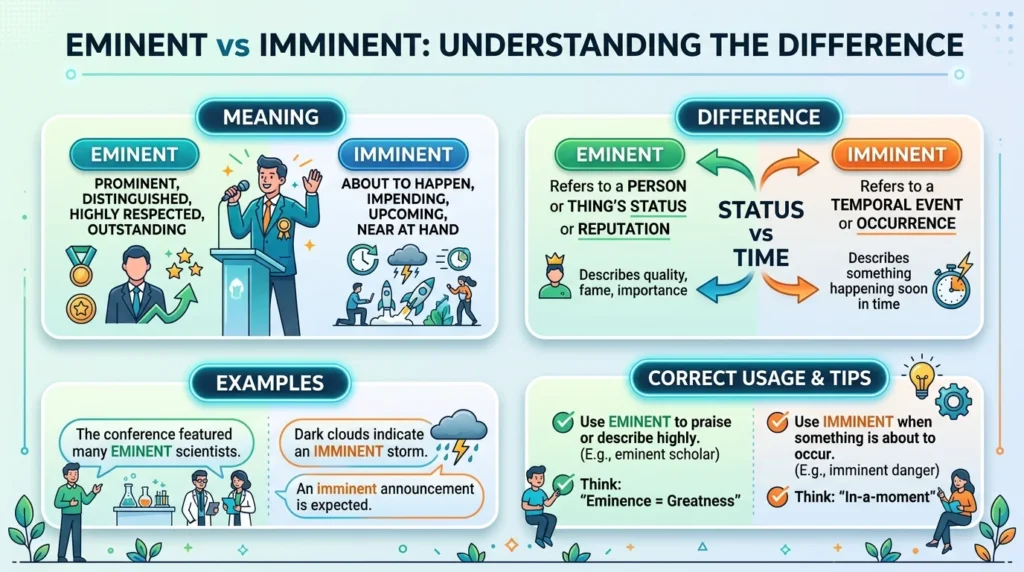
The good news is that the meanings are quite different. Eminent describes someone or something that is famous, respected, or highly important. For example, an eminent scientist is a scientist who is widely respected for their work.
Imminent, on the other hand, means that something is about to happen very soon. For example, a storm is imminent means the storm is expected to happen shortly.
Understanding this difference can help you avoid common vocabulary mistakes and make your writing more precise. This guide explains the meaning, origin, spelling, common errors, everyday examples, usage patterns, and simple memory tricks for Eminent vs Imminent.
Eminent vs Imminent – Quick Answer
The easiest way to understand the difference is:
- Eminent = famous, respected, distinguished, or important.
- Imminent = about to happen or likely to happen very soon.
Eminent Examples
- She is an eminent scientist.
- The university invited an eminent professor to speak.
- He became an eminent leader in his field.
In these examples, eminent describes someone who has a high reputation or status.
Imminent Examples
- A storm is imminent.
- The company warned that layoffs were imminent.
- The patient’s condition suggested that death was imminent.
Here, imminent describes something that is expected to happen soon.
Easy Memory Trick
Remember:
Eminent = Excellent and respected
Imminent = Immediate or coming soon
Another simple rule is:
Eminent people are important; imminent events are near.
The Origin of Eminent vs Imminent
Although eminent and imminent are often confused, they come from related Latin roots with different meanings.
Origin of Eminent
Eminent comes from the Latin word eminēre, meaning “to stand out” or “to project.”
The idea developed into the modern meaning of someone who stands out because of their ability, reputation, position, or achievements.
For example:
An eminent doctor
means a doctor who stands out in their profession and is widely respected.
The word entered English through French and became established as a term for people of high distinction.
Origin of Imminent
Imminent comes from the Latin imminēre, meaning “to project over,” “hang over,” or “be near.”
Over time, it developed the meaning of something that is approaching or about to happen.
For example:
Imminent danger
means danger that is very close or likely to happen soon.
Why Are They Confused?
The words share several letters:
- Eminent
- Imminent
They also have similar pronunciation.
However, their meanings are different:
Eminent → distinguished or respected
Imminent → about to happen
There is no British-American spelling issue here. The challenge is choosing the correct word.
British English vs American English Spelling
There is no significant spelling difference between British English and American English for eminent and imminent.
Both varieties use:
- eminent
- eminently
- imminent
- imminently
The spelling stays the same in both forms of English.
| Word | British English | American English | Meaning |
|---|---|---|---|
| Eminent | Eminent | Eminent | Famous or highly respected |
| Eminently | Eminently | Eminently | In a highly notable way |
| Imminent | Imminent | Imminent | About to happen |
| Imminently | Imminently | Imminently | Very soon or about to happen |
Examples in Both Varieties
British English:
The university welcomed an eminent historian.
American English:
The university welcomed an eminent historian.
The spelling does not change.
Similarly:
British English:
Heavy rain is imminent.
American English:
Heavy rain is imminent.
Again, the spelling is identical.
Which Spelling Should You Use?
You do not need to choose between British and American spelling for these words.
Instead, choose the word according to its meaning.
For US English
Use eminent for respected or distinguished people and things.
She is an eminent researcher.
Use imminent for something that will happen soon.
The deadline is imminent.
For UK and Commonwealth English
The same rules apply.
An eminent lawyer addressed the audience.
A decision is imminent.
For Global English
The same spellings work well for international readers.
The best approach is to remember the meaning rather than focus on pronunciation.
Ask yourself:
Am I describing importance or timing?
If you mean important, famous, or respected, use eminent.
If you mean about to happen, use imminent.
Common Mistakes with Eminent vs Imminent
These words are often mixed up because of their similar spelling.
Mistake 1: Using Imminent for a Famous Person
❌ He is an imminent scientist.
✅ He is an eminent scientist.
A respected scientist is eminent, not imminent.
Mistake 2: Using Eminent for Something Happening Soon
❌ The storm is eminent.
✅ The storm is imminent.
A storm that is about to arrive is imminent.
Mistake 3: Confusing “Eminent” With “Imminent” in News
❌ Officials warned of an eminent attack.
✅ Officials warned of an imminent attack.
The meaning is that the attack may happen soon.
Mistake 4: Using Imminent for Reputation
❌ She became an imminent figure in medicine.
✅ She became an eminent figure in medicine.
A highly respected person is eminent.
Mistake 5: Thinking “Imminent” Means “Important”
Imminent does not mean important.
For example:
The deadline is imminent.
This means the deadline is approaching soon.
It does not mean the deadline is famous or respected.
Eminent vs Imminent in Everyday Examples
These words appear in different types of writing.
In Emails
Eminent:
We are pleased to welcome an eminent industry expert to our conference.
Imminent:
Please complete the required documents because the deadline is imminent.
In News
Eminent:
An eminent economist discussed the country’s financial outlook.
Imminent:
Officials warned that flooding was imminent after several hours of heavy rain.
In Social Media
Eminent:
It was an honor to meet such an eminent author.
Imminent:
The weekend is here, and vacation is imminent!
In Academic Writing
Eminent:
The theory was developed by an eminent researcher.
Imminent:
The researchers warned of an imminent change in environmental conditions.
In Formal Writing
Eminent:
The committee consulted several eminent experts.
Imminent:
The organization took action because a major disruption appeared imminent.
Eminent vs Imminent – Google Trends & Usage Data
Searches for “Eminent vs Imminent” usually come from people who want to understand the difference between these similar-looking words.
The individual terms appear in different contexts.
Common Uses of Eminent
Eminent is often found in:
- Academic writing
- University websites
- Professional biographies
- Research papers
- Historical writing
- Business articles
- Formal speeches
- News reports
Common phrases include:
- eminent scientist
- eminent scholar
- eminent professor
- eminent lawyer
- eminent leader
- eminent expert
Common Uses of Imminent
Imminent is more common when discussing events or situations that may happen soon.
It appears in:
- News reports
- Weather reports
- Emergency communication
- Government announcements
- Business writing
- Security reports
- Legal writing
- General conversation
Common phrases include:
- imminent danger
- imminent threat
- imminent arrival
- imminent change
- imminent decision
- imminent collapse
Search popularity can change by country, season, news events, and user intent. Exact Google Trends figures should therefore be checked for a specific location and date range rather than treated as permanent values.
Eminent vs Imminent Comparison Table
| Feature | Eminent | Imminent |
|---|---|---|
| Basic meaning | Famous or respected | About to happen |
| Main idea | Importance or reputation | Nearness in time |
| Part of speech | Adjective | Adjective |
| Describes | People, experts, figures, achievements | Events, dangers, changes, situations |
| Example | An eminent scientist | An imminent storm |
| Common phrase | Eminent scholar | Imminent danger |
| Memory clue | Excellent/respected | Immediate/soon |
| Opposite idea | Unknown or ordinary | Distant or unlikely soon |
More Examples of Eminent
Here are some simple examples:
- He is an eminent physician.
- The award honored an eminent writer.
- An eminent judge gave the keynote speech.
- She is an eminent expert in engineering.
- The museum displayed work by an eminent artist.
- The conference attracted several eminent scholars.
In each case, eminent means distinguished or highly respected.
More Examples of Imminent
Examples include:
- A storm is imminent.
- The train’s arrival is imminent.
- The company announced that a decision was imminent.
- The workers were prepared for an imminent shutdown.
- The deadline is imminent.
- Officials said a major announcement was imminent.
In each case, imminent means something is expected very soon.
How to Remember Eminent vs Imminent
A simple memory trick can make these words easy.
Eminent = Excellent
Think:
Eminent → Excellent → Expert
An eminent person is often an expert or highly respected professional.
Example:
She is an eminent scientist.
Imminent = Immediate
Think:
Imminent → Immediate → Soon
Something imminent is close to happening.
Example:
A storm is imminent.
The Three-Second Test
When writing a sentence, ask:
Is it about a person or reputation?
→ Use eminent.
Is it about something happening soon?
→ Use imminent.
This simple test works in most situations.
FAQs About Eminent vs Imminent
1. What is the difference between eminent and imminent?
Eminent means famous, distinguished, or highly respected. Imminent means about to happen or likely to happen very soon.
2. Is eminent a positive word?
Usually, yes. Eminent often expresses respect or recognition for someone’s importance, ability, or achievements.
3. Is imminent always negative?
No. Imminent simply means something is about to happen. It can describe positive or neutral events.
For example:
Her arrival is imminent.
4. Is “imminent danger” correct?
Yes. Imminent danger means danger that is very close or likely to happen soon.
5. Can eminent describe a person?
Yes. This is one of its most common uses.
He is an eminent professor.
6. Can imminent describe a person?
Usually, no. Imminent normally describes an event, situation, threat, change, or action that is about to happen.
7. Are eminent and imminent pronounced the same?
They are very similar in pronunciation, but they are different words with different meanings.
8. Is there a British-American spelling difference?
No. Eminent and imminent are spelled the same in British and American English.
9. What is an easy way to remember the difference?
Remember:
Eminent = respected and important.
Imminent = happening soon.
Conclusion
Understanding Eminent vs Imminent becomes easy when you focus on the key difference between reputation and timing.
Eminent describes someone or something that is famous, distinguished, important, or highly respected. You might describe a scientist, professor, author, lawyer, or leader as eminent because they have achieved a high level of recognition.
Imminent describes something that is about to happen. A storm, deadline, decision, threat, arrival, or major change can be imminent when it is expected very soon.
There is no important spelling difference between British and American English for these words. The main challenge is using the correct word in the correct context.
For an easy memory trick, connect eminent with excellent and imminent with immediate. If you are talking about a respected person, choose eminent. If you are talking about something that is coming soon, choose imminent. This simple rule can help you write clearer emails, essays, reports, and professional documents.