
Imagine you are building a small house or renovating an old room. After the walls are finished, the electrician begins installing wires to supply electricity to lights, fans, and sockets. Instead of hiding the wires inside the wall, the electrician carefully fixes them on wooden battens using metal clips. This simple and organized wiring method is called Batten Wiring.
In many homes, especially in small buildings, workshops, and temporary installations, batten wiring is still used because it is easy to install, affordable, and simple to maintain. Electricians and technicians often prefer it when quick installation is required.
Understanding Batten Wiring in Home Electrical Installation is important for electrical students, technicians, and beginners who want to learn practical wiring systems. It helps you understand how electrical wiring is arranged, how safety is maintained, and how electricity reaches different parts of a building.
In this article, you will learn the batten wiring working principle, types of batten wiring, components, advantages and disadvantages, applications, comparison with other wiring systems, troubleshooting methods, and future trends in electrical installation.
2.What Is Batten Wiring?
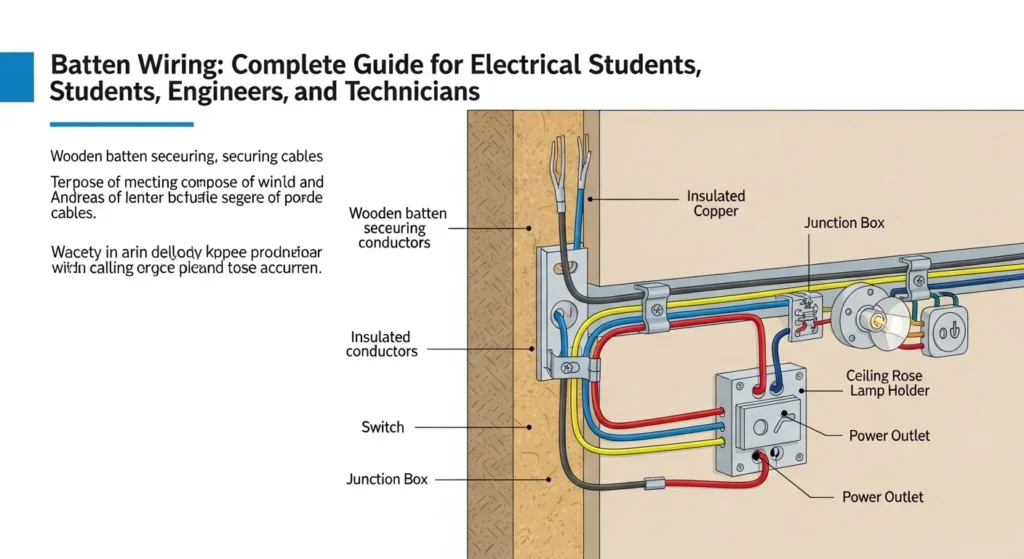
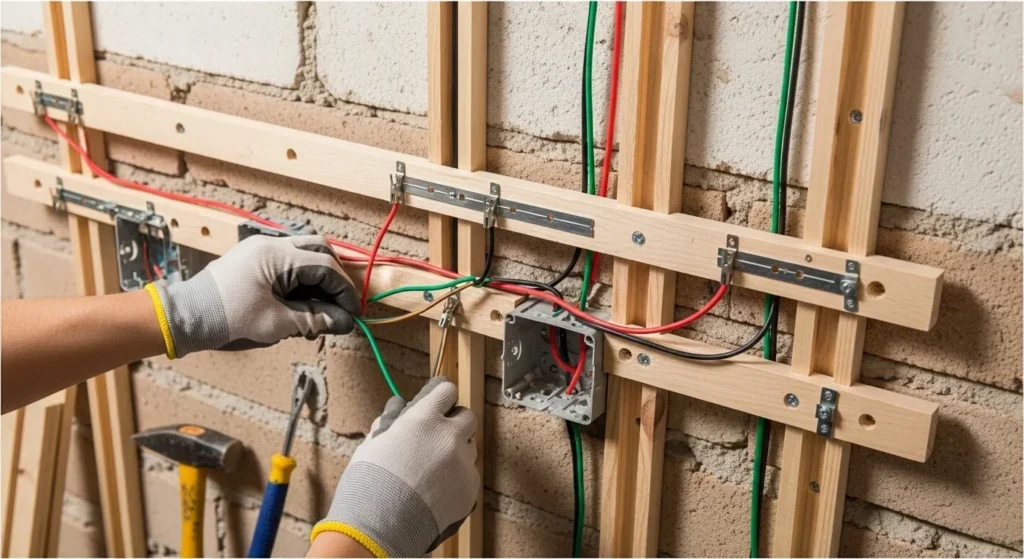
Batten wiring is a simple and commonly used electrical wiring system in which insulated cables are fixed on a wooden strip called a batten. The wires are held in place using metal or plastic clips that are attached to the wooden batten with screws. This method keeps the wires organized, straight, and properly supported along walls or ceilings.
Batten wiring has been widely used in houses, shops, workshops, and small buildings because it is easy to install and economical. In this system, the wiring remains visible on the surface, which makes inspection, maintenance, and repairs very simple for electricians. If any fault occurs, it can be detected and fixed quickly.
This wiring system is especially suitable for low-voltage electrical installations where safety, simplicity, and quick installation are important. In many electrical training institutes and small residential buildings, batten wiring is still used to teach basic wiring methods and circuit connections.
Although modern buildings often use concealed conduit wiring for better appearance and protection, batten wiring is still preferred in places where cost is low and frequent maintenance may be required.
Details of Batten Wiring in 2026
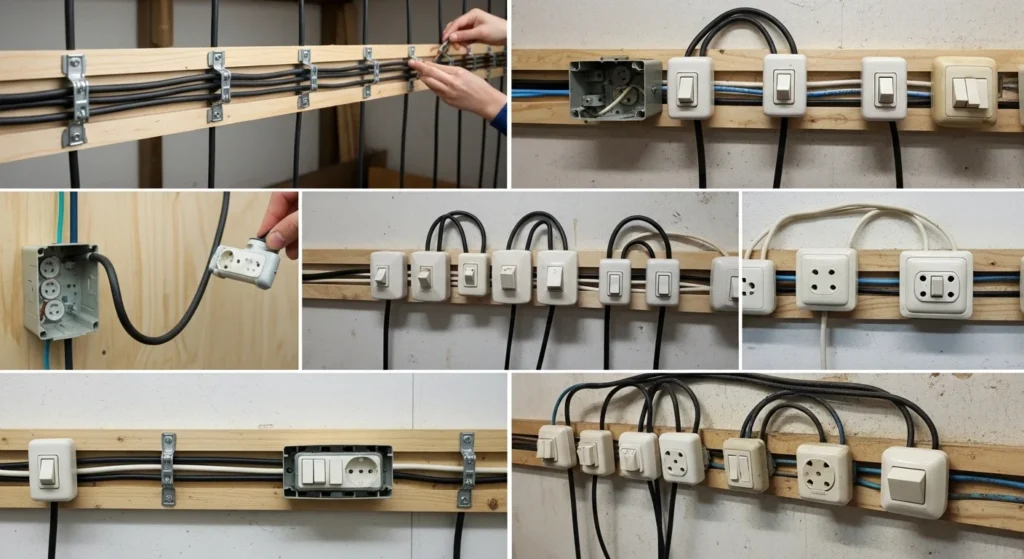
Batten wiring works by mounting insulated electrical cables on wooden battens that are fixed to the wall or ceiling. The wooden batten acts as a support base that keeps the wires properly aligned and prevents them from hanging loosely.
The cables used in batten wiring are usually PVC insulated or rubber-sheathed wires. These wires are strong enough to carry current safely while also providing insulation to prevent electrical shocks.
The wires are fixed to the batten using clips that hold the cable firmly in place. These clips are placed at regular intervals so the wires remain tight and properly arranged. Screws are used to fix both the batten and the clips securely.
One of the important advantages of batten wiring is that the entire wiring system remains visible and accessible. This allows electricians to easily check the wiring condition, detect faults, and replace damaged wires without breaking walls or ceilings.
However, because the wiring is exposed, it may be affected by moisture, heat, or mechanical damage. For this reason, batten wiring is usually used in dry indoor locations where the environment is safe and controlled.
Despite the development of modern wiring systems, batten wiring remains an important basic wiring method. It is still used in small electrical installations, workshops, and training laboratories because it is simple, economical, and easy to maintain.
Batten Wiring is a method of electrical wiring in which insulated cables are fixed on wooden battens using metal clips.
The wooden battens are mounted on the wall or ceiling, and the wires are placed neatly along the batten using brass clips. These clips hold the wires firmly and maintain proper spacing.
Simple Explanation
In simple words, batten wiring means:
- Electrical wires are not hidden inside the wall
- Wires are mounted on wooden strips
- Metal clips hold the wires in place
Practical Example
Suppose you install wiring in a small workshop. Instead of cutting walls and hiding wires inside conduits, you attach wooden battens on the wall and run the electrical wires on top of them. This is batten wiring in home electrical installation.
3.How Does Batten Wiring Work?
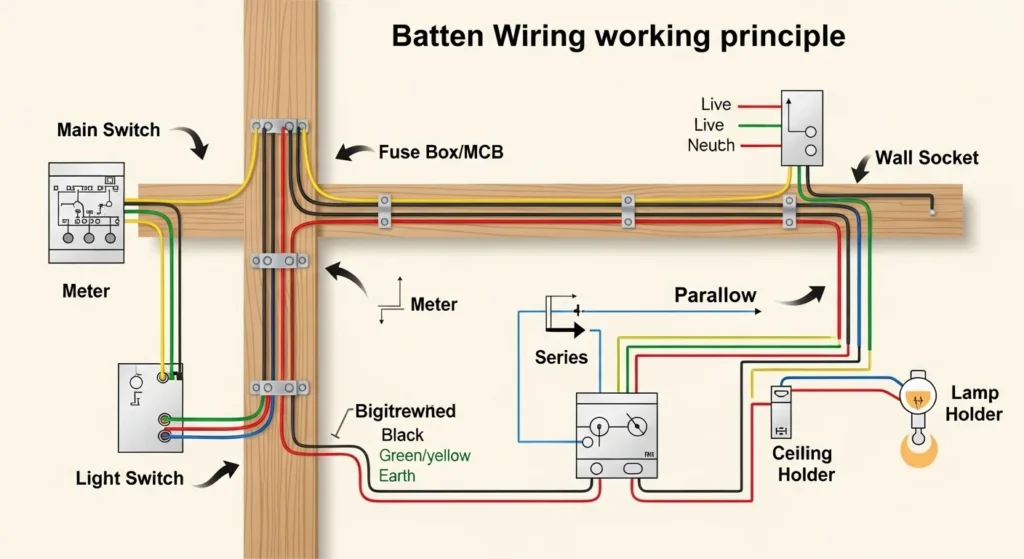
The batten wiring working principle is based on the safe routing, proper insulation, and secure fixing of electrical cables on a wooden batten to distribute electricity efficiently. In this wiring system, insulated electrical wires are mounted on a flat wooden strip, known as a batten, and held firmly in place using brass or plastic clips at regular intervals. The batten provides a strong and insulated base that keeps the wires organized, prevents unnecessary movement, and protects them from direct contact with walls or ceilings.
Unlike concealed wiring systems, batten wiring is installed on the surface of the wall or ceiling, making every wire visible and easily accessible. This design allows electricians to inspect, repair, or modify the wiring without damaging the building structure. The combination of insulated wires, sturdy wooden battens, and properly spaced clips creates a safe and reliable electrical distribution system for residential, commercial, and temporary installations.
The working principle of batten wiring is simple but highly effective. When electrical power is supplied from the main distribution board, current flows through the insulated conductors. The insulation around the wires prevents current leakage and protects people from electric shock. Since the wires are mounted on wooden battens instead of being fixed directly to the wall, there is an additional layer of electrical insulation that improves safety and reduces the possibility of moisture-related faults.
The wooden batten also acts as a mechanical support for the wiring system. It keeps the cables straight, properly aligned, and securely positioned, reducing stress on the conductors. Brass or plastic clips are fixed at regular intervals to prevent the wires from sagging, bending, or shifting over time. This secure arrangement not only improves the appearance of the installation but also extends the life of the wiring by reducing mechanical damage.
Another important feature of the batten wiring working principle is heat dissipation. Since the wires are exposed to the surrounding air instead of being enclosed inside walls or conduits, heat generated by the flow of electrical current can escape more easily. Better ventilation helps maintain a lower operating temperature, reducing the risk of overheating when the wiring is installed correctly and loaded within its rated capacity.
Batten wiring is also known for its easy maintenance. Because the entire wiring system is visible, electricians can quickly identify damaged insulation, loose clips, broken wires, or faulty connections during routine inspections. Repairs, extensions, or modifications can be completed without cutting walls or ceilings, making this system both economical and time-saving. For this reason, batten wiring has traditionally been used in homes, workshops, schools, warehouses, temporary buildings, and small commercial installations.
Although modern buildings often prefer concealed wiring for better appearance and protection, batten wiring remains a practical choice in locations where low installation cost, simple maintenance, and easy accessibility are more important than aesthetics.
Step-by-Step Working Process of Batten Wiring
The operation of a batten wiring system can be understood through the following step-by-step process.
Step 1: Planning the Wiring Route
The installation begins with careful planning of the wiring layout. Electricians determine the shortest and safest path for the cables while considering the locations of switches, sockets, lights, distribution boards, and electrical appliances.
Proper planning helps:
- Reduce cable length
- Minimize voltage drop
- Improve safety
- Keep the installation neat and organized
Step 2: Wooden Battens Are Fixed to the Wall or Ceiling
Flat wooden battens are securely mounted on the walls or ceilings using screws and wall plugs. These battens form the foundation of the entire wiring system.
The wooden battens provide several important functions:
- Support the electrical cables
- Electrically isolate the wires from the building surface
- Maintain proper alignment
- Prevent direct contact between wires and damp walls
The battens are installed in straight lines to create an organized wiring layout.
Step 3: Insulated Electrical Wires Are Placed on the Battens
After the battens have been installed, PVC-insulated or TRS (Tough Rubber Sheathed) cables are carefully laid along their length.
The insulation around the conductors performs several important functions:
- Prevents electrical leakage
- Protects users from electric shock
- Reduces the possibility of short circuits
- Increases the overall safety of the installation
The wires are arranged neatly so they do not cross unnecessarily or become tangled.
Step 4: Clips Secure the Wires Firmly
Brass clips, aluminum clips, or high-quality plastic clips are fixed over the wires at regular intervals.
These clips perform several important tasks:
- Hold the wires firmly in position
- Prevent sagging
- Protect the wires from movement caused by vibration
- Maintain proper spacing between cables
- Improve the appearance of the wiring
Correct clip spacing ensures that the wiring remains secure for many years.
Step 5: Electrical Accessories Are Connected
Once the wires are properly secured, electrical accessories are installed and connected.
These include:
- Switches
- Socket outlets
- Junction boxes
- Ceiling roses
- Light holders
- Fan regulators
- Distribution boards
Each accessory is connected according to the electrical wiring diagram, allowing electricity to reach different loads safely.
Step 6: Electricity Flows Through the Wiring System
When the main supply is switched ON, electrical current flows from the distribution board through the insulated wires.
The current travels safely through the wiring network and reaches connected electrical devices such as:
- Lights
- Ceiling fans
- Power sockets
- Electrical appliances
- Small motors
The insulation ensures that electricity remains inside the conductors while the wooden batten provides additional separation from the wall or ceiling.
Step 7: Heat Is Dissipated Naturally
As electrical current flows through the conductors, a small amount of heat is produced due to electrical resistance.
One advantage of batten wiring is that the exposed wires allow heat to dissipate into the surrounding air more effectively than some enclosed systems.
This natural ventilation helps:
- Reduce operating temperature
- Improve efficiency
- Extend cable life
- Lower the risk of overheating
Proper cable sizing and correct load selection are still essential to maintain safe operating temperatures.
Step 8: Easy Inspection and Maintenance
One of the biggest advantages of batten wiring is its accessibility.
Since all wires remain visible, electricians can quickly inspect the installation for:
- Damaged insulation
- Loose clips
- Broken conductors
- Burn marks
- Faulty connections
- Signs of overheating
Repairs or modifications can usually be completed without breaking walls or ceilings, making maintenance fast, simple, and cost-effective.
Step 9: Safe and Reliable Electrical Distribution
During normal operation, the wiring system continuously delivers electrical power to connected loads while maintaining proper insulation, secure cable support, and organized routing.
If protective devices such as circuit breakers or fuses detect an overload or short circuit, they disconnect the faulty circuit to prevent damage and ensure user safety.
Easy Analogy: Batten Wiring Is Like a Railway Track
A simple way to understand the batten wiring working principle is to compare it with a railway system.
Imagine a train traveling safely from one station to another.
- The wooden batten acts like the railway track, providing a strong and stable path.
- The insulated electrical wires are like the train, carrying electrical energy instead of passengers.
- The brass or plastic clips are like the rail fasteners and sleepers, keeping the track and train properly aligned.
- Switches and sockets are like railway stations, where electricity is delivered to different destinations.
- Circuit breakers and fuses are like railway safety officers, stopping the system immediately if a dangerous situation occurs.
Just as a train travels safely because the tracks are properly supported and maintained, electricity flows safely through batten wiring because the wires are securely fixed, well insulated, and correctly routed. This organized structure ensures efficient, reliable, and safe electrical distribution while making inspection and maintenance quick and convenient.
4. Types of Batten Wiring: Complete Guide with Features, Applications and Key Differences
Batten wiring can be classified based on the type of cable used.
4.1What Is CTS Batten Wiring? Complete Guide to Its Features, Uses and Installation
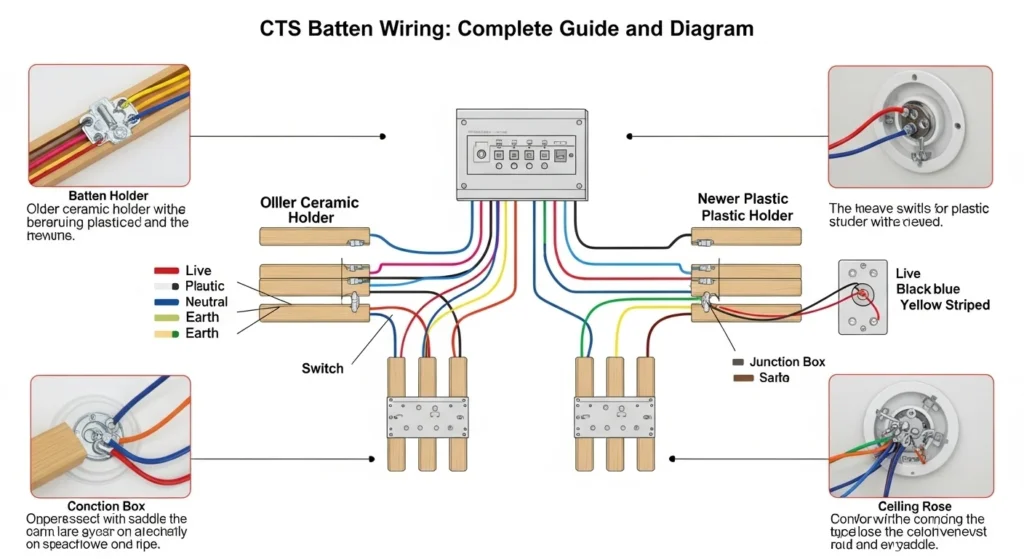
CTS stands for Cab Tyre Sheathed cable.
CTS Batten Wiring (Cab Tyre Sheathed Batten Wiring) is one of the most widely used traditional surface wiring methods for electrical installations. It was commonly used in residential buildings, schools, offices, workshops, garages, and small commercial establishments before concealed wiring became the standard. Even today, it is still used in certain applications where easy installation, low cost, and simple maintenance are important.
In this wiring system, CTS (Cab Tyre Sheathed) cables are fixed on wooden battens using brass, aluminum, or plastic clips. The wooden battens are securely mounted on walls or ceilings, providing a solid base for the cables. The clips are installed at regular intervals to hold the cables firmly in position, preventing them from sagging or moving over time. This creates a neat, organized, and easily accessible wiring arrangement.
The CTS cables used in this method consist of copper conductors covered with high-quality rubber insulation and an additional tough outer sheath. This protective sheath provides better resistance to mechanical damage, moisture, dust, and normal wear compared to ordinary insulated wires. As a result, the wiring system becomes more durable and reliable for everyday electrical installations.
The working principle of CTS Batten Wiring is simple and efficient. Electrical current flows through the insulated copper conductors from the distribution board to switches, sockets, lights, fans, and other electrical loads. The rubber insulation prevents current leakage and protects users from electric shock, while the outer sheath adds another layer of mechanical protection. The wooden batten acts as an insulating support, separating the cables from the wall or ceiling and reducing the chances of moisture affecting the wiring. The clips ensure that the cables remain straight, secure, and properly spaced, allowing safe electrical distribution throughout the building.
One of the biggest advantages of CTS Batten Wiring is its easy inspection and maintenance. Since all cables are visible, electricians can quickly identify damaged insulation, loose clips, or faulty connections without breaking walls or ceilings. Repairs, extensions, or modifications can be carried out easily, making this wiring system highly economical for small installations and temporary electrical work.
Although CTS Batten Wiring offers many practical benefits, it also has some limitations. The exposed cables may reduce the visual appearance of modern interiors, and the system is not recommended for highly damp, humid, or corrosive environments where moisture can damage the wooden battens and rubber insulation over time. For these reasons, concealed conduit wiring has largely replaced CTS Batten Wiring in new residential and commercial buildings.
Despite its reduced use in modern construction, CTS Batten Wiring remains an important topic in electrical engineering and vocational training. Students and technicians study this wiring method to understand the fundamentals of electrical cable installation, cable support, safety practices, and traditional wiring techniques.
Features of CTS Batten Wiring
CTS Batten Wiring offers several practical features that made it one of the most popular wiring systems for many years.
- Uses Cab Tyre Sheathed (CTS) cables with durable rubber insulation.
- Provides good mechanical protection through its tough outer sheath.
- Cables are mounted on wooden battens for proper support and insulation.
- Brass, aluminum, or plastic clips securely hold the cables in place.
- Simple and quick installation process.
- Easy to inspect, repair, and maintain because the wiring remains visible.
- Cost-effective for small residential and commercial installations.
- Offers neat and organized cable routing.
- Suitable for both lighting and power circuits.
- Requires fewer installation tools and materials.
- Can be easily extended or modified when additional wiring is needed.
- Provides reliable electrical distribution when installed according to safety standards.
Applications of CTS Batten Wiring
CTS Batten Wiring is commonly used in places where simple installation and easy maintenance are more important than concealed appearance.
Typical applications include:
- Residential houses
- Small shops
- Workshops
- Garages
- Farmhouses
- Schools
- Office buildings
- Temporary construction sites
- Warehouses
- Laboratories
- Training institutes
- Small industrial units
It is particularly suitable for locations where the wiring may need frequent inspection, maintenance, or future modifications.
Advantages of CTS Batten Wiring
- Low installation cost.
- Simple wiring method.
- Easy fault detection.
- Quick repairs and maintenance.
- Good mechanical strength.
- Neat cable arrangement.
- Reliable electrical insulation.
- Long service life when properly maintained.
Limitations of CTS Batten Wiring
- Less attractive than concealed wiring.
- Not suitable for damp or humid environments.
- Wooden battens may deteriorate over time.
- Exposed wiring is more vulnerable to accidental damage.
- Rarely used in modern residential construction.
Key Point
CTS Batten Wiring is the most common type of batten wiring traditionally used in homes and small buildings because it combines durable insulated cables, simple installation, good mechanical protection, and easy maintenance at a relatively low cost. It remains an important wiring method for learning the fundamentals of electrical installations and is still used in certain temporary and surface wiring applications.
4.2 What Is TRS Batten Wiring? Complete Guide to Its Features, Uses and Installation Process
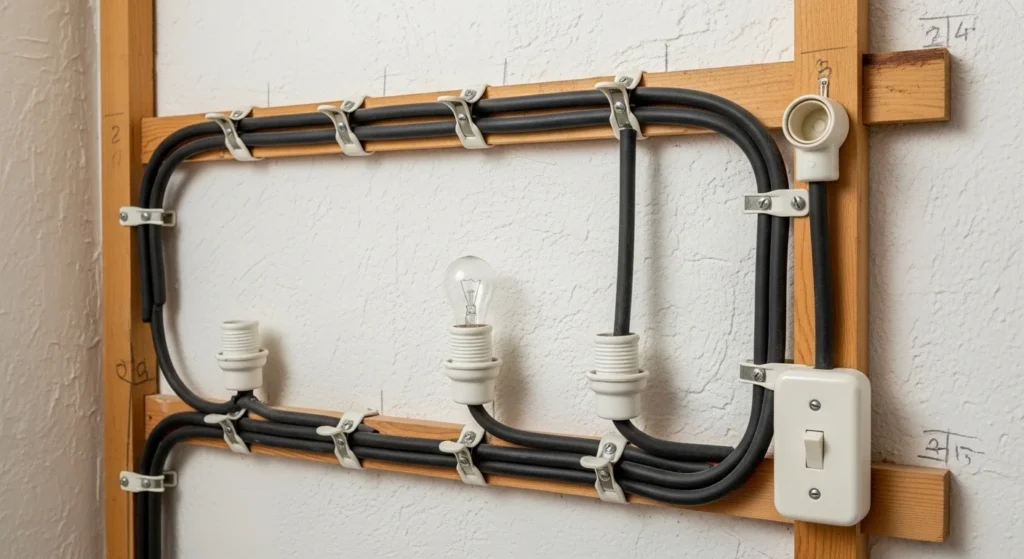
TRS means Tough Rubber Sheathed cable.
TRS Batten Wiring is a common surface wiring method used in residential and small commercial electrical installations. In this system, TRS (Tough Rubber Sheathed) cables are fixed on wooden battens using brass or aluminum clips. The cables are well insulated with tough rubber, which provides better protection against moisture, wear, and mechanical damage compared to ordinary wires. The wooden batten is first mounted on the wall or ceiling, and then the TRS cables are laid over it in a straight and organized manner. Clips are placed at equal distances to hold the cables firmly in position. The TRS Batten Wiring working principle is based on safely carrying electrical current through insulated conductors while the batten provides mechanical support and proper alignment. This wiring method is simple, cost-effective, and easy to install, making it suitable for temporary setups, small homes, workshops, and garages. It also allows easy inspection and maintenance since the wiring is visible. However, it is not ideal for modern buildings where concealed wiring is preferred for better appearance and safety. TRS Batten Wiring applications are mostly limited to areas where quick installation and low cost are important.
Features
- Flexible cables
- Good resistance to moisture
- Used in small industrial installations
4.3What Is PVC Batten Wiring? Complete Guide to Its Features, Uses and Installation Process
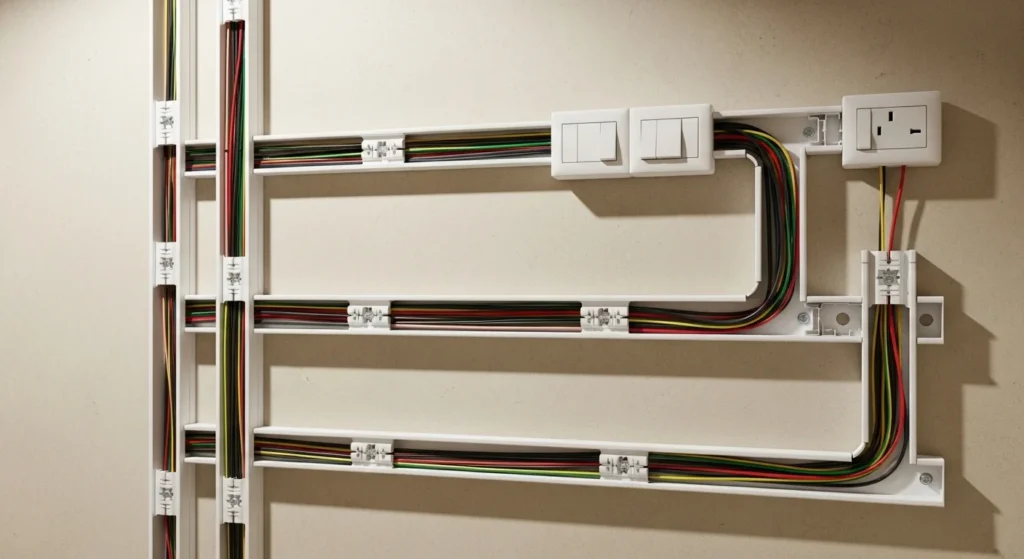
PVC Batten Wiring is a modern surface wiring method in which PVC (Polyvinyl Chloride) insulated cables are fixed on wooden battens using clips. In this system, the batten is first installed on the wall or ceiling, and then PVC cables are laid neatly along it and secured with brass or plastic clips at regular intervals. The PVC Batten Wiring working principle is based on carrying electrical current safely through PVC-insulated conductors while the batten provides mechanical support and proper cable arrangement. PVC insulation is strong, flexible, and resistant to moisture, chemicals, and heat, making it more durable than older rubber-based wiring systems like TRS or CTS. This wiring method is easy to install, cost-effective, and requires low maintenance since the wires are visible and accessible for inspection. It is commonly used in homes, offices, shops, and temporary installations. However, it may not be as visually appealing as concealed wiring and offers less protection compared to conduit systems. PVC Batten Wiring applications are widely seen in small to medium electrical setups where quick installation and reliability are required.
PVC Batten Wiring is one of the most commonly used methods in modern electrical installation, especially in homes, offices, and small commercial buildings. In this system, electrical wires covered with PVC insulation are fixed on a wooden or plastic batten that is mounted on walls or ceilings. This wiring method is popular because it is simple, low-cost, and easy to install or maintain.
People often search for PVC Batten Wiring to understand how it works, where it is used, and whether it is safe for home electrical systems. It is especially useful for beginners, electricians, and students who want to learn basic wiring systems. Compared to hidden conduit wiring, PVC batten wiring is more visible, which makes fault detection easier and repairs faster.
In this guide, you will learn what PVC batten wiring is, its features, advantages, applications, and step-by-step installation process. This article will help you clearly understand the system in simple language so you can use it in practical electrical work or study purposes.
What Is PVC Batten Wiring?
PVC Batten Wiring is a surface wiring method in which insulated electrical cables are laid on a PVC or wooden batten and fixed using clips. The batten is then mounted on the surface of walls or ceilings.
In this system, the cables remain exposed but are properly secured and protected. The PVC insulation of wires adds safety, while the batten provides mechanical support.
Simple Definition
PVC Batten Wiring is a surface electrical wiring system where PVC-insulated wires are installed on a batten fixed to walls or ceilings.
Key Idea
- Wires are not hidden inside walls
- They are fixed on the surface
- Easy to install, inspect, and repair
Features of PVC Batten Wiring
PVC Batten Wiring is widely used in electrical installations because it is simple, economical, and easy to manage. Its features make it suitable for homes, small offices, and temporary electrical setups.
1. Simple Installation
PVC Batten Wiring is very easy to install compared to other wiring systems such as conduit wiring. It does not require wall cutting or complex civil work.
Details:
- Wires are directly placed on PVC or wooden battens
- No need for drilling deep into walls
- Installation can be completed in less time
- Requires only basic tools like screws, clips, and cutters
Importance:
This simplicity makes it ideal for beginners, electricians, and temporary electrical setups where quick installation is required.
2. Low Cost System
One of the biggest advantages of PVC Batten Wiring is its affordability.
Details:
- Requires fewer materials than concealed wiring
- No need for pipes, conduits, or heavy accessories
- Less labor cost due to easy installation
- Reduces overall project expenses
Importance:
This makes it a cost-effective solution for small houses, shops, and budget electrical projects.
3. Easy Maintenance and Repair
Since the wiring is visible, maintenance becomes very simple and fast.
Details:
- Faults can be located easily without breaking walls
- Damaged wires can be replaced quickly
- Inspection can be done visually
- Troubleshooting takes less time
Importance:
This reduces downtime and maintenance cost, especially in commercial or frequently used installations.
4. Lightweight and Flexible System
PVC materials used in batten wiring are lightweight and easy to handle.
Details:
- PVC battens are easy to carry and install
- Wiring layout can be modified easily
- Suitable for quick installation projects
- Does not require heavy structural support
Importance:
This flexibility makes it ideal for temporary wiring systems and small-scale electrical setups.
5. Good Electrical Insulation
Safety is a key feature of PVC Batten Wiring due to its insulation properties.
Details:
- PVC coating prevents electric leakage
- Reduces risk of short circuits
- Protects wires from minor environmental damage
- Provides basic fire resistance (depending on quality)
Importance:
Proper insulation ensures safe operation and reduces electrical hazards in domestic installations.
PVC Batten Wiring is a practical and economical wiring method that offers simple installation, low cost, easy maintenance, lightweight structure, and good insulation. These features make it highly suitable for residential buildings, small offices, and temporary electrical systems. However, proper installation and good quality materials are essential to ensure long-term safety and performance.
Uses of PVC Batten Wiring
PVC Batten Wiring is widely used in different electrical applications due to its simplicity.Here is the expanded version with proper English headings and detailed explanations:
Applications, Advantages and Disadvantages of PVC Batten Wiring
PVC Batten Wiring is widely used in electrical systems due to its simplicity and cost-effectiveness. However, like any wiring method, it has both advantages and limitations. Understanding its applications, benefits, and drawbacks helps in selecting the right wiring system for different environments.
Applications of PVC Batten Wiring
PVC Batten Wiring is suitable for many low-cost and small-scale electrical installations where quick setup and easy maintenance are required.
1. Residential Buildings
PVC Batten Wiring is commonly used in houses where basic electrical requirements are needed.
Details:
- Suitable for small houses and apartments
- Used in temporary or rental homes
- Common in rural and semi-urban areas
- Ideal for basic lighting and fan circuits
Importance:
It provides a simple and affordable wiring solution for domestic use without complex installation work.
2. Offices
This wiring system is also used in small and medium office setups.
Details:
- Used in small office buildings
- Suitable for temporary office setups
- Supports basic electrical loads like lighting and computers
- Easy to modify when office layout changes
Importance:
Its flexibility makes it ideal for dynamic office environments where changes are frequent.
3. Shops and Commercial Areas
PVC Batten Wiring is widely used in small commercial spaces due to its low cost.
Details:
- Used in small retail shops
- Suitable for workshops and service centers
- Supports lighting and light machinery
- Easy to install during shop setup
Importance:
It helps shop owners reduce installation costs while maintaining basic electrical functionality.
4. Educational and Training Purposes
This wiring method is commonly used in electrical labs and training institutes.
Details:
- Used in electrical training labs
- Helps students learn wiring techniques
- Easy to demonstrate circuit concepts
- Safe for controlled learning environments
Importance:
It is highly effective for teaching basic electrical installation skills.
5. Temporary Installations
PVC Batten Wiring is ideal for temporary electrical setups where permanent installation is not required.
Details:
- Used at construction sites
- Temporary power distribution systems
- Event setups and exhibitions
- Short-term electrical projects
Importance:
Its easy installation and removal make it perfect for short-term use.
Advantages of PVC Batten Wiring
PVC Batten Wiring offers several benefits that make it a popular choice for basic electrical systems.
1. Easy to Install
This wiring system is very simple and does not require advanced tools or heavy construction work.
Details:
- No wall cutting required
- Quick installation process
- Requires basic tools only
- Suitable for beginners and electricians
2. Cost-Effective Solution
It is one of the most economical wiring methods available.
Details:
- Lower material cost
- Reduced labor charges
- Minimal installation equipment required
- Budget-friendly for small projects
3. Easy Fault Detection
Since wires are visible, identifying problems becomes simple.
Details:
- Faults can be located visually
- No need to break walls for inspection
- Faster troubleshooting process
- Reduces maintenance time
4. Quick Repair and Replacement
Damaged parts can be repaired without difficulty.
Details:
- Individual wires can be replaced easily
- Minimal downtime during repairs
- Simple maintenance process
- Cost-effective servicing
5. Flexible System
The wiring layout can be changed or expanded easily.
Details:
- Easy to add new connections
- Suitable for modifications
- Adjustable wiring paths
- Ideal for temporary setups
Disadvantages of PVC Batten Wiring
Despite its advantages, PVC Batten Wiring also has some limitations that must be considered.
1. Poor Aesthetic Appearance
The wiring is visible on walls or ceilings.
Details:
- Not visually appealing in modern interiors
- Wires are exposed
- May affect room design aesthetics
- Not preferred in luxury buildings
2. Less Protection for Wires
Compared to concealed wiring, protection is limited.
Details:
- Wires exposed to dust and moisture
- Higher risk of external damage
- Limited safety against environmental factors
- Requires careful installation
3. Risk of Physical Damage
Since wires are visible, they can be damaged more easily.
Details:
- Can be affected by accidental impact
- Risk from rodents or insects
- Possible wear and tear over time
- Needs protective installation practices
4. Not Suitable for Heavy Load Systems
This wiring method is designed for light electrical loads only.
Details:
- Not recommended for industrial machinery
- Limited load capacity
- Suitable only for basic electrical usage
- May overheat under heavy load conditions
PVC Batten Wiring is a practical and economical wiring method widely used in homes, offices, shops, and temporary installations. It offers benefits such as easy installation, low cost, and simple maintenance. However, it also has limitations like poor aesthetics, limited protection, and unsuitability for heavy electrical loads. Choosing this system depends on the specific requirements of the installation environment.
Step-by-Step Installation Process of PVC Batten Wiring
PVC Batten Wiring installation is a systematic process that must be done carefully to ensure safety, durability, and proper electrical performance. Each step plays an important role in building a reliable wiring system.
Step 1: Planning the Circuit Layout
Before starting any physical work, proper planning of the electrical circuit is essential. This step ensures that the wiring system is efficient and safe.
Details:
- Identify the location of switches, sockets, and appliances
- Calculate the total electrical load of the system
- Decide the shortest and safest wiring path
- Avoid crossing of wires where possible
- Ensure proper distribution of power points
Importance:
Good planning reduces wiring errors, prevents overload, and makes maintenance easier in the future.
Step 2: Fixing the Batten on Wall or Ceiling
In this step, the PVC or wooden batten is installed on the surface where wiring will be placed.
Details:
- Mark the wiring path on the wall or ceiling
- Use screws, nails, or wall plugs to fix the batten
- Ensure the batten is straight and firmly attached
- Maintain equal spacing between fixing points
Importance:
A properly fixed batten provides strong support and ensures wires remain stable and organized.
Step 3: Measuring and Cutting the Wires
After the batten is installed, wires are measured and cut according to the circuit design.
Details:
- Measure wire length carefully using a measuring tape
- Add extra length for connections and bends
- Use proper wire cutters for clean cuts
- Avoid unnecessary wastage of material
Importance:
Accurate measurement prevents wire shortage, reduces waste, and ensures neat installation.
Step 4: Laying the Wires on the Batten
Now the wires are placed on the installed batten in an organized manner.
Details:
- Lay wires straight along the batten path
- Avoid overlapping or twisting of wires
- Keep different circuits separated if needed
- Maintain proper spacing between wires
Importance:
Neat wiring improves safety, reduces confusion, and makes troubleshooting easier.
Step 5: Fixing Wires with Clips or Clamps
To hold wires securely in place, clips or clamps are used.
Details:
- Use PVC clips suitable for wire size
- Fix clips at regular intervals (usually 10–15 cm)
- Ensure wires are tightly secured but not damaged
- Check alignment after fixing each section
Importance:
Clips prevent wire movement, reduce sagging, and improve long-term stability.
Step 6: Making Electrical Connections
This is the most important step where wiring connections are completed.
Details:
- Connect wires to switches, sockets, and distribution boards
- Follow proper color coding (live, neutral, earth)
- Tighten all terminals properly
- Use insulation tape where required
- Double-check all connections before power ON
Importance:
Correct connections ensure safe operation and prevent short circuits or electrical faults.
Step 7: Testing the Complete System
After installation, the entire system is tested for safety and performance.
Details:
- Turn ON the main power supply
- Check all switches and sockets
- Test each circuit individually
- Look for loose connections or faults
- Ensure proper earthing system is working
Importance:
Testing confirms that the system is safe, functional, and ready for use.
Safety Tips for PVC Batten Wiring
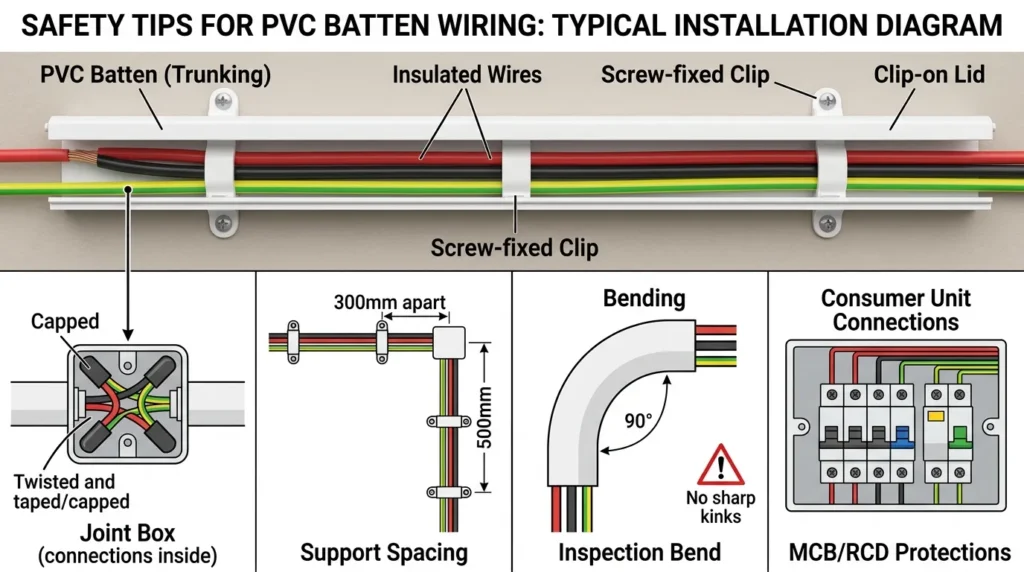
Safety is the most important factor in any electrical installation. PVC Batten Wiring is simple and cost-effective, but it must be installed carefully to avoid electrical hazards, short circuits, and fire risks. The following table explains important safety tips in detail.
| Safety Tip | Detailed Explanation | Importance / Benefit |
|---|---|---|
| Use good quality PVC insulated wires | Always select high-quality, branded PVC wires that meet electrical standards. Avoid cheap or damaged wires. | Prevents overheating, short circuits, and improves long-term safety. |
| Avoid overloading the circuit | Do not connect too many appliances to a single circuit or socket. | Reduces risk of wire overheating and fire hazards. |
| Proper wire spacing | Keep wires properly aligned and spaced on the batten without overlapping. | Ensures better heat dissipation and reduces electrical interference. |
| Secure fixing with clips | Use proper PVC clips or clamps at regular intervals to hold wires firmly. | Prevents wire movement, sagging, and physical damage. |
| Maintain proper earthing | Ensure all metal parts and appliances are properly grounded. | Protects users from electric shock and improves system safety. |
| Keep away from moisture | Avoid installing batten wiring in wet or damp areas without protection. | Reduces risk of leakage current and electrical accidents. |
| Use correct wire size | Select wire thickness according to electrical load requirements. | Prevents overheating and ensures efficient current flow. |
| Avoid direct sunlight exposure | Do not install wiring where it is exposed to strong sunlight for long periods. | Prevents PVC insulation from weakening or melting over time. |
| Regular inspection | Check wiring periodically for damage, loose clips, or worn insulation. | Helps in early fault detection and maintenance. |
| Turn off power before work | Always disconnect main supply before installation or repair work. | Prevents electric shock and ensures safe working conditions. |
| Avoid sharp bends in wires | Do not bend wires sharply while laying them on the batten. | Prevents internal wire damage and maintains conductivity. |
| Use proper junction boxes | Make all connections inside insulated junction boxes. | Reduces risk of short circuits and improves safety. |
Summary
PVC Batten Wiring is safe when installed correctly, but it requires proper care and attention during installation and maintenance. Following these safety tips ensures long-lasting performance, reduces electrical hazards, and improves the overall reliability of the wiring system. Proper installation practices not only protect electrical equipment but also ensure user safety in residential and commercial environments.
PVC Batten Wiring is a simple, cost-effective, and practical electrical wiring method widely used in homes, offices, and small commercial spaces. Its easy installation and maintenance make it ideal for beginners and temporary electrical setups. However, it is less suitable for high-load or modern concealed wiring systems due to its exposed nature.
Understanding PVC Batten Wiring helps electricians and students learn basic electrical installation techniques and improve their practical knowledge. With proper installation and safety measures, it can provide reliable performance for many low-power applications.
Features
- Lightweight
- Low cost
- Easy installation
- Common in modern homes
5. What Are the Main Components of Batten Wiring? Functions, Features and Uses Explained
Several components are used in batten wiring in home electrical installation.
1. What Is a Wooden Batten? Complete Guide to Its Features, Uses and Importance in Electrical Wiring
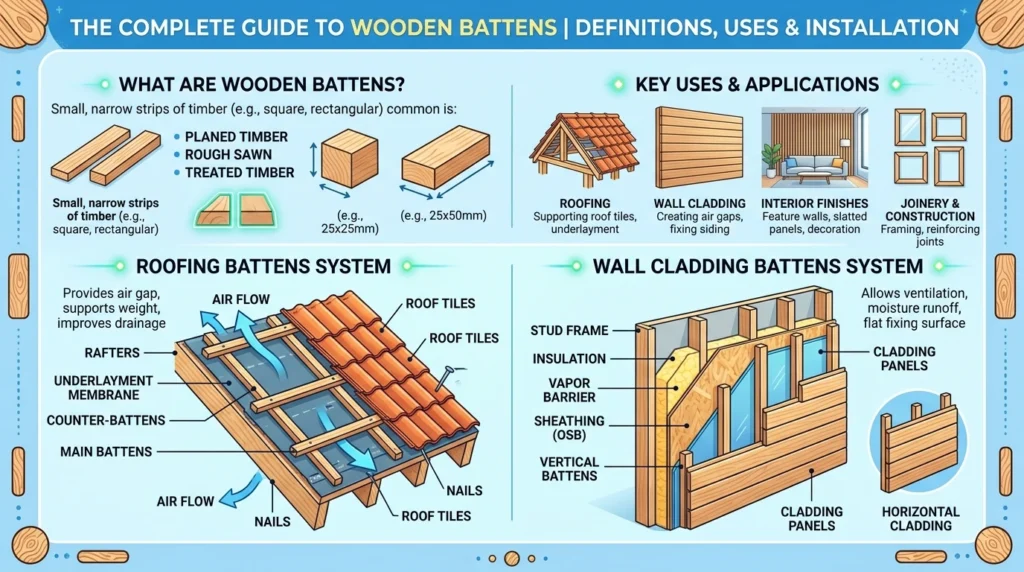
A Wooden Batten is a simple and commonly used wiring method in electrical installations, especially in residential and small commercial buildings. In this system, electrical wires are fixed on wooden strips called battens, which are mounted on walls or ceilings. The wires are secured using clips made of brass or plastic, ensuring that they remain in place and properly aligned. This method is widely used because it is easy to install, cost-effective, and suitable for low-voltage electrical systems. Wooden batten wiring is often preferred in places where a neat and organized appearance is required without the complexity of concealed wiring systems.
The working principle of wooden batten wiring is straightforward. Electrical wires are laid along the wooden batten and fixed at regular intervals using clips. The wooden batten acts as an insulating support, keeping the wires away from direct contact with the wall surface. This reduces the risk of moisture affecting the wires and provides a certain level of safety. The wires used in this method are usually PVC insulated, which further enhances protection against electrical leakage. Because the wiring is visible, it is easy to inspect, repair, or modify when needed. This makes wooden batten wiring very practical for maintenance work and temporary installations.
One of the main advantages of wooden batten wiring is its low cost and simplicity. It does not require complex tools or skilled labor, making it ideal for beginners and small projects. It also offers good heat dissipation, as the wires are exposed to air, reducing the chances of overheating. Another benefit is easy fault detection, since any damage or loose connection can be quickly identified and fixed. However, there are some limitations. Wooden batten wiring is not suitable for high-voltage or heavy load applications. The wooden material can be affected by moisture, insects, or fire, which reduces durability over time. It is also less safe compared to modern concealed wiring systems.
Despite its limitations, wooden batten wiring is still used in certain applications such as workshops, temporary setups, and rural areas. It provides a simple, practical, and economical solution for basic electrical needs. Understanding this wiring method helps students and technicians learn fundamental installation techniques and safety practices in electrical systems.
A flat wooden strip mounted on the wall.
Function:
- Supports electrical cables
- Provides mechanical base
2. Electrical Cables Guide 2026: Types, Sizes and Practical Applications
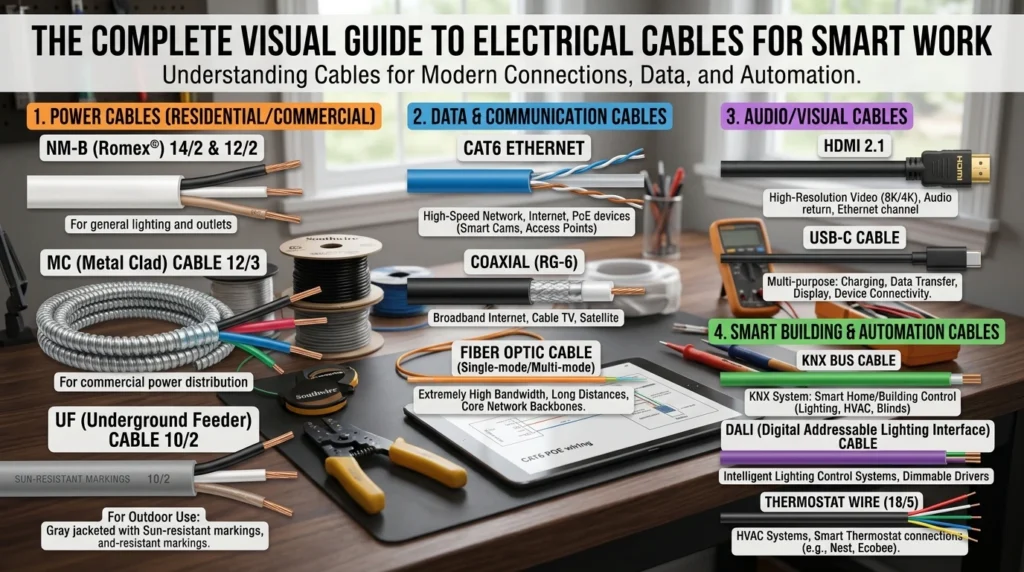
Insulated wires used for electrical power transmission.
Common types:
- PVC cables
- CTS cables
- TRS cables
Electrical cables play a very important role in batten wiring, which is one of the simplest and most commonly used wiring systems in residential and small commercial electrical installations. In batten wiring, electrical cables are laid on a wooden or plastic batten and fixed using clips, making the installation easy, visible, and cost-effective. The type of electrical cable used in this system is usually PVC (Polyvinyl Chloride) insulated cables, which provide good protection against electrical leakage, heat, and mechanical damage.
In batten wiring, single-core or twin-core cables are commonly used depending on the requirement of the circuit. These cables are selected based on the load capacity, voltage rating, and safety standards. Copper conductors are preferred because they offer high conductivity, low resistance, and better durability compared to aluminum wires. The insulation around the cable ensures that there is no direct contact between live wires and the batten surface, reducing the risk of short circuits and electrical hazards.
One of the main advantages of using electrical cables in batten wiring is easy installation and maintenance. Since the wiring is visible, any fault can be easily detected and repaired without damaging walls or ceilings. This makes it highly suitable for temporary installations, small houses, workshops, and schools. Additionally, the cost of installation is lower compared to concealed wiring systems.
However, proper selection of cable size is very important in batten wiring. If the load is high, thicker cables must be used to prevent overheating and voltage drop. Proper clipping and spacing of cables are also necessary to maintain safety and neatness in the installation.
Overall, electrical cables used in batten wiring provide a safe, reliable, and economical solution for basic electrical distribution. When installed correctly with proper insulation and quality materials, batten wiring ensures efficient performance and long service life in electrical systems.Before the table, it is useful to explain that electrical cable size selection is one of the most important parts of any electrical installation. Choosing the correct cable size improves efficiency, prevents overheating, reduces voltage drop, and protects electrical equipment from damage. The following guide provides commonly used cable sizes and their practical applications.
Electrical cables are used to carry electrical energy from one point to another safely and efficiently. They are available in different sizes depending on the amount of current they are required to carry. Selecting the correct cable size is essential because undersized cables may overheat, while oversized cables can unnecessarily increase installation costs.
The table below provides a general guide to commonly used copper cable sizes in residential and light commercial installations.
Electrical Cable Size Selection Table (2026)
| Cable Size (mm²) | Approx. Current Capacity (Amps) | Typical Voltage Rating | Common Applications | Recommended Protection Device |
|---|---|---|---|---|
| 0.5 mm² | 3–5 A | 300/500 V | Doorbells, signal circuits, electronic devices | 3 A Fuse |
| 0.75 mm² | 6 A | 300/500 V | Decorative lighting, small control circuits | 6 A MCB |
| 1.0 mm² | 10 A | 450/750 V | LED lighting circuits and small appliances | 6–10 A MCB |
| 1.5 mm² | 14–16 A | 450/750 V | Lighting circuits, ceiling fans, exhaust fans | 10–16 A MCB |
| 2.5 mm² | 20–24 A | 450/750 V | Socket outlets, kitchen appliances, water dispensers | 16–20 A MCB |
| 4 mm² | 25–32 A | 450/750 V | Air conditioners, washing machines, geysers | 25–32 A MCB |
| 6 mm² | 32–40 A | 450/750 V | Electric ovens, sub-main circuits, large AC units | 32–40 A MCB |
| 10 mm² | 45–55 A | 0.6/1 kV | Main distribution boards and heavy domestic loads | 50–63 A MCB |
| 16 mm² | 60–75 A | 0.6/1 kV | Small commercial feeders and distribution panels | 63–80 A MCCB |
| 25 mm² | 80–100 A | 0.6/1 kV | Industrial machinery and main feeders | 100 A MCCB |
| 35 mm² | 100–125 A | 0.6/1 kV | Large commercial installations | 125 A MCCB |
| 50 mm² | 125–150 A | 0.6/1 kV | Industrial distribution systems | 160 A MCCB |
| 70 mm² | 160–200 A | 0.6/1 kV | Heavy industrial loads and generator connections | 200 A MCCB |
| 95 mm² | 200–230 A | 0.6/1 kV | Large transformers and industrial feeders | 250 A MCCB |
| 120 mm² | 230–270 A | 0.6/1 kV | High-capacity power distribution systems | 250–315 A MCCB |
Common Types of Electrical Cables
| Cable Type | Description | Typical Applications |
|---|---|---|
| PVC Insulated Cable | Flexible cable with PVC insulation | House wiring and lighting circuits |
| XLPE Cable | Cross-linked polyethylene insulated cable | Industrial power distribution |
| Armoured Cable | Cable protected by a steel armour layer | Underground installations |
| Flexible Cable | Multi-strand conductor cable | Portable appliances and extension cords |
| Twin and Earth Cable | Flat cable with earth conductor | Domestic wiring installations |
| Control Cable | Used for signal and control purposes | Industrial automation systems |
Factors to Consider When Selecting Cable Size
- Calculate the total connected load.
- Consider the expected current demand.
- Account for voltage drop over long distances.
- Check ambient temperature conditions.
- Choose the correct protective device rating.
- Follow local electrical codes and standards.
- Allow future expansion if additional loads may be added later.
Important Safety Tips
- Never use a cable smaller than the required current rating.
- Always use high-quality certified cables.
- Install appropriate fuses, MCBs, or MCCBs for protection.
- Ensure proper earthing of the electrical system.
- Periodically inspect cables for damage or overheating.
- Consult a qualified electrician for large installations.
Choosing the correct electrical cable size is essential for the safety, efficiency, and reliability of any electrical installation. Small cable sizes are suitable for lighting and low-power applications, while larger cables are required for heavy domestic, commercial, and industrial loads. By considering current capacity, voltage rating, installation conditions, and protective devices, you can select the most appropriate cable for your project and ensure long-term performance.
3. What Are Brass Clips? Complete Guide to Their Uses, Benefits and Importance in Batten Wiring
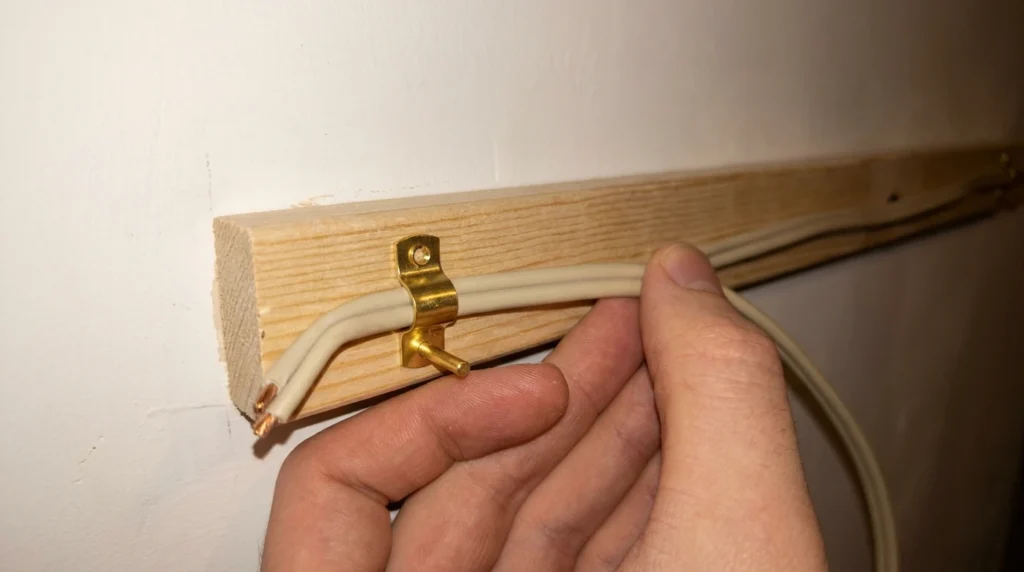
Metal clips used to hold wires on the batten.
Function:
- Secure the cables
- Maintain proper spacing
Brass clips are small but very important components used in electrical wiring systems, especially in batten wiring installations. These clips are made from high-quality brass material, which provides excellent strength, durability, and resistance to corrosion. Their main purpose is to hold and secure electrical cables firmly on wooden or plastic battens, ensuring that the wiring remains properly arranged and safe.
In batten wiring, electrical cables are laid along the surface of walls or ceilings and then fixed using brass clips at regular intervals. These clips help maintain proper alignment of the cables and prevent them from hanging loosely or getting damaged. Because brass is a strong and long-lasting metal, these clips can withstand pressure, vibration, and environmental conditions without losing their shape or grip.
Another important advantage of brass clips is their good conductivity and resistance to rust. Although they are mainly used for mechanical support rather than electrical conduction, their non-corrosive nature makes them ideal for long-term electrical installations. They are especially useful in areas where moisture or humidity is present, as they do not easily rust like ordinary iron nails or steel clips.
Brass clips are available in different sizes to accommodate various cable thicknesses. Electricians choose the appropriate size depending on the type of wiring being installed. Proper spacing between clips is also important to ensure that cables are securely fixed and the installation looks neat and professional.
In addition, brass clips make maintenance easier because the wiring system remains organized and accessible. If any fault occurs, electricians can easily trace and repair the cables without difficulty.
Overall, brass clips are an essential part of batten wiring systems. They provide safety, stability, and a clean installation finish, making electrical wiring more reliable and long-lasting.
4. What Are Screws? Complete Guide to Their Uses and Importance in Batten Wiring Installation
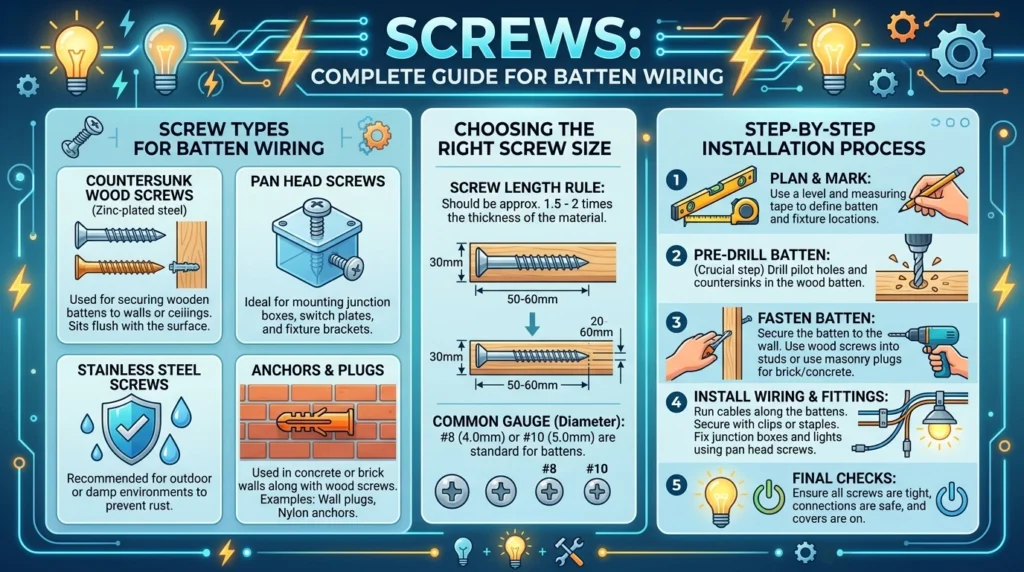
Used to fix battens and clips on the wall.
Screws are one of the most commonly used fastening components in electrical work, construction, and mechanical installations. They are small metal fasteners designed with a threaded body that allows them to grip materials tightly when rotated into a surface such as wood, plastic, or metal. In electrical wiring systems like batten wiring, screws play an important role in fixing accessories, clips, switchboards, and conduits securely to walls or wooden battens.
In batten wiring, screws are mainly used to hold clips and electrical fittings in place so that wires remain properly aligned and safe. They ensure that the installation is strong, stable, and long-lasting. Electricians use different types and sizes of screws depending on the material and load requirements. Common types include wood screws for wooden surfaces, self-tapping screws for metal sheets, and machine screws for electrical equipment assemblies.
One of the main advantages of screws is their strong holding power. Unlike nails, screws provide a tighter grip and are less likely to loosen over time due to vibration or load. This makes them ideal for electrical installations where safety and stability are very important. Screws are also easy to install and remove, which makes maintenance and repair work more convenient.
Most screws used in electrical applications are made from steel, often coated with zinc or other materials to prevent rust and corrosion. This coating increases their durability and makes them suitable for both indoor and slightly humid environments. Proper selection of screw size and type is very important to avoid damage to surfaces and ensure secure fitting.What Are Screws? Complete Guide to Their Uses and Importance in Batten Wiring Installation
Screws are essential fastening components used in batten wiring installations to securely fix battens, clips, switch boxes, and other electrical accessories to walls, ceilings, or wooden surfaces. They provide mechanical strength and stability to the entire wiring system, ensuring that cables remain properly supported and electrical components stay firmly in place. Choosing the correct type and size of screw is important for achieving a safe, durable, and professional electrical installation.
Uses and Importance of Screws in Batten Wiring Installation
| Use of Screws | Where They Are Used | Purpose / Function | Importance in Batten Wiring |
|---|---|---|---|
| Fixing Wooden or PVC Battens | Walls and ceilings | Secure battens firmly to the mounting surface | Provides a strong foundation for the entire wiring system |
| Mounting Brass Clips | Along the batten | Hold brass clips in place to support cables | Prevents cable movement and sagging |
| Installing Switch Boxes | Switchboards and accessory boxes | Fix switches and socket boxes securely | Ensures safe and stable operation of electrical accessories |
| Securing Junction Boxes | Connection points | Attach junction boxes to walls or battens | Protects wire joints and improves safety |
| Mounting Distribution Boards | Main electrical panel areas | Fasten distribution boards firmly | Prevents vibration and accidental displacement |
| Supporting Cable Routes | Cable pathways | Maintain proper cable alignment | Keeps wiring neat and organized |
| Fixing Electrical Accessories | Fans, regulators, holders, and small fittings | Provide mechanical attachment | Improves reliability and appearance of the installation |
| Repair and Maintenance Work | Existing wiring systems | Replace or refit damaged components | Makes maintenance easier and more efficient |
Common Types of Screws Used in Batten Wiring
| Type of Screw | Material | Typical Application | Main Advantage |
|---|---|---|---|
| Wood Screws | Mild Steel or Brass | Fixing battens to wooden surfaces | Strong grip in wood |
| Brass Screws | Brass | Electrical accessories and clips | Corrosion resistant |
| Self-Tapping Screws | Hardened Steel | PVC battens and thin metal surfaces | No pre-threading required |
| Machine Screws | Steel or Brass | Switches and distribution boards | Precise and secure fastening |
| Wall Plug Screws | Steel | Concrete and brick walls | Provides firm anchoring |
Key Benefits of Using Proper Screws
| Benefit | Explanation |
|---|---|
| Improved Safety | Prevents loose electrical components that may cause hazards |
| Better Stability | Keeps battens and accessories firmly fixed |
| Longer Service Life | Reduces wear caused by movement and vibration |
| Easy Maintenance | Allows quick removal and replacement of components |
| Professional Appearance | Ensures neat and well-organized installations |
Screws play a vital role in batten wiring installation by providing secure fastening for battens, clips, switch boxes, and other electrical accessories. Using the correct type and size of screw improves safety, enhances durability, and ensures the overall reliability of the electrical wiring system. Proper fastening not only creates a professional installation but also simplifies future maintenance and repairs.
Overall, screws are essential components in electrical and construction work. They provide strength, reliability, and flexibility in installation. In batten wiring systems, screws help ensure that all electrical components are fixed properly, contributing to a safe, neat, and efficient wiring setup.
5. What Are Screws? Complete Guide to Their Uses and Importance in Batten Wiring Installation
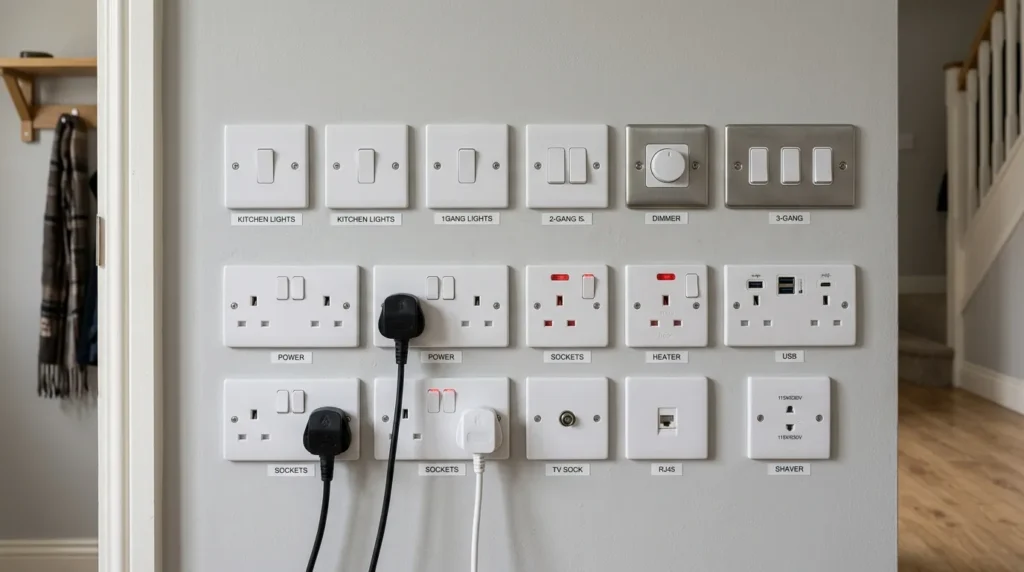
These control and distribute electrical power to devices.
Switches and sockets are essential electrical components used in every residential, commercial, and industrial wiring system. They play a key role in controlling and supplying electrical power safely to different appliances and devices. A switch is a device used to open or close an electrical circuit, allowing or stopping the flow of current. When a switch is turned ON, the circuit is completed and electricity flows to the connected device. When it is turned OFF, the circuit is broken and the flow of current stops.
Sockets, on the other hand, are points where electrical appliances are connected to the power supply using plugs. They provide a safe and convenient interface between the electrical supply and portable devices like fans, chargers, TVs, and other equipment. Switches and sockets are often installed together on switchboards for easy access and organized control of electricity in a building.
These components are designed with safety in mind. Modern switches and sockets are made from high-quality insulating materials like PVC or polycarbonate to prevent electric shocks. Inside, they use metal contacts that ensure proper conduction of electricity. Proper installation of switches and sockets is very important to avoid loose connections, overheating, or short circuits.
Different types of switches are used depending on requirements, such as single-pole switches, two-way switches, and dimmer switches. Similarly, sockets come in different ratings and designs to support various voltages and plug types. In modern electrical systems, modular switches and sockets are widely used because they are safer, more durable, and visually attractive.Switches and Sockets Explained: Their Role in Safe and Efficient Power Distribution
Switches and sockets are among the most important components of any electrical installation. They provide a safe and convenient way to control the flow of electricity and supply power to electrical appliances. Whether in homes, offices, schools, or industrial buildings, these devices help distribute electrical energy efficiently while protecting users from unnecessary risks.
Understanding their functions, types, and importance is essential for electricians, students, homeowners, and anyone interested in electrical systems.
What Are Switches?
A switch is an electrical device used to open or close an electrical circuit. It controls the flow of current by turning electrical equipment ON or OFF.
When a switch is turned ON, it completes the circuit and allows electricity to flow to the connected device. When it is turned OFF, the circuit is broken, stopping the flow of electricity.
Main Functions of Switches
- Control the operation of electrical appliances.
- Turn lighting circuits ON and OFF.
- Improve user convenience.
- Enhance electrical safety.
- Help reduce unnecessary power consumption.
Common Applications of Switches
- Lighting systems
- Ceiling fans
- Exhaust fans
- Water pumps
- Air conditioners
- Industrial control circuits
What Are Sockets?
A socket is an electrical outlet that allows electrical appliances to be connected to the power supply through a plug. It acts as an access point where electricity can be safely drawn from the wiring system.
Sockets are designed to provide secure contact between the electrical installation and portable devices.
Main Functions of Sockets
- Supply power to electrical appliances.
- Provide a safe connection point.
- Allow easy plugging and unplugging of equipment.
- Support the operation of multiple household devices.
- Improve convenience and flexibility.
Common Applications of Sockets
- Mobile phone chargers
- Television sets
- Refrigerators
- Computers and laptops
- Kitchen appliances
- Office equipment
Importance of Switches and Sockets in Power Distribution
Switches and sockets play a major role in ensuring that electricity is distributed safely and efficiently throughout a building.
1. Safe Control of Electricity
Switches allow users to control electrical circuits without directly handling wires.
Benefits
- Reduces the risk of electric shock.
- Prevents accidental contact with live conductors.
- Provides quick isolation of electrical equipment.
2. Efficient Power Distribution
Sockets provide multiple access points for electrical devices throughout a building.
Benefits
- Makes electricity available where needed.
- Eliminates unsafe temporary connections.
- Improves convenience for users.
3. Energy Conservation
Turning off unused appliances through switches helps reduce electricity consumption.
Benefits
- Lowers electricity bills.
- Prevents unnecessary energy wastage.
- Supports energy-efficient practices.
4. Improved User Convenience
Switches and sockets make daily use of electricity simple and accessible.
Benefits
- Easy operation of appliances.
- Quick access to power.
- Flexible use of portable devices.
5. Enhanced Electrical Safety
Modern switches and sockets are designed with safety features to protect users.
Benefits
- Minimize electrical hazards.
- Prevent overheating.
- Reduce the chances of short circuits.
Types of Switches Used in Electrical Installations
Different types of switches are used depending on the application and control requirements.
| Type of Switch | Function | Common Applications |
|---|---|---|
| One-Way Switch | Controls a device from one location | Room lights |
| Two-Way Switch | Controls a device from two locations | Staircase lighting |
| Intermediate Switch | Controls lighting from multiple locations | Large hallways |
| Push Button Switch | Operates only while pressed | Doorbells |
| Dimmer Switch | Adjusts light intensity | Decorative lighting |
| Pull Cord Switch | Operated using a cord | Bathrooms and ceiling fixtures |
| Smart Switch | Allows remote control through apps | Smart homes |
Types of Sockets Used in Electrical Installations
Sockets are available in different designs to suit various electrical requirements.
| Type of Socket | Description | Common Applications |
|---|---|---|
| Two-Pin Socket | Provides live and neutral connections | Small appliances |
| Three-Pin Socket | Includes an earth connection | Domestic appliances |
| Five-Pin Socket | Supports multiple plug configurations | Homes and offices |
| Industrial Socket | Designed for heavy-duty loads | Factories and workshops |
| USB Socket | Includes USB charging ports | Mobile devices |
| Smart Socket | Enables remote control and monitoring | Smart home systems |
Main Components of Switches and Sockets
Components of a Switch
| Component | Function |
|---|---|
| Toggle or Rocker | Operates the switch mechanism |
| Contacts | Open or close the electrical circuit |
| Terminals | Connect wires to the switch |
| Housing | Provides insulation and protection |
| Mechanism | Controls movement of contacts |
Components of a Socket
| Component | Function |
|---|---|
| Socket Outlet | Receives the plug pins |
| Terminals | Connect internal wiring |
| Earth Contact | Provides grounding protection |
| Insulated Body | Prevents electric shock |
| Faceplate | Covers and protects the socket assembly |
Safety Tips for Using Switches and Sockets
Proper use and maintenance of switches and sockets help prevent accidents.
| Safety Tip | Explanation |
|---|---|
| Avoid overloading sockets | Do not connect too many appliances to one outlet. |
| Replace damaged devices | Cracked switches or sockets should be replaced immediately. |
| Keep away from moisture | Water increases the risk of electric shock. |
| Use proper earthing | Ensure three-pin sockets have effective grounding. |
| Turn OFF power before repairs | Disconnect the supply before maintenance work. |
| Use quality products | Choose certified and standard-compliant accessories. |
| Keep away from children | Install child-protection covers where necessary. |
Common Problems and Solutions
| Problem | Possible Cause | Solution |
|---|---|---|
| Switch not working | Loose connection or faulty contacts | Tighten connections or replace the switch |
| Socket overheating | Overloading or poor connections | Reduce load and inspect wiring |
| Sparking during operation | Loose terminals | Tighten terminals and replace damaged parts |
| Plug not fitting properly | Worn socket contacts | Replace the socket |
| Frequent tripping | Circuit overload | Distribute the load correctly |
Advantages of Quality Switches and Sockets
- Improve electrical safety.
- Ensure efficient power distribution.
- Increase user convenience.
- Reduce maintenance problems.
- Enhance the appearance of electrical installations.
- Support energy-saving practices.
- Provide long-term reliability.
Switches and sockets are essential components of every electrical system. Switches provide safe control over electrical circuits, while sockets offer convenient access to power for various appliances and devices. Together, they ensure efficient power distribution, improve user convenience, and enhance electrical safety in homes, offices, and industrial environments.
Choosing high-quality switches and sockets, installing them correctly, and following proper safety practices can significantly improve the reliability and performance of an electrical installation. Understanding their functions and applications helps students, electricians, and homeowners use electrical energy more safely and effectively.
Another important aspect is correct placement. Switches are usually installed at a convenient height for easy access, while sockets are placed where appliances are commonly used. This improves both safety and usability.
Overall, switches and sockets are fundamental parts of electrical wiring systems. They provide control, safety, and convenience, making them an essential component in every electrical installation.
6. Junction Boxes
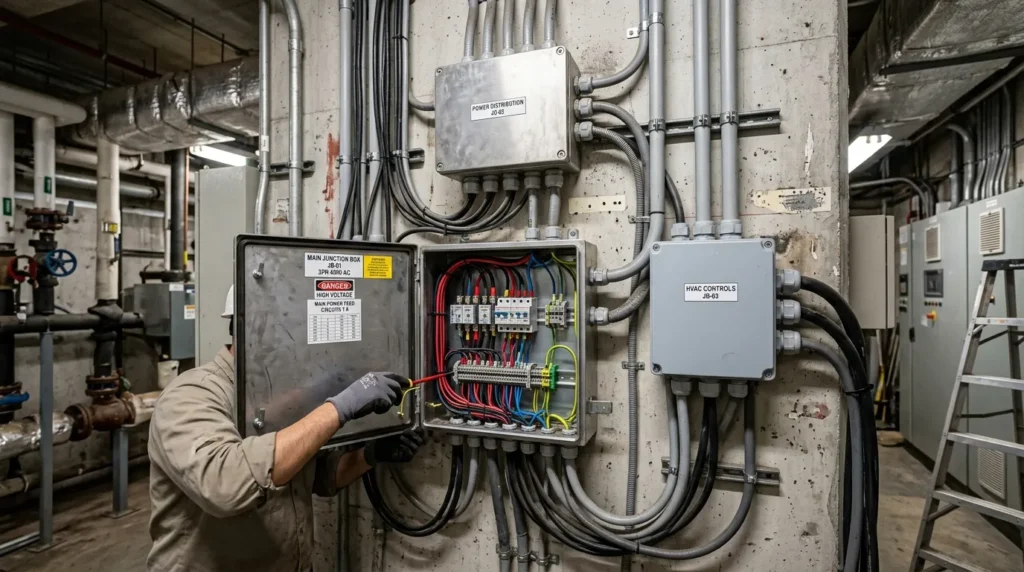
Used to connect multiple wires safely.
Junction boxes are an important part of electrical wiring systems used to safely connect and protect electrical wires. They are small protective enclosures made of plastic or metal that house wire connections, preventing them from being exposed to air, dust, moisture, and accidental contact. Junction boxes are widely used in residential, commercial, and industrial electrical installations to ensure safety and proper organization of wiring.
The main purpose of a junction box is to join multiple electrical wires together in a secure and insulated environment. Instead of leaving wire connections open, electricians place them inside a junction box, which reduces the risk of short circuits, electrical shocks, and fire hazards. These boxes also help in distributing power from one source to different circuits in a controlled manner.
Junction boxes come in different shapes and sizes depending on the wiring requirement. They may be round, square, or rectangular and are selected based on the number of wires and connections needed. Inside the box, wires are joined using connectors, terminal blocks, or wire nuts to ensure strong and stable connections.
One of the biggest advantages of junction boxes is easy maintenance and troubleshooting. If any electrical fault occurs, the junction box can be opened easily to inspect, repair, or replace the faulty connection without disturbing the entire wiring system. This makes electrical maintenance more efficient and less time-consuming.
In addition, junction boxes also provide mechanical protection to wires, preventing them from damage caused by external pressure or environmental conditions. Proper installation of junction boxes is very important, and they should always be placed at accessible points for future inspection.
Overall, junction boxes are a key safety component in electrical wiring systems. They ensure secure connections, protect wiring, and improve the reliability and organization of electrical installations in all types of buildings.
6. Advantages of Batten Wiring
There are several batten wiring advantages and disadvantages, but first let us understand the advantages.
Here is a clear table of Advantages of Batten Wiring:
| No. | Advantage | Explanation |
|---|---|---|
| 1 | Easy Installation | Batten wiring is simple to install on wooden or plastic battens without complex tools or procedures. |
| 2 | Low Cost | It is an economical wiring system as it requires fewer materials and less labor. |
| 3 | Easy Maintenance | Faults can be easily detected and repaired because wiring is visible on the surface. |
| 4 | Quick Fault Detection | Since wires are exposed, electricians can quickly identify damaged or loose connections. |
| 5 | Suitable for Small Buildings | Ideal for houses, schools, workshops, and temporary installations. |
| 6 | Flexible System | Changes and modifications in wiring can be done easily without much effort. |
| 7 | Time Saving | Installation takes less time compared to concealed wiring systems. |
| 8 | Less Skilled Labor Required | Basic electrical skills are enough for installation and maintenance. |
| 9 | Good for Temporary Use | Best option for temporary setups like exhibitions and construction sites. |
| 10 | Easy Inspection | Regular checking of wiring is simple due to open installation. |
Key Advantages
- Simple installation process
- Low installation cost
- Easy inspection and maintenance
- Quick repair of faulty wires
- Suitable for temporary wiring
- Good heat dissipation
- Less installation time
- Neat and organized appearance
Because of these benefits, electricians often use batten wiring for small projects.
7. Disadvantages / Limitations
Despite its advantages, batten wiring also has some limitations.
Here is a clear table of Disadvantages / Limitations of Batten Wiring:
| No. | Disadvantage | Explanation |
|---|---|---|
| 1 | Less Aesthetic Appearance | Wiring is visible on walls, which looks untidy compared to concealed wiring. |
| 2 | Mechanical Damage Risk | Exposed wires can be easily damaged by physical impact or external objects. |
| 3 | Not Suitable for Modern Buildings | It is not preferred in modern homes due to poor finishing and appearance. |
| 4 | Limited Safety | Higher risk of electric shock if insulation gets damaged. |
| 5 | Affected by Environmental Conditions | Moisture, heat, and dust can affect the durability of wiring. |
| 6 | Not Fire Resistant (Low Protection) | In case of short circuit, exposed wiring may increase fire risk if not properly maintained. |
| 7 | Shorter Lifespan | Compared to concealed wiring, batten wiring generally has a shorter service life. |
| 8 | Unsuitable for Heavy Load Systems | Not ideal for large industrial or high-power electrical installations. |
| 9 | Frequent Maintenance Needed | More regular inspection is required due to exposure. |
| 10 | Limited Protection from Rodents | Wires are more vulnerable to damage from rats and insects. |
Main Disadvantages
- Not suitable for damp locations
- Wires are exposed and may be damaged
- Not ideal for heavy industrial loads
- Wooden battens may catch fire
- Less protection compared to conduit wiring
- Appearance may not look modern
These factors should be considered before choosing this wiring system.
8. Batten Wiring Applications
The batten wiring system is a simple and economical method of electrical installation where insulated cables are fixed directly on wooden battens using clips. Because of its low cost, easy installation, and simple maintenance, it is widely used in places where advanced wiring systems are not required. However, it is mainly suitable for dry indoor environments and light electrical loads.
Common Uses of Batten Wiring (2026)
Batten wiring is a simple, economical, and reliable wiring method that has been widely used for many years in residential, commercial, and educational applications. Although modern wiring systems such as concealed and conduit wiring are now preferred for most permanent installations, batten wiring continues to be used in situations where low cost, easy installation, and simple maintenance are the primary requirements.
Because the electrical wires are fixed on wooden battens using brass link clips, the wiring remains easily accessible for inspection, repairs, and future modifications. Below are the most common applications of batten wiring.
1. Residential Buildings
Batten wiring is commonly used in small houses, apartments, cottages, and older residential buildings, particularly where the electrical load is relatively low. It provides an affordable solution for homeowners who require a simple and reliable wiring system without the higher cost of concealed installations.
In residential buildings, batten wiring is commonly installed for:
- Lighting circuits
- Ceiling and exhaust fans
- Power sockets
- Doorbells
- Small household appliances
- Kitchen lighting
- Bedroom and living room electrical circuits
Its open design allows electricians to inspect the wiring easily and perform repairs or modifications without damaging walls or ceilings.
Why it is used in homes:
- Low installation cost
- Simple wiring layout
- Easy maintenance and fault detection
- Quick installation
- Suitable for light electrical loads
2. Workshops and Small Industries
Small workshops and light industrial facilities frequently use batten wiring because it is practical, economical, and easy to maintain. These workplaces often require electrical installations that can be modified as equipment or machinery is relocated.
Common workshop applications include:
- General lighting systems
- Small electric motors
- Drilling machines
- Bench grinders
- Power tools
- Testing equipment
- Workbench power outlets
The exposed wiring enables electricians to quickly identify damaged cables, loose connections, or electrical faults, reducing maintenance time and equipment downtime.
Benefits in workshops:
- Easy inspection
- Fast troubleshooting
- Low installation cost
- Simple expansion of circuits
- Convenient maintenance
3. Temporary Electrical Installations
One of the most important applications of batten wiring is in temporary electrical installations, where electrical power is required for a limited period. Since the system is quick to install and easy to remove, it is ideal for projects that do not require permanent wiring.
Typical temporary applications include:
- Construction sites
- Exhibition halls
- Trade fairs
- Event lighting
- Festival decorations
- Temporary offices
- Outdoor stalls
- Emergency power installations
- Stage and entertainment setups
After the project is completed, the wiring can be dismantled with minimal effort, and many components can be reused in future installations.
Advantages for temporary use:
- Quick installation
- Easy dismantling
- Reusable materials
- Low labor cost
- Flexible wiring layout
4. Schools, Colleges, and Electrical Training Laboratories
Educational institutions commonly use batten wiring in electrical laboratories, vocational training centers, and engineering workshops because its open design makes it ideal for teaching electrical installation techniques.
Students can clearly observe:
- Cable routing
- Wire fixing methods
- Brass clip installation
- Electrical connections
- Switch and socket wiring
- Circuit layouts
- Fault-finding techniques
- Basic electrical safety practices
Because every component remains visible, instructors can easily demonstrate wiring procedures and explain electrical concepts during practical training sessions.
Educational benefits include:
- Better visual learning
- Easy demonstration of wiring methods
- Practical hands-on experience
- Simple maintenance for laboratory equipment
- Safe learning environment under supervision
5. Shops and Small Commercial Offices
Batten wiring is also suitable for small commercial establishments where electrical demand is moderate and installation costs need to be kept low.
Typical applications include:
- Retail shops
- Grocery stores
- Kiosks
- Small offices
- Reception areas
- Service centers
- Storage rooms
It is commonly used for:
- Lighting systems
- Ceiling fans
- Computers and office equipment
- Power outlets
- Display lighting
- Cash counter equipment
The simple installation process allows business owners to complete electrical work quickly while minimizing expenses.
Reasons for choosing batten wiring:
- Cost-effective installation
- Easy expansion of electrical circuits
- Convenient maintenance
- Suitable for moderate electrical loads
- Minimal installation time
6. Warehouses and Storage Buildings
Batten wiring is often installed in warehouses, storage facilities, and utility buildings where appearance is less important than functionality. These locations require reliable lighting and power distribution that can be easily inspected and maintained.
Typical applications include:
- Warehouse lighting
- Storage room power outlets
- Security lighting
- Ventilation fans
- Loading area electrical circuits
The exposed wiring allows maintenance personnel to detect faults quickly, reducing downtime and ensuring continuous operation.
7. Agricultural Buildings and Farmhouses
In some rural areas, batten wiring is used in farmhouses, barns, poultry houses, and agricultural buildings where a simple electrical installation is sufficient for lighting and small electrical equipment.
Common uses include:
- Barn lighting
- Water pumps
- Ventilation fans
- Small agricultural machines
- Storage sheds
However, proper protection against moisture and dust is essential to maintain safety and reliability.
Batten wiring remains a practical and economical solution for residential buildings, workshops, temporary installations, educational laboratories, shops, warehouses, and agricultural buildings where electrical loads are relatively light and easy maintenance is important. Its main advantages include low installation cost, quick installation, simple fault detection, and convenient maintenance.
Although modern wiring systems such as concealed wiring and conduit wiring are preferred for most permanent residential and commercial buildings because of their superior safety, durability, and appearance, batten wiring continues to play an important role in temporary electrical installations, training laboratories, and budget-friendly projects. Understanding its applications helps electrical students, technicians, and engineers select the most suitable wiring method for different installation requirements.
9. Comparison with Other Wiring Systems
Understanding the difference between batten wiring and conduit wiring helps electricians choose the right system.
| Feature | Batten Wiring | Conduit Wiring |
|---|---|---|
| Installation | Easy | Complex |
| Cost | Low | High |
| Safety | Moderate | High |
| Appearance | Basic | Modern |
| Maintenance | Easy | Difficult |
| Protection | Low | High |
Batten wiring is economical, while conduit wiring provides better protection.
10. Selection Guide
Selecting the correct wiring system is very important in electrical installations because it directly affects safety, performance, and durability. The choice depends on the environment, electrical load, cost, and installation requirements. The batten wiring system is simple and economical, but it must be used carefully in suitable conditions to avoid hazards and ensure long-term reliability.
Tips for Beginners
1. Consider the Environment
The environment plays a major role in selecting batten wiring. This system is best suited for dry and indoor areas only.
- Avoid using batten wiring in bathrooms, basements, or outdoor locations
- Moisture can damage insulation and increase the risk of electric shock
- Heat and humidity may reduce the life of cables
👉 Always ensure the installation area is safe, dry, and well-ventilated before selecting batten wiring.
2. Check Load Requirements
Batten wiring is designed for light electrical loads, so it should not be used for heavy machinery or high-power equipment.
- Suitable for lights, fans, and small appliances
- Not recommended for industrial machines or heavy motors
- Overloading can cause overheating and fire risks
👉 Always calculate the total load before installation to ensure safe operation.
3. Choose Quality Cables
The quality of cables used in batten wiring is extremely important for safety and performance.
- Use high-grade insulated copper or aluminum wires
- Ensure proper insulation thickness and durability
- Avoid low-quality or damaged cables
👉 Good quality cables reduce the risk of short circuits, leakage, and frequent maintenance issues.
4. Follow Safety Rules
Electrical safety rules must always be followed during installation and usage.
- Proper earthing (grounding) is essential
- Use correct circuit breakers and fuses
- Ensure proper spacing between clips and cables
- Avoid overloading circuits
👉 Safety measures protect both users and electrical equipment from accidents.
5. Use Skilled Electricians
Proper installation is critical for the safe performance of batten wiring systems.
- Skilled electricians ensure correct wiring layout
- They follow proper safety standards and regulations
- Reduce chances of wiring faults and future repairs
- Ensure neat and reliable installation
👉 Poor installation can lead to serious electrical hazards, so professional work is always recommended.
The selection of batten wiring systems should always be based on environmental conditions, load requirements, material quality, and safety standards. While batten wiring is cost-effective and easy to install, it is only suitable for light-duty applications in dry indoor areas. By following proper guidelines and using skilled professionals, safe and efficient electrical installations can be achieved.
11. Common Problems & Solutions
The batten wiring system is simple and widely used, but like any electrical installation, it can develop certain problems over time. These issues are usually caused by poor installation, overloading, aging of materials, or environmental effects. Understanding these problems and their solutions is important for maintaining safety and ensuring proper electrical performance.
Problem 1: Loose Clips
Cause:
Loose clips usually occur due to improper installation, weak fastening, or vibration over time. When clips are not properly tightened, the cables may hang loosely from the batten, increasing the risk of damage.
Solution:
To fix this problem, all loose clips should be tightened properly. If clips are broken, rusted, or damaged, they should be replaced immediately with new and strong clips. Proper spacing and secure fitting should always be maintained during installation.
Problem 2: Damaged Cable Insulation
Cause:
Cable insulation can get damaged due to aging, continuous exposure to heat, poor-quality materials, or mechanical injury during installation or maintenance work. Once insulation is damaged, the safety of the entire system is compromised.
Solution:
Damaged cables should be replaced immediately. Temporary repairs are not recommended because they do not provide long-term safety. High-quality insulated cables should always be used to prevent future issues.
Problem 3: Overheating Wires
Cause:
Overheating occurs when electrical wires carry more load than their rated capacity. This can happen due to excessive appliances connected to a single circuit or use of undersized cables.
Solution:
To solve this issue, the electrical load should be reduced or distributed across multiple circuits. In some cases, replacing the wire with a thicker cable that matches the load requirement is necessary. Proper circuit design helps prevent overheating problems.
Problem 4: Short Circuit
Cause:
A short circuit usually happens when the live wire and neutral wire come into direct contact due to broken insulation, loose connections, or faulty wiring. This is a serious electrical fault that can lead to fire hazards.
Solution:
The entire wiring system should be carefully inspected to locate the fault. The damaged section must be repaired or replaced immediately. Using proper insulation, correct wiring techniques, and circuit protection devices like fuses and MCBs can help prevent short circuits.
Although the batten wiring system is simple and cost-effective, it requires proper installation and regular maintenance to avoid common problems. By addressing issues like loose clips, damaged insulation, overheating, and short circuits in time, the system can remain safe, reliable, and efficient for long-term use.
12. Future Trends in Electrical Wiring Systems (2026)
The electrical industry is evolving rapidly with the introduction of smarter, safer, and more energy-efficient wiring technologies. Modern electrical installation methods have advanced far beyond traditional systems such as batten wiring, cleat wiring, and lead-sheathed wiring. Today’s wiring solutions focus on improving electrical safety, reducing energy consumption, simplifying maintenance, and supporting smart buildings.
With the increasing adoption of automation, renewable energy, and Internet of Things (IoT) technologies, modern wiring systems are becoming more intelligent and reliable. These innovations are transforming residential, commercial, and industrial electrical installations, making them more efficient, sustainable, and future-ready.
New Developments in Electrical Wiring Systems
Modern electrical wiring has undergone significant improvements in terms of safety, efficiency, durability, and automation. Advanced wiring methods, high-performance cables, and intelligent monitoring systems are replacing conventional wiring techniques to meet the growing demand for reliable electrical infrastructure.
The following are some of the most important developments shaping the future of electrical wiring systems.
1. Smart Home Wiring and Home Automation
Smart home wiring is one of the most significant advancements in modern electrical engineering. It enables homeowners to control electrical devices remotely using smartphones, tablets, voice assistants, or centralized automation systems.
Smart wiring integrates electrical circuits with intelligent control devices, allowing automatic operation based on user preferences, occupancy, or environmental conditions.
Key Features
- Remote control of lighting, fans, air conditioners, and appliances.
- Voice control through smart assistants such as Amazon Alexa and Google Assistant.
- Motion sensors for automatic lighting.
- Smart switches and wireless control systems.
- Programmable timers and scheduling functions.
- Integration with home security and surveillance systems.
- Real-time monitoring of electrical devices.
Benefits
- Greater convenience and comfort.
- Improved energy efficiency.
- Reduced electricity consumption.
- Enhanced home security.
- Better control over electrical appliances.
- Easy monitoring from anywhere in the world.
As smart home technology continues to evolve, intelligent wiring systems are expected to become a standard feature in modern residential buildings.
2. Advanced Insulation Materials
Electrical cable manufacturers now use high-performance insulation materials that provide better protection, higher durability, and improved resistance to heat, moisture, and chemicals compared to traditional insulation.
Modern insulation technologies help increase the reliability and lifespan of electrical installations while improving user safety.
Common Insulation Materials
- PVC (Polyvinyl Chloride)
- XLPE (Cross-Linked Polyethylene)
- LSZH (Low Smoke Zero Halogen)
- Fire-resistant insulation compounds
- Heat-resistant thermoplastic materials
Advantages
- Excellent electrical insulation.
- High resistance to heat and fire.
- Reduced risk of electrical leakage.
- Improved mechanical strength.
- Better moisture and chemical resistance.
- Longer service life.
- Lower maintenance requirements.
- Increased protection during short circuits.
These advanced materials play a vital role in improving the safety and reliability of modern electrical systems.
3. Modern Wiring Methods
Traditional open wiring systems are gradually being replaced by advanced wiring methods that provide better protection, improved appearance, and greater durability.
Modern buildings commonly use:
- Concealed wiring
- PVC conduit wiring
- Metal conduit wiring
- Cable trunking systems
- Cable tray systems
- Raceway wiring systems
These wiring methods protect electrical conductors from mechanical damage, moisture, dust, and accidental contact while providing a clean and professional installation.
Benefits
- Better protection against physical damage.
- Improved electrical safety.
- Neat and attractive appearance.
- Longer service life.
- Easier maintenance and future upgrades.
- Suitable for residential, commercial, and industrial buildings.
Today, concealed conduit wiring has become the preferred choice for most permanent electrical installations because it combines safety, durability, and aesthetic appeal.
4. Smart Energy Management Systems
Modern electrical installations increasingly incorporate intelligent energy management systems that monitor and optimize electricity usage in real time. These systems collect energy consumption data and automatically control electrical loads to reduce unnecessary power usage.
Key Features
- Smart energy meters.
- Real-time power monitoring.
- Automatic load management.
- Remote energy reporting.
- Power quality analysis.
- Peak demand control.
Benefits
- Lower electricity bills.
- Improved energy efficiency.
- Reduced power wastage.
- Better load balancing.
- Easier energy management.
5. Integration with Renewable Energy Systems
Future electrical wiring systems are being designed to work seamlessly with renewable energy sources such as solar power, wind energy, and battery storage systems.
Modern installations include wiring specifically designed for:
- Solar photovoltaic (PV) systems.
- Hybrid inverters.
- Battery energy storage.
- Electric vehicle (EV) charging stations.
- Smart grid connections.
This integration supports cleaner energy production while reducing dependence on conventional power sources.
6. Internet of Things (IoT) in Electrical Installations
The Internet of Things (IoT) is revolutionizing electrical engineering by enabling communication between electrical devices through the internet.
IoT-enabled electrical systems allow users to monitor and control equipment remotely while receiving instant alerts about faults or abnormal operating conditions.
Applications
- Smart lighting systems.
- Intelligent circuit breakers.
- Remote equipment monitoring.
- Predictive maintenance.
- Industrial automation.
- Smart buildings.
These technologies improve operational efficiency and reduce maintenance costs.
7. Eco-Friendly and Sustainable Wiring Solutions
Environmental sustainability is becoming an important consideration in electrical engineering. Manufacturers are developing environmentally friendly wiring products that reduce waste and improve energy efficiency.
Examples include:
- Recyclable cable insulation.
- Low-smoke, halogen-free cables.
- Energy-efficient electrical accessories.
- Sustainable manufacturing processes.
These developments contribute to safer buildings and reduced environmental impact.
The future of electrical wiring systems is centered on smart technology, enhanced safety, energy efficiency, automation, and sustainability. Innovations such as smart home wiring, advanced insulation materials, intelligent energy management systems, IoT-enabled monitoring, and renewable energy integration are transforming the way electrical installations are designed and operated.
Although traditional wiring methods such as batten wiring and cleat wiring remain valuable for educational purposes and temporary installations, modern buildings increasingly rely on concealed wiring, conduit systems, and intelligent electrical networks that offer superior safety, reliability, efficiency, and long-term performance. As technology continues to evolve, future electrical wiring systems will become even smarter, more connected, and better equipped to meet the growing demands of modern infrastructure.
4. Energy-Efficient Electrical Wiring Systems (2026)
Energy efficiency has become one of the most important goals in modern electrical installations. As electricity demand continues to increase, engineers and manufacturers are developing advanced wiring systems that minimize power losses while improving overall system performance. Modern electrical wiring is now designed not only to deliver electricity safely but also to optimize energy usage, reduce operating costs, and support sustainable building practices.
Today’s energy-efficient installations incorporate intelligent technologies that automatically control electrical loads based on occupancy, daylight availability, and real-time power consumption. These systems help eliminate unnecessary energy waste while maintaining comfort, safety, and convenience in residential, commercial, and industrial buildings.
Key Features of Energy-Efficient Installations
- Automatic Switching Systems: Motion sensors, occupancy sensors, daylight sensors, and programmable timers automatically switch lights and equipment on or off when required, preventing unnecessary electricity consumption.
- Energy Monitoring Devices: Smart energy meters and power monitoring systems provide real-time information about electricity usage, allowing users to identify energy-intensive appliances and improve efficiency.
- LED Lighting Systems: Modern LED lighting consumes significantly less electricity than traditional incandescent or fluorescent lamps while providing longer service life and lower maintenance costs.
- Smart Distribution Boards: Advanced distribution boards include intelligent monitoring, remote control, overload protection, and energy management features that improve electrical safety and efficiency.
- Smart Circuit Protection: Modern circuit breakers and protection devices detect faults quickly, reducing energy losses and protecting electrical equipment from damage.
- Building Automation Systems (BAS): Centralized control systems automatically manage lighting, air conditioning, ventilation, and other electrical loads to maximize energy savings.
- Renewable Energy Integration: Modern wiring systems are designed to work efficiently with solar panels, battery storage systems, and other renewable energy sources, helping reduce dependence on conventional electricity supplies.
Benefits of Energy-Efficient Wiring Systems
Energy-efficient electrical installations provide numerous advantages, including:
- Lower electricity bills through reduced power consumption.
- Improved overall energy efficiency.
- Reduced carbon emissions and environmental impact.
- Longer lifespan of electrical equipment.
- Better control and monitoring of energy usage.
- Enhanced electrical safety and reliability.
- Reduced maintenance and operating costs.
- Support for green buildings and sustainable infrastructure.
These modern technologies help homeowners, businesses, and industries reduce operating expenses while contributing to environmental sustainability and energy conservation.
Future of Electrical Wiring Systems (2026)
The latest developments in electrical wiring systems demonstrate a significant shift toward smart, safe, energy-efficient, and environmentally friendly technologies. Innovations such as smart home automation, advanced insulation materials, intelligent circuit protection, IoT-enabled monitoring, and energy management systems are transforming the way electricity is distributed and controlled.
Modern wiring systems not only improve electrical safety but also offer greater convenience, higher reliability, easier maintenance, and improved energy efficiency. As buildings become increasingly connected and automated, these advanced technologies are expected to become the standard for future electrical installations.
Although batten wiring is considered a traditional wiring method, it still remains useful in certain temporary installations, educational laboratories, workshops, renovation projects, and low-cost electrical applications where simplicity, easy maintenance, and quick installation are important. However, for permanent residential and commercial buildings, modern wiring systems such as concealed wiring, conduit wiring, and smart electrical installations are generally preferred because they provide superior safety, durability, appearance, and long-term performance.
13. Conclusion
Batten wiring is one of the simplest and oldest electrical wiring methods used in residential installations. In this system, electrical cables are mounted on wooden battens and secured with metal clips. The batten wiring working principle is straightforward, making it easy to understand and install.
This wiring system offers several advantages such as low cost, quick installation, and easy maintenance. However, it also has limitations like lower protection and exposure of wires. Therefore, it is mainly used in small homes, workshops, and temporary installations.
Understanding the batten wiring applications and batten wiring advantages and disadvantages helps electricians choose the right wiring method for specific situations. For beginners and electrical students, learning this system provides a strong foundation for understanding modern wiring techniques and electrical installation practices.