
Imagine a house with solar panels installed on the roof. During the day, sunlight hits the panels and electricity is produced. However, the electricity generated by solar panels cannot directly power most home appliances such as fans, lights, televisions, or refrigerators. This happens because solar panels produce direct current (DC), while household appliances require alternating current (AC).
This is where a Solar Inverter becomes extremely important. A solar inverter converts the electricity produced by solar panels into a usable form that can power homes, offices, and industries. Without an inverter, the electricity produced by solar panels would not be useful for most electrical devices.
Today, solar energy is becoming one of the most popular renewable energy sources around the world. Solar inverters play a crucial role in making solar power practical and efficient.
In this article, you will learn everything about Solar Inverter, including its definition, solar inverter working principle, types, main components, advantages and disadvantages, applications, and common troubleshooting methods. The goal is to explain this topic in simple and clear language so that electrical students, technicians, and beginners can easily understand it.
What is a Solar Inverter?
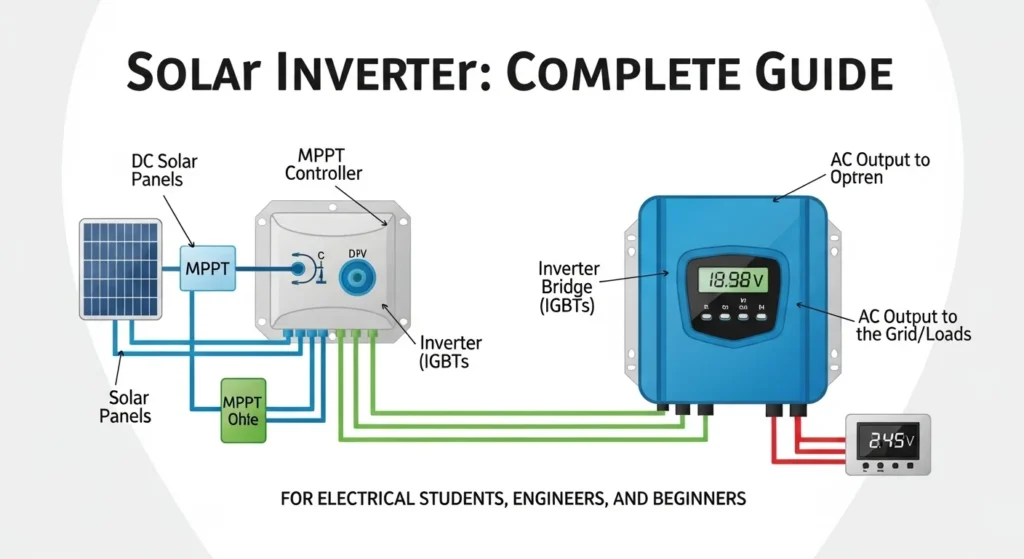
A solar inverter is an electrical device that converts the direct current (DC) electricity generated by solar panels into alternating current (AC) electricity used by most household appliances, commercial equipment, and industrial machines.
It is one of the most important components of a solar power system because solar panels produce DC electricity, while the electrical grid and most appliances operate on AC electricity. The solar inverter performs this conversion efficiently, allowing solar energy to power everyday electrical devices safely and effectively.
In addition to converting DC to AC, modern solar inverters monitor system performance, optimize energy production, and include built-in safety features to protect the solar system.
Simple Explanation
Think of a solar inverter as a translator between your solar panels and your electrical appliances. Solar panels produce electricity in the form of DC power, but televisions, refrigerators, fans, air conditioners, and other home appliances require AC power. The solar inverter translates DC electricity into AC electricity so these appliances can operate normally.
Practical Example
Suppose your rooftop solar panels generate 48V DC electricity on a sunny day. This DC power cannot be used directly by most household appliances. The solar inverter converts the 48V DC into 220V or 230V AC (depending on your country’s electrical standard), making it suitable for running lights, fans, televisions, refrigerators, washing machines, and other electrical equipment.
Why is a Solar Inverter Important?
Without a solar inverter, the electricity produced by solar panels would not be compatible with most homes, businesses, or the electrical grid. The inverter ensures that solar energy can be used efficiently, safely, and reliably for everyday applications, making it an essential part of every modern solar power system.
Solar Inverter Working Principle
The solar inverter working principle is based on converting the direct current (DC) electricity generated by solar panels into alternating current (AC) electricity that can safely power household appliances, commercial equipment, and industrial systems.
A solar inverter uses advanced power electronics and intelligent control circuits to perform this conversion efficiently. Modern inverters also monitor voltage, frequency, and output quality to ensure a stable and reliable power supply.
Step-by-Step Working Process
Step 1: DC Power Generation
When sunlight falls on the solar panels, photovoltaic (PV) cells convert solar energy into direct current (DC) electricity. This DC power is then sent to the solar inverter through DC cables.
Step 2: DC Voltage Conditioning
Before conversion begins, the inverter regulates and stabilizes the incoming DC voltage. This ensures the voltage remains within a safe operating range, even if sunlight intensity changes throughout the day.
Step 3: Electronic Switching
Inside the inverter, high-speed electronic components such as MOSFETs or IGBTs switch the DC current on and off thousands of times per second. This rapid switching is the key process that enables DC-to-AC conversion.
Step 4: AC Waveform Generation
The switching circuit creates a waveform that closely resembles alternating current. In modern pure sine wave inverters, sophisticated control techniques produce a smooth sine wave similar to the electricity supplied by the utility grid.
Step 5: Filtering and Voltage Control
The generated waveform passes through filters that remove unwanted electrical noise and harmonics. The inverter also regulates the output voltage and frequency to match the required electrical standards.
Step 6: AC Power Output
Finally, the inverter delivers clean and stable AC electricity—typically 220–240V AC at 50 Hz or 110–120V AC at 60 Hz, depending on the country’s electrical system. This AC power can then be used to operate lights, fans, televisions, refrigerators, air conditioners, computers, and other electrical appliances.
Simple Analogy
Imagine a river flowing in only one direction. This is similar to DC electricity, where current flows continuously in a single direction. Now imagine a machine that quickly changes the flow back and forth. The water would move alternately in both directions, just like AC electricity. A solar inverter
4. Types / Classification of Solar Inverters
Solar inverters are available in several types depending on their design and application.
Grid-Tied Solar Inverter: Definition, Working, Features, and Applications
A Grid-Tied Solar Inverter, also known as an On-Grid Solar Inverter, is designed to operate while connected directly to the utility power grid. It converts the DC electricity generated by solar panels into AC electricity for household or commercial use. If the solar panels produce more electricity than the building consumes, the excess power is automatically exported to the utility grid through a net metering system, where available.
Grid-tied inverters continuously synchronize their output voltage and frequency with the utility grid to ensure a safe and stable power supply. Since they rely on the grid as a backup source, they do not require battery storage, making them one of the most cost-effective and efficient solar inverter options.
Key Features
- Directly connected to the utility power grid
- Converts DC electricity into grid-compatible AC power
- Sends excess solar energy back to the grid through net metering
- Does not require batteries for operation
- High conversion efficiency, typically above 95%
- Lower installation and maintenance costs
- Automatic synchronization with grid voltage and frequency
- Suitable for residential, commercial, and industrial solar systems
Common Applications
- Residential rooftop solar systems
- Commercial buildings
- Offices
- Schools and colleges
- Hospitals
- Factories with reliable grid electricity
Best For
A Grid-Tied Solar Inverter is the best choice for locations with a stable electricity supply where the main goal is to reduce electricity bills and maximize the use of solar energy without investing in battery storage.
Off-Grid Solar Inverter: Definition, Working, Features, and Applications
An Off-Grid Solar Inverter is designed to operate independently of the utility power grid. It converts the DC electricity generated by solar panels into AC electricity to power electrical appliances. Unlike grid-tied systems, an off-grid inverter works with a battery bank, allowing excess solar energy to be stored during the day and used at night or during cloudy weather.
Since it does not rely on the utility grid, this type of inverter is ideal for locations where grid electricity is unavailable, unreliable, or too expensive to install. It provides a complete standalone power solution for homes, farms, cabins, and remote facilities.
Key Features
- Operates without a connection to the utility grid
- Converts solar DC power into usable AC electricity
- Works with battery banks for energy storage
- Stores excess solar energy for nighttime and backup use
- Provides electricity during power outages
- Includes battery charging and power management functions
- Suitable for remote and off-grid locations
- Can be used with solar panels, batteries, and backup generators
Common Applications
- Remote homes and villages
- Farms and agricultural facilities
- Mountain cabins and cottages
- Telecommunication towers
- Rural schools and healthcare centers
- Remote construction sites
- Boats, RVs, and mobile power systems
Best For
An Off-Grid Solar Inverter is the best choice for areas without reliable utility electricity or for users who want complete energy independence. It ensures a continuous power supply by storing excess solar energy in batteries for use whenever sunlight is unavailable.
What is a Hybrid Solar Inverter?
A Hybrid Solar Inverter is an advanced type of solar inverter that combines the features of both Grid-Tied and Off-Grid solar inverters. It can intelligently manage electricity from solar panels, battery storage, and the utility power grid, ensuring a continuous and reliable power supply.
During the day, the hybrid inverter uses electricity generated by the solar panels to power electrical loads. Any excess energy can be stored in batteries for later use or exported to the utility grid through net metering, depending on the system configuration. When solar power is unavailable, such as at night or during cloudy weather, the inverter automatically switches to battery power or grid electricity without interrupting the power supply.
Because of its flexibility and smart energy management capabilities, the hybrid solar inverter is becoming one of the most popular choices for modern residential, commercial, and industrial solar installations.
Key Features
- Combines the functions of grid-tied and off-grid solar inverters
- Operates with solar panels, battery storage, and the utility grid
- Automatically switches between different power sources
- Stores excess solar energy in batteries for later use
- Can export surplus electricity to the utility grid (where net metering is available)
- Provides backup power during grid failures
- Maximizes solar energy utilization and reduces electricity costs
- Includes intelligent energy management and battery charging systems
Common Applications
- Residential homes with battery backup
- Commercial buildings
- Offices
- Schools and hospitals
- Industrial facilities
- Smart homes with energy management systems
- Areas experiencing frequent power outages
Best For
A Hybrid Solar Inverter is the best choice for users who want the benefits of both grid connectivity and battery backup. It offers greater energy independence, improved reliability, and efficient use of solar power, making it an excellent solution for modern solar energy systems.
Key Features
- Flexible operation
- Battery storage support
- Smart energy management
What is a Micro Inverter?
A Micro Inverter is a small solar inverter that is installed directly on the back of each individual solar panel. Unlike a traditional string inverter, which converts the combined DC electricity from multiple solar panels, a micro inverter converts the DC power produced by each solar panel into AC power independently.
Because every panel has its own inverter, the performance of one panel does not affect the others. This design improves the overall efficiency of the solar system, especially when some panels are shaded, dirty, or installed at different angles. Micro inverters also provide panel-level monitoring, making it easier to identify and troubleshoot performance issues.
Although micro inverter systems have a higher initial cost, they offer better energy production, improved reliability, and greater flexibility for residential and small commercial solar installations.
Key Features
- Installed on each individual solar panel
- Converts DC electricity to AC at the panel level
- Higher overall energy efficiency
- Better performance in partial shading conditions
- Independent operation of each solar panel
- Real-time monitoring of individual panel performance
- Easy system expansion by adding more solar panels
- Improved safety due to lower high-voltage DC wiring
- Long service life with minimal maintenance
Common Applications
- Residential rooftop solar systems
- Small commercial solar installations
- Roofs with multiple angles or orientations
- Solar systems affected by trees, chimneys, or nearby buildings
- Smart solar systems requiring panel-level monitoring
Best For
A Micro Inverter is the best choice for solar installations where panels experience partial shading, are installed on different roof angles, or where maximum energy production and individual panel monitoring are important. Although the upfront cost is higher than a string inverter, the improved performance and flexibility often provide better long-term value.
Main Components of a Solar Inverter
A solar inverter is made up of several important electrical and electronic components that work together to convert DC electricity from solar panels into clean and stable AC electricity. Each component has a specific function that ensures the inverter operates efficiently, safely, and reliably.
DC Input Section
The DC input section is the entry point of the solar inverter. It receives the direct current (DC) electricity generated by the solar panels and prepares it for the conversion process.
Functions:
- Receives DC power from the solar panels
- Regulates the incoming voltage and current
- Protects the inverter from overvoltage and reverse polarity
- Supplies stable DC power to the internal circuits
Power Switching Circuit
The power switching circuit is the heart of the solar inverter. It uses high-speed electronic switches, such as MOSFETs or IGBTs, to rapidly switch the DC current on and off, creating the alternating waveform needed for AC power.
Functions:
- Converts DC electricity into alternating electrical pulses
- Operates at high switching frequencies for efficient conversion
- Controls the output voltage and frequency
- Improves overall energy conversion efficiency
Transformer or Inductor
Depending on the inverter design, a transformer or an inductor is used to regulate the output voltage. Traditional inverters often use transformers, while many modern solar inverters use transformer-less technology to improve efficiency and reduce size.
Functions:
- Adjusts the output voltage to the required level
- Provides electrical isolation in transformer-based designs
- Helps stabilize the AC output
- Improves power quality and efficiency
Control System
The control system acts as the brain of the solar inverter. It typically consists of a microcontroller, digital signal processor (DSP), or other intelligent electronic circuits that continuously monitor and control the inverter’s operation.
Functions:
- Monitors voltage, current, frequency, and temperature
- Controls the switching operation of the inverter
- Optimizes power conversion efficiency
- Detects faults and activates protection features
- Displays system status and performance data
Output Filter
The output filter smooths the electrical waveform produced by the switching circuit. It removes unwanted harmonics and electrical noise, ensuring that the inverter delivers clean, stable AC power suitable for sensitive electrical equipment.
Functions:
- Produces a smooth sine wave output
- Reduces electrical noise and harmonics
- Improves power quality
- Protects connected appliances from voltage disturbances
Cooling System
The cooling system prevents the inverter from overheating during operation. Depending on the inverter size and power rating, it may use heat sinks, cooling fans, or advanced thermal management systems to dissipate heat effectively.
Functions:
- Removes excess heat from internal components
- Maintains safe operating temperatures
- Improves efficiency and reliability
- Extends the lifespan of the inverter
- Protects against thermal overload
Protection Circuit
Modern solar inverters also include a protection circuit that safeguards both the inverter and the connected electrical system from abnormal operating conditions.
Functions:
- Protects against overload and short circuits
- Prevents damage from overvoltage and undervoltage
- Detects overheating and shuts down the inverter if necessary
- Provides anti-islanding protection in grid-tied systems
- Ensures safe and reliable operation
Together, these components enable a solar inverter to efficiently convert solar energy into usable electricity while maintaining high performance, safety, and long-term reliability.
6. Solar Inverter Advantages
Solar inverter technology provides many benefits in modern power systems.
Advantages
- Converts solar DC power into usable AC electricity
- Improves energy efficiency
- Supports renewable energy generation
- Reduces electricity bills
- Helps reduce carbon emissions
- Enables energy independence
- Can integrate with battery storage
These solar inverter advantages and disadvantages should be considered when designing solar power systems.
7. Solar Inverter Disadvantages / Limitations
Although solar inverters offer many benefits, they also have some limitations.
Disadvantages
- Initial installation cost can be high
- Efficiency losses occur during conversion
- Requires regular maintenance
- Sensitive to extreme temperatures
- Battery systems may increase cost
Understanding these limitations helps engineers design better solar systems.
Solar Inverter Applications
Solar inverters are widely used in residential, commercial, industrial, and off-grid power systems. By converting the DC electricity generated by solar panels into AC electricity, they make solar energy suitable for powering a wide range of electrical devices and equipment. As the demand for renewable energy continues to grow, solar inverter applications are expanding across many sectors.
Residential Applications
Solar inverters are an essential part of home solar power systems. They provide clean AC electricity to operate everyday household appliances while helping homeowners reduce electricity bills and dependence on the utility grid.
Common residential applications include:
- Lighting systems
- Ceiling fans
- Televisions
- Refrigerators
- Air conditioners
- Washing machines
- Water pumps
- Home battery backup systems
Commercial Applications
Commercial buildings use solar inverters to improve energy efficiency and lower operating costs. These systems help businesses generate their own electricity and reduce reliance on conventional power sources.
Common commercial applications include:
- Office buildings
- Shopping malls
- Hotels
- Schools and colleges
- Hospitals
- Banks
- Restaurants
- Retail stores
Industrial Applications
Many industries use solar inverters as part of large-scale solar power systems to reduce electricity expenses and support sustainable manufacturing. Industrial solar systems can power heavy electrical equipment and production facilities.
Common industrial applications include:
- Manufacturing plants
- Factories
- Warehouses
- Processing industries
- Industrial machinery
- Conveyor systems
- Water treatment plants
Agricultural Applications
Solar inverters play an important role in modern agriculture by providing reliable electricity for farming operations, especially in areas with limited grid access.
Common agricultural applications include:
- Solar water pumping systems
- Irrigation systems
- Greenhouses
- Livestock farms
- Grain storage facilities
- Agricultural processing equipment
Remote and Off-Grid Applications
In areas where utility electricity is unavailable or unreliable, solar inverters provide an independent source of power. They are commonly used with battery storage systems to ensure continuous electricity throughout the day and night.
Common off-grid applications include:
- Remote villages
- Mountain cabins
- Rural homes
- Telecommunication towers
- Construction sites
- Disaster relief camps
- Remote healthcare centers
Electric Vehicle (EV) Charging Stations
With the growing popularity of electric vehicles, solar inverters are increasingly used in solar-powered EV charging stations. They convert solar energy into AC power for EV charging equipment, helping reduce carbon emissions and energy costs.
Smart Energy Systems
Modern smart homes and smart buildings use advanced solar inverters with intelligent energy management features. These systems optimize energy consumption by coordinating power from solar panels, batteries, and the utility grid.
Applications include:
- Smart homes
- Smart buildings
- Energy management systems
- Battery energy storage systems (BESS)
- Home automation systems
Utility-Scale Solar Power Plants
Large solar farms use high-capacity solar inverters to convert electricity generated by thousands of solar panels into grid-compatible AC power. This electricity is then supplied to the national power grid to serve homes, businesses, and industries.
Why Solar Inverters Are Widely Used
Solar inverters are essential wherever solar energy is converted into usable electricity. Their ability to deliver safe, efficient, and reliable AC power makes them a key component in modern renewable energy systems, from small residential rooftops to large utility-scale solar power plants.
9. Comparison Section
Difference Between Solar Inverter and Normal Inverter
| Feature | Solar Inverter | Normal Inverter |
|---|---|---|
| Power Source | Solar Panels | Batteries or Grid |
| Input Power | DC from solar panels | Battery DC |
| Purpose | Solar energy conversion | Backup power |
| Grid Interaction | Often connected to grid | Usually standalone |
| Efficiency | Designed for solar systems | General use |
Understanding the difference between solar inverter and normal inverter helps beginners choose the correct device.
Solar Inverter Selection Guide
Selecting the right solar inverter is essential for achieving high efficiency, reliable performance, and long-term savings. An inverter that matches your solar power system and energy needs will ensure smooth operation, reduce energy losses, and protect your electrical equipment. Before purchasing a solar inverter, consider the following important factors.
Power Rating
The inverter’s power rating should match the total electrical load it is expected to supply. An undersized inverter may overload and shut down, while an oversized inverter can increase installation costs unnecessarily.
Tip: Choose an inverter with a capacity that comfortably supports your current power requirements and allows for small future increases in load.
Efficiency
Efficiency indicates how effectively the inverter converts DC electricity from solar panels into AC electricity. A higher efficiency rating means less energy is lost during the conversion process, resulting in better overall system performance.
Tip: Select an inverter with a conversion efficiency of 95% or higher for maximum energy savings.
System Type
Choose the inverter type based on your solar power system and energy requirements.
- Grid-Tied Inverter: Best for locations with a reliable utility power grid.
- Off-Grid Inverter: Ideal for remote areas without grid electricity.
- Hybrid Inverter: Suitable for systems requiring both grid connectivity and battery backup.
Selecting the correct system type ensures the inverter operates efficiently in your specific application.
Input Voltage Compatibility
Ensure the inverter is compatible with the voltage produced by your solar panel array. The inverter’s DC input voltage range should match the output voltage of the solar panels to achieve safe and efficient operation.
Output Voltage and Frequency
Verify that the inverter provides the correct AC output voltage and frequency required in your country.
For example:
- 220–240V AC, 50 Hz in many countries.
- 110–120V AC, 60 Hz in others.
This ensures compatibility with household and industrial electrical equipment.
Battery Compatibility
If you are installing an off-grid or hybrid solar system, choose an inverter that supports the battery type you plan to use, such as lead-acid or lithium-ion batteries. Proper compatibility improves battery performance and extends its service life.
Safety Features
A good solar inverter should include multiple built-in protection features to ensure safe and reliable operation.
Look for protection against:
- Overload
- Short circuit
- Overvoltage
- Undervoltage
- Overheating
- Reverse polarity
- Surge protection
- Anti-islanding protection (for grid-tied systems)
Monitoring and Smart Features
Modern solar inverters often include advanced monitoring capabilities that allow users to track system performance in real time.
Useful features include:
- LCD display
- Mobile app monitoring
- Wi-Fi or Bluetooth connectivity
- Remote system diagnostics
- Energy production reports
- Fault notifications
Warranty and Reliability
A solar inverter is a long-term investment, so choose a product from a trusted manufacturer with a proven reputation for quality and reliability. A longer warranty provides added confidence and reduces future maintenance costs.
Tip: Look for products with a warranty of 5 to 10 years or more, depending on the manufacturer.
Tips for Beginners
If you are buying your first solar inverter, keep these practical tips in mind:
- Calculate your total electrical load before selecting an inverter.
- Choose an inverter with 10–20% extra capacity for future expansion.
- Select the correct inverter type based on your system (grid-tied, off-grid, or hybrid).
- Prefer pure sine wave inverters for better appliance compatibility.
- Check the inverter’s efficiency rating before purchasing.
- Ensure the inverter includes essential safety protections.
- Purchase from a reputable brand with good after-sales support and warranty coverage.
- Consult a qualified solar professional if you are unsure about the required inverter size.
Choosing the right solar inverter will improve the performance, efficiency, reliability, and lifespan of your solar power system while ensuring a safe and uninterrupted electricity supply.
Common Solar Inverter Problems & Solutions
Like any electrical equipment, a solar inverter may occasionally experience performance issues due to environmental conditions, installation errors, component failures, or improper maintenance. Understanding these common problems and their solutions can help improve system reliability, reduce downtime, and extend the inverter’s lifespan.
Q1: Why is my solar inverter not turning on?
A solar inverter may fail to start if it is not receiving sufficient DC power from the solar panels or if there is an internal fault.
Possible Causes:
- Low solar panel voltage
- Loose or damaged wiring
- Blown fuse or tripped circuit breaker
- Faulty DC isolator switch
- Internal inverter malfunction
Solution:
- Check whether the solar panels are generating sufficient DC voltage.
- Inspect all DC and AC wiring connections.
- Verify that the circuit breakers and fuses are in good condition.
- Ensure all switches are turned on correctly.
- If the problem continues, contact a qualified solar technician.
Q2: Why does the solar inverter shut down frequently?
Frequent shutdowns usually indicate that the inverter’s protection system is preventing damage caused by abnormal operating conditions.
Possible Causes:
- Overheating
- Overloading
- Poor ventilation
- High ambient temperature
- Grid voltage fluctuations (for grid-tied systems)
Solution:
- Improve airflow around the inverter.
- Clean dust from cooling vents and fans.
- Reduce the connected electrical load if necessary.
- Install the inverter in a cool, shaded location.
- Check the utility grid voltage if applicable.
Q3: Why is my solar inverter producing less power than expected?
Lower-than-normal power output is one of the most common issues in solar power systems.
Possible Causes:
- Dirty solar panels
- Cloudy weather
- Partial shading from trees or buildings
- Incorrect panel orientation
- Damaged solar panels
- Loose electrical connections
Solution:
- Clean the solar panels regularly.
- Remove any objects causing shade.
- Inspect the panels for physical damage.
- Verify that all wiring connections are secure.
- Monitor system performance through the inverter display or mobile app.
Q4: Why is the inverter displaying an error code?
Modern solar inverters continuously monitor system performance and display error codes whenever an abnormal condition is detected.
Possible Causes:
- Grid faults
- Battery problems
- Communication errors
- Overvoltage or undervoltage
- Internal hardware failure
Solution:
- Refer to the inverter’s user manual to identify the error code.
- Restart the inverter if recommended by the manufacturer.
- Check all electrical connections.
- Contact technical support if the error persists.
Q5: Why is the solar inverter overheating?
Overheating can reduce efficiency and may cause the inverter to shut down automatically for protection.
Possible Causes:
- Blocked ventilation openings
- Dirty cooling fans
- High surrounding temperature
- Continuous operation at maximum load
Solution:
- Keep ventilation openings clean and unobstructed.
- Install the inverter in a well-ventilated, shaded area.
- Clean cooling fans and heat sinks regularly.
- Avoid exceeding the inverter’s rated capacity.
Q6: Why is the inverter making unusual noises?
Some inverters produce a slight humming sound during normal operation. However, loud or unusual noises may indicate a problem.
Possible Causes:
- Loose internal components
- Faulty cooling fan
- Electrical vibration
- Worn mechanical parts
Solution:
- Inspect the cooling fan for damage.
- Tighten any loose mounting hardware.
- If abnormal noise continues, have the inverter inspected by a qualified technician.
Q7: Why is the battery not charging properly? (Off-Grid and Hybrid Systems)
In battery-based solar systems, charging problems can affect the availability of backup power.
Possible Causes:
- Weak sunlight
- Faulty battery
- Incorrect charging settings
- Damaged charge controller
- Loose battery connections
Solution:
- Check battery voltage and health.
- Inspect battery terminals and cables.
- Verify the inverter’s charging settings.
- Replace old or damaged batteries if necessary.
Preventive Maintenance Tips
Regular maintenance helps improve the efficiency and lifespan of a solar inverter.
- Clean dust from the inverter and ventilation openings.
- Inspect wiring and cable connections periodically.
- Keep solar panels clean for maximum energy production.
- Monitor system performance regularly.
- Update inverter firmware if supported by the manufacturer.
- Schedule professional inspections at regular intervals.
Proper maintenance minimizes unexpected failures and ensures reliable operation throughout the inverter’s service life.
Future Trends in Solar Inverter Technology
Solar inverter technology is advancing rapidly as renewable energy systems become more intelligent, efficient, and connected. Modern inverters are no longer simple DC-to-AC converters—they are becoming smart energy management devices that improve system performance, enhance safety, and support the future of sustainable power generation.
Smart Solar Inverters
Smart solar inverters include advanced monitoring and communication features that allow users to track system performance in real time through mobile applications or web-based platforms.
Key Features:
- Real-time performance monitoring
- Remote diagnostics and troubleshooting
- Automatic fault detection
- Wi-Fi and Bluetooth connectivity
- Cloud-based data monitoring
- Remote software updates
These features make system management easier and reduce maintenance costs.
AI-Based Energy Management
Artificial Intelligence (AI) is transforming solar energy systems by making them more efficient and intelligent.
AI-powered solar inverters can:
- Predict energy production based on weather conditions
- Optimize battery charging and discharging
- Reduce energy losses
- Automatically manage household energy consumption
- Improve overall system efficiency
As AI technology continues to evolve, solar power systems will become even smarter and more reliable.
Higher Efficiency Designs
Manufacturers are continuously developing new semiconductor materials and advanced power electronics to improve inverter efficiency.
Future solar inverters are expected to offer:
- Higher conversion efficiency
- Lower heat generation
- Reduced energy losses
- Smaller and lighter designs
- Longer operating life
These improvements will help maximize the energy produced by solar panels.
Integration with Smart Grids
Future solar inverters will play an important role in smart grid technology. Instead of simply supplying electricity, they will communicate directly with utility companies to improve power distribution and grid stability.
Benefits include:
- Better load balancing
- Improved power quality
- Faster fault detection
- Efficient energy distribution
- Increased use of renewable energy
This integration will create a more stable and resilient electrical grid.
Better Battery Integration
With the growing popularity of energy storage systems, future solar inverters will provide improved compatibility with advanced battery technologies.
Expected improvements include:
- Faster battery charging
- Smarter battery management
- Longer battery lifespan
- Better backup power performance
- Seamless switching between solar, battery, and grid power
Increased Use of Hybrid Inverters
Hybrid solar inverters are becoming increasingly popular because they combine the advantages of grid-tied and off-grid systems.
Future hybrid inverters will offer:
- More intelligent energy management
- Higher storage capacity
- Improved backup functionality
- Greater energy independence
- Enhanced compatibility with electric vehicles (EVs)
Electric Vehicle (EV) Integration
As electric vehicle adoption continues to grow, solar inverters will increasingly support EV charging systems.
Future systems will be able to:
- Charge EVs directly using solar energy
- Optimize charging based on solar production
- Reduce electricity costs
- Support vehicle-to-home (V2H) and vehicle-to-grid (V2G) technologies
Improved Cybersecurity
As solar inverters become more connected through the Internet of Things (IoT), protecting them from cyber threats is becoming increasingly important.
Future inverters will include:
- Secure communication protocols
- Data encryption
- Multi-layer authentication
- Advanced network security features
These improvements will help protect both users and electrical infrastructure.
Sustainable and Eco-Friendly Designs
Manufacturers are also focusing on environmentally friendly production methods and recyclable materials.
Future solar inverters are expected to feature:
- Lower energy consumption
- Eco-friendly manufacturing processes
- Recyclable components
- Reduced environmental impact
- Longer service life
Solar inverter technology is evolving quickly to meet the growing demand for clean, reliable, and intelligent energy systems. Innovations such as smart monitoring, artificial intelligence, advanced battery integration, higher efficiency designs, smart grid connectivity, and electric vehicle compatibility will make future solar power systems more efficient, reliable, and sustainable than ever before.
13. Conclusion
A Solar Inverter is one of the most important components of any solar power system. It converts the DC electricity produced by solar panels into AC electricity that can be used by homes, businesses, and industries.
Understanding the solar inverter working principle helps electrical students and technicians learn how solar energy systems function. There are several types of solar inverters, including grid-tied, off-grid, hybrid, and micro inverters, each designed for different applications.
Solar inverters provide many benefits such as clean energy generation, reduced electricity costs, and support for renewable energy. However, they also have certain limitations such as installation cost and efficiency losses.
By understanding solar inverter applications, advantages and disadvantages, and proper selection methods, beginners can design and operate solar systems more effectively. As technology continues to advance, solar inverters will play an even greater role in the future of sustainable energy systems.