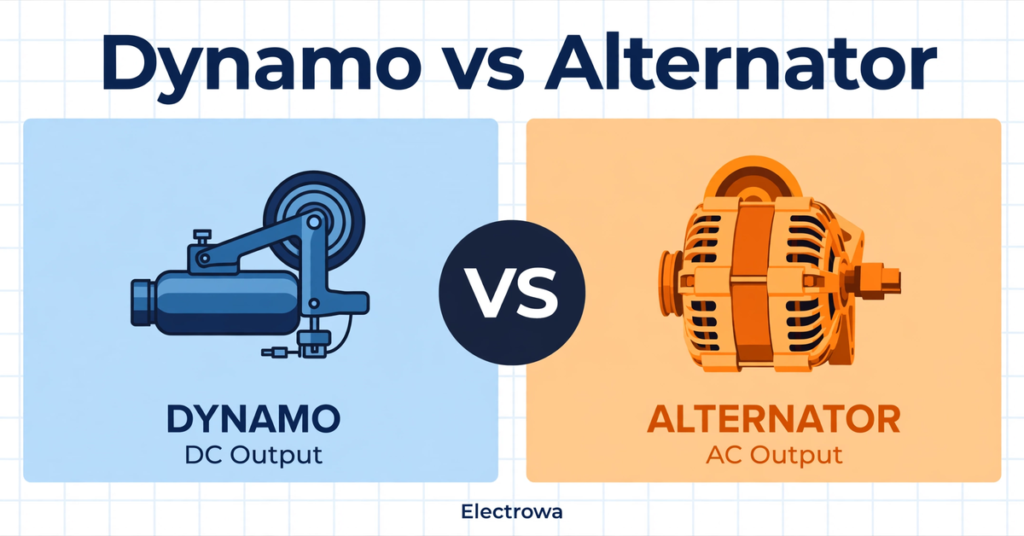

A dynamo and an alternator both convert mechanical energy into electrical energy using electromagnetic induction: a coil rotating in a magnetic field produces an induced voltage. Yet they are built differently, give different outputs, and serve different jobs — a bicycle light uses a dynamo, a car uses an alternator.
The key difference is simple: a dynamo produces direct current (DC), while an alternator produces alternating current (AC). A dynamo uses a commutator — a split ring flipping the connections every half turn, so the output always flows one way. An alternator uses slip rings instead, so its output stays AC; a rectifier is added if DC is needed. That one choice affects efficiency, maintenance, size, and cost.
In this guide, you will learn how each machine works, compare them side by side, and work through a real EMF calculation — and why modern vehicles and power systems almost always choose the alternator.
How a Dynamo Works
A dynamo has a rotating coil, called the armature, between the poles of a magnet. As the coil spins, the magnetic flux through it keeps changing, and Faraday’s law says a changing flux induces a voltage. So the induced voltage reverses every half turn — it is AC inside the machine.
The commutator is what makes the output DC. It is a split metal ring on the rotating shaft, with two carbon brushes pressing against it. Every half turn it swaps the coil’s connections, so current in the external circuit always flows the same way. The result is pulsing DC. Early dynamos powered bicycle lamps and old cars — but the commutator brings sparking, brush wear, and regular maintenance.
How an Alternator Works
An alternator also rotates a coil in a magnetic field, but it skips the commutator. In most modern alternators the magnetic field rotates (the rotor) while the output coils stay still (the stator). The output is AC, taken from slip rings or directly from the stationary stator.
With no commutator to flip the current, the alternator is simpler, lighter, and can spin much faster. That is why a car alternator charges the battery even at low engine speeds and keeps up with headlights, fans, and electronics. When DC is needed, a built-in rectifier bridge of diodes converts the AC output to DC. Power stations use the same idea at huge scale: giant alternators driven by turbines generate the AC that feeds the grid.
Dynamo vs Alternator: Comparison Table
| Feature | Dynamo | Alternator |
|---|---|---|
| Output | Direct current (DC) | Alternating current (AC) |
| Current collection | Commutator (split ring) | Slip rings |
| Efficiency | Lower, around 60–75% | Higher, around 75–90% |
| Output at low speed | Weak at low speed | Good at low speed |
| Maintenance | High — brushes wear out | Low — no commutator |
| Size and weight | Bulky | Compact |
| Voltage control | Harder | Easy |
| Typical uses | Bicycle lamps | Cars, power stations |
Worked Example: EMF of a Dynamo
Faraday’s law gives the induced EMF as e = N × (change in flux ÷ time), where N is the number of turns. Suppose a dynamo coil has 100 turns, and the flux through it changes by 0.02 weber in 0.01 seconds. The rate of change is 0.02 ÷ 0.01 = 2 weber per second, so e = 100 × 2 = 200 V. A real dynamo’s commutator delivers this as pulsing DC.
A smaller example is a bicycle dynamo. A typical bottle dynamo is rated 6 V and 0.5 A, so its power is P = V × I = 6 × 0.5 = 3 W — just enough for a small lamp. That is why pedalling feels harder with the light on: your legs supply those 3 watts, plus losses.
Which Is Better?
For almost every modern job, the alternator wins. It is more efficient, needs less maintenance, is lighter for the same power, and works well at low speeds. Cars switched to alternators in the 1960s; power stations never used dynamos at grid scale. The dynamo survives for tiny jobs like bicycle lamps, where a simple 3 W DC output is all that is needed. For everything else, the alternator — plus a rectifier when DC is needed — is the better machine.
Frequently Asked Questions
1. What is the main difference between a dynamo and an alternator?
A dynamo produces DC using a commutator; an alternator produces AC using slip rings. The commutator flips the current every half turn; the alternator does not.
2. Is a dynamo AC or DC?
DC at its terminals — but the voltage induced inside its coil is AC. The commutator converts that internal AC into pulsing DC.
3. Why do cars use alternators instead of dynamos?
Alternators are lighter, more efficient, need less maintenance, and charge at idle. A dynamo struggles at low speed and its brushes wear out quickly.
4. Can an alternator work as a dynamo?
Not directly — an alternator produces AC, so you must add a rectifier. With one, an alternator can do every job a dynamo does, and do it better.
5. Which is more efficient, a dynamo or an alternator?
The alternator: a dynamo is typically 60–75% efficient, while an alternator reaches 75–90%.
6. Where are dynamos still used today?
Mainly in bicycle lamps and a few small DC applications. Almost all vehicle charging and grid power generation now uses alternators.
Conclusion
A dynamo and an alternator both turn motion into electricity, but the alternator does it better for nearly every use. The dynamo’s commutator gives direct current at the cost of sparking, wear, and lower efficiency. The alternator gives clean AC or DC, higher efficiency, and almost no maintenance. Remember the rule: more turns and faster flux change mean more voltage — 100 turns and a 0.02 Wb change in 0.01 s gives 200 V.
Also read: What Is a Dynamo? · Separately Excited DC Motor · Power Loss Formula · Voltage Drop Formula · Starter Solenoid