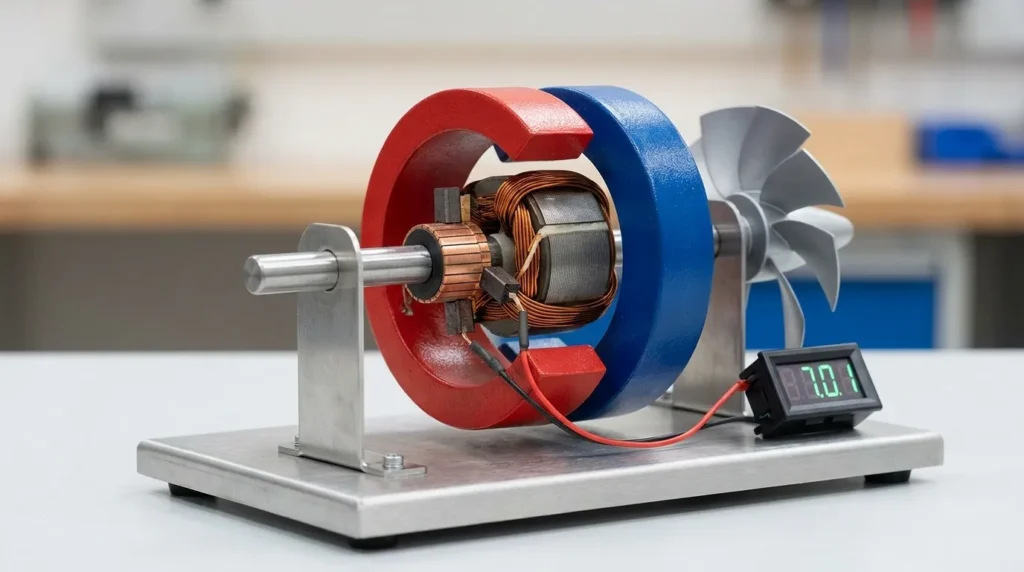

Imagine riding a bicycle at night with a small light attached to the front wheel. As soon as you start pedaling, the light turns on without using a battery. This happens because a dynamo converts the mechanical energy from the rotating wheel into electrical energy. Although modern batteries and alternators are widely used today, dynamos remain one of the best examples of electromagnetic energy conversion and are still found in many practical applications.
The dynamo played a major role in the development of electrical engineering. It was one of the first machines capable of generating direct current (DC) efficiently and laid the foundation for modern electric generators. Understanding how a dynamo works helps students learn the basic principles behind motors, generators, and electromagnetic induction.
Whether you are an electrical engineering student, technician, engineer, or beginner, learning the dynamo working principle is essential. In this complete guide, you will learn what a dynamo is, its working principle, types, components, dynamo applications, advantages, disadvantages, troubleshooting methods, selection tips, and the difference between dynamo and alternator.
2. What Is a Dynamo? Complete Guide (2026)
A dynamo is an electrical generator that converts mechanical energy into direct current (DC) electrical energy by using the principle of electromagnetic induction. It is one of the earliest types of electrical generators and played a significant role in the development of electrical power generation before the widespread use of alternators.
A dynamo produces electricity when its armature (rotating coil) spins inside a magnetic field created by permanent magnets or electromagnets. As the armature rotates, it cuts through the magnetic flux, inducing an electrical voltage in the conductors. A commutator and carbon brushes then convert the internally generated alternating current into direct current (DC), making the output suitable for DC-powered devices.
Before alternators became common, dynamos were widely used in automobiles, industrial machines, battery charging systems, and power stations. Today, they are mainly found in bicycle lighting systems, educational laboratories, portable DC generators, and small renewable energy applications.
Because of their simple construction and ability to generate DC power directly, dynamos remain an important topic for students, electricians, and electrical engineers studying the fundamentals of electrical machines.
Simple Explanation
Think of a hand-operated water pump. When you move the handle, mechanical effort forces water to flow through the pipe. A dynamo works in a similar way. Instead of pumping water, it converts the mechanical rotation of a shaft into electrical energy. The faster the shaft rotates, the greater the amount of electricity produced.
Practical Example
A common example is a bicycle hub dynamo or bottle dynamo. As the bicycle wheel rotates, it drives the dynamo, which generates electricity to power the front and rear lights. This allows the lights to operate without rechargeable batteries, making the system reliable, energy-efficient, and environmentally friendly.
3. Dynamo Working Principle (2026)
The working principle of a dynamo is based on Faraday’s Law of Electromagnetic Induction, which states that an electromotive force (EMF) is induced in a conductor whenever it moves through a magnetic field or when the magnetic flux linked with the conductor changes.
Inside the dynamo, the armature rotates within the magnetic field produced by permanent magnets or field windings. As the armature conductors cut through the magnetic field lines, electrical voltage is generated in the windings. Initially, this induced voltage is alternating in nature. However, a commutator reverses the electrical connections every half rotation, converting the alternating voltage into a unidirectional direct current (DC). Finally, carbon brushes collect the DC output and deliver it to the external electrical circuit.
The amount of electricity generated depends on several factors, including the strength of the magnetic field, the speed of rotation, and the number of turns in the armature winding. Increasing any of these factors generally increases the output voltage.
Step-by-Step Working Process
Step 1: Mechanical Energy is Applied
Mechanical energy from an engine, bicycle wheel, hand crank, wind turbine, or another prime mover rotates the dynamo shaft.
Step 2: Armature Rotation
The rotating shaft turns the armature inside the magnetic field created by permanent magnets or field windings.
Step 3: Magnetic Flux is Cut
As the armature conductors rotate, they continuously cut across the magnetic field lines, causing a change in magnetic flux.
Step 4: Electromagnetic Induction Occurs
According to Faraday’s Law, the changing magnetic flux induces an electromotive force (EMF) in the armature conductors.
Step 5: Commutator Converts the Current
The induced current inside the armature is naturally alternating. The commutator reverses the armature connections every half rotation, ensuring that the output current always flows in the same direction.
Step 6: Carbon Brushes Collect the Current
Stationary carbon brushes maintain electrical contact with the rotating commutator and transfer the generated DC electricity to the external circuit.
Step 7: Electrical Power is Supplied
The generated direct current flows to the connected electrical load, such as lights, batteries, motors, or other DC-powered equipment.
Step 8: Continuous Electricity Generation
As long as the shaft continues rotating and the magnetic field remains present, the dynamo continuously converts mechanical energy into electrical energy.
Easy Analogy
Imagine using a manual bicycle pump. Every time you move the handle, air is pushed into the tire. The faster and more consistently you pump, the more air is delivered. A dynamo works in a similar way—continuous mechanical rotation produces a continuous flow of electrical energy. Faster rotation generally results in a higher electrical output, just as faster pumping delivers air more quickly.
Types of Dynamo
Different types of dynamos are designed for different power requirements and operating conditions.
4.1 Permanent Magnet Dynamo: Features, Working, Advantages, and Applications (2026)
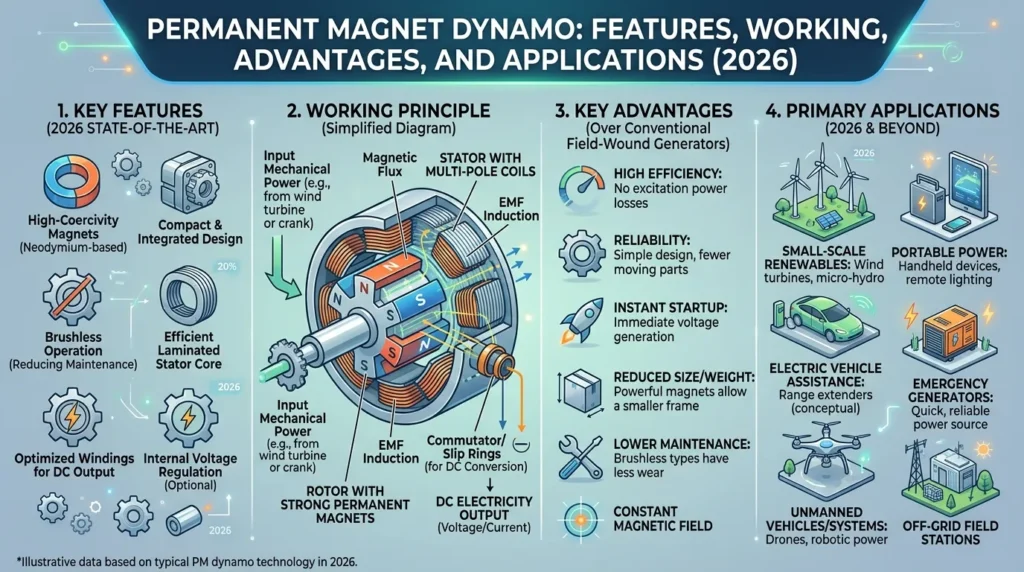
A Permanent Magnet Dynamo (PMD) is a type of dynamo that uses permanent magnets instead of electromagnets or field windings to produce the magnetic field required for electricity generation. As the armature rotates inside this fixed magnetic field, it cuts the magnetic flux lines and generates electrical energy based on Faraday’s Law of Electromagnetic Induction.
Since the magnetic field is produced by permanent magnets, no external power source or field excitation is required. This makes the dynamo simple, compact, and highly reliable for low-power applications.
Permanent magnet dynamos are commonly used in bicycle lighting systems, portable generators, educational demonstration models, and small renewable energy systems, where a lightweight and maintenance-free DC power source is needed.
Working Principle
The permanent magnets create a constant magnetic field inside the dynamo housing. When the armature rotates within this magnetic field, an electromotive force (EMF) is induced in the armature windings. The commutator converts the internally generated alternating current into direct current (DC), while the carbon brushes transfer the electricity to the external circuit.
Because the magnetic field remains constant, the output voltage mainly depends on the speed of armature rotation.
Key Features
A permanent magnet dynamo offers several useful features:
- Uses permanent magnets to produce the magnetic field.
- No external excitation or field current is required.
- Simple and compact construction.
- Lightweight and easy to install.
- High reliability with fewer moving parts.
- Low maintenance requirements.
- Good efficiency for small power applications.
- Provides a stable magnetic field throughout operation.
Advantages
Permanent magnet dynamos provide several benefits compared to other small DC generators:
- Simple design with fewer components.
- Lower maintenance because there are no field windings.
- Reduced power losses due to the absence of field excitation.
- Compact size suitable for portable equipment.
- Reliable operation in remote locations.
- Cost-effective for low-power electricity generation.
- Environmentally friendly when used with renewable energy sources.
Limitations
Despite their advantages, permanent magnet dynamos also have some limitations:
- Limited power output compared to larger dynamos.
- Magnetic strength may gradually decrease over many years.
- Output voltage varies with rotational speed.
- Less suitable for heavy industrial applications.
- Difficult to control the magnetic field strength because the magnets are permanent.
Applications
Permanent magnet dynamos are widely used in applications requiring a small and dependable DC power source.
Common applications include:
- Bicycle lighting systems.
- Hub dynamos and bottle dynamos.
- Small portable DC generators.
- Educational laboratory models.
- Hand-crank emergency generators.
- Small wind turbines.
- Micro-hydroelectric systems.
- Battery charging systems.
- Scientific experiments and training equipment.
Key Takeaway
A Permanent Magnet Dynamo is a simple and efficient DC generator that uses permanent magnets to create the magnetic field, eliminating the need for external excitation. Its compact design, low maintenance, and reliable performance make it an excellent choice for bicycle lighting, portable generators, educational equipment, and other low-power electrical applications. While it is not suitable for high-power industrial use, it remains one of the most practical and economical types of dynamos for small-scale electricity generation.
4.2 Electromagnetic Dynamo: Features, Working, Advantages, and Applications (2026)
An Electromagnetic Dynamo is a type of dynamo that uses electromagnets (field windings) instead of permanent magnets to produce the magnetic field required for electricity generation. The field windings are energized by electrical current, creating a strong and controllable magnetic field around the armature.
When the armature rotates inside this magnetic field, it cuts the magnetic flux lines and generates electrical energy according to Faraday’s Law of Electromagnetic Induction. A commutator converts the internally generated alternating current into direct current (DC), while carbon brushes transfer the DC output to the external circuit.
Because the strength of the magnetic field can be adjusted by controlling the field current, electromagnetic dynamos are capable of producing higher power output and more stable voltage than permanent magnet dynamos. For this reason, they have been widely used in industrial applications and older DC power generation systems.
Working Principle
The field windings receive electrical current, producing a powerful magnetic field around the armature. As the armature rotates within this magnetic field, voltage is induced in the conductors. The commutator continuously reverses the armature connections, converting the generated alternating voltage into a smooth direct current (DC), which is then delivered to the external electrical circuit through carbon brushes.
By increasing or decreasing the field current, the magnetic field strength—and therefore the output voltage—can be regulated.
Key Features
An electromagnetic dynamo offers several important features:
- Uses electromagnetic field windings instead of permanent magnets.
- Produces a stronger and controllable magnetic field.
- Output voltage can be adjusted by changing the field current.
- Suitable for medium and high-power DC generation.
- Provides stable and reliable electrical output.
- Capable of handling larger electrical loads.
- Better voltage regulation than permanent magnet dynamos.
Advantages
Electromagnetic dynamos provide several benefits for industrial and commercial applications:
- Higher power generation capacity.
- Adjustable output voltage.
- Strong magnetic field for improved performance.
- Better efficiency in large electrical systems.
- Suitable for continuous operation.
- Reliable performance under varying load conditions.
- Widely used for industrial DC power applications.
Limitations
Despite their advantages, electromagnetic dynamos also have some drawbacks:
- More complex construction than permanent magnet dynamos.
- Requires an external excitation current for the field windings.
- Larger size and heavier weight.
- Higher maintenance due to additional components.
- Greater installation and operating costs.
- Field winding losses reduce overall efficiency slightly.
Applications
Electromagnetic dynamos are commonly used where higher DC power output and adjustable voltage are required.
Common applications include:
- Industrial DC generators.
- Laboratory and testing equipment.
- Older power generation systems.
- Battery charging plants.
- DC motor power supplies.
- Manufacturing and production facilities.
- Educational and research laboratories.
- Railway and traction systems (historically).
- Heavy-duty electrical machinery.
Key Takeaway
An Electromagnetic Dynamo uses electrically energized field windings to create a controllable magnetic field for generating direct current (DC). Compared with permanent magnet dynamos, it offers higher power output, better voltage regulation, and greater flexibility, making it suitable for industrial DC generators, laboratory equipment, battery charging systems, and older power generation installations. Although it requires external field excitation and more maintenance, it remains an important example of DC generator technology in electrical engineering.
4.3 Bottle Dynamo: Features, Working, Advantages, and Applications (2026)
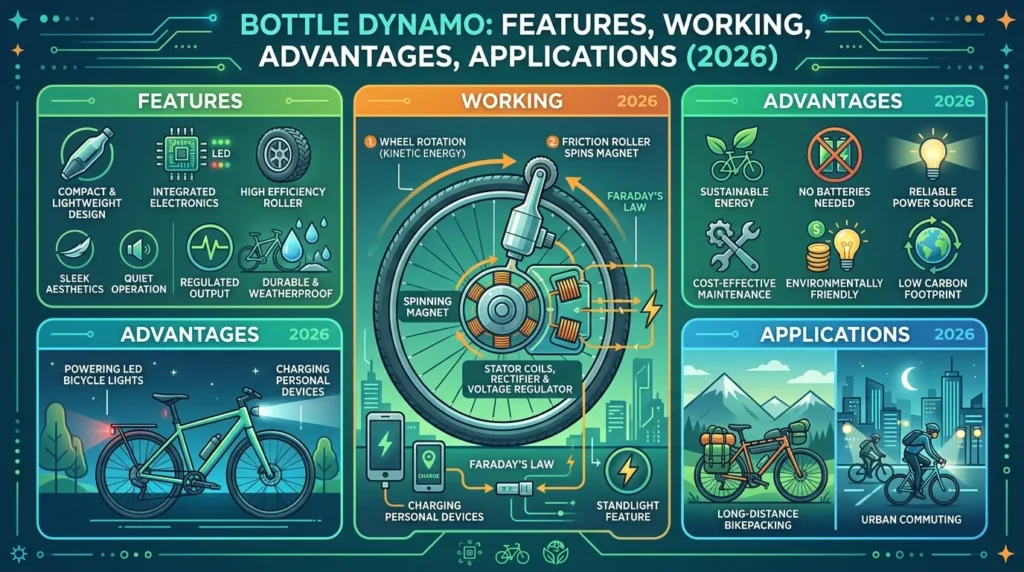
A Bottle Dynamo is a small permanent magnet generator commonly used on bicycles to produce electricity for lighting systems. It is called a bottle dynamo because its cylindrical shape resembles a small bottle. The dynamo is mounted beside the bicycle wheel, where a small roller presses against the sidewall of the tire.
As the bicycle moves, the rotating tire turns the roller, which spins the dynamo shaft. The rotating armature cuts through the magnetic field, generating electrical energy through electromagnetic induction. The generated electricity is then supplied to the bicycle’s front and rear lights, eliminating the need for disposable or rechargeable batteries.
Bottle dynamos are popular because they are simple, inexpensive, reliable, and easy to install, making them an ideal solution for bicycle lighting.
Working Principle
When the bicycle is in motion, the tire rotates and drives the roller attached to the bottle dynamo. This mechanical rotation turns the armature inside a magnetic field, inducing an electrical voltage. The generated electricity is transferred through wires to power the bicycle’s lighting system. The faster the bicycle travels, the greater the electrical output produced by the dynamo.
Key Features
Bottle dynamos offer several practical features:
- Compact and lightweight design.
- Simple installation on most bicycles.
- Low manufacturing and maintenance cost.
- Generates electricity without batteries.
- Operates automatically while riding.
- Durable construction for everyday use.
- Reliable performance for low-power lighting applications.
Advantages
Bottle dynamos provide several benefits for cyclists:
- No need to replace or recharge batteries.
- Environmentally friendly source of electrical power.
- Easy to install and remove.
- Low maintenance requirements.
- Affordable and widely available.
- Provides continuous lighting while the bicycle is moving.
- Improves rider visibility and road safety, especially at night.
Limitations
Despite their advantages, bottle dynamos have some limitations:
- Produces electricity only while the bicycle is moving.
- Roller may slip in wet or muddy conditions.
- Creates slight resistance, making pedaling a little harder.
- Can generate noise due to friction between the roller and tire.
- Output voltage varies with bicycle speed.
Applications
Bottle dynamos are widely used in low-power bicycle electrical systems.
Common applications include:
- Bicycle headlamps.
- Rear safety lights.
- LED bicycle lighting systems.
- Bicycle safety equipment.
- Educational demonstrations of electricity generation.
- Small portable DC lighting applications.
Key Takeaway
A Bottle Dynamo is a compact bicycle generator that converts the mechanical rotation of a bicycle wheel into electrical energy using the principle of electromagnetic induction. Its low cost, easy installation, simple design, and reliable performance make it a popular choice for powering bicycle headlamps and rear safety lights without relying on batteries. Although its output depends on the bicycle’s speed, it remains one of the most practical and eco-friendly lighting solutions for cyclists.
4.4 Hub Dynamo: Features, Working, Advantages, and Applications (2026)
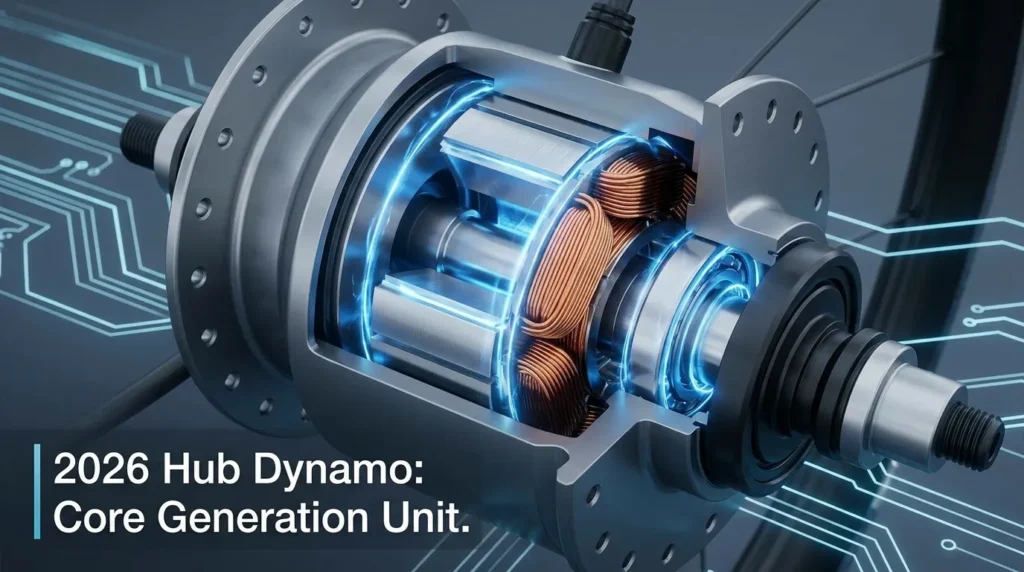
A Hub Dynamo is a type of bicycle dynamo that is built directly into the front or rear wheel hub. Unlike a bottle dynamo, which uses a roller against the tire, a hub dynamo generates electricity internally as the wheel rotates. This design eliminates friction with the tire, making it more efficient, quieter, and highly reliable.
Inside the hub, permanent magnets rotate around stationary coils. As the bicycle wheel turns, the rotating magnetic field cuts through the coils, generating electrical energy through Faraday’s Law of Electromagnetic Induction. The electricity produced is then supplied to bicycle lights or other low-power accessories.
Hub dynamos are widely used on touring bicycles, commuter bikes, and long-distance cycling equipment because they provide a continuous and dependable source of electrical power without requiring batteries.
Working Principle
The hub dynamo is integrated into the bicycle wheel hub. When the wheel rotates, permanent magnets inside the hub spin around stationary windings, creating a changing magnetic field. This changing magnetic field induces an electrical voltage in the windings. The generated electricity is then delivered through electrical cables to power the bicycle’s lighting system or compatible accessories.
Because there is no roller rubbing against the tire, the system operates smoothly with very little energy loss and almost no noise.
Key Features
Hub dynamos offer several advanced features that make them superior to traditional bottle dynamos:
- Built directly into the bicycle wheel hub.
- High electrical efficiency with minimal power loss.
- Quiet and smooth operation.
- Weather-resistant sealed construction.
- Long service life with minimal maintenance.
- Reliable performance in all weather conditions.
- Generates electricity continuously while riding.
- Low rolling resistance compared to bottle dynamos.
Advantages
Hub dynamos provide many benefits for cyclists:
- Higher efficiency than bottle dynamos.
- Silent operation with no tire friction noise.
- Excellent performance in wet and muddy conditions.
- Durable and low-maintenance design.
- Longer operating life due to sealed components.
- No batteries required for lighting.
- Consistent power supply during cycling.
- Improves rider safety with dependable lighting.
Limitations
Despite their many advantages, hub dynamos also have a few limitations:
- Higher initial cost than bottle dynamos.
- Installation is more complex because the dynamo is integrated into the wheel hub.
- Slightly heavier than standard bicycle hubs.
- Repairs or replacement may require removing the wheel.
Applications
Hub dynamos are widely used in modern bicycle electrical systems and other low-power applications.
Common applications include:
- Touring bicycles.
- Commuter bicycles.
- Electric bicycle lighting systems.
- Front and rear LED bicycle lights.
- GPS devices and cycling computers.
- USB charging systems for mobile phones and navigation devices.
- Bicycle safety accessories.
- Long-distance and adventure cycling equipment.
Key Takeaway
A Hub Dynamo is a highly efficient bicycle generator that is built into the wheel hub, allowing it to generate electricity without direct contact with the tire. Its quiet operation, weather-resistant construction, long service life, and excellent efficiency make it the preferred choice for touring bicycles, commuter bikes, electric lighting systems, and cycling accessories. Although it costs more than a bottle dynamo, its superior performance and reliability make it an excellent long-term investment for cyclists.
5. Main Components of a Dynamo (2026)
A dynamo is made up of several essential components that work together to convert mechanical energy into direct current (DC) electrical energy. Each part has a specific function in the electricity generation process. The efficient operation of a dynamo depends on the proper coordination of these components, from creating the magnetic field to delivering electrical power to the external circuit.
5.1 Armature
The armature is the rotating part of the dynamo where electrical voltage is generated. It consists of a laminated iron core wound with copper conductors and is mounted on the shaft. As the armature rotates inside the magnetic field, its conductors cut through the magnetic flux, inducing an electromotive force (EMF) according to Faraday’s Law of Electromagnetic Induction.
Functions
- Carries the armature windings (conductors).
- Rotates inside the magnetic field.
- Generates induced voltage.
- Converts mechanical energy into electrical energy.
- Transfers generated current to the commutator.
5.2 Field Magnets
Field magnets create the magnetic field required for electricity generation. Depending on the type of dynamo, these may be permanent magnets or electromagnets (field windings). A strong and stable magnetic field is essential for inducing voltage in the rotating armature.
Functions
- Produce magnetic flux.
- Create the magnetic field for electromagnetic induction.
- Determine the strength of the generated voltage.
- Support efficient electricity generation.
- Maintain a stable magnetic field during operation.
5.3 Commutator
The commutator is a cylindrical assembly made of copper segments insulated from each other. It is mounted on the rotating shaft and works with the carbon brushes to convert the internally generated alternating current (AC) into direct current (DC).
Without the commutator, the output of the dynamo would be alternating current instead of direct current.
Functions
- Converts internally generated AC into DC.
- Reverses the armature connections every half rotation.
- Produces a unidirectional current at the output.
- Transfers electrical power from the rotating armature.
- Maintains continuous DC output.
5.4 Carbon Brushes
Carbon brushes are stationary conductive blocks that maintain sliding electrical contact with the rotating commutator. They collect the generated electrical current and transfer it safely to the external electrical circuit.
Carbon is commonly used because it provides good electrical conductivity while minimizing wear on the commutator.
Functions
- Maintain electrical contact with the commutator.
- Collect the generated electrical current.
- Deliver DC power to the external circuit.
- Ensure continuous electrical conduction.
- Reduce sparking during operation.
5.5 Shaft
The shaft is a strong mechanical component that connects the armature to the external driving source, such as an engine, turbine, hand crank, or bicycle wheel. It transfers mechanical energy to the armature, allowing it to rotate inside the magnetic field.
Functions
- Transfers mechanical input power.
- Rotates the armature.
- Supports the rotating components.
- Maintains proper alignment.
- Ensures smooth operation of the dynamo.
5.6 Bearings
Bearings support the rotating shaft and allow it to spin smoothly with minimal friction. They play an important role in improving the efficiency, reliability, and lifespan of the dynamo.
Well-lubricated bearings reduce mechanical wear and ensure stable operation even during continuous use.
Functions
- Support smooth shaft rotation.
- Reduce mechanical friction.
- Improve operating efficiency.
- Minimize wear and vibration.
- Increase the service life of the dynamo.
5.7 Frame (Yoke)
The frame, also known as the yoke, is the outer body of the dynamo. It provides mechanical support for all internal components and helps complete the magnetic circuit. In electromagnetic dynamos, the field poles are mounted on the frame.
Functions
- Supports all internal components.
- Protects the dynamo from external damage.
- Completes the magnetic path.
- Holds the field magnets securely.
- Provides structural strength and stability.
Key Takeaway
The main components of a dynamo—including the armature, field magnets, commutator, carbon brushes, shaft, bearings, and frame (yoke)—work together to convert mechanical energy into direct current (DC) electrical energy. Each component performs a specific function, from creating the magnetic field and generating voltage to collecting and delivering electricity. Understanding these parts helps students, technicians, and engineers better understand the construction, operation, and maintenance of dynamos.
Advantages of Dynamo
Understanding the dynamo advantages and disadvantages helps engineers determine where dynamos remain useful.
Advantages
- Generates direct current without external conversion.
- Simple operating principle.
- Reliable construction.
- Easy to understand and repair.
- Suitable for small-scale power generation.
- Works without batteries in bicycle applications.
- Good educational demonstration device.
- Compact design for portable applications.
- Durable mechanical construction.
- Low operating cost in small systems.
Disadvantages of Dynamo
Despite its benefits, a dynamo also has several limitations.
- Brushes wear over time.
- Commutator requires regular maintenance.
- Lower efficiency than modern alternators.
- Produces electrical sparking.
- Limited output power.
- Mechanical friction reduces efficiency.
- Requires periodic cleaning.
- Heavy compared to modern generators.
- Not suitable for large power generation.
- Higher maintenance than brushless systems.
8. Applications of a Dynamo (2026)
A dynamo is used in a wide range of applications where direct current (DC) electrical power is required. Although modern alternators have replaced dynamos in many large-scale power systems, dynamos are still widely used in bicycle lighting, educational laboratories, portable generators, vintage vehicles, and small renewable energy projects. Their simple construction, reliable operation, and ability to generate DC electricity make them valuable in both learning environments and practical applications.
Below are the major applications of a dynamo.
8.1 Home Applications
Small dynamos are commonly used in homes and educational projects where a simple DC power source is required. Hand-operated dynamos can generate electricity during power outages or in locations without access to the electrical grid.
Common home applications include:
- Emergency hand-crank generators.
- Small educational generators.
- Science laboratory demonstrations.
- Battery charging for low-power devices.
- DIY electrical and electronics projects.
- Portable LED lighting systems.
Benefits
- Generates electricity without external power.
- Simple and reliable operation.
- Useful during emergency situations.
- Ideal for educational learning.
8.2 Bicycle Applications
One of the most common modern uses of dynamos is in bicycle electrical systems. Bottle dynamos and hub dynamos generate electricity as the bicycle wheel rotates, providing continuous power for lighting and electronic accessories.
Common bicycle applications include:
- Front bicycle headlights.
- Rear safety lights.
- LED bicycle lighting systems.
- GPS charging systems.
- USB charging accessories.
- Cycling computers and navigation devices.
- Safety warning lights.
Benefits
- No batteries required.
- Continuous power while riding.
- Environmentally friendly.
- Improves cyclist visibility and safety.
8.3 Industrial Applications
Although modern industries mainly use alternators, dynamos are still found in certain industrial environments, research facilities, and specialized DC power systems.
Common industrial applications include:
- Older DC power generation systems.
- Small workshop equipment.
- Battery charging systems.
- Industrial testing equipment.
- DC motor power supplies.
- Mechanical training equipment.
Benefits
- Reliable DC power generation.
- Suitable for specialized industrial applications.
- Easy maintenance and operation.
- Useful for training and testing purposes.
8.4 Educational Applications
Dynamos are widely used in schools, colleges, universities, and technical institutes to teach the principles of electricity generation and electromagnetic induction. Their visible construction allows students to understand how mechanical energy is converted into electrical energy.
Common educational applications include:
- Engineering colleges.
- Electrical laboratories.
- Physics demonstrations.
- Technical training centers.
- Science exhibitions.
- Electrical machine experiments.
- Practical learning workshops.
Benefits
- Demonstrates Faraday’s Law of Electromagnetic Induction.
- Enhances practical learning.
- Helps students understand DC generator construction.
- Supports engineering and technical education.
8.5 Transportation Applications
Before alternators became the standard, dynamos were widely used in transportation systems to supply electrical power and charge batteries.
Common transportation applications include:
- Vintage automobiles.
- Classic motorcycles.
- Historic railway equipment.
- Antique tractors.
- Early commercial vehicles.
- Restoration projects for classic vehicles.
Benefits
- Provides authentic electrical systems for vintage vehicles.
- Charges vehicle batteries.
- Powers lighting and ignition systems.
- Preserves historical engineering designs.
8.6 Modern Technology Applications
Even today, dynamos continue to play a role in modern technology, especially in portable and renewable energy systems where small-scale DC power generation is required.
Common modern applications include:
- Portable charging devices.
- Renewable energy demonstration systems.
- Small wind turbine generators.
- Micro-hydroelectric projects.
- Mechanical energy conversion experiments.
- Emergency power generation kits.
- Educational renewable energy projects.
- Off-grid DC power systems.
Benefits
- Supports clean energy education.
- Converts renewable mechanical energy into electricity.
- Provides portable power in remote areas.
- Encourages sustainable energy solutions.
Key Takeaway
The applications of a dynamo extend across homes, bicycles, industries, educational institutions, transportation systems, and modern renewable energy projects. Its ability to convert mechanical energy into direct current (DC) electrical energy makes it useful for powering bicycle lights, charging batteries, operating portable generators, supporting engineering education, and demonstrating the principles of electromagnetic induction. Although many large-scale systems now use alternators, the dynamo remains an important electrical machine for low-power and educational applications.
Difference Between Dynamo and Alternator
Although both generate electricity, they operate differently.
| Feature | Dynamo | Alternator |
|---|---|---|
| Output Current | Direct Current (DC) | Alternating Current (AC) |
| Current Conversion | Uses commutator | Uses rectifier if DC is required |
| Brushes | Required | Usually uses slip rings |
| Efficiency | Lower | Higher |
| Maintenance | Higher | Lower |
| Output at Low Speed | Good | Moderate |
| Modern Usage | Limited | Very common |
| Typical Applications | Bicycle lighting, small DC systems | Vehicles, power plants, generators |
Understanding the difference between dynamo and alternator helps beginners choose the correct electrical machine for specific applications.
9. Dynamo Selection Guide: How to Choose the Right Dynamo (2026)
Selecting the right dynamo depends on your power requirements, operating conditions, installation method, and intended application. Whether you need a dynamo for a bicycle, educational project, portable generator, or industrial equipment, choosing the correct model ensures better performance, higher efficiency, longer service life, and reliable electricity generation.
Before purchasing or installing a dynamo, consider the following important factors.
9.1 Output Power
The first step is to determine how much electrical power your application requires. The dynamo should be capable of supplying sufficient voltage and current without being overloaded.
For example:
- Low-power dynamos are suitable for bicycle lights and small electronic devices.
- Medium-power dynamos are used for educational equipment and battery charging.
- High-power dynamos are designed for industrial DC power applications.
Selection Tips
- Match the dynamo output with the connected electrical load.
- Avoid using an undersized dynamo, as it may overheat.
- Choose a slightly higher power rating for future expansion.
9.2 Operating Speed
A dynamo generates electricity only when its armature rotates. The output voltage and power depend largely on the rotational speed of the shaft.
Generally:
- Higher rotational speed produces higher output voltage.
- Lower speed generates less electrical power.
Selection Tips
- Check the rated operating speed specified by the manufacturer.
- Ensure the driving source can maintain the required RPM.
- Avoid excessive speeds that may damage the dynamo.
9.3 Voltage Rating
Always choose a dynamo with an output voltage that matches the electrical equipment or battery system it will power.
Common voltage ratings include:
- 6 V – Bicycle lighting systems.
- 12 V – Battery charging and small DC applications.
- 24 V and above – Industrial and specialized DC systems.
Selection Tips
- Match the voltage rating with your electrical devices.
- Incorrect voltage may damage connected equipment.
- Use voltage regulators if stable output is required.
9.4 Type of Dynamo
Different types of dynamos are designed for different applications.
Choose the type that best suits your needs:
- Bottle Dynamo – Affordable, lightweight, and easy to install on bicycles.
- Hub Dynamo – More efficient, quieter, weather-resistant, and ideal for long-distance cycling.
- Permanent Magnet Dynamo – Best for small portable generators and educational projects.
- Electromagnetic Dynamo – Suitable for higher-power industrial DC applications.
Selection Tips
- Select the dynamo based on the intended application.
- Consider installation requirements and available space.
- Compare efficiency, maintenance, and power output.
9.5 Maintenance Requirements
Maintenance plays an important role in the long-term performance of a dynamo.
If minimal maintenance is preferred, choose models with:
- Sealed bearings.
- Weather-resistant construction.
- High-quality carbon brushes.
- Durable copper windings.
Selection Tips
- Hub dynamos generally require less maintenance than bottle dynamos.
- Regularly inspect brushes and bearings in industrial dynamos.
- Keep the dynamo clean and free from dust and moisture.
9.6 Environmental Conditions
The surrounding environment greatly affects the reliability and lifespan of a dynamo. Select a model that is suitable for the conditions in which it will operate.
Consider factors such as:
- Rain and humidity.
- Dust and dirt.
- High or low temperatures.
- Outdoor exposure.
- Continuous operation.
- Mechanical vibration.
Selection Tips
- Choose weather-resistant dynamos for outdoor use.
- Use sealed designs in dusty or wet environments.
- Ensure adequate cooling for continuous operation.
9.7 Build Quality
The quality of construction directly affects the efficiency, durability, and service life of a dynamo.
Look for features such as:
- High-quality copper windings.
- Strong permanent magnets or efficient field windings.
- Precision bearings.
- Durable steel shaft.
- Robust frame and housing.
- Reliable carbon brushes and commutator.
Selection Tips
- Choose products from reputable manufacturers.
- Inspect the build quality before purchase.
- Better-quality components provide improved efficiency and longer service life.
9.8 Efficiency and Performance
Efficiency determines how effectively the dynamo converts mechanical energy into electrical energy.
A high-efficiency dynamo offers:
- Lower energy losses.
- Better voltage stability.
- Reduced heating.
- Improved overall performance.
- Longer operating life.
Selection Tips
- Compare efficiency ratings when available.
- Select models with low friction and high-quality internal components.
- Consider energy losses during continuous operation.
Key Takeaway
Choosing the right dynamo requires careful consideration of output power, operating speed, voltage rating, dynamo type, maintenance needs, environmental conditions, build quality, and efficiency. A properly selected dynamo delivers safe, reliable, and efficient DC power while providing a longer service life and lower maintenance costs. Whether for bicycle lighting, educational experiments, portable generators, or industrial applications, selecting the correct dynamo ensures dependable performance for years to come.
10. Common Dynamo Problems and Troubleshooting Solutions (2026)
Like any electrical machine, a dynamo may experience problems due to wear, poor maintenance, improper installation, or mechanical faults. Identifying the cause early and performing regular maintenance helps improve efficiency, reduce downtime, and extend the service life of the dynamo.
Below are some of the most common dynamo problems, their possible causes, and practical solutions.
10.1 Why Is the Dynamo Not Producing Electricity?
If a dynamo fails to generate electrical power, both mechanical and electrical components should be inspected.
Possible Causes
- Loose or damaged electrical connections.
- Worn or damaged carbon brushes.
- Dirty or damaged commutator.
- Broken or open armature winding.
- Weak or damaged field magnets.
- Shaft not rotating properly.
Solutions
- Tighten and inspect all electrical connections.
- Replace worn carbon brushes.
- Clean or repair the commutator surface.
- Test the armature winding for continuity and repair if necessary.
- Check the magnetic field strength.
- Ensure the shaft rotates freely without obstruction.
10.2 Why Is the Output Voltage Low?
A dynamo may generate electricity but produce a lower voltage than expected.
Possible Causes
- Low rotational speed.
- Weak magnetic field.
- Dirty or worn commutator.
- Poor brush contact.
- Partial winding damage.
- Excessive electrical load.
Solutions
- Increase the operating speed to the rated value.
- Inspect and strengthen the magnetic field if possible.
- Clean the commutator regularly.
- Adjust or replace the carbon brushes.
- Test the windings for damage.
- Reduce the connected electrical load if necessary.
10.3 Why Does the Dynamo Produce Sparks?
Small sparks around the brushes may occur during operation, but excessive sparking indicates a problem that should be corrected immediately.
Possible Causes
- Worn carbon brushes.
- Rough or dirty commutator surface.
- Incorrect brush pressure.
- Loose electrical connections.
- Damaged commutator segments.
Solutions
- Replace worn brushes.
- Clean and polish the commutator.
- Adjust the brush spring pressure.
- Tighten all electrical connections.
- Replace damaged commutator segments if required.
10.4 Why Does the Dynamo Become Noisy?
Unusual noise often indicates mechanical wear or improper alignment.
Possible Causes
- Worn bearings.
- Shaft misalignment.
- Loose mounting bolts.
- Excessive vibration.
- Damaged rotating parts.
Solutions
- Inspect and replace worn bearings.
- Realign the shaft properly.
- Tighten all mounting hardware.
- Check for vibration and balance rotating components.
- Replace damaged mechanical parts.
10.5 Why Does the Dynamo Overheat?
Excessive heat can reduce efficiency and damage the insulation of the windings.
Possible Causes
- Electrical overloading.
- Poor ventilation.
- Short-circuited windings.
- Continuous operation beyond rated capacity.
- Excessive mechanical friction.
Solutions
- Operate within the rated load capacity.
- Improve ventilation around the dynamo.
- Inspect the windings for faults.
- Allow the dynamo to cool during long operating periods.
- Lubricate or replace worn bearings.
10.6 How Can the Service Life of a Dynamo Be Increased?
Proper maintenance greatly improves the reliability and lifespan of a dynamo.
Maintenance Tips
- Clean the commutator regularly.
- Replace worn carbon brushes before excessive wear occurs.
- Inspect electrical connections periodically.
- Lubricate bearings when recommended by the manufacturer.
- Keep the dynamo free from dust, dirt, and moisture.
- Avoid operating above the rated load.
- Check alignment and mounting bolts regularly.
- Perform routine inspections and preventive maintenance.
11. Future Trends in Dynamo Technology (2026)
Although alternators and brushless generators are widely used in modern electrical systems, dynamos continue to evolve for specialized applications such as bicycle lighting, portable power generation, educational equipment, and renewable energy systems. Modern engineering focuses on improving efficiency, durability, and sustainability while reducing maintenance requirements.
11.1 Advanced Permanent Magnet Materials
Modern dynamos use stronger rare-earth permanent magnets that provide higher magnetic flux, improving efficiency and increasing electrical output while reducing size and weight.
Benefits
- Higher efficiency.
- Increased power density.
- Smaller and lighter designs.
- Improved long-term performance.
11.2 Lightweight and Compact Designs
Manufacturers are developing smaller and lighter dynamos using advanced materials without sacrificing strength or reliability.
Benefits
- Easier installation.
- Improved portability.
- Reduced overall equipment weight.
- Better performance for bicycle and portable applications.
11.3 Improved Bearing Technology
Modern sealed bearings reduce friction, minimize wear, and require very little maintenance.
Benefits
- Quieter operation.
- Longer service life.
- Lower maintenance costs.
- Improved mechanical efficiency.
11.4 High-Efficiency Copper Windings
Improved winding techniques and high-purity copper conductors reduce electrical losses and increase power generation efficiency.
Benefits
- Higher electrical output.
- Lower heat generation.
- Better voltage stability.
- Improved overall efficiency.
11.5 Smart Monitoring Systems
Modern dynamos may include sensors that continuously monitor operating conditions.
These systems can monitor:
- Output voltage.
- Current.
- Temperature.
- Rotational speed.
- Equipment health.
Benefits
- Early fault detection.
- Predictive maintenance.
- Improved reliability.
- Reduced downtime.
11.6 Renewable Energy Integration
Dynamos continue to play an important role in educational and small-scale renewable energy projects.
Common applications include:
- Small wind turbines.
- Micro-hydroelectric generators.
- Hand-crank emergency generators.
- Off-grid portable charging systems.
- Sustainable energy demonstration projects.
11.7 Eco-Friendly Manufacturing
Manufacturers are increasingly adopting environmentally friendly production methods by using recyclable materials, energy-efficient manufacturing processes, and sustainable design practices.
Benefits
- Reduced environmental impact.
- Improved sustainability.
- Longer product life.
- Lower material waste.
Key Takeaway
Modern dynamo technology continues to improve through advanced magnetic materials, compact construction, high-efficiency windings, smart monitoring systems, improved bearings, and eco-friendly manufacturing. While large-scale power generation now relies mainly on alternators, dynamos remain highly valuable for portable power generation, bicycle lighting, educational training, renewable energy projects, and specialized DC power applications, ensuring they continue to play an important role in electrical engineering.
Conclusion
The dynamo is one of the earliest and most important electrical generators, converting mechanical energy into direct current through the principle of electromagnetic induction. Understanding the dynamo working principle, types, components, dynamo applications, and dynamo advantages and disadvantages provides a strong foundation in electrical engineering and power generation. Although modern alternators have replaced dynamos in many large-scale applications, dynamos continue to be valuable in bicycle lighting systems, educational laboratories, portable generators, and vintage electrical equipment. Their simple design, reliable operation, and practical demonstration of electromagnetic induction make them an essential topic for students and technicians. By mastering how a dynamo works, you will better understand the operation of generators, motors, and modern electrical energy conversion systems.