
Imagine a large industrial machine in a factory that must run at a precise speed to produce high-quality products. If the motor speed fluctuates even slightly, the entire manufacturing process may be affected. In such situations, engineers often use a Separately Excited DC Motor because it offers accurate control over speed and performance.
DC motors are widely used in industries, laboratories, and modern automation systems. Among different types of DC motors, the Separately Excited DC Motor is known for its excellent speed control and flexible operation. Unlike other DC motors, this motor uses an independent power source for its field winding, which makes it easier to adjust and regulate its performance.
Understanding the Separately Excited DC Motor working principle, components, and applications is very important for electrical students, engineers, and technicians. This motor is commonly studied in electrical engineering courses and frequently used in advanced industrial systems.
In this article, you will learn the complete concept of the Separately Excited DC Motor, including its working principle, types, components, applications, advantages and disadvantages, comparison with other DC motors, troubleshooting tips, and future technological developments.
What is a Separately Excited DC Motor?
A Separately Excited DC Motor is a type of DC motor in which the field winding and armature winding are supplied by two separate power sources.
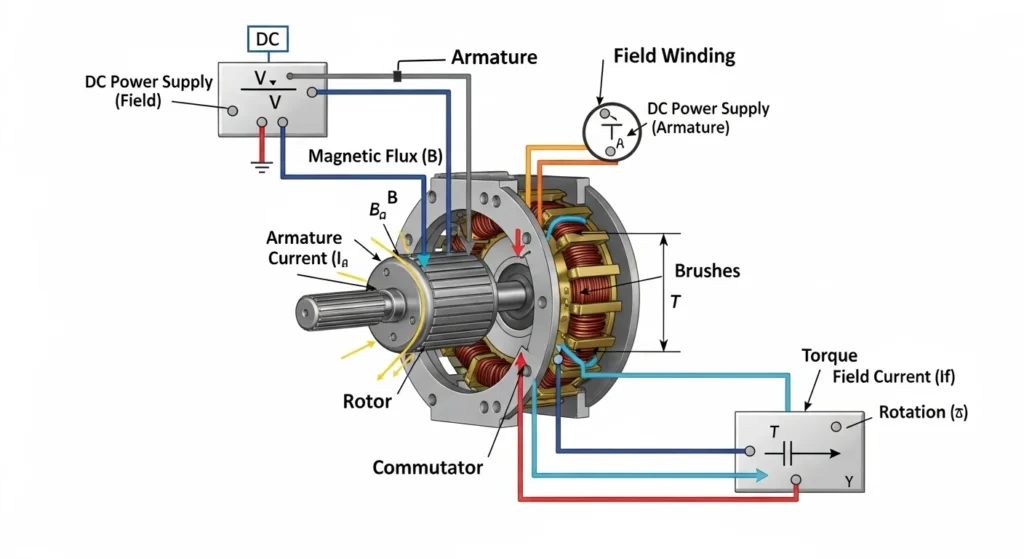
In most DC motors, the field winding receives power from the same source as the armature. However, in a separately excited motor, the field current is controlled independently. This design allows engineers to adjust the magnetic field strength and control the motor speed more precisely. A separately excited DC motor is a type of direct current motor in which the field winding and the armature winding are powered by two different and independent power supplies. In other words, the magnetic field required for the motor is produced by a separate external source rather than by the same supply that powers the armature. This design allows better control of the motor’s speed and torque compared to many other types of DC motors. In a separately excited DC motor, the field winding is placed on the stator, while the armature winding is located on the rotor. When direct current is supplied to the field winding from a separate source, it produces a strong magnetic field around the motor. At the same time, another DC supply is connected to the armature winding through brushes and a commutator. When current flows through the armature conductors placed inside the magnetic field, an electromagnetic force is produced according to the principle of electromagnetic interaction. This force causes the rotor to rotate, and mechanical energy is produced at the motor shaft.
One of the most important characteristics of a separately excited DC motor is its excellent speed control. Because the field current and armature current are supplied independently, engineers can easily adjust the speed by varying either the armature voltage or the field current. If the armature voltage is increased, the motor speed increases. Similarly, if the field current is reduced, the magnetic field becomes weaker, which also increases the motor speed. This flexibility makes separately excited DC motors very useful in applications where precise speed control is required. Another advantage of this motor is that it provides stable operation and smooth performance under varying load conditions. Since the field circuit is independent, changes in armature current do not significantly affect the field flux.
Separately excited DC motors are widely used in industrial applications where accurate control of speed and torque is necessary. For example, they are commonly used in rolling mills, paper manufacturing machines, elevators, conveyors, and electric traction systems. These motors are also used in testing laboratories and research facilities where controlled motor operation is required. Despite their advantages, separately excited DC motors also have some limitations. They require an additional power supply for the field winding, which increases the complexity and cost of the system. They also need regular maintenance because of components such as brushes and commutators that wear out over time. However, due to their excellent speed regulation, high efficiency, and reliable performance, separately excited DC motors remain an important type of motor used in many electrical and industrial systems.
Simple Explanation
In simple words, a Separately Excited DC Motor is a type of DC motor in which the armature winding and the field winding receive power from two different DC sources. Unlike other DC motors, the field circuit is completely independent of the armature circuit. This independent arrangement allows engineers to control the field current and armature current separately, making it easier to regulate the motor’s speed and torque according to operational requirements.
Because the magnetic field strength can be adjusted without affecting the armature supply, separately excited DC motors provide excellent speed regulation and smooth performance. They are highly suitable for applications where precise control and stable operation are essential, especially when load conditions change frequently.
Practical Example
Separately excited DC motors are widely used in industries that require accurate speed control and dependable performance. Since the field and armature supplies are independent, the motor can maintain a nearly constant speed even under varying loads.
Common Applications
- Steel rolling mills
- Electric test equipment
- Industrial automation systems
- Printing machines
- Paper manufacturing plants
- Laboratory testing equipment
- Elevator control systems
Example in a Steel Rolling Mill
In a steel rolling mill, heavy steel sheets pass continuously through rollers and require a constant rolling speed to maintain product quality. If the speed fluctuates, the thickness and finish of the steel may be affected. A separately excited DC motor allows operators to adjust the motor speed accurately while maintaining stable operation, even when the load changes suddenly. This makes the motor highly reliable for demanding industrial processes.
Separately Excited DC Motor Working Principle
The Separately Excited DC Motor working principle is based on the fundamental law of electromagnetism. According to this principle, whenever a current-carrying conductor is placed inside a magnetic field, it experiences a mechanical force. This force causes movement, and when many conductors are arranged around a rotating armature, the combined effect produces continuous rotational motion.
The magnetic field is produced by the field winding, while the armature winding carries the current that interacts with this magnetic field. The interaction between these two magnetic effects generates torque, causing the motor shaft to rotate and deliver mechanical power.
Step-by-Step Working Process
1. Field Supply Is Applied
The operation begins when an external DC source supplies current to the field winding. The field winding is wound around the stator poles and produces a strong and steady magnetic field around the motor.
This magnetic field acts as the stationary magnetic environment necessary for motor operation. The strength of this field can be adjusted by changing the field current, allowing control over the motor speed.
2. Armature Supply Is Applied
After establishing the magnetic field, a separate DC source supplies current to the armature winding located on the rotor. The armature conductors become current-carrying conductors capable of interacting with the magnetic field.
The armature current determines the amount of torque produced by the motor. Since the armature circuit is independent of the field circuit, both can be controlled separately for improved performance.
3. Magnetic Interaction Occurs
As current flows through the armature conductors, they are exposed to the magnetic field created by the field winding. The magnetic field around the conductors interacts with the stator field.
This interaction follows Fleming’s Left-Hand Rule, which states that a force acts on a current-carrying conductor placed within a magnetic field. The direction of this force depends on the direction of both the current and the magnetic field.
4. Electromagnetic Force Is Generated
Due to the interaction between the armature current and the field flux, an electromagnetic force develops on each armature conductor. The combined effect of these forces produces torque on the armature.
This torque overcomes the inertia of the rotor and any connected mechanical load. The greater the armature current, the larger the torque produced by the motor.
5. Armature Starts Rotating
The generated torque causes the armature to rotate around its axis. As the armature turns, the commutator continuously reverses the current direction in the conductors at appropriate intervals.
This reversal ensures that the torque always acts in the same rotational direction, allowing smooth and continuous operation. The rotating shaft then transfers mechanical power to the connected machine or equipment.
Speed Control Advantage
One of the major advantages of a separately excited DC motor is its excellent speed control capability.
Speed can be controlled by:
- Adjusting the armature voltage.
- Changing the field current.
- Using electronic speed controllers.
- Combining armature and field control methods.
Because the field and armature circuits are independent, operators can achieve precise speed regulation over a wide operating range.
Simple Analogy
Think of the motor as riding a bicycle.
- The field winding acts like the road, providing the direction and path for movement.
- The armature current acts like the pedaling force, supplying the energy needed to move.
- The electromagnetic interaction is similar to the friction between the bicycle tires and the road, converting effort into forward motion.
When the road provides guidance and the rider pedals effectively, the bicycle moves smoothly. In the same way, when the magnetic field and armature current work together inside a separately excited DC motor, continuous rotational motion is produced.
A separately excited DC motor operates using two independent DC power supplies—one for the field winding and another for the armature winding. The field supply creates a magnetic field, while the armature supply provides current to the rotating conductors. Their interaction generates electromagnetic force and torque, causing the armature to rotate. Due to its precise speed control, stable performance, and ability to handle varying loads efficiently, this motor is widely used in industrial applications where accuracy and reliability are essential.
Types / Classification of Separately Excited DC Motor
Separately excited DC motors can be classified according to the method used to control their speed and performance. Since the armature circuit and field circuit are supplied by separate DC sources, these motors offer excellent flexibility in operation. Different control methods are selected depending on the application’s requirements, such as precise speed regulation, constant torque, or varying load conditions. The two most common classifications are speed-controlled separately excited motors and voltage-controlled separately excited motors.
Speed Controlled Separately Excited Motor
A Speed Controlled Separately Excited Motor is a type of motor in which the speed is regulated by changing the field current while keeping the armature voltage relatively constant. The field winding receives power from an independent DC source, allowing the magnetic field strength to be adjusted without affecting the armature circuit. When the field current is increased, the magnetic field becomes stronger, causing the motor speed to decrease. Conversely, reducing the field current weakens the magnetic field and allows the motor to rotate at a higher speed. This method is known as field control and is widely used because it provides smooth speed variation above the rated speed of the motor. Industries prefer this technique in applications requiring accurate and flexible speed adjustments. It is especially useful where operating conditions frequently change and constant performance is required.
Features
- Speed is controlled by varying field current.
- Armature voltage remains nearly constant.
- Increasing field current reduces speed.
- Decreasing field current increases speed.
- Provides smooth speed regulation.
- Suitable for above-base speed operation.
- Offers good efficiency.
- Used in variable-speed industrial drives.
Applications
- Steel rolling mills.
- Paper manufacturing machines.
- Printing presses.
- Textile industries.
- Conveyor systems.
- Industrial automation equipment.
Voltage Controlled Separately Excited Motor
A Voltage Controlled Separately Excited Motor controls speed by varying the armature voltage while maintaining a constant field current. Since the magnetic field remains unchanged, changes in armature voltage directly affect the speed of the motor. Increasing the armature voltage increases the current supplied to the armature, resulting in higher motor speed. Similarly, reducing the voltage lowers the speed. This method provides excellent speed control below the rated speed and is commonly used where precise and stable operation is essential. Modern electronic drives and power converters have made armature voltage control highly efficient and reliable. Because of its simplicity and accuracy, this control technique is widely adopted in industrial processes requiring consistent performance.
Features
- Speed is controlled through armature voltage.
- Field current remains constant.
- Higher voltage increases speed.
- Lower voltage decreases speed.
- Provides precise speed control.
- Suitable for below-base speed operation.
- Responds quickly to control inputs.
- Compatible with electronic drive systems.
Applications
- Laboratory testing equipment.
- Precision machine tools.
- Robotics systems.
- Elevators and hoists.
- Electric traction systems.
- Automated production lines.
Main Components of Separately Excited DC Motor
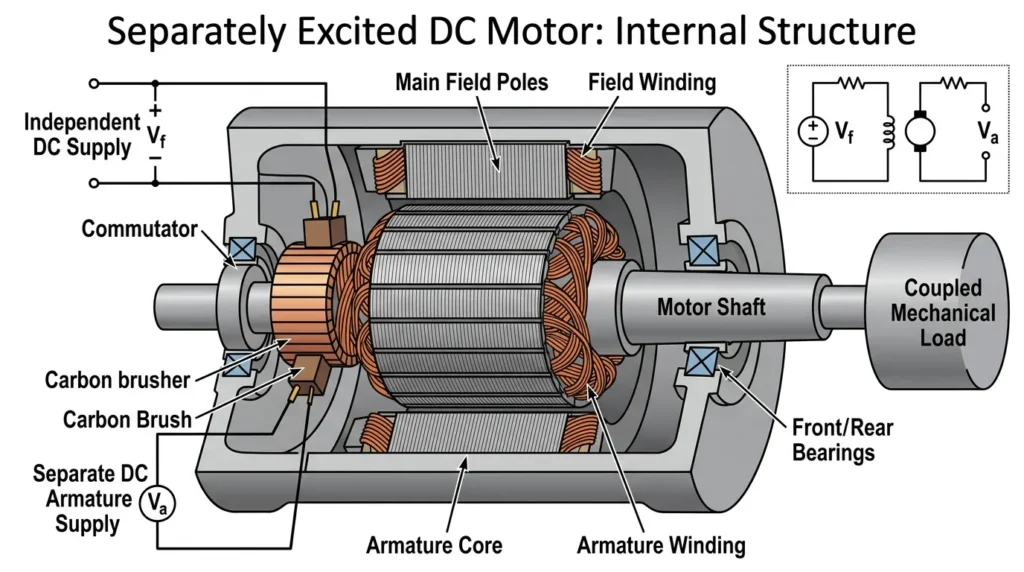
A Separately Excited DC Motor consists of several important components that work together to convert electrical energy into mechanical energy. Each part performs a specific function and contributes to the efficient operation of the motor. Understanding these components helps students, engineers, and technicians diagnose faults, perform maintenance, and appreciate the working mechanism of the motor.
Field Winding
The field winding is one of the most important parts of a separately excited DC motor because it produces the magnetic field required for motor operation. It consists of insulated copper conductors wound around the field poles mounted on the stator. Unlike other DC motors, the field winding receives power from a separate DC source independent of the armature circuit. When current flows through the field coils, a strong magnetic field is established around the poles. The strength of this field can be adjusted by changing the field current, allowing accurate speed control. Proper functioning of the field winding ensures stable motor performance and efficient torque production. Any interruption in the field circuit can significantly affect motor operation.
Functions
- Produces the main magnetic field.
- Receives power from an external DC source.
- Enables speed regulation.
- Supports torque generation.
- Maintains stable motor operation.
- Allows field strength adjustment.
- Improves performance under varying loads.
- Enhances control flexibility.
Armature
The armature is the rotating component of the motor where electromagnetic interaction takes place. It is mounted on the shaft and consists of laminated steel cores containing slots that house insulated conductors. When current flows through these conductors, they interact with the magnetic field produced by the field winding. This interaction generates electromagnetic force, creating torque that rotates the armature. The armature is designed to withstand mechanical stresses and provide efficient energy conversion. Since it carries the main load current, proper insulation and cooling are essential for reliable operation. The armature plays a direct role in determining the motor’s output power and performance.
Functions
- Carries armature current.
- Produces electromagnetic torque.
- Rotates to generate mechanical motion.
- Supports armature conductors.
- Transfers power to the shaft.
- Converts electrical energy into mechanical energy.
- Withstands rotational forces.
- Determines motor output performance.
Commutator
The commutator is a cylindrical arrangement of copper segments mounted on the motor shaft. These segments are insulated from one another using materials such as mica. The commutator works together with the brushes to ensure that the torque generated within the motor remains in the same direction. As the armature rotates, the commutator periodically reverses the current in the armature conductors at precise intervals. This action allows continuous rotational motion and prevents the motor from reversing direction. The commutator is a critical component in maintaining smooth motor operation. Proper maintenance is necessary to avoid sparking and excessive wear.
Functions
- Reverses armature current direction.
- Maintains unidirectional torque.
- Enables continuous rotation.
- Works with brushes for power transfer.
- Improves motor efficiency.
- Supports stable operation.
- Prevents torque reversal.
- Facilitates electrical switching.
Brushes
Brushes are stationary carbon or graphite components that maintain electrical contact between the external power supply and the rotating commutator. They are mounted in brush holders and pressed gently against the commutator surface using springs. As the commutator rotates, the brushes conduct current to the armature winding without interrupting the electrical connection. Because brushes are subject to friction and wear, they require periodic inspection and replacement. High-quality brushes ensure efficient current transfer and minimize sparking. Proper brush maintenance contributes to reliable motor performance and longer service life.
Functions
- Transfer current to the armature.
- Maintain contact with the commutator.
- Enable continuous power supply.
- Support smooth motor operation.
- Minimize electrical interruptions.
- Reduce sparking with proper maintenance.
- Ensure efficient current flow.
- Require periodic inspection and replacement.
Shaft
The shaft is a strong cylindrical component attached directly to the armature. It rotates along with the armature and transfers the mechanical energy produced by the motor to external equipment or machinery. The shaft is usually made from high-strength steel to withstand twisting forces and continuous operation. It supports rotating parts and ensures smooth transmission of torque. Proper alignment of the shaft is essential to avoid vibration and mechanical damage. Since it serves as the output member of the motor, its reliability directly affects machine performance.
Functions
- Transfers mechanical power.
- Supports the rotating armature.
- Delivers torque to external loads.
- Maintains rotational stability.
- Withstands mechanical stress.
- Ensures efficient power transmission.
- Reduces vibration when aligned properly.
- Supports connected machinery.
Frame or Yoke
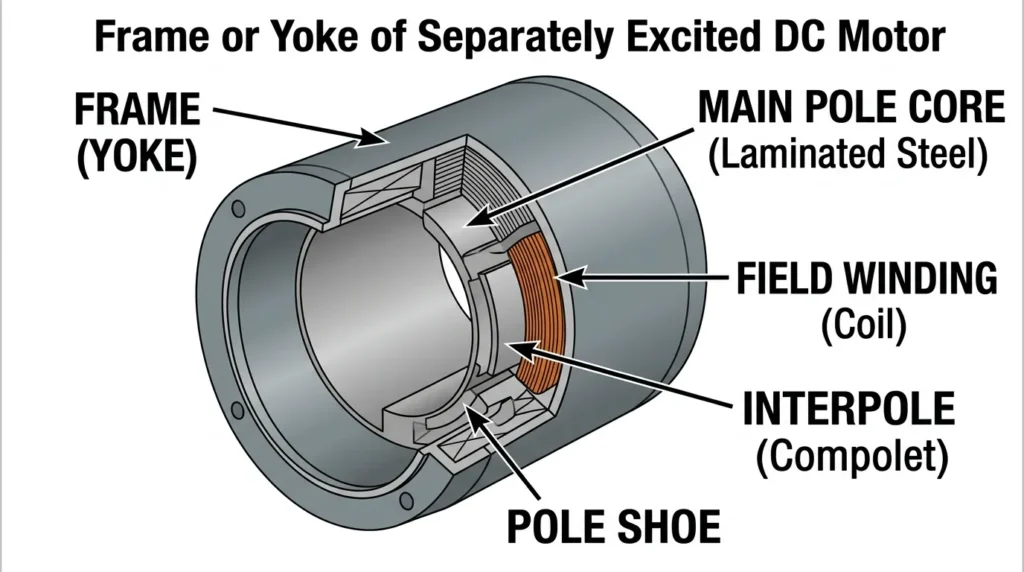
The frame, also known as the yoke, forms the outer body of the motor and provides structural support to all internal components. It is generally manufactured from cast steel or cast iron to provide strength and durability. The frame protects the motor from dust, moisture, and accidental damage while maintaining the alignment of internal parts. It also acts as a path for magnetic flux in some motor designs. A robust frame improves safety and extends the motor’s operational life. Proper enclosure design also assists in heat dissipation and cooling.
Functions
- Provides mechanical support.
- Protects internal components.
- Maintains structural integrity.
- Supports field poles and windings.
- Shields against external damage.
- Assists in heat dissipation.
- Improves motor durability.
- Enhances operational safety.
A separately excited DC motor is highly valued for its excellent speed regulation, precise control, and dependable performance. Its classifications, including speed-controlled and voltage-controlled motors, allow engineers to select the most suitable control method for specific applications. Components such as the field winding, armature, commutator, brushes, shaft, and frame work together to convert electrical energy into useful mechanical output. Understanding these classifications and components provides a solid foundation for studying DC motor operation, troubleshooting faults, and applying these motors effectively in modern industrial systems.
Advantages
The Separately Excited DC Motor advantages and disadvantages are important considerations for engineers, technicians, and designers when selecting the most suitable motor for a particular application. Due to its independent field and armature supplies, this motor offers excellent control characteristics and dependable performance. These advantages make it one of the preferred choices for applications where precision, flexibility, and stable operation are essential.
Excellent Speed Control
One of the biggest advantages of a separately excited DC motor is its outstanding speed control capability. Since the field winding and armature winding are supplied independently, the motor speed can be adjusted accurately by varying either the field current or the armature voltage. This allows smooth operation over a wide speed range. The motor can maintain the desired speed even when operating conditions change. Such precise control is difficult to achieve with many other types of motors.
High Efficiency in Variable Speed Applications
Separately excited DC motors perform very efficiently in applications where frequent speed changes are required. Because only the required amount of power is supplied for a specific operating condition, unnecessary energy losses are minimized. The motor responds quickly to speed adjustments and maintains efficient performance throughout its operating range. This makes it suitable for industrial processes that demand flexibility and energy efficiency.
Stable Performance Under Varying Loads
These motors can maintain nearly constant speed even when the mechanical load changes. The independent field excitation helps stabilize the motor’s operation and prevents sudden speed fluctuations. This characteristic is particularly important in industries where product quality depends on uniform speed. Stable performance also improves productivity and reduces operational disturbances.
Easy Adjustment of Field Current
The field current can be adjusted independently without affecting the armature circuit. This provides greater flexibility in controlling motor characteristics according to application requirements. Operators can easily increase or decrease the magnetic field strength to obtain the desired speed and torque. Such adaptability makes the motor highly versatile in different industrial environments.
Suitable for Research and Industrial Testing
Separately excited DC motors are widely used in laboratories and testing facilities because of their controllable characteristics. Students and researchers can study the effects of varying field and armature conditions independently. The motor’s predictable behavior allows accurate experimentation and performance analysis. It is therefore an important machine in educational institutions and research centers.
Good Torque Characteristics
These motors provide excellent torque characteristics, especially during starting and varying load conditions. They can produce sufficient torque to handle demanding applications while maintaining smooth operation. The ability to control torque accurately improves machine performance and reliability. This feature makes them suitable for heavy-duty industrial processes.
Summary of Advantages
- Excellent and precise speed control.
- High efficiency in variable-speed operations.
- Stable performance under changing loads.
- Independent adjustment of field current.
- Suitable for research and testing applications.
- Good starting and operating torque.
- Flexible operating characteristics.
- Reliable performance in industrial environments.
These benefits make separately excited DC motors ideal for precision industrial machines and applications requiring accurate control.
Disadvantages / Limitations
Despite their many advantages, Separately Excited DC Motors also have certain limitations. These disadvantages should be carefully considered before selecting the motor for a particular application. Factors such as cost, maintenance requirements, and system complexity may influence the choice of motor technology.
Requires Two Separate Power Supplies
One of the major disadvantages of this motor is the need for two independent DC power sources. One supply energizes the field winding, while the other powers the armature circuit. This arrangement increases the complexity of the electrical system and requires additional equipment. In some installations, providing two separate supplies may not be practical.
Higher Installation Cost
Because of the additional power supply arrangements and control equipment, the installation cost of a separately excited DC motor is generally higher than that of simpler motor types. Extra wiring, controllers, and protection devices add to the initial investment. Although the motor offers excellent performance, the higher cost may not be justified for basic applications.
More Complex Control System
The independent control of field and armature circuits requires a more sophisticated control system. Operators and maintenance personnel must understand the interaction between these circuits for proper operation. Advanced controllers may also be required to achieve accurate speed regulation. This complexity increases system design and commissioning efforts.
Requires Regular Maintenance of Brushes and Commutator
Since the motor uses brushes and a commutator, periodic maintenance is necessary. Brushes wear out due to friction and must be inspected and replaced when needed. The commutator also requires cleaning and maintenance to prevent sparking and ensure efficient operation. Failure to maintain these components can reduce motor performance and reliability.
Larger Size Compared to Some Modern Motors
Separately excited DC motors may occupy more space than certain modern AC motors and brushless alternatives. Their additional components contribute to increased size and weight. In applications where compactness is important, engineers may choose other motor technologies. Space limitations can therefore affect their suitability.
Summary of Limitations
- Requires two separate DC power supplies.
- Higher installation and equipment costs.
- More complicated control arrangements.
- Needs regular brush and commutator maintenance.
- Larger size compared to some alternatives.
- Increased maintenance expenses.
- More complex troubleshooting procedures.
Because of these limitations, engineers sometimes select other motor types for simpler and less demanding applications.
Separately Excited DC Motor Applications
The Separately Excited DC Motor applications are mainly found in industries and systems where precise speed regulation and dependable operation are essential. Their excellent control characteristics make them suitable for both traditional industrial processes and modern automated systems.
Industrial Applications
Separately excited DC motors are widely used in industrial machinery that requires constant speed and accurate control. Their ability to maintain stable performance under varying loads makes them highly reliable in manufacturing environments. These motors help improve production quality and operational efficiency.
Common Industrial Uses
- Steel rolling mills.
- Paper manufacturing machines.
- Textile machinery.
- Printing presses.
- Conveyor systems.
- Packaging equipment.
- Heavy-duty machine tools.
- Material handling systems.
Laboratory Applications
Educational institutions and research laboratories frequently use these motors for experimentation and testing purposes. Their independent control features allow students and researchers to observe the effects of varying field and armature conditions. The motor’s predictable characteristics make it ideal for learning and analysis.
Common Laboratory Uses
- Electrical machine testing.
- Research experiments.
- Speed control studies.
- Performance analysis.
- Educational demonstrations.
- Control system investigations.
- Efficiency measurements.
- Motor characteristic studies.
Modern Technology Applications
With the advancement of automation technology, separately excited DC motors continue to find applications in modern control systems. Their precise speed and torque control capabilities support highly accurate operations in advanced equipment. They remain valuable in systems requiring dependable motion control.
Common Modern Applications
- Electric traction systems.
- Industrial automation.
- Robotics systems.
- Motion control equipment.
- Automated production lines.
- Servo drive applications.
- Position control systems.
- Specialized manufacturing processes.
Separately excited DC motors offer a unique combination of precise speed control, stable operation, and excellent torque characteristics. Their advantages make them highly suitable for industrial machinery, research facilities, and advanced automation systems. However, factors such as higher installation costs, the need for separate power supplies, and regular maintenance must also be considered. By carefully evaluating both the advantages and limitations, engineers can determine whether a separately excited DC motor is the most appropriate choice for a particular application.
Comparison with Other DC Motors
Understanding the difference between separately excited DC motor and shunt motor helps engineers choose the right motor.
| Feature | Separately Excited DC Motor | DC Shunt Motor |
|---|---|---|
| Power Supply | Field and armature have separate supply | Same power supply |
| Speed Control | Excellent | Good |
| Complexity | More complex | Simpler |
| Cost | Higher | Lower |
| Applications | Industrial precision systems | General machinery |
This comparison shows that separately excited motors provide better control but require more complex systems.
Selection Guide
Choosing the right motor is an important decision because it directly affects the efficiency, reliability, and overall performance of a machine or industrial process. A motor that is not suitable for the application may lead to excessive energy consumption, poor performance, frequent breakdowns, and higher maintenance costs. When selecting a Separately Excited DC Motor, engineers should carefully evaluate the operational requirements, available resources, and long-term maintenance needs. Considering these factors helps ensure that the motor delivers stable and efficient performance throughout its service life.
Consider Speed Control Requirements
One of the main reasons for selecting a Separately Excited DC Motor is its excellent speed control capability. Since the field winding and armature winding are supplied independently, the motor speed can be adjusted accurately over a wide operating range. This makes it ideal for applications where maintaining a specific speed is critical to product quality and process efficiency.
Industries such as printing, paper manufacturing, steel rolling, and automation often require motors that can respond quickly to speed changes without losing stability. If precise speed regulation and flexibility are essential, a separately excited DC motor is an excellent choice.
Points to Consider
- Determine whether accurate speed control is required.
- Evaluate the need for variable-speed operation.
- Consider applications with frequent speed adjustments.
- Assess whether stable speed under changing conditions is important.
- Choose this motor when precision is a priority.
Evaluate Power Supply Availability
A separately excited DC motor requires two independent DC power supplies—one for the field winding and another for the armature winding. Before selecting this motor, it is important to ensure that the existing electrical infrastructure can provide these separate supplies safely and reliably.
In some facilities, additional power converters, rectifiers, or control units may be needed to establish the required DC sources. If the necessary supply arrangement cannot be provided economically, another motor type may be more practical.
Points to Consider
- Verify the availability of separate DC supplies.
- Check the capacity of the electrical system.
- Consider the cost of additional power equipment.
- Ensure proper protection devices are installed.
- Confirm that the power supply arrangement is reliable.
Check Load Characteristics
The nature of the mechanical load plays a major role in motor selection. Separately excited DC motors perform exceptionally well in applications where the load varies frequently. Their ability to maintain stable speed and produce suitable torque under changing conditions makes them highly dependable.
Machines that experience sudden increases or decreases in load benefit from the motor’s flexible control characteristics. Understanding the load profile helps ensure that the selected motor can operate efficiently without excessive stress.
Points to Consider
- Determine whether the load is constant or variable.
- Assess starting torque requirements.
- Evaluate the possibility of sudden load changes.
- Select a motor capable of handling operating demands.
- Ensure stable performance under all conditions.
Maintenance Capability
Like other brushed DC machines, separately excited DC motors require periodic maintenance to ensure reliable operation. Components such as brushes and commutators wear over time and need regular inspection, cleaning, and replacement. Therefore, maintenance capability should be considered before choosing this motor.
Organizations with trained personnel and proper maintenance facilities can manage these requirements effectively. However, in environments where maintenance support is limited, the additional servicing needs may become a disadvantage.
Points to Consider
- Ensure qualified maintenance staff are available.
- Plan for regular brush inspections.
- Schedule commutator cleaning and servicing.
- Maintain spare parts for replacements.
- Consider long-term maintenance costs.
Selecting the right Separately Excited DC Motor involves more than simply matching power ratings. Engineers must consider factors such as speed control requirements, availability of separate power supplies, load characteristics, and maintenance capabilities. When these aspects align with the application’s needs, the motor delivers excellent performance, precise control, and dependable operation. Careful selection not only improves productivity and efficiency but also reduces operating costs and extends the service life of the equipment.
Common Problems & Solutions
Like all electrical machines, a Separately Excited DC Motor can develop operational problems over time. These issues may arise due to electrical faults, improper maintenance, overloading, or unfavorable operating conditions. Understanding the common problems and their solutions helps technicians diagnose faults quickly, reduce downtime, and maintain reliable motor performance. Regular inspection and preventive maintenance can prevent many of these issues before they become serious.
Why is the motor not starting?
One of the most common problems is that the motor fails to start when the power supply is switched on. This problem can occur because the armature circuit is not receiving voltage, the field supply is interrupted, or the brushes have become excessively worn. Loose terminals, blown fuses, and damaged wiring may also prevent proper operation. Since the motor requires both field and armature excitation, failure in either circuit can stop the motor from starting.
Possible Causes
- No armature voltage supply.
- Faulty or interrupted field supply.
- Worn-out carbon brushes.
- Loose electrical connections.
- Blown fuses or tripped protection devices.
Solution
- Check all power connections carefully.
- Verify the presence of armature voltage.
- Inspect the field supply circuit.
- Replace damaged or worn brushes.
- Reset or replace faulty protective devices.
Why is motor speed unstable?
Unstable motor speed is another issue that affects performance and process quality. The motor may speed up and slow down unexpectedly during operation. This usually occurs because of fluctuations in field current, poor electrical contacts, defective controllers, or unstable power supplies. If left unresolved, unstable speed can affect the efficiency and accuracy of industrial operations.
Possible Causes
- Fluctuating field current.
- Loose or poor wiring connections.
- Faulty speed control equipment.
- Unstable power supply.
- Damaged field circuit components.
Solution
- Stabilize the field supply voltage.
- Inspect and tighten electrical connections.
- Test the speed control system.
- Replace defective control components.
- Perform regular maintenance checks.
Why is the motor overheating?
Motor overheating is a serious problem that can shorten insulation life and damage internal components. Excessive heat is often caused by overloading, inadequate ventilation, excessive current flow, or prolonged operation under unsuitable conditions. Dust accumulation and blocked cooling passages can also reduce heat dissipation. Early detection of overheating helps prevent major motor failures.
Possible Causes
- Operating beyond rated load.
- Poor ventilation around the motor.
- Excessive armature current.
- Blocked cooling passages.
- Continuous operation without rest periods.
Solution
- Reduce the mechanical load.
- Improve ventilation and cooling.
- Monitor current levels regularly.
- Clean cooling vents and passages.
- Operate the motor within its rated capacity.
Future Trends
Electrical motor technology continues to evolve as industries demand higher efficiency, better control, and improved reliability. Although modern motor technologies are advancing rapidly, separately excited DC motors remain important in applications requiring precise speed regulation. New developments are making these motors smarter, more energy-efficient, and easier to integrate into automated systems.
Digital Motor Control
Modern motor control systems increasingly use microprocessors, digital drives, and advanced control algorithms to regulate motor performance. These controllers provide extremely accurate speed adjustment and fast response to changing operating conditions. Digital systems also allow programmable settings and improved fault diagnostics. As a result, operators can achieve better productivity and more consistent performance.
Benefits
- More precise speed regulation.
- Faster response to load changes.
- Improved fault detection.
- Programmable operating parameters.
- Enhanced operational efficiency.
Integration with Automation
Separately excited DC motors are becoming an important part of automated production environments. They can easily interface with programmable logic controllers (PLCs), industrial controllers, and automated monitoring systems. This integration enables coordinated machine operation and improved manufacturing efficiency. Automated systems also reduce human error and increase production consistency.
Benefits
- Supports automated manufacturing.
- Improves production accuracy.
- Enables coordinated machine control.
- Reduces manual intervention.
- Enhances productivity.
Energy Efficient Designs
Manufacturers are continuously developing motor designs that consume less energy while delivering the same or even better performance. Improved magnetic materials, optimized winding configurations, and advanced cooling systems help reduce losses and improve efficiency. Energy-efficient motors lower operating costs and support environmental sustainability initiatives.
Benefits
- Reduced electricity consumption.
- Lower operating expenses.
- Improved overall efficiency.
- Reduced heat generation.
- Environmentally friendly operation.
Smart Monitoring Systems
Advanced sensor technologies now allow real-time monitoring of motor operating conditions. Parameters such as temperature, speed, vibration, current, and overall performance can be continuously tracked. These monitoring systems provide early warnings of developing faults and support predictive maintenance programs. As a result, unexpected breakdowns can be minimized and equipment reliability improved.
Benefits
- Continuous condition monitoring.
- Early fault detection.
- Reduced downtime.
- Improved maintenance planning.
- Increased equipment reliability.
These technological advancements are shaping the future of Separately Excited DC Motors. Through digital control, automation integration, energy-efficient designs, and smart monitoring systems, these motors will continue to provide reliable and precise performance in modern industrial applications while meeting the growing demands for efficiency and sustainability.
Conclusion
The Separately Excited DC Motor is an important type of DC motor known for its precise speed control and reliable performance. By using separate power supplies for the field winding and armature, engineers can adjust the magnetic field and regulate motor speed accurately.
Understanding the Separately Excited DC Motor working principle, components, and applications helps electrical students and technicians build a strong foundation in electric machine technology. Although the motor requires a more complex power supply system and regular maintenance, its benefits make it highly valuable for industrial and research applications.
The Separately Excited DC Motor advantages and disadvantages must be carefully considered when selecting a motor for a specific task. With advancements in automation and digital motor control, this motor will continue to play an important role in modern electrical engineering systems.
Learning these concepts will help beginners develop deeper knowledge of DC machines and prepare them for advanced electrical engineering applications.