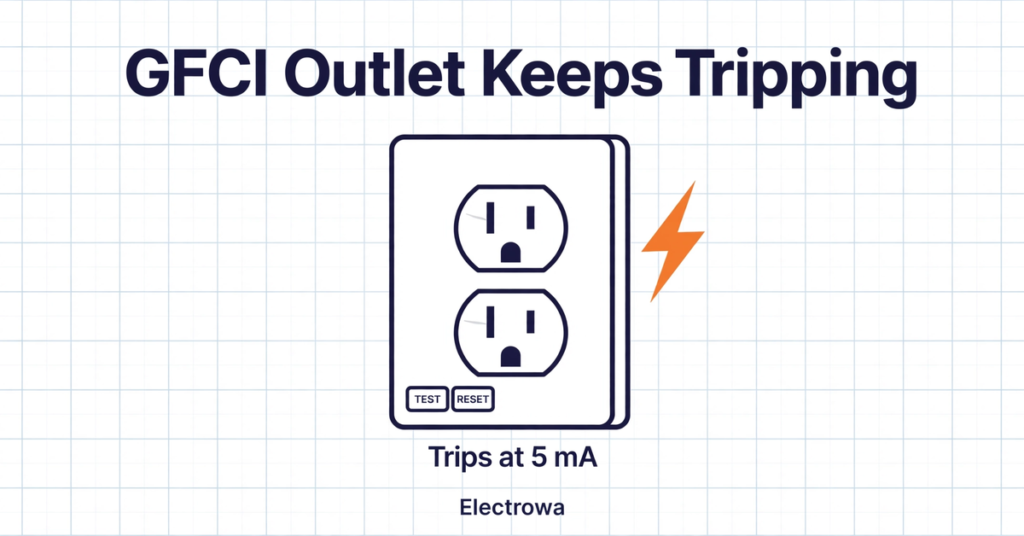

A GFCI outlet that keeps tripping is trying to tell you something. A ground fault circuit interrupter compares the current going out on the hot wire with the current coming back on the neutral wire. When the two differ by more than 4 to 6 milliamps, it trips in a fraction of a second and cuts the power. Below: five common causes and a safe five-step test.
What Is a GFCI and Where Is One Required?
A GFCI is a special outlet with TEST and RESET buttons. Inside, a sensor constantly checks the hot and neutral currents. If 5 milliamps leaks to ground, the sensor trips the outlet. The National Electrical Code (NEC) requires GFCI protection in kitchens, bathrooms, garages, basements, and all outdoor outlets. A breaker protects wires from overload; a GFCI protects people from shock. That is the key difference: if a GFCI trips, the problem is almost always a ground fault, not too many watts.
5 Common Causes of a Tripping GFCI
1. A Real Ground Fault
A damaged cord, a cracked housing, or a wire touching a metal box lets current leak to ground. The GFCI does its job and trips. If the same appliance trips it every time, that appliance is the problem.
2. Moisture and Water
Water is the most common cause in bathrooms, kitchens, and outdoor outlets. Rain or condensation puts a thin film of water across the contacts. Outlets with a worn weatherproof cover trip most often after rain.
3. A Worn-Out GFCI Outlet
A GFCI outlet lasts about 10 to 15 years. The sensor weakens with age, and an old outlet can trip for no clear reason. If it is over a decade old or will not reset empty, it has failed.
4. A Shared Neutral
In some older wiring, two circuits share one neutral wire. The GFCI sees current leaving on its hot wire but returning on another path, reads an imbalance, and trips. This usually shows up after a new GFCI is installed, and an electrician must fix it.
5. A Faulty Appliance
Old fridges, washers, and power tools leak a little current as insulation ages. One appliance may leak 2 milliamps and another 3.5. Each is under the limit alone, but together they reach 5.5 milliamps, and the GFCI trips.
5-Step Diagnostic: Find the Cause in Order
- Unplug everything. Remove every plug from the GFCI outlet and its downstream outlets. Press RESET. If it holds, the problem is in something you unplugged.
- Plug things back one at a time. Plug in one appliance and wait. Repeat with each one. The appliance that trips the GFCI is the faulty one. Have it repaired or replaced.
- Press the TEST button. With nothing plugged in, press TEST: the outlet should trip and RESET should pop out. Press RESET to restore power. If TEST does nothing, the outlet is dead and must be replaced.
- Check for moisture. Look for water or dampness around the outlet, especially outdoors and near sinks. Dry the area and let the outlet dry. If it trips again once wet, replace the weatherproof cover or seal.
- Check the other outlets on the same circuit. One GFCI often protects several downstream outlets, so a bathroom GFCI can trip because of an outlet in the next room. Unplug them all and repeat step 2.
Worked Example: Small Leaks Add Up to a Trip
A GFCI trips when the imbalance between hot and neutral current passes about 5 milliamps. Imagine an outdoor circuit with two appliances on the same GFCI. An old refrigerator leaks 2 milliamps through aging insulation. A pressure washer with a damp cord leaks 3.5 milliamps. Neither one alone can trip the GFCI, because 2 is less than 5 and 3.5 is also less than 5. But the GFCI sees the total leakage: 2 + 3.5 = 5.5 milliamps. That is more than the 5 milliamp trip limit, so the GFCI trips even though each one looks fine alone. The fix is to remove the biggest leak, usually the wettest or oldest item, and keep outdoor outlets dry with a proper in-use weatherproof cover.
Symptom, Cause, and Fix at a Glance
| Symptom | Likely Cause | Fix |
|---|---|---|
| Trips on reset, nothing plugged in | Worn-out GFCI or a wiring ground fault | Replace the GFCI; if it still trips, call an electrician |
| Trips only when it rains | Moisture in an outdoor outlet | Dry the outlet, replace the weatherproof cover |
| Trips only when one appliance runs | Faulty appliance leaking current | Repair or replace it |
| Trips when two appliances run together | Small leaks adding up past 5 milliamps | Move one appliance to another circuit |
| Trips right after a new GFCI was installed | Shared neutral | An electrician must check the neutral wiring |
GFCI Test Steps and What Each Result Means
| Step | What to Do | What the Result Tells You |
|---|---|---|
| 1 | Unplug everything, press RESET | Holds: the fault is in an appliance. Trips again: the fault is in the wiring. |
| 2 | Plug appliances back one at a time | The appliance that trips it is leaking current and needs repair or replacement. |
| 3 | Press TEST, then RESET | TEST trips and RESET restores power: the GFCI works. Anything else: replace the outlet. |
| 4 | Check for water and dampness | Wet outlet: moisture is the cause. Dry it and fix the cover or seal. |
| 5 | Test the downstream outlets | Another outlet trips it: the fault is elsewhere on the same circuit. |
When to Call an Electrician
Call a licensed electrician if the GFCI trips with nothing plugged in, if a new GFCI trips right after installation, or if you see burn marks, hear buzzing, or smell burning. Turn off the breaker and wait for help.
Frequently Asked Questions
Why does my GFCI trip when it rains?
Rain adds a leakage path to ground in outdoor outlets. Even 1 or 2 extra milliamps can push the total past the 5 milliamp limit. Dry the outlet and replace a worn cover.
Can I replace a GFCI outlet myself?
Yes, if you turn off the breaker and verify the power is off with a tester. Wire the line and load terminals correctly. If unsure, hire an electrician.
Does a GFCI trip on overload?
No. A GFCI trips only on a ground fault of 4 to 6 milliamps. Overload is the breaker’s job. If RESET has not popped out, the breaker tripped.
Why does my GFCI trip with nothing plugged in?
The outlet is usually worn out, or there is a ground fault, moisture in the box, or a shared neutral. If it will not reset empty, replace it.
How long does a GFCI outlet last?
About 10 to 15 years. Test it monthly. If it fails the test, or trips randomly in its second decade, replace it.
Can one GFCI protect several outlets?
Yes. A GFCI protects every downstream outlet wired to its load terminals. That is why a GFCI in one room can trip because of an outlet in another room.
Also Read
- AFCI Breaker Keeps Tripping: Causes and Fixes
- GFCI vs AFCI: What Is the Difference?
- What Size Breaker Do I Need?
- How Many Watts Can a 20 Amp Breaker Handle?