
Synchronous motors and induction motors are the two main types of AC motor, and from the outside they look almost identical: a steel frame, a terminal box, and a spinning shaft. Inside, they work in fundamentally different ways — and that difference decides everything from speed accuracy and power factor to cost and maintenance. An induction motor is the rugged workhorse of industry, while a synchronous motor is the precision machine used where exact speed or power-factor correction matters. This guide explains how each one works and compares them across 10 key differences, so you can choose the right motor for the job.
The short version: an induction motor always runs slightly slower than the speed of the stator’s rotating magnetic field, while a synchronous motor locks onto that field and runs at exactly its speed. That single fact drives almost every other difference between them.
What Is a Synchronous Motor?
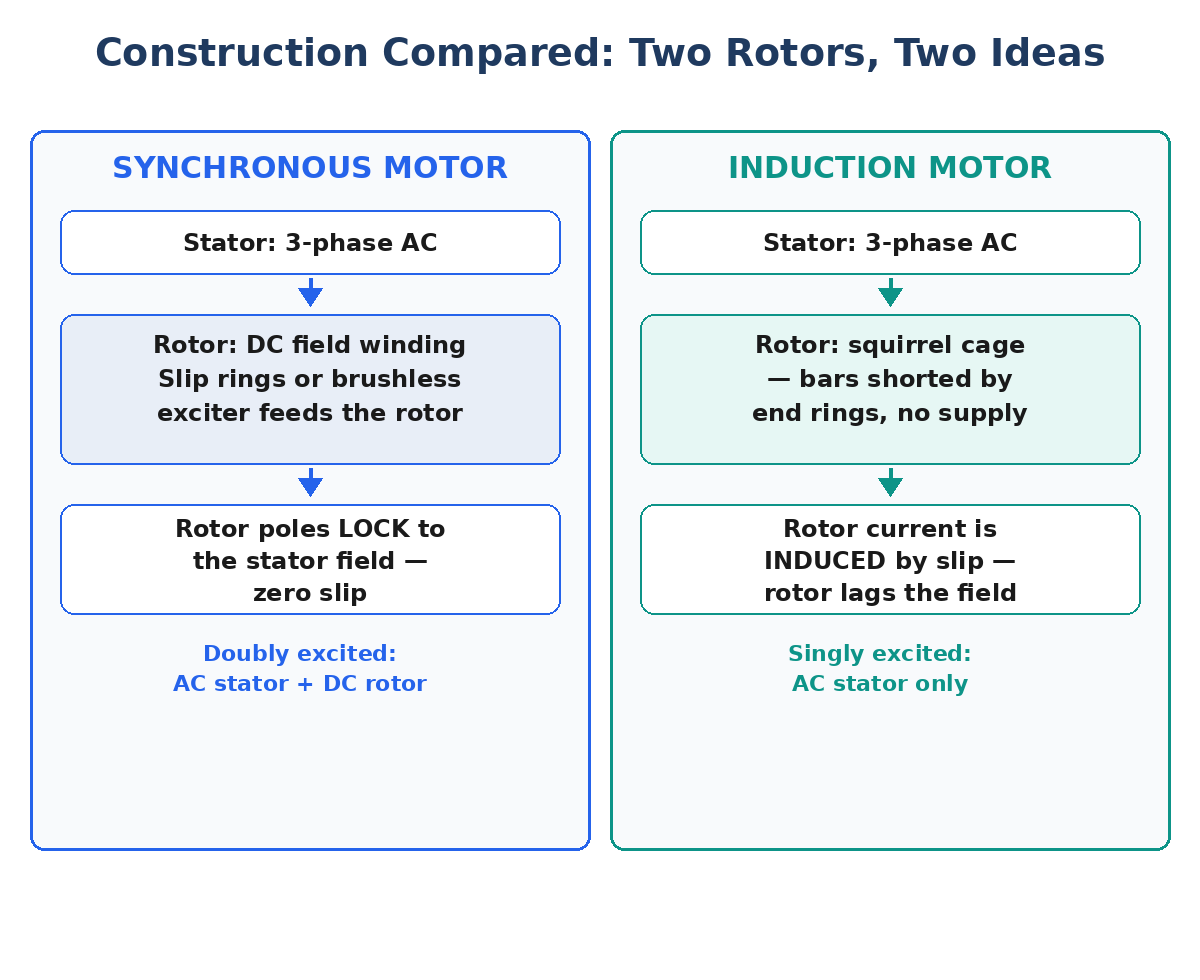
A synchronous motor is an AC motor whose rotor turns at exactly the synchronous speed of the stator’s rotating magnetic field — Ns = (120 × f) / P, where f is the supply frequency and P is the number of poles. The rotor carries its own magnetic poles, created either by a DC field winding fed through slip rings or a brushless exciter, or by permanent magnets. These rotor poles lock magnetically to the rotating stator field, so the rotor turns in step with it, with zero slip, no matter how the load changes (as long as the load stays within the motor’s pull-out torque limit).
Because it is doubly excited — AC on the stator and DC on the rotor — a synchronous motor has a feature no induction motor can match: its power factor is adjustable. Change the DC field current and the motor moves from lagging to unity to leading power factor. Over-excited, it can even export reactive power to the supply, acting like a capacitor bank — a role known as a synchronous condenser. Our dedicated guide to the synchronous motor covers its construction and starting methods in detail.
What Is an Induction Motor?
An induction motor, also called an asynchronous motor, is singly excited: only the stator receives AC power. The stator’s rotating magnetic field induces current in the rotor conductors, and that induced current produces the torque that turns the shaft. Because torque depends on relative motion between the field and the rotor, the rotor must always turn slightly slower than synchronous speed. That speed gap — slip, typically 2% to 5% at full load — is essential to how the motor works.
The most common type is the squirrel-cage induction motor, whose rotor is a simple cage of aluminum or copper bars short-circuited by end rings, with no windings, no slip rings, and no brushes. That simplicity is the reason induction motors dominate industry: they are cheap, rugged, and need very little maintenance. Our guide to the three-phase induction motor explains the rotating-field principle, and the squirrel-cage induction motor article covers the rotor design that makes it so reliable.
10 Key Differences at a Glance
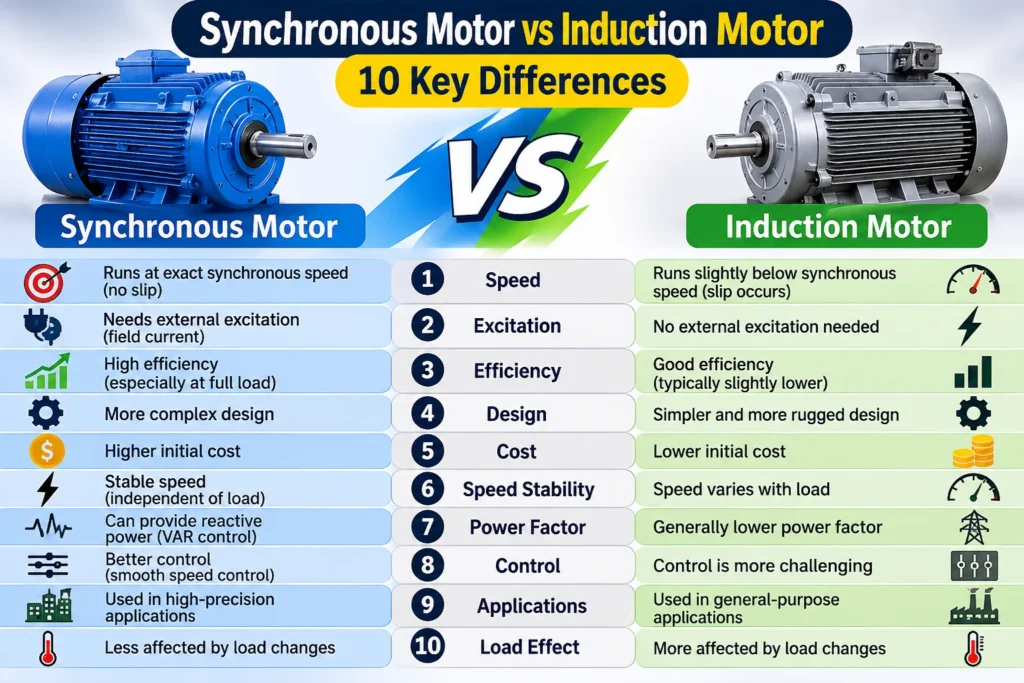
The table below compares the two motors across the ten differences that matter most in practice — speed, starting, power factor, efficiency, cost, and more.
| # | Feature | Synchronous Motor | Induction Motor |
|---|---|---|---|
| 1 | Operating speed | Exactly synchronous speed Ns, constant regardless of load | Always below Ns; speed drops as load increases |
| 2 | Slip | Zero slip in steady operation | Non-zero slip (typically 2–5% at full load); slip is essential for torque |
| 3 | Excitation | Doubly excited — AC stator + DC rotor field | Singly excited — AC stator only; rotor current is induced |
| 4 | Self-starting | Not self-starting; needs a damper winding, pony motor, or VFD to reach synchronous speed | Self-starting; starts directly when connected to the supply |
| 5 | Power factor | Adjustable — lagging, unity, or leading; can correct plant power factor | Always lagging (about 0.8–0.9 at full load, as low as 0.3–0.4 at light load) |
| 6 | Efficiency | Higher — large machines reach up to about 98%; permanent-magnet types 93–98% | Good but lower — IE3 motors about 89–94%, IE4 about 91–96% |
| 7 | Cost | 30–50% more expensive for the same rating, plus exciter and controls | Lower purchase cost and simpler drive requirements |
| 8 | Construction & maintenance | More complex — field winding, slip rings or exciter, and starting equipment need attention | Simple and rugged — squirrel-cage rotor has no brushes or slip rings |
| 9 | Speed control | Speed is locked to supply frequency; very stable, but needs a VFD to vary | Speed varies with load and slip unless a VFD controls it |
| 10 | Typical applications | Compressors, mills, crushers, large pumps, power-factor correction (synchronous condenser) | Pumps, fans, conveyors, HVAC, machine tools — general-purpose drives |
Speed and Load Behavior
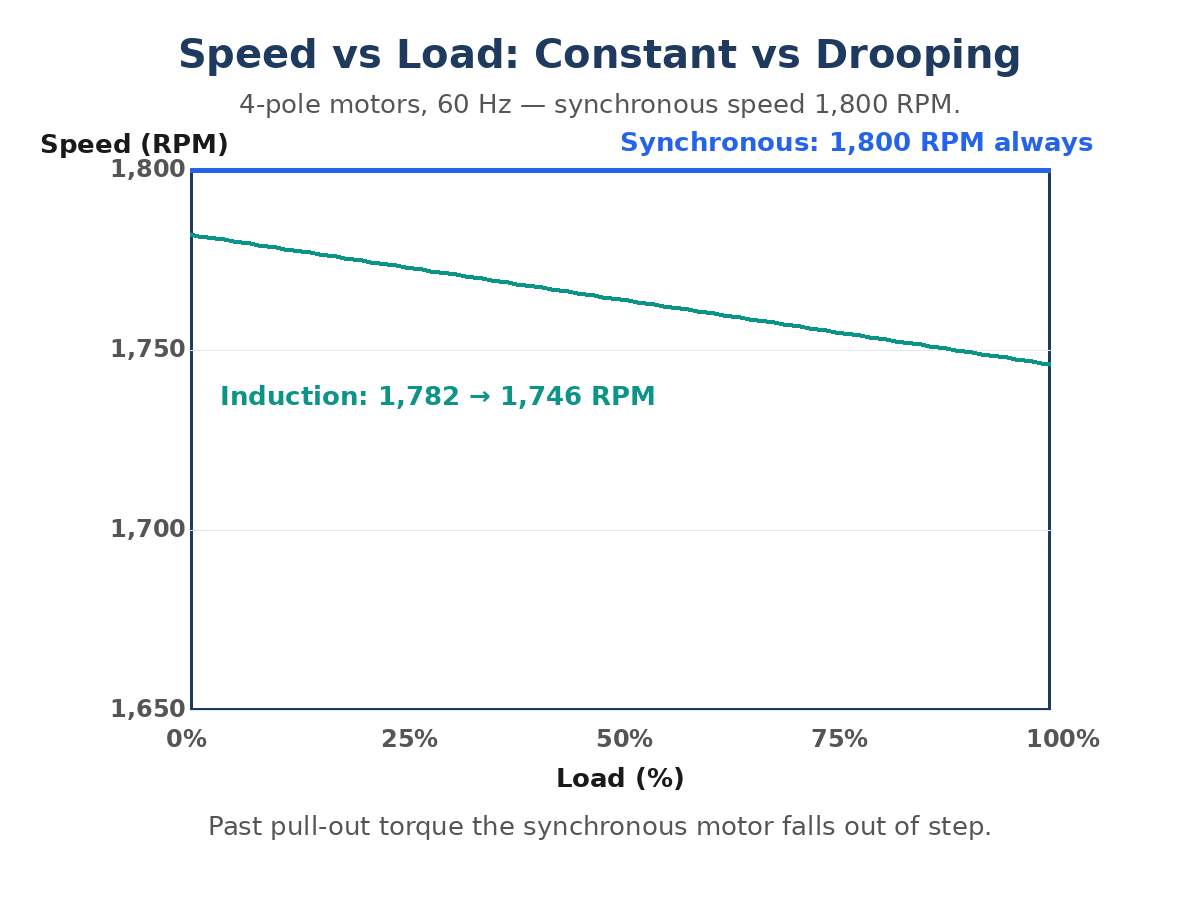
The first two differences — speed and slip — are the ones users notice most. A synchronous motor holds exactly 1,800 RPM (for a 4-pole motor on 60 Hz) whether it is lightly loaded or heavily loaded, right up to the point where the load exceeds its pull-out torque and it falls out of step. That makes it the right choice for clocks, rolling mills, and any process where speed must not drift.
An induction motor’s speed droops as the load rises: a 4-pole motor that runs at 1,782 RPM at no load may run at 1,746 RPM at full load — a 2% drop that is usually harmless for a pump or fan but unacceptable for precision timing. A variable frequency drive can compensate for this droop, which is why most modern induction-motor installations pair the motor with a VFD when speed accuracy matters.
Starting: The Synchronous Motor’s Weakness
A synchronous motor cannot start by itself. At standstill, the stator field sweeps past the rotor poles 60 times a second, pulling them first one way and then the other, so the average torque is zero. Practical starting methods include a damper winding — a squirrel-cage winding embedded in the rotor pole faces that lets the motor start like an induction motor and pull into synchronism — a small pony motor that spins the rotor up to speed, or a VFD that ramps the frequency up gradually. Our article on types of motor starters covers the starting equipment used for both motor types.
An induction motor, by contrast, develops starting torque the instant power is applied. It can be started direct-on-line, with a star-delta starter, a soft starter, or a VFD, depending on the size of the motor and the capacity of the supply. This self-starting ability, combined with low cost, is the main reason induction motors outsell synchronous motors by a huge margin in general industry.
Power Factor and Efficiency
Power factor is where the synchronous motor earns its premium. An induction motor always draws magnetizing current from the supply, so it runs at a lagging power factor — roughly 0.8 to 0.9 at full load and much worse at light load. In a plant full of induction motors, that lagging reactive power can attract utility penalties unless capacitor banks are installed.
A synchronous motor’s field current is under the operator’s control. Run it over-excited and it draws a leading current, supplying reactive power to the plant and canceling the lagging current of the induction motors nearby. A synchronous motor installed purely for this purpose, with no mechanical load at all, is called a synchronous condenser. On efficiency, the synchronous motor also wins — it has no slip, and therefore no rotor copper loss from slip — with large machines reaching about 98% efficiency, against 89% to 96% for premium-efficiency (IE3/IE4) induction motors.

How to Choose Between Them
Choose an induction motor when the application is a general-purpose drive — pumps, fans, conveyors, compressors, HVAC — where cost, ruggedness, and self-starting matter more than exact speed. For most loads under a few hundred horsepower, the induction motor is the default answer, and a VFD can add precise speed control when needed.
Choose a synchronous motor when you need one of three things: speed that never varies with load, a leading power factor to correct a plant’s reactive power, or the highest efficiency on a large continuous load where the 30% to 50% price premium pays back over years of operation. Large low-speed drives — ball mills, crushers, and reciprocating compressors — are the classic synchronous-motor applications, along with synchronous condensers for power-factor correction.
For a broader view of where both motors sit in the AC motor family, see our classification of AC motors article.
Frequently Asked Questions
What is the main difference between a synchronous motor and an induction motor?
A synchronous motor runs at exactly synchronous speed with zero slip, while an induction motor always runs slightly below synchronous speed because slip is what creates its torque. The synchronous motor is doubly excited (AC stator + DC rotor) and its power factor is adjustable; the induction motor is singly excited and always runs at a lagging power factor.
Why is a synchronous motor not self-starting?
At standstill, the rotating stator field sweeps past the rotor poles too fast for them to lock on, so the average torque is zero. The motor needs a damper winding, a pony motor, or a VFD to bring the rotor close to synchronous speed before it can lock in step.
Which motor is more efficient?
The synchronous motor is more efficient, especially at large ratings — large synchronous machines can reach about 98% efficiency, while premium-efficiency (IE3/IE4) induction motors reach about 89% to 96%. The synchronous motor has no slip and therefore no slip-related rotor copper loss.
Can a synchronous motor improve power factor?
Yes. When over-excited, a synchronous motor draws a leading current and supplies reactive power to the system, canceling the lagging reactive power drawn by induction motors. A synchronous motor run without a mechanical load for this purpose is called a synchronous condenser.
Which motor should I use for a pump or fan?
An induction motor, in almost every case. Pumps and fans do not need exact speed, and the induction motor is cheaper, self-starting, and nearly maintenance-free. Add a VFD if you need variable speed or soft starting.
Conclusion
The synchronous motor and the induction motor solve the same problem — turning AC power into rotation — in two different ways. The induction motor is simple, rugged, self-starting, and cheap, which is why it powers most of industry. The synchronous motor costs more and needs help to start, but it holds exact speed at any load, runs more efficiently, and can correct a plant’s power factor. Choose the induction motor for general-purpose drives and the synchronous motor when constant speed, leading power factor, or maximum efficiency justifies the premium. For a detailed feature-by-feature comparison with selection guidance, see the synchronous vs induction motor guide on Greensky Power.