
English has many word pairs that look almost the same but have very different meanings. Personal vs personnel is a common example. The two words share the same root, sound similar, and appear often in workplaces, emails, forms, and business writing. Yet using the wrong one can change the meaning of a sentence.
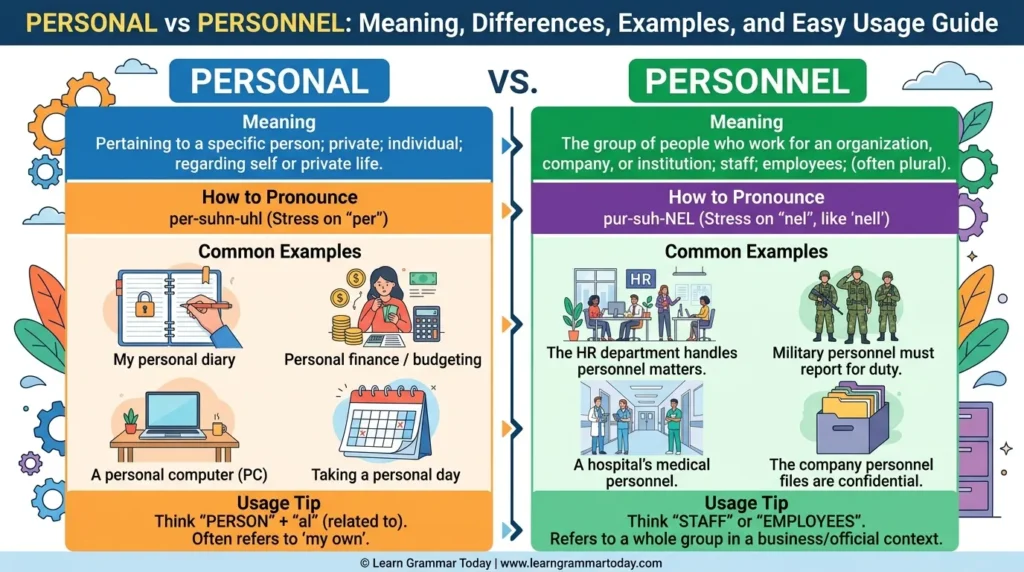
The word personal usually describes something related to an individual, such as personal information, personal belongings, or personal opinions. Personnel, on the other hand, refers to the people who work for an organization, company, military unit, or other group.
This difference is easy to understand once you connect each word with its purpose. If you are talking about one person’s private matters or individual life, you usually need personal. If you are talking about employees or staff members, you need personnel.
People often search for “personal vs personnel” because the words look and sound similar. This guide explains their meanings, origins, spelling, common mistakes, everyday uses, and simple ways to remember the difference.
Personal vs Personnel – Quick Answer
The quickest way to remember the difference is:
- Personal = related to a person or individual.
- Personnel = employees or staff members of an organization.
Personal
Personal is an adjective.
Examples:
- This is my personal opinion.
- Please keep my personal information private.
- He uses his personal phone for work.
- She has a personal reason for leaving.
Personnel
Personnel is mainly a noun referring to people employed by an organization.
Examples:
- All personnel must attend the meeting.
- The company has trained personnel on site.
- Military personnel arrived at the location.
- Only authorized personnel can enter the room.
Easy Memory Trick
Think:
Personal = person
Personnel = people at work
This simple connection can help you choose the correct word quickly.
The Origin of Personal vs Personnel
Although personal and personnel have different meanings today, they are closely related historically.
Both words come from forms of the Latin word persona, meaning a person, character, or role.
Origin of Personal
Personal entered English through French and Latin roots.
It developed the meaning of something connected with an individual person.
Over time, it came to describe things that belong to, affect, or relate to a particular person.
Examples include:
- Personal belongings
- Personal opinions
- Personal experience
- Personal space
- Personal information
Origin of Personnel
Personnel also has French roots.
The French word personnel was used to refer to people associated with an organization or group.
English adopted the term with a more specific workplace meaning.
Today, personnel commonly means the employees or staff of an organization.
Why Do They Look So Similar?
The words are related because both developed from the idea of a person.
Their similar spelling can cause confusion, but their modern grammatical roles are different.
| Word | Basic Meaning |
|---|---|
| Personal | Related to an individual |
| Personnel | Employees or staff |
British English vs American English Spelling
Unlike some English word pairs, personal vs personnel does not have a major British-American spelling difference.
Both British and American English use:
- personal
- personnel
The main difference is how often certain workplace terms may appear in different regions or industries.
Comparison Table
| Meaning | British English | American English |
|---|---|---|
| Related to an individual | Personal | Personal |
| Employees or staff | Personnel | Personnel |
| Private information | Personal information | Personal information |
| Employees in an organization | Personnel | Personnel |
The spelling remains the same in both forms of English.
Example in British English
All hospital personnel must wear identification badges.
Example in American English
All hospital personnel must wear identification badges.
The meaning and spelling are the same.
Which Spelling Should You Use?
The choice depends on what you mean, not where your audience lives.
Use Personal for Individual Matters
Use personal when describing something connected to a particular person.
Examples:
- Personal email
- Personal account
- Personal opinion
- Personal experience
- Personal goals
- Personal belongings
Example:
I prefer to keep my personal and professional life separate.
Use Personnel for Employees
Use personnel when referring to workers or staff.
Examples:
- Company personnel
- Airport personnel
- Security personnel
- Medical personnel
- Military personnel
- Emergency personnel
Example:
Only authorized personnel are allowed inside the control room.
Advice for Global Writers
If you write for an international audience, the same basic rule applies:
Personal = individual
Personnel = staff
This distinction works in American English, British English, Canadian English, Australian English, and other major English varieties.
Common Mistakes with Personal vs Personnel
Because the words look similar, they are often mixed up.
Mistake 1: Personal for Employees
Incorrect:
All personal must attend the training.
Correct:
All personnel must attend the training.
Here, the sentence means all employees must attend.
Mistake 2: Personnel for Private Information
Incorrect:
Please send your personnel information.
Correct:
Please send your personal information.
Here, the meaning is information about an individual.
Mistake 3: Personal Opinion vs Personnel Opinion
Incorrect:
This is my personnel opinion.
Correct:
This is my personal opinion.
An opinion belongs to a person, so personal is correct.
Mistake 4: Personnel Belongings
Incorrect:
Please collect your personnel belongings.
Correct:
Please collect your personal belongings.
Belongings belong to an individual, so use personal.
Mistake 5: Personal Department
Incorrect:
Contact the personal department.
Correct:
Contact the personnel department.
A personnel department deals with employees and staffing.
However, in modern workplaces, human resources department or HR department is often more common.
Personal vs Personnel in Everyday Examples
Understanding how these words appear in real writing makes the difference easier to remember.
In Emails
Personal:
I am writing to discuss a personal matter.
Personnel:
Please contact the personnel department for assistance.
In the Workplace
Personal:
Employees should protect their personal information.
Personnel:
All personnel must complete the safety training.
In News Writing
Personal:
The athlete shared his personal experience with reporters.
Personnel:
Emergency personnel responded quickly to the incident.
In Social Media
Personal:
This is my personal account.
Personnel:
The word is less common in casual social media because people usually say staff, workers, or employees.
In Formal Writing
Personal:
The applicant provided personal details on the form.
Personnel:
Authorized personnel may access the restricted area.
Personal vs Personnel Comparison Table
| Feature | Personal | Personnel |
|---|---|---|
| Part of speech | Usually adjective | Usually noun |
| Main meaning | Related to an individual | Employees or staff |
| Refers to | One person or individual matters | A group of workers |
| Common phrase | Personal information | Personnel department |
| Common phrase | Personal opinion | Security personnel |
| Common phrase | Personal belongings | Military personnel |
| Pronunciation | PUR-suh-nuhl | pur-suh-NEL |
| British spelling | Personal | Personnel |
| American spelling | Personal | Personnel |
How to Remember Personal vs Personnel
A simple memory method can prevent most mistakes.
Personal Has “Person”
The word personal looks closely connected to person.
Think:
Personal = one person
Examples:
- Personal opinion
- Personal phone
- Personal experience
- Personal information
Personnel Has “Nel”
Think of personnel as a group of people working together.
Examples:
- Company personnel
- Airport personnel
- Medical personnel
- Security personnel
You can also remember:
Personal = private or individual
Personnel = staff or workers
Personal vs Personnel – Google Trends & Usage Data
Searches for personal vs personnel occur because both words are common in professional and everyday English.
The confusion is especially likely among:
- English learners
- Job applicants
- Office workers
- Students
- Business writers
- People completing forms
- Non-native English speakers
The two words are also common in different contexts.
Personal Is More Widely Used
Personal appears in many areas of daily communication.
People commonly use phrases such as:
- Personal information
- Personal life
- Personal opinion
- Personal account
- Personal experience
- Personal reasons
Because of this broad use, personal generally appears in many more everyday contexts.
Personnel Is More Specialized
Personnel is strongly connected with organizations and employment.
Common phrases include:
- Personnel department
- Personnel records
- Military personnel
- Security personnel
- Personnel management
- Authorized personnel
The word is more common in workplace, government, military, healthcare, and formal contexts.
Country and Context
The spelling is generally consistent across English-speaking countries.
The difference is mainly meaning and context, not regional spelling.
Personal vs Personnel Examples
Here are some quick examples to make the difference clear.
| Sentence | Correct Word | Why? |
|---|---|---|
| This is my ___ opinion. | Personal | Individual opinion |
| All ___ must wear helmets. | Personnel | Workers/staff |
| Keep your ___ information safe. | Personal | Individual information |
| Security ___ checked the building. | Personnel | Security staff |
| He gave a ___ reason. | Personal | Individual reason |
| Medical ___ treated the patients. | Personnel | Medical workers |
| She opened a ___ bank account. | Personal | Belongs to an individual |
| Only authorized ___ can enter. | Personnel | Authorized workers |
When Should You Use “Personal”?
Use personal when the sentence relates to an individual person.
Common combinations include:
Personal Information
Never share sensitive personal information with unknown people.
Personal Experience
She talked about her personal experience.
Personal Opinion
That is my personal opinion.
Personal Belongings
Please take your personal belongings with you.
Personal Goals
He created personal goals for the new year.
Personal Life
She prefers not to discuss her personal life.
When Should You Use “Personnel”?
Use personnel when referring to employees, staff, or workers.
Security Personnel
Security personnel are checking visitors at the entrance.
Military Personnel
Military personnel participated in the exercise.
Medical Personnel
Medical personnel treated the injured passengers.
Airport Personnel
Airport personnel helped passengers find their gates.
Authorized Personnel
Only authorized personnel can access the control room.
Company Personnel
Company personnel received safety training.
FAQs About Personal vs Personnel
Is personal and personnel the same?
No. Personal usually means related to an individual, while personnel means employees or staff members.
What is the difference between personal and personnel?
Personal describes something connected with a person. Personnel refers to people who work for an organization.
Is it personal information or personnel information?
The correct phrase is personal information when you mean information about an individual.
Is it personal department or personnel department?
The traditional phrase is personnel department, meaning a department responsible for employees. Today, human resources department is also very common.
Is personnel singular or plural?
Personnel is generally a collective noun referring to employees or staff as a group. It can take a singular or plural verb depending on the variety of English and sentence structure.
For example:
The personnel are ready.
In American English, collective nouns can also sometimes be treated as singular depending on the intended meaning and style.
What does military personnel mean?
Military personnel means people who serve in the military.
What does personal mean?
Personal means related to a particular person, especially their private life, opinions, belongings, or experiences.
How can I easily remember personal vs personnel?
Remember:
Personal = person or individual
Personnel = employees or staff
Conclusion
The difference between personal vs personnel is simple once you focus on meaning.
Personal describes something connected to an individual. It is commonly used for private matters, opinions, experiences, belongings, information, and goals. For example, you can have a personal opinion, personal phone, or personal account.
Personnel refers to employees, workers, or staff members within an organization. You may see it in phrases such as security personnel, medical personnel, military personnel, and authorized personnel.
The two words have related historical roots, which explains why they look and sound similar. However, their modern meanings are clearly different.
There is also no major British-American spelling difference between them. Both varieties use personal and personnel in the same way.
The easiest memory trick is to think of personal as something related to one person, while personnel means people working for an organization.
Once you learn this simple distinction, you can confidently use these words in emails, job applications, business documents, academic writing, and everyday communication.