
English tenses help us show when an action happens. Did something happen yesterday? Is it happening now? Will it happen tomorrow? Tenses make the time clear.
Many students and English learners search for “English tenses” because verb forms can be confusing. Words such as work, worked, is working, has worked, and will work may describe the same basic action, but they show different times or situations. Learning the rules can make speaking and writing much easier.
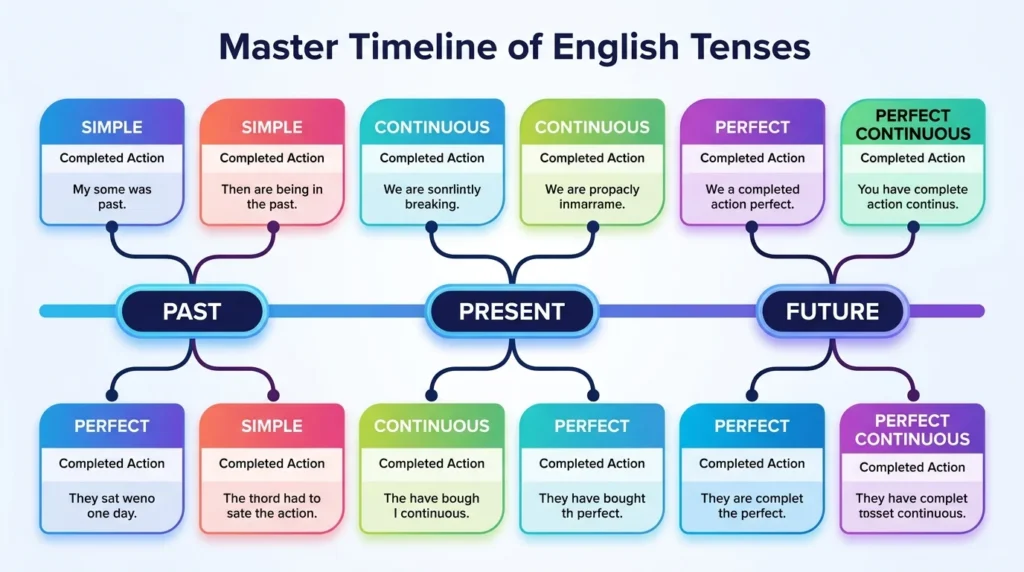
English has three main time periods: past, present, and future. These are commonly taught through 12 traditional tense forms. Each form has a different use. For example, “I work” describes a present habit, while “I worked” describes a completed past action. “I will work” describes a future action.
In this guide, you will learn the 12 English tenses, their structures, examples, common mistakes, British and American usage, everyday examples, related keywords, and practical tips. Whether you are a beginner, student, teacher, or English learner, this guide will help you understand English tenses step by step.
English Tenses – Quick Answer
English tenses are verb forms used to show the time and nature of an action or state.
English grammar is commonly taught using 12 traditional tenses.
| Time | Simple | Continuous | Perfect | Perfect Continuous |
|---|---|---|---|---|
| Present | Present Simple | Present Continuous | Present Perfect | Present Perfect Continuous |
| Past | Past Simple | Past Continuous | Past Perfect | Past Perfect Continuous |
| Future | Future Simple | Future Continuous | Future Perfect | Future Perfect Continuous |
1. Present Simple
Used for habits, facts, and regular actions.
I work every day.
She lives in Riyadh.
2. Present Continuous
Used for an action happening now or around now.
I am studying English.
She is working today.
3. Present Perfect
Used for past actions connected to the present.
I have finished my work.
She has visited London.
4. Present Perfect Continuous
Used for an action that started in the past and continues or has recently stopped.
I have been studying for two hours.
5. Past Simple
Used for completed past actions.
I visited my friend yesterday.
6. Past Continuous
Used for an action that was happening at a particular time in the past.
I was watching TV at 8 p.m.
7. Past Perfect
Used for an action completed before another past action.
She had left before I arrived.
8. Past Perfect Continuous
Used for an ongoing action that happened before another past event.
He had been working for three hours before he went home.
9. Future Simple
Used for future actions, decisions, promises, and predictions.
I will call you tomorrow.
10. Future Continuous
Used for an action that will be happening at a particular future time.
I will be working at 8 p.m.
11. Future Perfect
Used for an action that will be completed before a future time.
I will have finished the work by Friday.
12. Future Perfect Continuous
Used for an action that will continue for a period up to a future point.
By June, I will have been working here for two years.
The Origin of English Tenses
The word tense comes from the Old French tens, meaning “time.” It comes from the Latin tempus, also meaning “time.”
The grammatical idea of tense developed from the need to show when an action or event happens.
English has changed greatly over time. Old English had a different verb system from modern English. Modern English has relatively few verb endings compared with many other languages. Instead, it often uses helping verbs and combinations of verbs to express different meanings.
For example:
I work.
I am working.
I have worked.
I will work.
The main verb work stays recognizable, while helping verbs and verb forms change the meaning.
The phrase English tenses is used around the world to describe these grammatical patterns.
There is no British or American spelling difference in the term English tenses.
British English vs American English Spelling
The spelling of English tenses is the same in British and American English.
| Feature | British English | American English |
|---|---|---|
| English | English | English |
| Singular | tense | tense |
| Plural | tenses | tenses |
| Phrase | English tenses | English tenses |
| Spelling difference | None | None |
The word tense does not change spelling between the two varieties.
Tense vs Tenses
Use tense when referring to one grammatical form or category.
The present simple is a verb tense.
Use tenses when referring to several forms.
Students learn English tenses.
Common Spelling Mistakes
Correct:
✅ tense
✅ tenses
Incorrect:
❌ tens
❌ tences
❌ tenseses
The word tens is different. It usually refers to numbers such as 10, 20, 30, and 40.
Which Spelling Should You Use?
There is no British-versus-American spelling choice for English tenses.
Use:
English tenses
in both British and American English.
For US English
Use the standard spelling in:
- school work
- grammar lessons
- academic writing
- websites
- emails
- professional communication
For UK and Commonwealth English
Use the same spelling:
English tenses
British English does not use a different spelling for tense or tenses.
For Global English
English tenses is the standard phrase for international English learners.
Although British and American English sometimes differ in vocabulary and grammar usage, the spelling of tense remains the same.
Common Mistakes with English Tenses
English learners often make mistakes when choosing verb forms. Here are some common problems.
Mistake 1: Using the Present Simple for an Action Happening Now
❌ I work now.
If you mean the action is happening at this moment, use the present continuous:
✅ I am working now.
However, I work can be correct when talking about your job or routine.
Mistake 2: Using the Past Simple With “Since”
❌ I worked here since 2022.
Better:
✅ I have worked here since 2022.
Or:
✅ I have been working here since 2022.
Mistake 3: Using the Wrong Past Form
❌ She go to work yesterday.
✅ She went to work yesterday.
The past simple of go is went.
Mistake 4: Forgetting “-s” in the Present Simple
❌ He work every day.
✅ He works every day.
With he, she, and it, most present simple verbs take -s or -es.
Mistake 5: Using “Did” With a Past Verb
❌ Did you went there?
✅ Did you go there?
After did, use the base form of the verb.
Mistake 6: Confusing “Will” and “Going To”
Both can refer to the future, but their uses can differ.
I will call you later.
I am going to visit my family this weekend.
The exact choice depends on the meaning and context.
Mistake 7: Mixing Tenses Without a Reason
❌ Yesterday, I go to work and finished my project.
Better:
✅ Yesterday, I went to work and finished my project.
Keep the tense consistent when the actions happen in the same time period.
English Tenses in Everyday Examples
Tenses are used in almost every type of communication.
In Emails
Present Simple:
I work in the maintenance department.
Present Continuous:
I am writing to ask about the position.
Past Simple:
I sent the documents yesterday.
Present Perfect:
I have attached my CV.
Future Simple:
I will contact you next week.
Using the correct tense helps make professional emails clear.
In News
News writing often uses the past simple for completed events:
The company announced a new policy yesterday.
The present simple can also appear in headlines:
Company announces new investment plan.
The present perfect is often used for recent events connected to the present:
The government has announced new measures.
In Social Media
I am watching the game now.
We visited Dubai last weekend.
I have just finished my project.
I will share the photos tomorrow.
Short posts often use simple and continuous tenses.
In Formal Writing
The researchers conducted the study in 2025.
The results show a clear increase.
The company has introduced a new system.
Correct tense use makes formal writing easier to understand.
12 English Tenses With Structures and Examples
| Tense | Basic Structure | Example |
|---|---|---|
| Present Simple | Subject + base verb | She works here. |
| Present Continuous | Subject + am/is/are + verb-ing | She is working. |
| Present Perfect | Subject + has/have + past participle | She has worked here. |
| Present Perfect Continuous | Subject + has/have been + verb-ing | She has been working. |
| Past Simple | Subject + past verb | She worked yesterday. |
| Past Continuous | Subject + was/were + verb-ing | She was working. |
| Past Perfect | Subject + had + past participle | She had worked. |
| Past Perfect Continuous | Subject + had been + verb-ing | She had been working. |
| Future Simple | Subject + will + base verb | She will work. |
| Future Continuous | Subject + will be + verb-ing | She will be working. |
| Future Perfect | Subject + will have + past participle | She will have worked. |
| Future Perfect Continuous | Subject + will have been + verb-ing | She will have been working. |
English Tenses – When to Use Each Tense
Present Simple
Use it for:
- habits
- routines
- facts
- permanent situations
I drink coffee every morning.
Present Continuous
Use it for:
- actions happening now
- temporary situations
- changing situations
She is learning English.
Present Perfect
Use it for:
- past actions connected to the present
- life experiences
- recent events
I have visited Spain twice.
Present Perfect Continuous
Use it for:
- actions continuing from the past
- duration
I have been studying for three hours.
Past Simple
Use it for:
- completed past actions
- events at a definite past time
We visited the museum yesterday.
Past Continuous
Use it for:
- actions in progress in the past
- background actions
I was sleeping when you called.
Past Perfect
Use it for:
- an earlier past action before another past action
The train had left before we arrived.
Past Perfect Continuous
Use it for:
- duration before a past event
She had been waiting for an hour before the bus arrived.
Future Simple
Use it for:
- predictions
- promises
- spontaneous decisions
- future actions
I will help you.
Future Continuous
Use it for:
- actions in progress at a future time
This time tomorrow, I will be flying home.
Future Perfect
Use it for:
- actions completed before a future deadline
By Monday, I will have finished the report.
Future Perfect Continuous
Use it for:
- duration continuing up to a future point
By next year, I will have been working here for five years.
English Tenses Comparison Table
| Tense | Time | Main Use | Example |
|---|---|---|---|
| Present Simple | Present | Habit or fact | I work every day. |
| Present Continuous | Present | Happening now | I am working now. |
| Present Perfect | Past + present | Past action with present connection | I have finished. |
| Present Perfect Continuous | Past + present | Ongoing duration | I have been working. |
| Past Simple | Past | Completed action | I worked yesterday. |
| Past Continuous | Past | Action in progress | I was working. |
| Past Perfect | Past before past | Earlier past action | I had worked. |
| Past Perfect Continuous | Past before past | Earlier duration | I had been working. |
| Future Simple | Future | Future action or prediction | I will work. |
| Future Continuous | Future | Action in progress | I will be working. |
| Future Perfect | Future | Completed before future point | I will have worked. |
| Future Perfect Continuous | Future | Duration until future point | I will have been working. |
English Tenses – Google Trends & Usage Data
The keyword “English tenses” has strong educational search intent. Students, English learners, teachers, exam candidates, and writers often search for this topic when they need help understanding verb forms.
Related searches include:
- English tenses
- English tenses rules
- English tenses examples
- 12 English tenses
- English tense chart
- English tenses formula
- English tenses exercises
- present tense
- past tense
- future tense
- tenses in English grammar
The topic is evergreen, so it remains useful throughout the year. Search interest can increase during school terms, examination periods, homework seasons, and English-language courses.
Interest can vary by country and context. Countries with large English-learning populations may have strong demand for grammar topics. Searchers may also use different terms based on their education level and language background.
Google Trends does not provide one fixed global monthly search volume for “English tenses.” Interest changes according to the selected country, time period, search type, and comparison keywords. Therefore, SEO content should not claim a permanent worldwide search volume without specifying the exact data source and settings.
For SEO, English tenses has clear informational intent. A strong page should provide a quick definition, explain the 12 traditional tense forms, show structures and examples, and answer common learner questions.
English Tenses – Keyword Variations Side by Side
| Keyword Variation | Search Intent | Example |
|---|---|---|
| English tenses | General learning | Learn English tenses. |
| English tenses rules | Learn grammar rules | Study English tenses rules. |
| English tenses examples | Find examples | Read English tenses examples. |
| 12 English tenses | Learn all traditional forms | Study the 12 English tenses. |
| English tense chart | Find a quick reference | Use an English tense chart. |
| English tenses formula | Learn structures | Study each tense formula. |
| English tenses exercises | Practice grammar | Complete English tenses exercises. |
| tenses in English grammar | General grammar learning | Learn tenses in English grammar. |
| present tense | Learn present forms | Study the present tense. |
| past tense | Learn past forms | Study the past tense. |
| future tense | Learn future forms | Study the future tense. |
FAQs About English Tenses
1. What are English tenses?
English tenses are verb forms used to show when an action or state happens and, in many cases, how it relates to another time or event.
2. How many tenses are there in English?
English grammar is commonly taught using 12 traditional tense forms: four present, four past, and four future forms.
3. What are the three main tenses?
The three main time categories are:
- Present
- Past
- Future
These are commonly divided into simple, continuous, perfect, and perfect continuous forms.
4. What is the easiest English tense to learn?
For many beginners, the present simple is a good starting point because it is used for basic facts, habits, routines, and regular actions.
Example:
I work every day.
5. What is the difference between present simple and present continuous?
The present simple commonly describes habits and facts.
I work every day.
The present continuous commonly describes an action happening now or around the present time.
I am working now.
6. What is the difference between past simple and present perfect?
The past simple normally describes a completed past event, often with a definite past time.
I visited London last year.
The present perfect connects a past action or experience with the present.
I have visited London.
7. Which tense should I use for the future?
The correct form depends on your meaning. Will, be going to, and present forms such as the present continuous can all refer to future events in different situations.
Examples:
I will call you later.
I am going to start a new course.
I am meeting my friend tomorrow.
Conclusion
English tenses are essential for clear communication because they help us show when actions and events happen. The system may look difficult at first, but it becomes easier when you learn each form step by step. English grammar is commonly taught through 12 traditional tense forms, divided into present, past, and future categories.
The four common forms in each time group are simple, continuous, perfect, and perfect continuous. Each has a different purpose. For example, the present simple is useful for habits and facts, while the present continuous describes actions happening now. The past simple describes completed past actions, and the future simple can describe future actions, predictions, or promises.
One of the best ways to learn English tenses is to study the structure, purpose, signal words, and examples for each form. Then practice by creating your own sentences.
Do not worry about learning all 12 forms at once. Start with the present simple, present continuous, past simple, and future simple. Once these are clear, move to the perfect and perfect continuous forms.
There is no British or American spelling difference in English tenses. The phrase is spelled the same in both varieties of English.