
Imagine you are installing a new electrical control panel in a factory. Hundreds of wires from sensors, motors, switches, and power supplies need to be connected safely and neatly. If every wire were joined using tape or twisted together, troubleshooting and maintenance would become extremely difficult. This is where a Terminal Block becomes one of the most important components in an electrical system.
A Terminal Block provides a safe, secure, and organized method of connecting multiple electrical wires. It simplifies wiring, improves electrical safety, reduces maintenance time, and makes future modifications much easier. Whether you are working on a residential distribution board, an industrial control panel, a PLC automation system, or renewable energy equipment, terminal blocks play a vital role in ensuring reliable electrical connections.
For electrical students, engineers, technicians, and beginners, understanding the Terminal Block working principle, types, components, applications, and selection process is essential. In this complete guide, you will learn how terminal blocks work, where they are used, their advantages and disadvantages, common troubleshooting methods, and the latest developments in modern electrical connection technology. By the end of this article, you will have a solid understanding of why terminal blocks are considered the backbone of organized electrical wiring systems.
What is a Terminal Block?
A Terminal Block is an electrical connector used to securely join two or more electrical wires without soldering. It provides a safe, reusable, and organized connection point for electrical circuits, making installation, maintenance, and troubleshooting much easier.
In simple words, a terminal block acts like a meeting point where electrical wires are connected safely while allowing electricity to flow from one wire to another.
Unlike twisted wire connections or permanent solder joints, terminal blocks allow wires to be disconnected and reconnected quickly whenever repairs or modifications are required.
Simple Practical Example
Imagine a railway station where passengers from different trains meet before continuing their journey.
Similarly:
- Incoming wire brings electrical power.
- Terminal block acts as the station.
- Outgoing wire carries power to another device.
The terminal block keeps every connection secure, organized, and easy to identify.
Because of this, terminal blocks are widely used in:
- Electrical Control Panels
- Distribution Boards
- PLC Panels
- Industrial Machines
- Solar Power Systems
- HVAC Equipment
- Motor Control Centers (MCC)
- Building Automation Systems
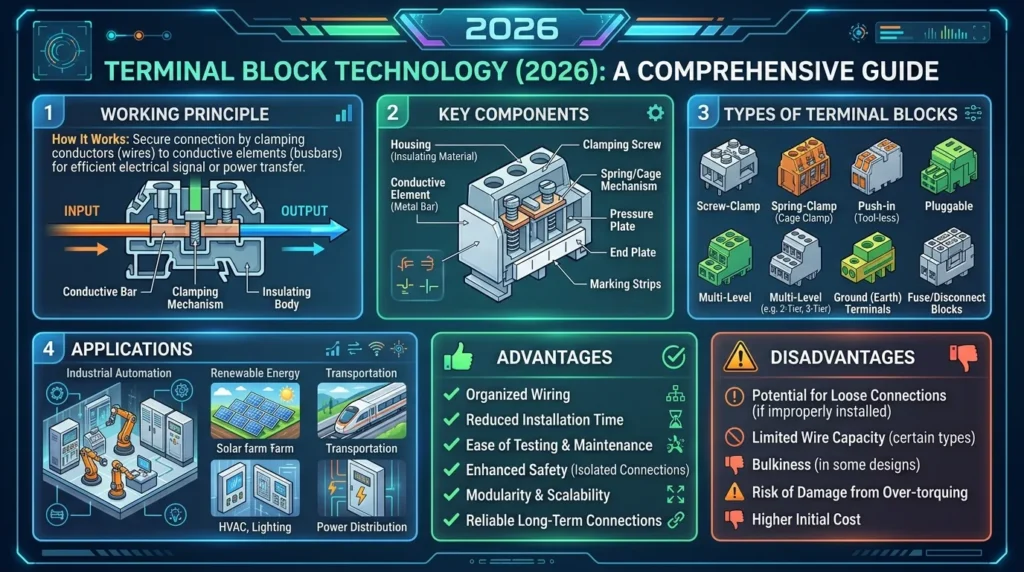
Terminal Block Working Principle
The Terminal Block working principle is simple. It provides a low-resistance electrical path between conductors while mechanically securing the wires.
Instead of twisting wires together, the terminal block uses a clamping mechanism that tightly holds the conductors.
Step-by-Step Working Principle
Step 1: Wire Preparation
The insulation at the end of the wire is removed using a wire stripper.
Only the required conductor length should be exposed.
Step 2: Wire Insertion
The stripped wire is inserted into the terminal block connection point.
Depending on the design, the wire may enter through:
- Screw terminal
- Spring clamp
- Push-in connector
- Barrier terminal
Step 3: Clamping the Wire
The terminal block securely clamps the conductor.
Depending on the terminal type:
- Screw terminals tighten the wire with a screw.
- Spring terminals use spring pressure.
- Push-in terminals automatically grip the conductor.
This creates a firm mechanical connection.
Step 4: Electrical Contact
Once clamped, the metal conductor inside the terminal block creates direct contact with the wire.
Electric current now flows through:
Battery → Wire → Terminal Block → Output Wire → Electrical Device
Because the contact resistance is very low, very little energy is lost as heat.
Step 5: Power Distribution
The electrical current continues flowing safely toward:
- Motors
- Switches
- PLC Inputs
- Sensors
- Lighting Circuits
- Control Devices
Step 6: Easy Maintenance
Whenever maintenance is required, technicians simply loosen the terminal connection without cutting the wire.
This makes repairs faster and safer.
Simple Analogy
Think of a terminal block as a bridge connecting two roads.
- One road brings traffic.
- The bridge safely connects both roads.
- Vehicles continue without interruption.
Similarly, the terminal block safely connects two electrical wires while allowing current to flow continuously.
Types of Terminal Blocks
Different electrical applications require different terminal block designs. Choosing the correct type improves safety, reliability, and maintenance.
Screw Terminal Block
The Screw Terminal Block is the most commonly used terminal block in electrical panels.
It uses a screw to press the conductor firmly against the metal contact.
Features
- Strong mechanical connection
- High current capacity
- Easy installation
- Excellent reliability
- Suitable for industrial environments
Applications
- Electrical Control Panels
- Distribution Boards
- Power Distribution Panels
- Industrial Machines
Spring Clamp Terminal Block
A Spring Clamp Terminal Block uses spring pressure instead of screws.
The spring automatically applies constant pressure to the conductor.
Features
- Vibration-resistant
- Fast installation
- Maintenance-free
- Reliable electrical contact
- Reduced loose connections
Applications
- Railway Systems
- Industrial Automation
- PLC Panels
- High-vibration equipment
Push-In Terminal Block
Push-in terminal blocks allow the wire to be inserted directly without tightening screws.
Features
- Very quick wiring
- Compact design
- Easy maintenance
- High reliability
- Saves installation time
Applications
- Building Automation
- PLC Control Panels
- Smart Electrical Systems
- Factory Automation
Barrier Terminal Block
Barrier terminal blocks include insulating barriers between terminals.
These barriers improve electrical safety.
Features
- Better insulation
- High-voltage capability
- Prevents accidental short circuits
- Rugged construction
Applications
- Industrial Power Panels
- Generator Control Panels
- Marine Electrical Systems
- Heavy Machinery
DIN Rail Terminal Block
DIN Rail Terminal Blocks are mounted on standardized DIN rails inside electrical panels.
They are the most common choice in modern industrial control systems.
Features
- Easy installation
- Modular design
- Space-saving
- Organized wiring
- Easy expansion
Applications
- PLC Panels
- Motor Control Centers
- Automation Panels
- Distribution Panels
Fuse Terminal Block
A Fuse Terminal Block combines a fuse holder and wire connection into one device.
Features
- Provides circuit protection
- Simplifies maintenance
- Saves panel space
- Easy fuse replacement
Applications
- Control Circuits
- Low-Voltage Panels
- Industrial Machines
- Instrumentation Systems
Ground (Earth) Terminal Block
Ground terminal blocks are specially designed for protective earthing connections.
Features
- Connects protective earth wires
- Improves electrical safety
- Prevents electric shock
- Easy identification using green-yellow color
Applications
- Electrical Panels
- Switchgear
- Distribution Boards
- Industrial Equipment
Double-Level Terminal Block
These terminal blocks have two connection levels stacked vertically.
Features
- Saves panel space
- Higher wiring density
- Organized cable management
- Ideal for compact panels
Applications
- PLC Cabinets
- Automation Panels
- Compact Electrical Cabinets
- Industrial Control Systems
Multi-Level Terminal Block
Multi-level terminal blocks provide three or more wiring levels.
Features
- Maximum space utilization
- Reduces cabinet size
- Organized wiring
- Supports complex control circuits
Applications
- Process Industries
- Automation Systems
- Large PLC Panels
- Industrial Instrumentation
High-Current Terminal Block
These terminal blocks are designed for heavy electrical loads.
Features
- Large conductor size
- High current rating
- Low heat generation
- Heavy-duty construction
Applications
- Power Distribution Panels
- Transformer Connections
- Motor Feeders
- Generator Systems
PCB Terminal Block
PCB (Printed Circuit Board) terminal blocks are mounted directly onto electronic circuit boards.
Features
- Compact size
- Secure PCB connections
- Easy replacement
- Low-voltage operation
Applications
- Electronic Equipment
- Power Supplies
- Control Boards
- Industrial Electronics
Main Components of a Terminal Block
Every terminal block consists of several parts that work together to provide a secure, reliable, and low-resistance electrical connection. Understanding these components helps students and technicians troubleshoot wiring issues and choose the right terminal block for different applications.
1. Insulating Housing
The housing is the outer body of the terminal block, usually made from high-quality flame-retardant plastic such as polyamide (PA66).
Function
- Protects users from electric shock
- Holds all internal parts securely
- Resists heat, chemicals, and mechanical impact
- Prevents accidental short circuits
2. Current-Carrying Metal Conductor
Inside every terminal block is a metal conductor made of copper, brass, or tinned copper.
Function
- Carries electrical current between connected wires
- Provides low electrical resistance
- Minimizes voltage drop and heat generation
- Ensures reliable electrical conductivity
3. Clamping Mechanism
The clamping mechanism secures the wire inside the terminal block.
Depending on the design, it may use:
- Screw clamp
- Spring clamp
- Push-in clamp
- Cage clamp
Function
- Holds wires firmly
- Prevents loose connections
- Maintains constant electrical contact
- Reduces vibration-related failures
4. Terminal Screw (For Screw-Type Terminal Blocks)
Screw-type terminal blocks use steel or stainless-steel screws to tighten the conductor.
Function
- Locks the wire securely
- Allows easy installation and removal
- Provides adjustable clamping pressure
5. Wire Entry Port
This is the opening where the conductor is inserted.
Function
- Guides the wire into position
- Prevents incorrect insertion
- Supports different wire sizes
6. DIN Rail Mount (Optional)
Most industrial terminal blocks are designed for DIN rail mounting.
Function
- Enables quick installation
- Makes wiring more organized
- Allows easy replacement or expansion
7. End Plates and End Stops
These accessories are installed at the ends of terminal block rows.
Function
- Prevent movement along the DIN rail
- Improve insulation
- Keep the assembly secure
8. Jumper Bars (Bridging Connectors)
Jumper bars electrically connect multiple terminal blocks.
Function
- Distribute power to several terminals
- Reduce wiring time
- Simplify electrical panel design
Advantages of a Terminal Block
Understanding the Terminal Block advantages and disadvantages helps engineers choose the right wiring solution for electrical systems.
Advantages
- Provides secure and reliable electrical connections.
- Simplifies electrical panel wiring.
- Makes maintenance and troubleshooting easier.
- Eliminates the need for wire twisting or soldering.
- Reduces installation time.
- Supports quick wire replacement.
- Improves electrical safety.
- Offers excellent vibration resistance (spring clamp models).
- Supports organized cable management.
- Compatible with residential, commercial, and industrial systems.
- Available for both low-voltage and high-voltage applications.
- Long service life with minimal maintenance.
Real-World Benefits
- Faster electrical installations
- Reduced downtime during repairs
- Cleaner control panel layouts
- Improved technician safety
- Lower maintenance costs
- Easier future system expansion
Disadvantages / Limitations
Although terminal blocks are highly reliable, they have a few practical limitations.
Disadvantages
- Screw terminals may loosen over time due to vibration.
- Low-quality terminal blocks can overheat under heavy loads.
- Incorrect wire size may lead to poor electrical contact.
- Higher initial cost than simple wire joints.
- Periodic inspection is recommended for screw-type terminals.
- Moisture can affect unsealed terminal blocks.
- Incorrect tightening torque may damage the conductor.
Proper installation and regular maintenance significantly reduce these issues.
Terminal Block Applications
The Terminal Block applications are found in almost every electrical and electronic system because they provide safe, organized, and reusable wire connections.
Residential Electrical Systems
Terminal blocks are used in:
- Distribution Boards
- Consumer Units
- Lighting Circuits
- Smart Home Systems
Industrial Control Panels
Industrial control panels use terminal blocks for connecting:
- PLC Inputs and Outputs
- Contactors
- Relays
- Sensors
- Push Buttons
- Indicator Lamps
Power Distribution Panels
Power distribution systems use terminal blocks to organize incoming and outgoing electrical circuits.
Motor Control Centers (MCC)
Terminal blocks simplify wiring for:
- Electric Motors
- Star-Delta Starters
- DOL Starters
- Soft Starters
- Variable Frequency Drives (VFDs)
Renewable Energy Systems
Modern renewable energy installations use terminal blocks in:
- Solar PV Systems
- Wind Turbines
- Battery Storage Systems
- Hybrid Power Systems
HVAC Systems
Heating, ventilation, and air conditioning equipment relies on terminal blocks for sensor and controller wiring.
Railway and Transportation
Spring clamp terminal blocks are widely used because they resist vibration.
Telecommunications
Used for:
- Signal Distribution
- Communication Equipment
- Data Centers
- Network Cabinets
Building Automation
Terminal blocks connect:
- Fire Alarm Systems
- Security Systems
- Building Management Systems (BMS)
- Smart Lighting Controls
Difference Between Terminal Block and Electrical Connector
Many beginners confuse terminal blocks with electrical connectors. Both connect wires, but their applications are different.
| Feature | Terminal Block | Electrical Connector |
|---|---|---|
| Primary Purpose | Permanent or semi-permanent wire connection | Quick connection and disconnection |
| Installation | Fixed inside panels | Portable equipment |
| Wire Connection | Screw, spring, or push-in | Plug and socket |
| Maintenance | Easy wiring modifications | Easy device replacement |
| Current Capacity | Medium to high | Low to high (varies by type) |
| Common Applications | Control panels, distribution boards, PLC panels | Consumer electronics, appliances, automotive systems |
The difference between Terminal Block and Electrical Connector is that a terminal block is designed for organized panel wiring, while connectors are intended for quick plug-and-play connections.
Selection Guide
Choosing the right Terminal Block improves system reliability and safety.
1. Current Rating
Select a terminal block that can safely carry the expected electrical current.
2. Voltage Rating
Always choose a voltage rating equal to or higher than the operating voltage.
3. Wire Size
Check the supported conductor size before installation.
4. Connection Type
Choose according to the application:
- Screw Terminal
- Spring Clamp
- Push-In
- Barrier Terminal
5. Mounting Method
For industrial panels, DIN rail-mounted terminal blocks are the preferred option.
6. Environmental Conditions
Consider:
- Temperature
- Moisture
- Dust
- Chemicals
- Vibration
Choose IP-rated or sealed models where necessary.
7. Safety Certifications
Use products certified by recognized standards such as:
- IEC
- UL
- CE
- CSA
8. Future Expansion
Leave spare terminal positions for future wiring modifications.
Common Problems & Solutions (FAQs)
Why is my terminal block overheating?
Possible Causes
- Loose screw connection
- Overloaded circuit
- Incorrect wire size
- Poor-quality terminal block
Solution
Tighten connections, verify the current rating, and replace damaged components if needed.
Why is there intermittent power?
Possible Causes
- Loose conductor
- Corrosion
- Broken wire
Solution
Inspect all connections and replace any damaged wires or terminals.
Can terminal blocks be reused?
Yes. Most terminal blocks are designed for repeated installation and maintenance, provided they are not physically damaged.
Which is better: screw terminal or spring clamp?
- Screw terminals are ideal for high-current applications.
- Spring clamp terminals are better for vibration-prone environments and require less maintenance.
How often should terminal blocks be inspected?
For industrial systems, inspect them during scheduled maintenance. Check for loose connections, discoloration, corrosion, and signs of overheating.
Future Trends of Terminal Blocks (2026)
As electrical systems become smarter and more connected, Terminal Blocks (2026) are evolving to support modern automation and energy-efficient technologies.
Smart Terminal Blocks
Advanced models include diagnostic features that help detect wiring faults and improve maintenance.
Push-In Connection Technology
Push-in terminal blocks continue to replace traditional screw terminals due to faster installation and improved reliability.
Compact High-Density Designs
Manufacturers are producing smaller terminal blocks that save valuable panel space while maintaining high performance.
IoT and Industry 4.0 Integration
Modern terminal blocks are increasingly used in smart factories, supporting connected devices, remote monitoring, and intelligent automation systems.
Improved Materials
New flame-retardant plastics and corrosion-resistant conductors increase durability, safety, and service life.
Sustainable Manufacturing
Eco-friendly materials and recyclable designs are becoming more common, supporting green engineering initiatives.
Conclusion
A Terminal Block is a simple yet essential component in every modern electrical installation. It provides a safe, organized, and reliable way to connect electrical wires while simplifying installation, maintenance, and troubleshooting. By understanding the Terminal Block working principle, different types, components, applications, and advantages and disadvantages, students and professionals can design safer and more efficient electrical systems. Whether used in residential wiring, industrial control panels, PLC automation, renewable energy systems, or power distribution networks, terminal blocks improve reliability, reduce downtime, and enhance safety. As automation, smart manufacturing, and Industry 4.0 continue to grow, modern terminal blocks will become even more advanced, making them an indispensable part of future electrical and automation technologies.