
Imagine you are repairing an electric crane in a workshop. The operator tells you that the motor must lift heavy loads smoothly and provide strong starting torque. In another situation, you are working on a small electric toy car that needs steady speed control.
Both machines use DC motors — but not the same type.
This is why understanding the Types of DC Motor is very important. Different DC motors are designed for different tasks. Some provide high starting torque, some give constant speed, and others are compact for small electronic devices.
As an electrical student or technician, choosing the wrong motor type can cause overheating, poor performance, or mechanical failure. Knowing the correct motor type improves efficiency, safety, and reliability.
In this article, you will learn the Types of DC Motor, DC motor working principle, classifications, components, applications, advantages and disadvantages, comparison between types, selection guide, and troubleshooting tips. I will explain everything clearly, just like a senior engineer guiding a junior in practical field work.
2. What is Types of DC Motor?
The term Types of DC Motor refers to the different classifications of direct current (DC) motors based on how their field windings are connected.
Simple Definition
A DC motor is an electrical machine that converts direct current electrical energy into mechanical energy.
DC motors are classified mainly according to how the field winding is connected with the armature winding.
Simple Explanation
When DC supply is applied, the motor produces rotation. But the way we connect the field coil changes torque, speed, and performance.
Practical Example
- A crane uses a DC series motor for high starting torque.
- A lathe machine may use a DC shunt motor for constant speed.
- Modern battery-operated devices often use permanent magnet DC motors.
Each type has its own purpose.
3. DC Motor Working Principle
The DC motor working principle is based on the principle that a current-carrying conductor placed in a magnetic field experiences a force.
This is known as Fleming’s Left-Hand Rule.
Step-by-Step Working
- DC supply is given to the motor.
- Current flows through the armature winding.
- Magnetic field is produced by field winding or magnets.
- Interaction between magnetic field and armature current produces force.
- Force creates torque.
- The rotor starts rotating.
Easy Analogy
Think of pushing a rotating door.
- Your hand is like electric current.
- The door frame is like magnetic field.
- When both interact, the door rotates.
In the same way, electric current and magnetic field interact to produce motion.
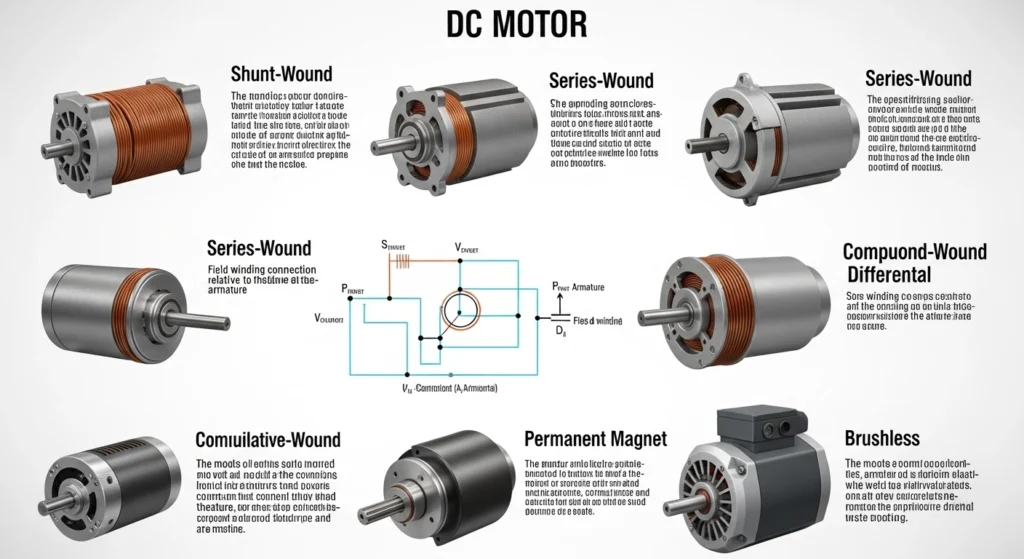
4.What Are the 4 Types of DC Motors?
The four main types of DC motors are:
- DC Series Motor
- DC Shunt Motor
- Compound DC Motor
- Permanent Magnet DC Motor (PMDC)
These motors differ mainly in how their field winding or permanent magnets are arranged to produce the magnetic field.
DC Series Motor: Working Principle and Applications
A DC Series Motor is a type of direct current motor in which the field winding is connected in series with the armature winding. Because of this connection, the same current flows through both the field winding and the armature. As the load increases, the armature current increases, which also strengthens the magnetic field and allows the motor to produce very high torque.
DC series motors are mainly used in applications that require high starting torque, such as electric traction, cranes, hoists, elevators, and heavy-duty industrial equipment. However, they have an important limitation: a DC series motor should never be operated without a mechanical load, because its speed can rise to a dangerously high level.
What Is a DC Series Motor?
In a DC series motor, the series field winding is connected in series with the armature. Therefore, the same current passes through the field winding and armature circuit.
The field winding is designed to carry the full armature current and is generally made with relatively few turns of thick wire. When a high current flows through the winding, it produces a strong magnetic field.
This strong magnetic field interacts with the current-carrying armature conductors and produces electromagnetic torque. Because the field strength increases with armature current, the motor can develop very high torque during starting and heavy-load conditions.
Working Principle of DC Series Motor
The working principle of a DC series motor is based on the principle that a current-carrying conductor placed in a magnetic field experiences a mechanical force.
The operation can be explained in the following steps:
- DC Supply Is Applied: When a DC supply is connected, current flows through the series field winding and armature.
- Magnetic Field Is Produced: The current flowing through the series field winding creates a magnetic field.
- Armature Current Flows: The same current passes through the armature conductors.
- Force Is Produced: The interaction between the armature current and magnetic field produces a mechanical force.
- Torque Is Developed: The forces acting on the armature conductors combine to produce electromagnetic torque.
- Armature Rotates: The produced torque rotates the armature and shaft.
- Continuous Rotation: The brushes and commutator maintain the required current direction in the armature, allowing continuous rotation.
Because the field winding is in series with the armature, the motor develops very high torque when the starting current is high.
Speed Characteristics of DC Series Motor
A major characteristic of a DC series motor is that its speed changes significantly with load.
When the load increases, the motor draws more current. This increases the magnetic field and produces more torque, while the motor speed generally decreases.
When the load decreases, the armature current and field strength decrease. The motor speed can then rise significantly.
At no load, the field produced by the series winding becomes relatively weak, and the motor may accelerate to an extremely high speed. This can cause serious mechanical damage.
Therefore, a DC series motor must not be operated at no load.
Construction of DC Series Motor
A DC series motor contains the following major components:
- Series Field Winding: Connected in series with the armature and carries the full motor current.
- Armature: The rotating component that carries the armature winding and produces torque.
- Commutator: Reverses the current direction in the armature conductors at the appropriate time.
- Brushes: Transfer current between the stationary electrical circuit and rotating commutator.
- Shaft: Transfers mechanical power from the motor to the connected load.
- Yoke/Frame: Provides mechanical support and forms part of the magnetic circuit.
- Bearings: Support the shaft and allow smooth rotation.
Key Features of DC Series Motor
- Very high starting torque
- Field winding connected in series with armature
- Same current flows through field and armature
- Speed varies significantly with load
- Suitable for heavy-load starting
- Strong torque at low speeds
- Cannot safely operate at no load
- Requires brush and commutator maintenance
Advantages of DC Series Motor
1. Very High Starting Torque
The most important advantage of a DC series motor is its extremely high starting torque. This allows it to start and move heavy loads effectively.
2. Suitable for Heavy Loads
It performs well in applications where a large amount of torque is required during starting and acceleration.
3. Simple Construction
Its basic construction and series field arrangement make it relatively straightforward to operate and control.
4. Good Acceleration
The motor can provide strong acceleration, making it useful in electric traction and lifting equipment.
5. Suitable for Traction Applications
Its high starting torque makes it particularly useful for moving heavy vehicles and equipment from rest.
Disadvantages of DC Series Motor
Despite its high starting torque, a DC series motor has several limitations:
- Speed varies widely with load.
- It must not be operated without load.
- No-load operation can cause dangerous overspeed.
- Speed regulation is poor compared with a DC shunt motor.
- Brushes and commutator require regular maintenance.
- Sparking and brush wear may occur during operation.
- It is not suitable for applications requiring constant speed.
Applications of DC Series Motor
DC series motors are used where very high starting torque is required.
1. Electric Traction
They have historically been widely used in electric railway and traction systems because they can provide high torque when starting heavy vehicles.
2. Cranes
Cranes require high torque to lift heavy loads from rest, making series motors suitable for lifting mechanisms.
3. Hoists
Hoists use high starting torque to raise and lower heavy materials.
4. Elevators
DC series motors have been used in elevator systems where strong starting and acceleration torque is required.
5. Winches
Winches require high torque to pull or lift heavy loads, making the high starting torque of series motors useful.
6. Heavy Industrial Machines
Some heavy-duty equipment uses series-type motor characteristics where high starting torque is more important than constant speed.
Where Is a DC Series Motor Used?
Typical applications include:
- Electric traction
- Cranes
- Hoists
- Elevators
- Winches
- Heavy-duty lifting equipment
- Industrial drives requiring high starting torque
- Certain older electric vehicle and railway systems
DC Series Motor vs DC Shunt Motor
The main difference is the connection of the field winding.
In a DC series motor, the field winding is connected in series with the armature, so the same current flows through both. This gives the motor very high starting torque but poor speed regulation.
In a DC shunt motor, the field winding is connected in parallel with the armature. Its magnetic field remains relatively constant, giving the motor nearly constant speed but lower starting torque than a series motor.
Important Safety Consideration
A DC series motor should never be operated without a mechanical load. At no load, the armature current becomes low, reducing the magnetic field produced by the series winding. The motor may then accelerate to an excessively high speed, which can damage the armature, bearings, or other mechanical components.
For this reason, proper load conditions and suitable speed-control methods are essential when operating a DC series motor.
Overall Summary
A DC Series Motor is a powerful DC motor designed primarily for applications requiring very high starting torque. Its series-connected field winding produces a strong magnetic field when the motor draws high current, allowing it to start heavy loads effectively.
Its major limitation is its variable speed and dangerous no-load behavior. Therefore, it is not suitable for constant-speed applications. Nevertheless, its excellent starting performance makes it valuable in electric traction, cranes, hoists, elevators, winches, and heavy-duty lifting systems.
DC Shunt Motor: Working Principle and Applications
A DC Shunt Motor is a type of direct current motor in which the field winding is connected in parallel with the armature winding. Because the field winding and armature are connected across the same DC supply, the field current remains relatively constant during normal operation. This produces a nearly constant magnetic field and allows the motor to maintain a fairly stable speed.
DC shunt motors are widely used in applications where constant speed, smooth operation, and good speed regulation are important. Common applications include lathes, fans, pumps, conveyors, machine tools, and various industrial drives.
What Is a DC Shunt Motor?
In a DC shunt motor, the field winding is connected in parallel (shunt) with the armature winding. Both circuits receive the same supply voltage, but the current flowing through the field winding and armature winding is different.
The shunt field winding is designed with relatively high resistance, so it draws a comparatively small current. This current produces the magnetic field required for motor operation.
Because the field winding is connected directly across the supply, the magnetic field remains approximately constant. As a result, the motor can maintain a nearly constant speed even when the mechanical load changes.
Working Principle of DC Shunt Motor
The operation of a DC shunt motor is based on the principle that a current-carrying conductor placed in a magnetic field experiences a mechanical force.
The working process can be explained as follows:
- DC Supply Is Applied: When a DC voltage is connected to the motor, current flows through both the armature and shunt field winding.
- Magnetic Field Is Produced: Current flowing through the shunt field winding produces a magnetic field around the armature.
- Armature Current Flows: Current passes through the armature conductors located within the magnetic field.
- Force Is Produced: The interaction between the armature current and magnetic field produces a mechanical force on the armature conductors.
- Torque Is Developed: These forces combine to produce electromagnetic torque.
- Armature Rotates: The torque causes the armature and shaft to rotate, producing mechanical output.
- Continuous Rotation: The commutator and brushes maintain the proper current direction in the armature conductors, allowing continuous rotation.
Since the field current remains nearly constant, the magnetic flux also remains approximately constant. This gives the DC shunt motor its characteristic nearly constant-speed operation.
Construction of DC Shunt Motor
A DC shunt motor consists of several important components:
- Field Winding: Produces the main magnetic field and is connected in parallel with the armature.
- Armature: The rotating part that carries the armature winding and produces torque.
- Commutator: Helps maintain unidirectional torque by switching the current direction in the armature conductors.
- Brushes: Transfer electrical current between the stationary circuit and rotating commutator.
- Shaft: Transfers the mechanical power produced by the motor to the connected load.
- Frame/Yoke: Provides mechanical support and forms part of the magnetic circuit.
- Bearings: Support the shaft and allow smooth rotation.
Speed Characteristics of DC Shunt Motor
One of the most important characteristics of a DC shunt motor is its nearly constant speed. Under normal operating conditions, the field flux remains approximately constant.
When the mechanical load increases, the motor draws more armature current to produce additional torque. The speed may decrease slightly, but the reduction is generally small compared with a DC series motor.
This makes the shunt motor suitable for machines that need stable and consistent operating speed.
Key Features of DC Shunt Motor
- Nearly constant speed
- Good speed regulation
- Moderate starting torque
- Smooth operation
- Field winding connected in parallel with armature
- Suitable for continuous operation
- Reliable performance under varying loads
- Widely used in industrial drives
Advantages of DC Shunt Motor
1. Nearly Constant Speed
The motor maintains a relatively stable speed even when the load changes, making it suitable for constant-speed applications.
2. Good Speed Regulation
The difference between no-load and full-load speed is relatively small.
3. Smooth Operation
The nearly constant magnetic field allows smooth and predictable motor operation.
4. Suitable for Continuous Operation
DC shunt motors can operate continuously in many industrial applications where stable speed is required.
5. Easy Speed Control
The motor speed can be controlled by adjusting the armature voltage or field current, depending on the control system.
Disadvantages of DC Shunt Motor
Despite its good speed characteristics, a DC shunt motor has some limitations:
- Starting torque is lower than that of a DC series motor.
- Brushes and commutator require regular maintenance.
- Brush wear can produce sparking and electrical noise.
- It requires a DC power supply.
- The motor is generally less suitable for applications requiring very high starting torque.
Applications of DC Shunt Motor
DC shunt motors are used in applications where stable speed and smooth operation are more important than very high starting torque.
Common applications include:
1. Lathes
Lathes require relatively constant speed during machining operations, making DC shunt motors suitable for this application.
2. Fans and Blowers
The motor’s stable speed characteristic makes it useful for fans and similar equipment.
3. Pumps
DC shunt motors can be used in pumps where relatively constant operating speed is required.
4. Conveyors
They are suitable for conveyor systems that require steady and controlled movement.
5. Machine Tools
Drilling machines, milling machines, and other machine tools can use shunt motors for stable-speed operation.
6. Industrial Drives
They are used in various industrial systems where constant or controlled speed is required.
Where Is a DC Shunt Motor Used?
Typical applications include:
- Lathes
- Fans
- Blowers
- Pumps
- Conveyors
- Machine tools
- Drilling machines
- Milling machines
- Industrial drives
- Printing machines
DC Shunt Motor vs DC Series Motor
The main difference between the two motors is their field-winding connection. In a DC shunt motor, the field winding is connected in parallel with the armature, while in a DC series motor, the field winding is connected in series with the armature.
As a result, the shunt motor provides better speed regulation and nearly constant speed, while the series motor provides much higher starting torque.
Overall Summary
A DC shunt motor is an important DC motor designed primarily for applications requiring nearly constant speed and good speed regulation. Its parallel field connection produces an approximately constant magnetic field, allowing the motor to operate smoothly under varying load conditions.
Although it has lower starting torque than a DC series motor and requires brush and commutator maintenance, its stable speed characteristics make it a practical choice for lathes, fans, pumps, conveyors, machine tools, and industrial drives.
4.3 DC Compound Motor
This motor combines both series and shunt windings.
A DC Compound Motor is a type of direct current motor that combines the features of both DC series and DC shunt motors. It has two field windings: one connected in series with the armature and the other connected in parallel (shunt) with it. This combination allows the motor to provide both good starting torque and fairly constant speed, making it suitable for a wide range of industrial applications such as presses, elevators, rolling mills, conveyors, and compressors. The working principle of a DC motor is based on Lorentz Force Law, which states that a current-carrying conductor placed in a magnetic field experiences a mechanical force.
In a DC compound motor, when DC supply is applied, current flows through both the shunt and series field windings. The shunt winding produces a steady magnetic field, while the series winding produces a field that varies with load current. The combination of these two fields creates a balanced magnetic effect. The interaction between the magnetic field and the armature current generates torque, causing the rotor to rotate. Depending on the connection, compound motors can be either cumulative compound (fields add together) or differential compound (fields oppose each other).
One of the main advantages of a DC compound motor is its ability to provide high starting torque along with better speed regulation compared to a DC series motor. It is more stable under varying load conditions and offers good overall performance. This makes it suitable for applications where both load variation and steady operation are important.
However, there are some disadvantages. The construction of a compound motor is more complex due to the presence of two field windings. It also requires regular maintenance because of brushes and commutators, which can wear out over time. In addition, it is more expensive than simple DC motors.
Overall, a DC compound motor is a versatile and efficient machine that combines the advantages of series and shunt motors. Its balanced performance, strong starting torque, and stable operation make it an important choice for many industrial and heavy-duty applications.
It is further divided into two types:
(a) Cumulative Compound Motor
A cumulative compound motor is a type of DC compound motor in which the series field winding and shunt field winding are connected in such a way that their magnetic fields add together. This means both windings produce flux in the same direction, resulting in stronger overall magnetic field strength. It is widely used in applications like elevators, presses, rolling mills, and heavy machinery where both high starting torque and good speed regulation are required. The working principle of this motor is based on Lorentz Force Law, which states that a current-carrying conductor in a magnetic field experiences a force.
In a cumulative compound motor, when DC supply is given, current flows through both the shunt and series field windings. The shunt field provides a constant magnetic flux, while the series field increases flux as load increases. This combined magnetic effect produces strong starting torque and stable operation under varying loads. As load increases, the series field strengthens the overall flux, helping the motor handle heavy loads efficiently without large speed variations.
One of the main advantages of a cumulative compound motor is its excellent balance between high starting torque and good speed stability. It performs better than a shunt motor under heavy loads and is more stable than a series motor at no load. However, it is more complex in construction and requires regular maintenance due to brushes and commutators.
Overall, a cumulative compound motor is a reliable and powerful DC motor suitable for industrial applications where both strength and stability are required.
- Series field supports shunt field
- High starting torque
- Better speed control
(b) Differential Compound Motor
A differential compound motor is a type of DC compound motor in which the series field winding is connected in such a way that its magnetic flux opposes the flux of the shunt field winding. This means the net magnetic field becomes weaker as the load increases. It is rarely used in practical applications because of its unstable characteristics. The working principle of this motor is based on Lorentz Force Law, where a current-carrying conductor placed in a magnetic field experiences a force.
In a differential compound motor, when DC supply is given, current flows through both shunt and series field windings. The shunt field produces a constant magnetic flux, while the series field produces an opposing flux. As load increases, the series field strengthens and further reduces the total flux, which can cause the motor speed to increase instead of decreasing. This behavior makes the motor unstable under varying load conditions.
One major disadvantage of a differential compound motor is poor speed regulation and instability, especially at high loads. Because of this, it is not suitable for most industrial applications. However, it may be used in special cases where a nearly constant power output is required.
Overall, a differential compound motor has limited practical use due to its unstable performance and is generally avoided in modern electrical systems.
- Series field opposes shunt field
- Rarely used
- Unstable performance
Compound motors offer balanced performance.
Permanent Magnet DC Motor (PMDC): Working Principle and Applications
A Permanent Magnet DC Motor (PMDC) is a type of DC motor in which permanent magnets are used to produce the magnetic field instead of field windings. Because the motor does not require a separate field winding or field current, its construction is simpler, more compact, and easier to maintain than many conventional DC motors.
PMDC motors are commonly used in small electrical and electronic devices, automotive systems, battery-powered equipment, robotics, toys, portable tools, and small appliances. They are particularly useful where compact size, low maintenance, and efficient operation are important.
What Is a PMDC Motor?
In a conventional DC motor, the magnetic field is usually produced by field windings that require electrical current. In a PMDC motor, these field windings are replaced by permanent magnets mounted inside the motor housing.
The permanent magnets continuously produce a fixed magnetic field. When DC voltage is applied to the armature, current flows through the armature conductors. The interaction between the armature current and the magnetic field produces electromagnetic torque, causing the rotor to rotate.
Since the magnetic field is provided by permanent magnets, there is no need for a separate field excitation supply.
Working Principle of PMDC Motor
The operation of a PMDC motor is based on the principle that a current-carrying conductor placed in a magnetic field experiences a mechanical force.
The working process can be explained in the following steps:
- DC Supply Is Applied: When a DC voltage is connected to the motor, current flows through the armature winding.
- Magnetic Field Is Produced: Permanent magnets inside the motor create a fixed magnetic field.
- Interaction Takes Place: The armature conductors carrying current interact with the magnetic field produced by the permanent magnets.
- Torque Is Produced: This interaction generates electromagnetic torque on the armature.
- Rotor Rotates: The produced torque causes the armature or rotor to rotate continuously.
- Continuous Operation: The commutator and brushes switch the current direction in the armature winding at the appropriate time, allowing continuous rotation.
The speed of a PMDC motor can generally be controlled by varying the armature voltage. Because the permanent-magnet field is approximately constant, the motor has a relatively simple speed-control system.
Construction of PMDC Motor
A PMDC motor has a relatively simple construction compared with wound-field DC motors. Its main components include:
- Permanent Magnets: Produce the main magnetic field inside the motor.
- Armature: The rotating part that carries the armature winding.
- Commutator: Changes the direction of current in the armature winding to maintain continuous rotation.
- Brushes: Transfer electrical current between the stationary supply and rotating commutator.
- Shaft: Transfers the mechanical output of the motor to the connected load.
- Bearings: Support the rotating shaft and allow smooth rotation.
- Motor Housing: Provides mechanical protection and supports the internal components.
Key Features of PMDC Motor
The main features of a Permanent Magnet DC Motor include:
- Compact and lightweight construction
- Permanent magnets instead of field windings
- No separate field excitation required
- Simple electrical design
- Low maintenance requirements
- Good efficiency for small applications
- Easy speed control through armature voltage
- Suitable for battery-powered equipment
- Quick starting and stopping response
Advantages of PMDC Motor
PMDC motors offer several advantages because they do not require field windings.
1. Simple Construction
The absence of field windings makes the motor simpler and more compact.
2. Low Maintenance
There is no field winding to maintain, and the motor generally requires less maintenance than wound-field DC motors. However, brushes and the commutator may still require maintenance.
3. High Efficiency
Because there are no field-winding copper losses, PMDC motors can provide good efficiency, particularly in small and medium applications.
4. Compact Size
Permanent magnets allow the motor to be designed in a small and lightweight form, making it suitable for portable devices.
5. Easy Speed Control
The motor speed can be controlled relatively easily by changing the armature voltage.
6. Battery-Friendly Operation
PMDC motors are widely used with batteries because they do not require a separate power source for field excitation.
Disadvantages of PMDC Motor
Despite their advantages, PMDC motors also have some limitations:
- Permanent magnets can lose magnetic strength under excessive temperature or severe operating conditions.
- Field strength cannot be adjusted easily because it is provided by permanent magnets.
- They are generally more suitable for low- to medium-power applications.
- High starting current can occur under heavy-load conditions.
- Brush and commutator wear can occur during operation.
- Very high-power applications may require other motor designs.
Applications of PMDC Motor
PMDC motors are widely used in applications that require a compact, efficient, and simple DC motor.
Common applications include:
1. Automotive Systems
PMDC motors are used in automotive equipment such as windshield wipers, power windows, seat adjustment systems, and other small motor-driven mechanisms.
2. Toys
Battery-powered toys often use small PMDC motors because they are inexpensive, compact, and easy to operate.
3. Portable Tools
Cordless drills, small electric screwdrivers, and other battery-powered tools may use permanent magnet DC motors.
4. Robotics
Small robots use PMDC motors for wheel drives, actuators, and other motion-control applications.
5. Small Appliances
They can be found in small household and electronic devices where controlled rotational motion is required.
6. Battery-Powered Devices
PMDC motors are particularly useful in battery-operated equipment because they require only the armature supply.
7. Fans and Blowers
Small fans, blowers, and cooling systems can use PMDC motors for compact and efficient operation.
Where Is a PMDC Motor Used?
Typical applications include:
- Toys
- Windshield wiper systems
- Power windows
- Small fans
- Portable tools
- Robotics
- Battery-powered devices
- Small pumps
- Office equipment
- Small actuators
- Automotive accessories
PMDC Motor vs Conventional DC Motor
The main difference is that a PMDC motor uses permanent magnets to produce its magnetic field, while a conventional wound-field DC motor uses field windings.
This makes the PMDC motor simpler and eliminates the need for field excitation power. However, because the magnetic field of a PMDC motor is largely fixed, its field strength cannot be controlled as easily as that of a separately excited or wound-field DC motor.
Overall Summary
A Permanent Magnet DC Motor (PMDC) is a simple, compact, and efficient DC motor that uses permanent magnets instead of field windings. Its straightforward construction, low maintenance requirements, and compatibility with battery power make it highly useful in small electrical, automotive, robotic, and portable applications.
Although PMDC motors are not generally preferred for very high-power applications, they are an excellent choice when compact size, simple construction, low maintenance, and efficient operation are the main requirements.
Separately Excited DC Motor: Working Principle and Applications
A separately excited DC motor is a type of DC motor in which the field winding and armature winding are supplied by two separate DC power sources. Unlike a shunt DC motor, where the field winding receives power from the same source as the armature, a separately excited motor allows the field current to be controlled independently.
This independent field control makes the motor highly suitable for applications that require precise speed control, adjustable torque, and stable performance. By changing the field current or armature voltage separately, the motor can operate over a wide range of speeds.
How Does a Separately Excited DC Motor Work?
The working principle of a separately excited DC motor is based on the interaction between a magnetic field and a current-carrying armature conductor. When DC power is supplied to the field winding, it produces a magnetic field around the motor.
A separate DC supply is then connected to the armature. When armature current flows through the conductors located inside the magnetic field, a force is produced on the conductors. This force creates electromagnetic torque, which causes the armature to rotate.
Because the field winding has its own independent power supply, the strength of the magnetic field can be adjusted without directly changing the armature supply. This provides greater flexibility in controlling the motor’s speed and torque.
Speed Control of a Separately Excited DC Motor
One of the most important features of a separately excited DC motor is its excellent speed-control capability. The motor speed can be controlled by adjusting the armature voltage or field current.
- Increasing armature voltage generally increases motor speed.
- Reducing armature voltage decreases motor speed.
- Reducing field current can increase the motor speed through field weakening.
- Adjusting field current provides additional control over the motor’s operating range.
This makes separately excited DC motors useful where accurate and smooth speed regulation is required.
Key Features of Separately Excited DC Motor
- Excellent speed control
- Independent field and armature supplies
- Wide speed-control range
- Good torque control
- Stable operation under varying loads
- Suitable for precision industrial applications
- Provides independent control of field strength
Advantages
The main advantage of a separately excited DC motor is its precise control of speed and torque. Since the field and armature circuits are independently supplied, the motor can be easily adjusted for different operating requirements.
Other advantages include:
- Accurate speed regulation
- Flexible speed control
- Good dynamic performance
- Easy field weakening for high-speed operation
- Suitable for variable-speed industrial drives
Disadvantages
Despite its excellent control characteristics, a separately excited DC motor also has some limitations:
- Requires a separate DC power supply for the field winding
- Higher installation cost
- More complex control system
- Requires additional electrical equipment
- Brushes and commutators require regular maintenance
Applications
Separately excited DC motors are commonly used in applications where precise speed and torque control are important. Typical applications include:
- Rolling mills
- Industrial control systems
- Machine tools
- Laboratory equipment
- Electric drives
- Printing machines
- Conveyor systems
- Precision-speed applications
Why Is a Separately Excited DC Motor Important?
A separately excited DC motor is important because it provides independent control of the field and armature, allowing engineers to adjust motor speed and torque according to the requirements of an application. Although it requires a more complex power arrangement than some other DC motors, its excellent controllability makes it valuable in industrial and precision-drive applications.
5. Main Components
Understanding parts helps in maintenance.
5.1 Armature
- Rotating part
- Carries current
- Produces torque
5.2 Field Winding
- Produces magnetic field
- Mounted on stator
5.3 Commutator
- Converts AC induced in armature into DC
- Maintains unidirectional torque
5.4 Brushes
- Made of carbon
- Supply current to armature
5.5 Shaft
- Transfers mechanical power
Each component is essential for smooth motor operation.
6. Advantages of Different Types of DC Motors (Detailed and Expanded Explanation)
DC motors are highly valued in electrical engineering because they offer excellent speed control, strong starting torque, and flexible operation. Each type of DC motor has unique advantages that make it suitable for different industrial and commercial applications.
General Advantages of DC Motors (Expanded)
- Very High Starting Torque (DC Series Motor):
DC series motors can produce extremely high starting torque, which is essential for heavy-load applications like cranes, hoists, and electric trains. This allows the motor to start smoothly even under sudden heavy load conditions without stalling. - Excellent and Precise Speed Control (DC Shunt Motor):
DC shunt motors maintain almost constant speed even when load changes. This makes them ideal for applications requiring accuracy, stability, and controlled operation such as machine tools and production machines. - Easy Speed Adjustment and Control:
The speed of DC motors can be controlled by adjusting armature voltage or field current. This makes them highly flexible for different industrial processes. - Simple Construction with Easy Operation:
DC motors have a straightforward design, making them easy to understand, install, and maintain compared to more complex motor systems. - Battery Operation Capability:
DC motors can run efficiently on battery power, making them suitable for electric vehicles, portable machines, and backup systems. - Good Torque Stability:
They provide smooth and continuous torque output, which improves mechanical performance and reduces vibration in machines. - Quick Response to Load Changes:
DC motors respond quickly when load is applied or removed, making them suitable for dynamic industrial environments.
Real-World Benefits (Expanded)
- Smooth lifting in cranes and hoists with controlled motion
- Stable operation in industrial machines with minimal speed variation
- High efficiency in battery-operated tools and vehicles
- Compact and reliable performance in automation systems
- Improved precision in robotics and electronic equipment
7. Disadvantages and Limitations of DC Motors (Detailed and Expanded Explanation)
Although DC motors offer many advantages, they also have certain limitations that affect their long-term use and maintenance requirements.
- Brush Wear and Frequent Maintenance:
DC motors use carbon brushes that continuously rub against the commutator. Over time, these brushes wear out and must be replaced regularly, increasing maintenance effort and cost. - Sparking and Commutator Wear:
Electrical sparking occurs at the commutator, especially under heavy load or poor maintenance conditions. This can damage the surface and reduce motor efficiency. - Not Suitable for Very High-Speed Applications:
Mechanical commutation limits the maximum speed of DC motors, making them less suitable for ultra-high-speed industrial applications. - Higher Initial and Maintenance Cost:
Compared to AC motors, DC motors often require more maintenance and have higher operational costs over time. - Limited Use in Modern Large Industries:
Many industries now prefer brushless and AC motors due to lower maintenance and higher efficiency. - Sensitivity to Environmental Conditions:
Dust, moisture, and temperature changes can affect brush and commutator performance, reducing motor life.
8. Applications of Different Types of DC Motors (Detailed and Expanded Explanation)
DC motors are used in a wide variety of applications depending on torque requirements, speed control, and operational conditions.
DC Series Motor Applications (Heavy Torque Use)
DC series motors are designed for heavy starting torque applications.
- Electric locomotives and traction systems
- Cranes, hoists, and lifting machines
- Winches and conveyor systems
- Heavy industrial drives requiring high initial force
DC series motors are specially designed for applications that require very high starting torque and strong pulling power. Due to their unique construction, where the field winding is connected in series with the armature, these motors produce maximum torque at startup, making them ideal for heavy-duty and demanding industrial tasks.
In electric traction systems such as trains, trams, and locomotives, DC series motors are widely used because they can easily handle heavy loads during starting and provide strong acceleration. They are also commonly used in cranes, hoists, and winches, where heavy materials need to be lifted or pulled from rest. Their high starting torque ensures smooth and powerful lifting operations.
In automotive starter motors, DC series motors play a crucial role in starting internal combustion engines by providing the initial high torque required to crank the engine. They are also used in elevators and lifting equipment, where sudden load changes require strong torque output.
Additionally, DC series motors are used in industrial conveyor systems and heavy-duty rolling machines, where large loads must be moved or processed. Their ability to handle sudden load variations makes them highly suitable for such applications.
However, DC series motors should not be used at no-load conditions because their speed can increase dangerously. Despite this limitation, they remain one of the most powerful motor types for heavy torque and high-load applications, making them essential in industrial and transportation systems.
DC Shunt Motor Applications (Constant Speed Use)
DC shunt motors are best for applications requiring stable speed.
- Lathe machines and drilling machines
- Fans, blowers, and centrifugal pumps
- Printing and textile machines
- Conveyor belts requiring uniform speed
DC shunt motors are widely used in applications where constant speed operation is essential, regardless of load variations. These motors are designed in such a way that the field winding is connected in parallel with the armature, which helps maintain a nearly uniform speed even when the load changes. Because of this stable performance, DC shunt motors are highly suitable for precision-based and continuous industrial operations.
In industrial environments, DC shunt motors are commonly used in machine tools such as lathes, drilling machines, milling machines, and grinding machines, where constant speed is required for accurate cutting and shaping of materials. Any variation in speed can affect product quality, so these motors ensure smooth and precise operation. They are also used in fans, blowers, and centrifugal pumps, where steady airflow or fluid movement is needed for long durations.
In the printing industry, DC shunt motors are used in printing presses and paper handling machines, where uniform speed is necessary to maintain print quality and alignment. They are also applied in textile machinery, where consistent fabric processing depends on stable motor speed.
Additionally, DC shunt motors are used in conveyor systems, especially in production lines where materials must move at a fixed speed for proper assembly and packaging. Their ability to provide smooth, vibration-free, and controlled operation makes them highly reliable for continuous-duty applications.
Overall, DC shunt motors are ideal for systems that demand precision, stability, and consistent performance, making them an important choice in many industrial and commercial operations.
Compound Motor Applications (Mixed Performance)
Compound motors combine high torque and good speed control.
- Elevators and lifts
- Rolling mills and steel industries
- Press machines and industrial stamping
- Heavy-duty compressors
Compound DC motors are designed to combine the advantages of both series and shunt motors, providing high starting torque along with relatively good speed regulation. Because of this balanced performance, they are widely used in applications where both strong starting power and stable running speed are required. These motors are highly suitable for medium to heavy industrial operations where load conditions can vary during operation.
One of the main applications of compound motors is in elevators and lifts, where the motor must provide high torque at startup to lift heavy loads and then maintain smooth, controlled speed during operation. They are also commonly used in rolling mills in the steel industry, where heavy materials need strong force for initial rolling and consistent speed control for finishing processes. In press machines and punching equipment, compound motors are preferred because they can handle sudden load changes while maintaining stable operation.
Compound motors are also used in conveyors, compressors, and industrial machines where load variations are frequent. Their ability to handle fluctuating loads without significant speed drop makes them highly reliable for continuous industrial processes. Additionally, they are used in heavy-duty machine tools where both torque and speed stability are critical for accurate machining operations.
Overall, compound DC motors are an excellent choice for industrial applications that require a combination of high starting torque and good speed regulation, making them highly efficient for demanding and variable load conditions.
PMDC Motor Applications (Modern Compact Systems)
PMDC motors are small, efficient, and widely used in modern systems.
- Automotive systems (wipers, windows, seat adjustment)
- Robotics and automation systems
- Household appliances
- Medical and precision instruments
PMDC (Permanent Magnet DC) motors are widely used in modern compact and efficient systems due to their simple construction, high efficiency, and low maintenance requirements. These motors use permanent magnets instead of field windings, which makes them smaller in size, lighter in weight, and more energy-efficient compared to conventional DC motors. Because of these features, PMDC motors are highly suitable for applications where space, performance, and reliability are important.
In automotive systems, PMDC motors are commonly used in components such as windshield wipers, power windows, seat adjusters, and cooling fans. Their quick response and reliable operation make them ideal for vehicles. In robotics and automation systems, PMDC motors provide precise motion control, which is essential for robotic arms, small actuators, and automated machines. Their compact size allows easy integration into complex mechanical designs.
PMDC motors are also widely used in household appliances such as vacuum cleaners, mixers, hair dryers, and small kitchen machines. In these applications, they provide smooth operation and efficient energy usage. Additionally, they are used in medical equipment and precision instruments where accurate and stable performance is required.
Overall, PMDC motors are an excellent choice for modern systems that demand compact design, low maintenance, and high efficiency, making them an important part of today’s electrical and electronic applications.
9. Difference Between DC Series Motor and DC Shunt Motor (Detailed Explanation)
Understanding the differences helps in selecting the correct motor for specific applications.
| Feature | DC Series Motor | DC Shunt Motor |
|---|---|---|
| Field Connection | Series with armature | Parallel with armature |
| Starting Torque | Very High | Moderate |
| Speed Stability | Poor | Excellent |
| No-load Speed | Very Dangerous (very high) | Safe and stable |
| Load Behavior | Speed decreases with load | Speed remains constant |
| Efficiency | High under heavy load | High under steady load |
| Applications | Cranes, trains | Fans, lathes |
DC series motors are best for heavy starting loads, while DC shunt motors are ideal for constant-speed industrial applications.
10. DC Motor Selection Guide: Detailed Criteria for Proper Motor Selection in Industrial Applications
Choosing the correct DC motor is very important for achieving high performance, energy efficiency, long service life, and safe operation. A wrong selection can lead to overheating, poor efficiency, frequent breakdowns, and increased maintenance cost. Therefore, engineers must carefully analyze different technical and environmental factors before selecting a DC motor.
1. Load Requirement (Torque and Mechanical Demand)
The load requirement is the first and most important factor in motor selection. It determines how much torque is needed during starting and running conditions.
- Heavy Starting Load:
For applications that require very high starting torque, such as cranes, hoists, and lifting machines, a DC series motor is the best choice. It can handle sudden heavy loads without stalling. - Constant Load Operation:
For applications where load remains almost constant, such as fans and lathes, a DC shunt motor is more suitable because it maintains stable speed.
2. Speed Control Requirement (Accuracy and Stability)
Different applications require different levels of speed control.
- Precise Speed Control Needed:
When accurate speed variation is required, a separately excited DC motor is used. It allows fine and independent control of field and armature current. - General Industrial Use:
For normal applications where exact precision is not critical, a DC shunt motor provides stable and reliable speed performance.
3. Duty Cycle and Working Time (Operating Load Pattern)
Duty cycle defines how long and how frequently the motor operates.
- Continuous Heavy Duty Operation:
A compound motor is preferred because it combines the advantages of both series and shunt motors. - Intermittent Operation:
A DC series motor is suitable for short-duration heavy load tasks such as cranes and elevators.
4. Power Source Availability (Supply Type)
The type of power supply plays an important role in motor selection.
- Battery-Based Systems:
PMDC (Permanent Magnet DC Motor) is ideal for portable systems, electric vehicles, and small devices. - Industrial Power Conversion Systems:
In industries where AC is converted to DC using drives, controlled DC motors are used for better efficiency and control.
5. Maintenance Requirement (Service and Reliability)
Maintenance level affects long-term operating cost and system reliability.
- Low Maintenance Requirement:
PMDC and brushless DC motors are preferred because they do not use brushes and require minimal servicing. - High Performance with Regular Maintenance:
Traditional brushed DC motors are used where performance is more important than maintenance cost.
6. Environmental Conditions (Operating Environment)
Environmental conditions directly affect motor life and performance.
- Dusty or Humid Environment:
Sealed or protected motor designs should be used to prevent dust, moisture, and corrosion damage. - Harsh Industrial Conditions:
Motors with strong insulation and protective enclosures are required for long-term durability.
7. Cost and Efficiency Balance (Economic Consideration)
Cost is always an important factor in motor selection.
- Engineers must balance initial cost, energy efficiency, and maintenance cost.
- A cheaper motor may increase long-term maintenance expenses, while a high-quality motor may reduce downtime and improve efficiency.
Proper DC motor selection is essential for safe, efficient, and reliable system performance. By carefully analyzing load requirements, speed control needs, duty cycle, power source, maintenance level, environmental conditions, and cost factors, engineers can choose the most suitable motor for any application and ensure long-term operational success.
DC motors remain essential in modern engineering due to their flexibility, high torque, and excellent control features. Proper understanding of their advantages, limitations, applications, and selection criteria ensures safe, efficient, and long-lasting performance in all electrical systems.
11. Common Problems and Solutions in DC Motors (Detailed Troubleshooting Guide)
DC motors are reliable and widely used in many industrial and commercial applications, but over time they can develop faults due to continuous operation, poor maintenance, or electrical and mechanical issues. Proper troubleshooting helps improve efficiency, reduce downtime, and extend motor life.
Q1: Motor sparking at brushes – causes and solution
Detailed Reason:
Brush sparking is a common issue in DC motors. It mainly occurs due to worn-out carbon brushes, poor brush contact with the commutator, dirt or carbon buildup, or incorrect brush alignment. When contact is not smooth, electrical arcing increases, which reduces efficiency and damages the commutator surface.
Solution:
To fix this issue, replace worn brushes with new ones and ensure proper alignment with the commutator surface. Clean the commutator regularly to remove carbon dust and improve smooth electrical contact. Proper maintenance reduces sparking and improves motor performance.
Q2: Motor overheating – causes and solution
Detailed Reason:
Overheating occurs when the motor operates beyond its rated load, has poor ventilation, or experiences excessive friction in bearings or internal parts. Continuous overload causes higher current flow, which increases temperature and damages insulation over time.
Solution:
Reduce the load to within rated capacity and ensure proper cooling and ventilation around the motor. Check bearings and moving parts for friction or damage. Regular maintenance helps prevent overheating and improves efficiency.
Q3: Motor speed fluctuating – causes and solution
Detailed Reason:
Speed fluctuation is usually caused by unstable power supply, loose field connections, or faulty speed control systems. Poor electrical contact can interrupt current flow, leading to uneven motor speed.
Solution:
Inspect and tighten all electrical connections, especially field wiring. Ensure a stable voltage supply and repair or replace faulty speed control components. This ensures smooth and stable motor operation.
Q4: Motor not starting – causes and solution
Detailed Reason:
A DC motor may fail to start due to open circuits, damaged windings, faulty switches, or power supply issues. If current does not reach the motor properly, it cannot generate torque.
Solution:
Check electrical continuity using testing tools and inspect wiring connections. Repair or replace faulty components and ensure proper power supply before restarting the motor.
Q5: Excessive noise in motor – causes and solution
Detailed Reason:
Unusual noise is often caused by worn bearings, shaft misalignment, loose parts, or internal mechanical damage. These issues increase vibration and reduce smooth operation.
Solution:
Replace damaged bearings and ensure proper shaft alignment. Tighten all mechanical components and perform regular lubrication to reduce noise and vibration.
Regular inspection, preventive maintenance, and early fault detection are essential for keeping DC motors in good condition. Proper troubleshooting not only improves performance but also increases safety, reliability, and motor lifespan.
13. Conclusion
The Types of DC Motor play an important role in electrical engineering. Each type — Series, Shunt, Compound, PMDC, and Separately Excited — is designed for specific performance requirements.
Understanding the DC motor working principle, applications, and the difference between DC series motor and DC shunt motor helps engineers make correct decisions.
Each motor type has its own advantages and disadvantages. Selecting the right motor ensures efficiency, reliability, and long service life.
As an electrical professional, mastering DC motor fundamentals will strengthen your practical knowledge and improve your ability to design and maintain electrical systems confidently.