
Have you ever looked at an electricity bill or a household appliance and wondered what the difference is between power and energy? Many people use these terms as if they mean the same thing, but they describe two different concepts. Understanding power vs energy is important for students, engineers, electricians, homeowners, and anyone interested in electricity or science.
People often search for power vs energy because appliance labels show watts (W), while electricity bills use kilowatt-hours (kWh). This creates confusion. Is a higher wattage always better? Does more power mean more energy? The answer is no. Power tells you how fast energy is used, while energy tells you how much work is done or consumed over time.
In this guide, you’ll learn the difference between power and energy using simple explanations and practical examples. We’ll also cover their history, spelling rules, common mistakes, everyday uses, popularity in online searches, and frequently asked questions. By the end, you’ll clearly understand these important electrical terms and know how to use them correctly.
Power vs Energy – Quick Answer
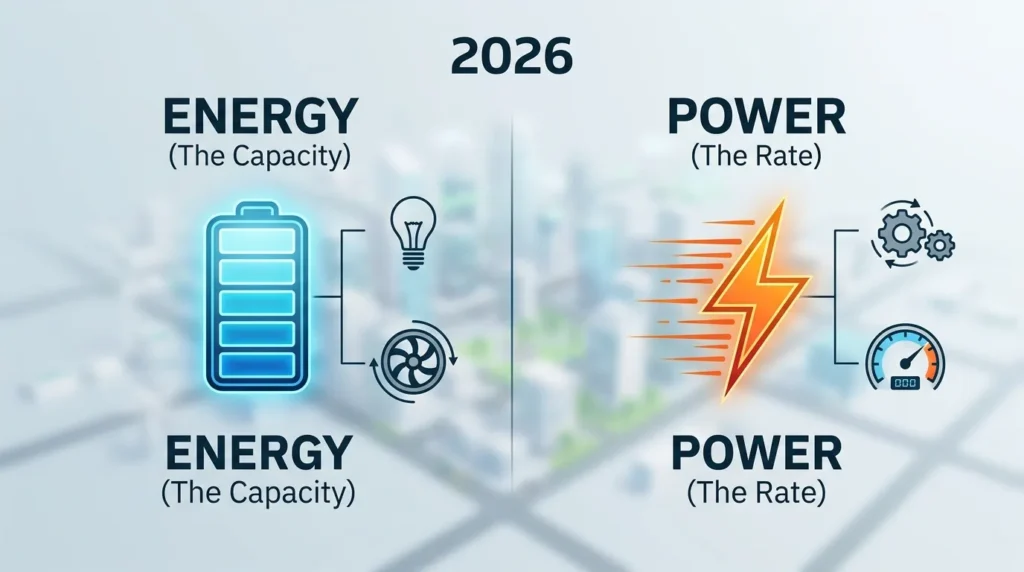
Power is the rate at which energy is used or transferred.
Energy is the total amount of work done or stored over time.
Simple Example
Think about filling a water tank.
- Power is how fast the water flows from the tap.
- Energy is the total amount of water collected in the tank.
A powerful machine works faster, but the amount of energy it uses depends on how long it runs.
Quick Comparison
| Feature | Power | Energy |
|---|---|---|
| Meaning | Rate of using energy | Total work done |
| Unit | Watt (W) | Joule (J), Kilowatt-hour (kWh) |
| Depends on Time | No | Yes |
| Measures | Speed | Quantity |
The Origin of Power vs Energy
The words power and energy have been used in science for centuries.
Power
The word power comes from the Old French word poeir, meaning ability or strength.
In physics, power refers to the rate at which work is done or energy is transferred.
Energy
The word energy comes from the Greek word energeia, meaning activity or operation.
Today, energy describes the ability to do work or produce change.
Why There Are No Spelling Differences
The words power and energy are spelled the same in British English and American English.
Only nearby English words may have different spellings.
British English vs American English Spelling
The terms power and energy never change spelling.
However, surrounding words sometimes differ.
Examples
British English
- Analyse power consumption.
- Optimise energy usage.
American English
- Analyze power consumption.
- Optimize energy usage.
Comparison Table
| British English | American English |
|---|---|
| Power | Power |
| Energy | Energy |
| Analyse | Analyze |
| Optimise | Optimize |
| Organise | Organize |
| Programme | Program (software) |
Which Spelling Should You Use?
Always write:
- Power
- Energy
Their spelling is correct in every English-speaking country.
For US Readers
Use American English around these terms.
Example:
- Optimize energy efficiency.
For UK Readers
Use British English.
Example:
- Optimise energy efficiency.
For a Global Audience
American English is more common in engineering manuals and technical documentation, while British English is widely accepted in the UK and Commonwealth countries. Stay consistent throughout your content.
Power vs Energy: Key Differences
Definition
Power measures how quickly energy is transferred or used.
Energy measures the total amount of work done.
Units
Power is measured in:
- Watts (W)
- Kilowatts (kW)
- Megawatts (MW)
Energy is measured in:
- Joules (J)
- Kilowatt-hours (kWh)
- Megawatt-hours (MWh)
Time
Power does not include time directly.
Energy depends on both power and time.
Formula:
Energy = Power × Time
Practical Example
A 1000-watt heater running for 2 hours uses:
2 kilowatt-hours (kWh) of energy.
The power stays the same.
The energy increases as operating time increases.
Power vs Energy Comparison Table
| Feature | Power | Energy |
|---|---|---|
| Definition | Rate of energy transfer | Total energy used |
| SI Unit | Watt (W) | Joule (J) |
| Common Electrical Unit | Kilowatt (kW) | Kilowatt-hour (kWh) |
| Depends on Time | No | Yes |
| Formula | Work ÷ Time | Power × Time |
| Example | 1500 W heater | 3 kWh after 2 hours |
Common Mistakes with Power vs Energy
Many people confuse these terms.
Mistake 1
Power and energy are the same thing.
✅ Correction:
Power measures the rate of energy use, while energy measures the total amount used.
Mistake 2
Watts measure energy.
✅ Correction:
Watts measure power.
Energy is measured in joules or kilowatt-hours.
Mistake 3
Higher power always means higher electricity bills.
✅ Correction:
Electricity cost depends on both power and operating time.
Mistake 4
Kilowatts and kilowatt-hours are identical.
✅ Correction:
Kilowatts measure power.
Kilowatt-hours measure energy.
Mistake 5
Turning on a high-power appliance briefly always uses more energy.
✅ Correction:
A high-power appliance used for a short time may consume less energy than a low-power appliance used for many hours.
Power vs Energy in Everyday Examples
“The new air conditioner has higher power, but its energy consumption is lower because it runs more efficiently.”
News
“Governments continue investing in renewable energy while improving power generation capacity.”
Social Media
“I finally understand why my electricity bill is measured in kWh instead of watts.”
Formal Writing
“Power describes the rate of energy transfer, whereas energy represents the total amount of work performed over time.”
Power vs Energy – Google Trends & Usage Data
Interest in power vs energy remains high because students, engineers, electricians, and homeowners frequently search for electrical concepts.
Popular Search Topics
- Power vs energy difference
- Power and energy formula
- Watt vs kilowatt-hour
- What is electrical power?
- What is electrical energy?
Countries with High Search Interest
- United States
- India
- United Kingdom
- Canada
- Australia
Searches often increase during engineering courses, physics classes, electrical training, and when people compare household appliance energy consumption.
Power vs Energy Keyword Variations
| Search Term | Meaning |
|---|---|
| Power vs Energy | Main comparison |
| Energy vs Power | Same comparison, reversed |
| Difference between power and energy | General explanation |
| Power and energy difference | Beginner guide |
| Power vs energy formula | Mathematical comparison |
| Power vs energy examples | Practical learning |
| Watt vs kilowatt-hour | Unit comparison |
| Electrical power vs energy | Engineering context |
FAQs
What is the main difference between power and energy?
Power is the rate of using or transferring energy, while energy is the total amount of work done over time.
Is watt a unit of power or energy?
A watt (W) is a unit of power.
Is kilowatt-hour a unit of power?
No. A kilowatt-hour (kWh) is a unit of energy.
Why does my electricity bill use kWh?
Electricity companies charge for the total energy you use, which is measured in kilowatt-hours.
Can two appliances have the same power but different energy consumption?
Yes. If they operate for different lengths of time, their energy consumption will be different.
What is the formula connecting power and energy?
Energy = Power × Time
This formula shows that energy depends on both power and operating time.
Which is more important, power or energy?
Both are important. Power describes performance, while energy determines total electricity consumption and operating cost.
Conclusion
Understanding power vs energy is essential for anyone learning physics, electrical engineering, or simply trying to understand household electricity. Although the terms are closely related, they describe different concepts. Power tells you how quickly energy is used or transferred, while energy measures the total amount consumed over a period of time. This difference explains why appliance ratings use watts but electricity bills use kilowatt-hours. Knowing these concepts helps you compare appliances, calculate electricity usage, improve energy efficiency, and make better purchasing decisions. Whether you’re a student, technician, engineer, or homeowner, understanding the relationship between power and energy provides a strong foundation for electrical knowledge. By remembering that power is the rate and energy is the total amount, you’ll avoid one of the most common misunderstandings in science and electrical engineering.