
Breath vs breathe is a common English word confusion. The two words look almost the same, but they have different meanings, pronunciations, and grammatical roles. If you are writing an email, school assignment, social media post, or professional document, using the wrong word can make your sentence incorrect.
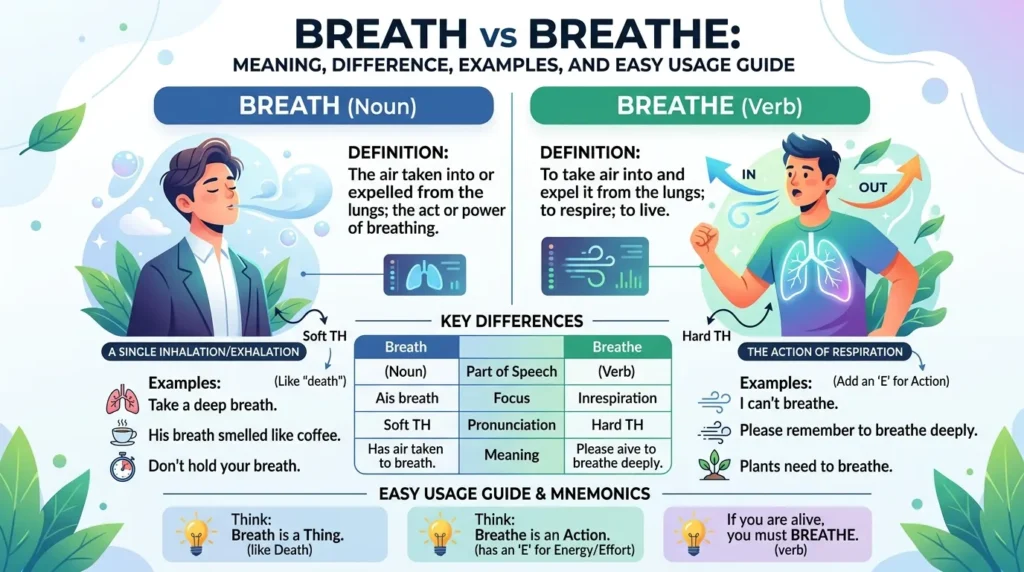
The easiest way to remember the difference is simple: breath is a noun, while breathe is a verb. A breath is the air you take into or push out of your lungs. To breathe means to take air into your lungs and release it.
For example, you can say, “Take a deep breath.” But you should say, “Try to breathe slowly.”
People often search for “breath vs breathe” because the extra e changes both the pronunciation and the function of the word. Once you understand this small difference, the words become much easier to use.
This guide explains their meanings, origins, pronunciation, British and American usage, common mistakes, everyday examples, and simple memory tricks.
Breath vs Breathe – Quick Answer
The quickest answer is:
- Breath = a noun → the air you take in or release.
- Breathe = a verb → the action of taking in and releasing air.
What Does Breath Mean?
Breath is a noun.
It refers to the air that enters or leaves your lungs.
Examples:
- Take a deep breath.
- She held her breath.
- I could see my breath in the cold air.
- He took a quick breath before speaking.
What Does Breathe Mean?
Breathe is a verb.
It means to take air into your lungs and release it.
Examples:
- Try to breathe slowly.
- Plants need air to breathe.
- It is difficult to breathe underwater.
- Remember to breathe deeply.
Easy Memory Trick
Remember:
Breath = thing
Breathe = action
You take a breath, but you breathe air.
The Origin of Breath vs Breathe
Breath and breathe are closely related words. Both developed from Old English forms connected with breathing and air.
Origin of Breath
The word breath comes from Old English brǣþ, which referred to breath, odor, or the act of breathing.
Over time, its meaning became more closely associated with the air that a person takes into or releases from the lungs.
Today, we use breath as a noun.
Examples include:
- A deep breath
- A short breath
- Fresh breath
- Bad breath
- Hold your breath
Origin of Breathe
Breathe comes from the Old English verb brēþan, meaning to breathe or exhale.
It developed into the modern English verb breathe.
The extra e helps distinguish the verb from the noun.
Why Do They Look So Similar?
They describe the same basic physical process, so their shared spelling makes sense.
However, English spelling and pronunciation developed in different ways.
The final e in breathe also affects its pronunciation.
- Breath → /breθ/
- Breathe → /briːð/
This pronunciation difference is very important.
British English vs American English Spelling
There is no major spelling difference between British and American English for breath and breathe.
Both varieties use the same spellings.
| Word | British English | American English | Meaning |
|---|---|---|---|
| Breath | Breath | Breath | Air taken in or released |
| Breathe | Breathe | Breathe | To take in and release air |
British English Examples
Take a deep breath.
Try to breathe slowly.
American English Examples
Take a deep breath.
Try to breathe slowly.
The spelling stays the same in both forms of English.
The important difference is not regional spelling. It is grammar, meaning, and pronunciation.
Which Spelling Should You Use?
You should choose the word based on what you mean.
Use Breath for a Noun
Use breath when you are talking about the air itself or one act of breathing.
Examples:
- Take a breath.
- Hold your breath.
- I lost my breath.
- She smelled his breath.
- He took a deep breath.
Use Breathe for a Verb
Use breathe when you are describing the action.
Examples:
- Breathe deeply.
- I can barely breathe.
- The baby is breathing normally.
- Try to breathe slowly.
- We need to breathe fresh air.
For US Audiences
American readers use breath and breathe in the same way.
For UK and Commonwealth Audiences
British and Commonwealth readers also use the same distinction.
For Global English
If you write for a worldwide audience, use the same basic rule:
Breath = noun
Breathe = verb
Common Mistakes with Breath vs Breathe
These words are often confused because their spelling differs by only one letter.
Mistake 1: Take a Deep Breathe
Incorrect:
Take a deep breathe.
Correct:
Take a deep breath.
Why?
Take needs a noun here. A breath is the thing you take.
Mistake 2: I Cannot Breath
Incorrect:
I cannot breath.
Correct:
I cannot breathe.
Why?
The sentence describes an action. Therefore, you need the verb breathe.
Mistake 3: Hold Your Breathe
Incorrect:
Hold your breathe.
Correct:
Hold your breath.
The phrase is hold your breath.
Mistake 4: Breath Slowly
Incorrect:
Breath slowly.
Correct:
Breathe slowly.
The word describes an action, so use the verb.
Mistake 5: Catch My Breathe
Incorrect:
I need to catch my breathe.
Correct:
I need to catch my breath.
The fixed expression is catch your breath.
Breath vs Breathe Pronunciation
Pronunciation is another major difference.
Breath
Breath sounds like breth.
The final sound is similar to the th in think.
Pronunciation:
/breθ/
Example:
Take a deep breath.
Breathe
Breathe sounds like breeth.
The final sound is similar to the th in this.
Pronunciation:
/briːð/
Example:
Try to breathe slowly.
Simple Pronunciation Trick
Think:
Breath = short vowel + unvoiced “th”
Breathe = long “ee” + voiced “th”
The spelling difference helps signal the pronunciation difference.
Breath vs Breathe Comparison Table
| Feature | Breath | Breathe |
|---|---|---|
| Part of speech | Noun | Verb |
| Meaning | Air taken in or released | The action of breathing |
| Pronunciation | /breθ/ | /briːð/ |
| Example | Take a breath. | Breathe slowly. |
| Common phrase | Hold your breath | Breathe deeply |
| Common phrase | Catch your breath | Breathe fresh air |
| Extra letter | No final e | Final e |
Breath vs Breathe in Everyday Examples
Understanding real-life examples can make the difference easier to remember.
In Emails
Breath:
Please take a moment to catch your breath before continuing.
Breathe:
If you feel stressed, try to breathe slowly.
In News
Breath:
The athlete held his breath before entering the water.
Breathe:
The athlete struggled to breathe after the race.
On Social Media
Breath:
Take a deep breath and keep going!
Breathe:
Stop for a moment and breathe.
In Formal Writing
Breath:
The patient reported shortness of breath.
Breathe:
The patient was able to breathe normally after treatment.
In Everyday Conversation
I need to catch my breath.
I need to breathe.
Both sentences are correct, but they use different grammatical forms.
Common Phrases With Breath
Learning common phrases is a great way to remember breath.
Take a Breath
Take a breath before you answer.
Hold Your Breath
Hold your breath for a few seconds.
Catch Your Breath
I stopped to catch my breath.
Out of Breath
She was out of breath after running.
Under Your Breath
He spoke under his breath.
Bad Breath
Good dental care can help prevent bad breath.
Waste Your Breath
Don’t waste your breath arguing with him.
Common Phrases With Breathe
Here are common expressions using breathe.
Breathe Deeply
Breathe deeply and relax.
Breathe Slowly
Try to breathe slowly.
Breathe In
Breathe in through your nose.
Breathe Out
Breathe out slowly.
Breathe Easily
We can breathe easily now that the problem is solved.
Breathe Fresh Air
I like to breathe fresh air in the morning.
Breath vs Breathe – Google Trends & Usage Data
Searches for breath vs breathe are common because the two words are widely used in everyday English.
The confusion appears across English-speaking regions and among English learners worldwide.
Why Do People Search for This Pair?
Common reasons include:
- Similar spelling
- Similar meaning
- Different pronunciation
- Confusion between nouns and verbs
- School writing
- Professional writing
- English language learning
- Grammar checking
Which Word Is More Common?
Breathe appears frequently in instructions and sentences describing actions.
For example:
- Breathe slowly.
- Breathe deeply.
- Breathe normally.
Breath is common in fixed expressions and noun phrases.
For example:
- Take a breath.
- Hold your breath.
- Catch your breath.
- Out of breath.
Usage varies greatly by context, so raw search popularity does not mean one word is a replacement for the other.
How to Remember Breath vs Breathe
A simple rule can help.
Remember the E
The extra e in breathe can remind you that it is the verb.
Think:
Breathe = do something
You perform the action of breathing.
Breath Is the Thing
A breath is something you can:
- Take
- Hold
- Catch
- Lose
For example:
Take a breath.
Hold your breath.
Catch your breath.
If you can put take, hold, or catch before the word, breath is often correct.
FAQs About Breath vs Breathe
What is the difference between breath and breathe?
Breath is a noun meaning the air taken into or released from the lungs. Breathe is a verb meaning to take air in and release it.
Is it take a breath or take a breathe?
The correct phrase is take a breath.
Example:
Take a deep breath.
Is it breathe deeply or breath deeply?
The correct phrase is breathe deeply because it describes an action.
Is it hold your breath or hold your breathe?
The correct phrase is hold your breath.
Is breathe pronounced like breath?
No. Breath is pronounced approximately “breth,” while breathe is pronounced approximately “breeth.”
Is breath a noun or verb?
Breath is normally used as a noun.
Example:
He took a deep breath.
Is breathe a noun or verb?
Breathe is a verb.
Example:
Try to breathe slowly.
How can I remember the difference between breath and breathe?
Remember: breath is a thing, while breathe is an action. You take a breath, but you breathe air.
Conclusion
The difference between breath vs breathe is simple once you understand their grammatical roles.
Breath is a noun. It refers to the air that enters or leaves your lungs, or to one act of breathing. You can take a breath, hold your breath, catch your breath, or be out of breath.
Breathe is a verb. It describes the action of taking air into your lungs and releasing it. You can breathe slowly, breathe deeply, or breathe fresh air.
The words are closely related and come from old English words connected with air and breathing. Their similar spelling explains why they are often confused, but the extra e in breathe helps distinguish the verb.
There is no important British-American spelling difference. Both varieties of English use breath and breathe in the same way.
The easiest rule is:
Breath = noun
Breathe = verb
If you remember that you take a breath but breathe air, you can avoid most common mistakes in everyday and professional writing.