
English has many words that sound alike but have different meanings. Their vs There is one of the most common examples. These two words look similar, sound similar, and often appear in the same types of sentences. That makes them easy to mix up, especially when writing quickly.
If you have ever stopped and asked, “Should I use their or there?” you are not alone. Students, writers, professionals, and even native English speakers sometimes confuse them. The good news is that the difference is simple once you know what each word does.
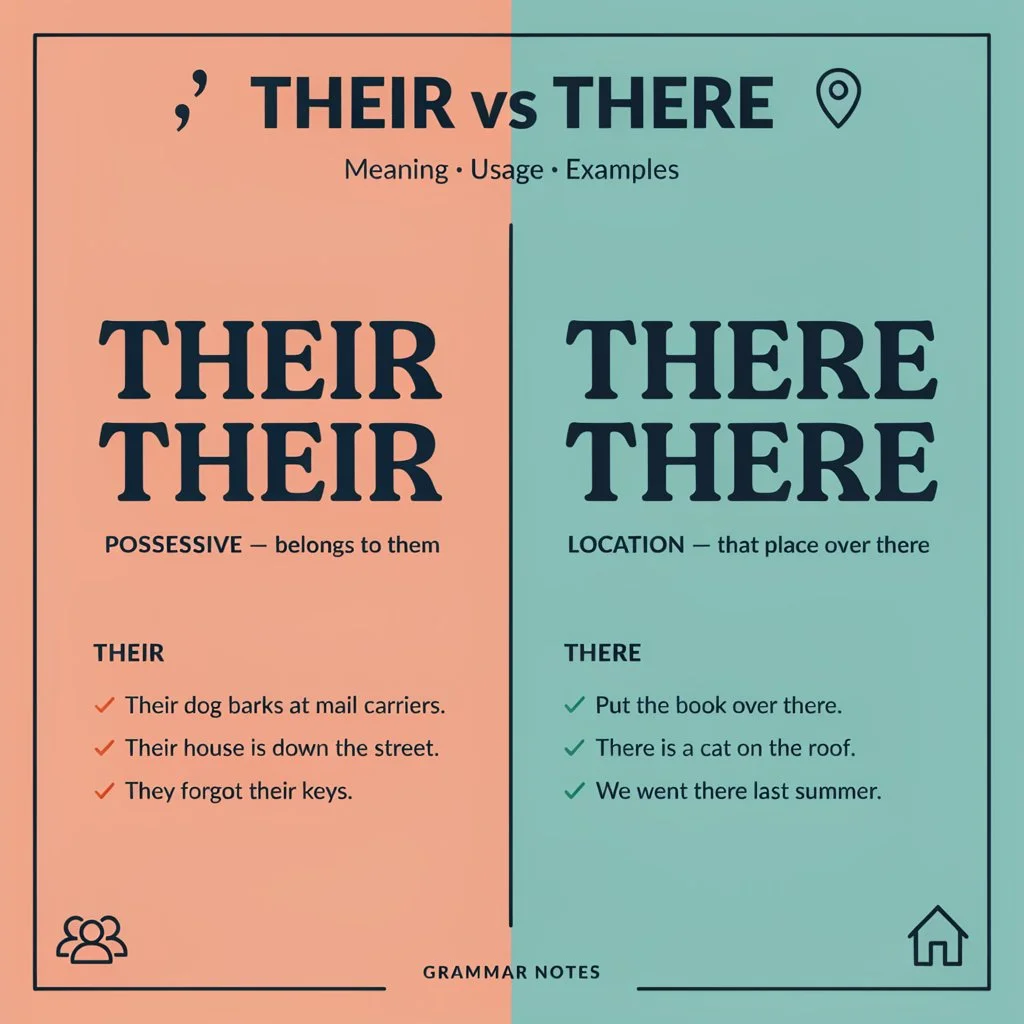
Their shows possession or a connection to people or things. There usually refers to a place, position, or the existence of something. For example, “Their car is outside” uses their to show ownership, while “The car is over there” uses there to show location.
This guide explains Their vs There in simple English. You will learn their meanings, origins, common mistakes, spelling differences, everyday uses, and easy ways to remember which word to choose.
Their vs There – Quick Answer
The easiest way to remember the difference is:
- Their = belongs to them
- There = a place or position
- They’re = they are
Although this article focuses on Their vs There, they’re is important because it is often confused with both words.
| Word | Meaning | Example |
|---|---|---|
| Their | Shows possession | Their house is large. |
| There | Refers to a place or position | Put the bag there. |
| They’re | Short for “they are” | They’re ready to leave. |
Examples of Their
Use their when something belongs to, relates to, or is connected with them.
- The students finished their homework.
- The players wore their uniforms.
- The company changed their policy.
- The children cleaned their room.
Easy test: Replace their with his or her. If the sentence still makes sense, their may be correct.
The students brought their books.
The students brought his or her books.
The first version is natural because their shows possession.
Examples of There
Use there when talking about a place or position.
- Put the keys over there.
- We will meet there at noon.
- Your phone is there on the table.
- She went there yesterday.
Easy test: If you can use here instead, there may be the correct word.
Put the book there.
Put the book here.
There is also used to introduce something that exists:
- There is a problem.
- There are three students outside.
- There was a meeting yesterday.
The Origin of Their vs There
The words their and there did not develop from exactly the same source. Their different histories help explain why they have different spellings and meanings.
Origin of Their
Their comes from Middle English and was influenced by Old Norse. It developed from Old Norse forms related to the meaning “of them” and replaced an older Old English possessive form. Historical sources place its development around the Middle English period, with its first known use dating to the 13th century.
The basic idea remained connected to possession:
their house = the house belonging to them
Today, their is used for groups and is also widely used with a singular person when the person’s gender is unknown or when gender does not need to be stated.
Someone left their phone here.
Cambridge Dictionary also recognizes this modern singular use of their.
Origin of There
There is much older. It comes from Old English forms such as þǣr and thēr, meaning “in or at that place.” It is related to words in other Germanic languages, including Dutch and German.
Its main meaning has stayed connected to location:
The school is over there.
Over time, there also developed other grammatical uses. For example:
There is a problem.
There are many options.
So, although their and there look similar today, they have different historical roots and developed different grammatical roles.
British English vs American English Spelling
There is no spelling difference between British English and American English for their and there.
Both forms are spelled the same:
- British English: their
- American English: their
- British English: there
- American English: there
The difference is not regional spelling. It is meaning and grammar.
| Word | British English | American English | Meaning |
|---|---|---|---|
| Their | Their | Their | Belonging to them |
| There | There | There | Place, position, or existence |
| They’re | They’re | They’re | They are |
Cambridge Dictionary lists the same spellings for British and American English, while pronunciation can vary by accent.
Example in British English
Their office is over there.
Example in American English
Their office is over there.
The spelling and grammar are the same.
This is different from words such as colour/color, centre/center, or travelling/traveling, where British and American spelling can differ.
Which Spelling Should You Use?
Choosing between their and there does not depend on whether your audience is American or British. Choose the word based on its meaning.
For a US Audience
Use:
- their for possession
- there for place or existence
- they’re for “they are”
Example:
Their manager is waiting there.
For a UK or Commonwealth Audience
The same rule applies.
Their manager is waiting there.
The spelling does not change.
For a Global Audience
Use standard English and focus on clear grammar. If your website has an international audience, avoid treating their and there as regional spelling choices.
The main issue is word function, not country.
Common Mistakes with Their vs There
Mistake 1: Using There for Possession
Incorrect:
There car is parked outside.
Correct:
Their car is parked outside.
Why? The car belongs to them, so use their.
Mistake 2: Using Their for Location
Incorrect:
Put the box over their.
Correct:
Put the box over there.
Why? The sentence refers to a place.
Mistake 3: Confusing Their With They’re
Incorrect:
Their going to the store.
Correct:
They’re going to the store.
Why? They’re means they are.
Mistake 4: Writing There House
Incorrect:
There house is beautiful.
Correct:
Their house is beautiful.
The house belongs to them.
Mistake 5: Writing Their Is
Incorrect:
Their is a problem with the computer.
Correct:
There is a problem with the computer.
Here, there introduces the existence of something.
A Simple Three-Word Test
When you are unsure, ask:
Does it mean “belongs to them”?
→ Use their.
Does it mean a place or position?
→ Use there.
Does it mean “they are”?
→ Use they’re.
Their vs There in Everyday Examples
Knowing the rule is useful, but seeing these words in real situations makes the difference easier to remember.
In Emails
Their:
The managers have approved their new schedule.
There:
The documents are available there.
They’re:
They’re reviewing the documents now.
In professional emails, using the correct word matters because spelling mistakes can make your writing look careless.
In News Writing
News articles often use both words:
The company announced their new plan on Monday.
Officials said there was no immediate danger.
Here, their shows a connection to the company, while there introduces the existence of a situation.
In Social Media
Social media writing is often informal, but the same rules apply.
Their team played well today.
Look over there!
They’re celebrating the win.
In Formal Writing
Formal writing should use the correct word carefully.
Incorrect:
Their are several reasons for the change.
Correct:
There are several reasons for the change.
Incorrect:
The students submitted there assignments.
Correct:
The students submitted their assignments.
Comparison Table: Their vs There
| Feature | Their | There |
|---|---|---|
| Main function | Shows possession | Shows place, position, or existence |
| Basic meaning | Belonging to them | In or at that place |
| Part of speech | Possessive determiner | Adverb/pronoun and other grammatical uses |
| Example | Their house is new. | The house is there. |
| Memory trick | Think “heir” and ownership | Think “here” and location |
| Common confusion | They’re, there | Their, they’re |
Their vs There – Google Trends & Usage Data
People often search for Their vs There because the words are commonly confused. They are also extremely common words in everyday English, so the confusion appears in school writing, workplace communication, websites, social media, and search queries.
Google Trends can be used to compare search interest by country, region, and time. However, Google Trends does not provide a simple fixed monthly search-volume number for a word. Its data is based on a sample of aggregated and anonymized Google searches and is shown as relative interest. Google also notes that search patterns can differ between countries, so regional analysis is important.
For a topic such as Their vs There, the most useful markets to examine include:
- United States
- United Kingdom
- Canada
- Australia
- India
- Other English-speaking markets
The exact level of search interest can change over time. Therefore, writers should check Google Trends for the current period before making claims about which country has the highest interest.
The broader usage is clear: their and there are everyday English words, while searches such as “their vs there,” “there or their,” and “difference between their and there” reflect a common grammar problem.
For SEO, this makes the topic useful for educational websites, grammar blogs, English-learning sites, student resources, and writing guides.
Their vs There: Quick Comparison
| Variation | Meaning | Correct Example | Incorrect Example |
|---|---|---|---|
| Their | Belonging to them | Their dog is friendly. | There dog is friendly. |
| There | Place or position | The dog is over there. | The dog is over their. |
| There is | Shows existence | There is a dog outside. | Their is a dog outside. |
| There are | Shows existence of multiple things | There are two dogs outside. | Their are two dogs outside. |
| They’re | They are | They’re outside. | Their outside. |
Easy Ways to Remember Their vs There
Here are three simple memory tricks.
1. Their = Possession
Think:
Their = belongs to them
Example:
Their house = the house belonging to them.
2. There = Location
Think:
There contains here.
This can remind you that there is often connected to a place.
Example:
The keys are over there.
Merriam-Webster also recommends using the word here inside there as a memory aid.
3. They’re = They Are
The apostrophe is your clue.
They’re = They are
Example:
They’re happy.
They are happy.
If you can replace they’re with they are, it is correct.
FAQs About Their vs There
1. What is the difference between their and there?
Their shows possession or a relationship to them. There usually refers to a place, position, or the existence of something.
Their car is there.
2. Is their a possessive word?
Yes. Their is a possessive determiner. It shows that something belongs to or is connected with them.
Their house is beautiful.
Cambridge Dictionary defines their as referring to something belonging to or relating to them.
3. Is there used for a place?
Yes. There often refers to a place or position.
Put the bag there.
It can also introduce something that exists:
There is a problem.
4. Is “they’re” the same as “their”?
No. They’re is a contraction of they are.
They’re ready. = They are ready.
Their shows possession.
Their bags are ready.
5. Which is correct: “their house” or “there house”?
The correct phrase is their house because the house belongs to them.
6. Which is correct: “over their” or “over there”?
The correct phrase is over there when you are talking about a location.
The store is over there.
7. Do British and American English spell their and there differently?
No. Both British and American English use their and there. The difference is based on meaning, not regional spelling.
Conclusion
Understanding Their vs There is simple once you focus on meaning instead of spelling. Their shows possession or a connection to people or things. There usually refers to a place, position, or the existence of something. A third word, they’re, means “they are” and is another common source of mistakes.
Remember these three rules: their = belongs to them, there = place or existence, and they’re = they are. For example, “Their car is over there” uses both words correctly. “They’re waiting there” uses they’re for “they are” and there for location.
These rules are the same in British, American, Canadian, Australian, and other major forms of English. There is no British-versus-American spelling difference between their and there. The key is choosing the word that matches the meaning.
Whether you are writing an email, school assignment, article, social media post, or business report, using their vs there correctly makes your writing clearer and more professional. When unsure, stop and ask what the word means. That quick check can prevent most mistakes.