
Have you ever typed “your welcome” instead of “you’re welcome” or wondered whether to write “your amazing” or “you’re amazing”? If so, you’re not alone. The confusion between your and you’re is one of the most common grammar mistakes in English.
Many students, bloggers, professionals, and social media users search for “your vs you’re” because both words sound exactly the same. However, they have completely different meanings and grammar rules. Using the wrong one can make emails, assignments, articles, or business messages look unprofessional.
The good news is that the difference is very simple once you understand it. In this guide, you’ll learn the meaning of each word, where it came from, when to use it, common mistakes, real-life examples, British vs American usage, Google Trends insights, comparison tables, and expert writing tips. By the end of this article, you’ll be able to choose the correct word with confidence every time.
Your vs You’re – Quick Answer
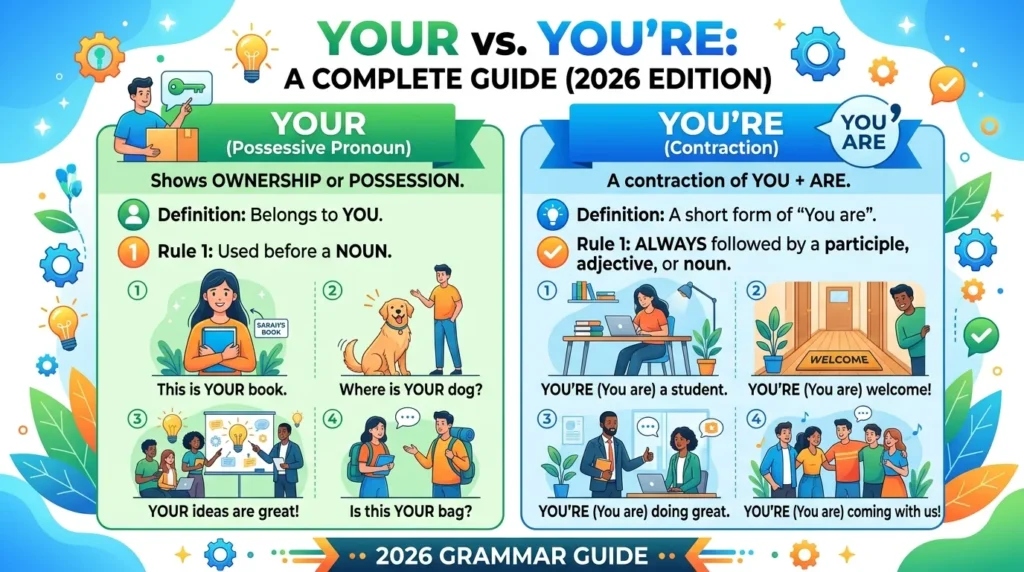
What Is the Difference Between Your and You’re?
The difference is simple:
- Your shows ownership or possession.
- You’re is the short form (contraction) of you are.
Quick Examples
| Word | Meaning | Example |
|---|---|---|
| Your | Belonging to you | Your phone is ringing. |
| You’re | You are | You’re very kind. |
Easy Trick
Replace you’re with you are.
If the sentence still makes sense, use you’re.
✅ You’re late. → You are late.
❌ Your late. → Your late. (Incorrect)
The Origin of Your vs You’re
Where Did “Your” Come From?
The word your comes from Old English ēower, which was used to show possession. Over time, its spelling changed into the modern word your.
Examples:
- Your book
- Your house
- Your opinion
Where Did “You’re” Come From?
You’re is a contraction of you are.
English speakers began using contractions to make speaking and writing quicker and more natural.
Examples:
- You’re welcome.
- You’re doing great.
- You’re my best friend.
Why Are They Confusing?
The confusion exists because:
- They sound exactly alike.
- English contains many homophones.
- Spell check often cannot detect the mistake.
British English vs American English Spelling
Unlike many English words, your and you’re have exactly the same spelling and grammar rules in both British English and American English.
There is no spelling difference between the two varieties of English.
Comparison Table
| Feature | British English | American English |
|---|---|---|
| Your | ✔ Same | ✔ Same |
| You’re | ✔ Same | ✔ Same |
| Meaning | Same | Same |
| Grammar Rule | Same | Same |
| Pronunciation | Nearly identical | Nearly identical |
Examples
British:
- Your train is late.
- You’re very polite.
American:
- Your car is ready.
- You’re invited.
Which Spelling Should You Use?
If You’re Writing for American Readers
Use:
- Your for possession.
- You’re for you are.
If You’re Writing for British Readers
Use the exact same grammar rules.
If You’re Writing for a Global Audience
There is no regional preference.
Simply choose the correct word based on grammar.
Quick Rule
Ask yourself:
Can I replace it with “you are”?
If yes:
Use you’re.
If no:
Use your.
Common Mistakes with Your vs You’re
Mistake 1
❌ Your amazing.
✅ You’re amazing.
Mistake 2
❌ I like you’re car.
✅ I like your car.
Mistake 3
❌ Your welcome.
✅ You’re welcome.
Mistake 4
❌ You’re phone is ringing.
✅ Your phone is ringing.
Mistake 5
❌ Your the best.
✅ You’re the best.
Quick Correction Table
| Incorrect | Correct |
|---|---|
| Your welcome | You’re welcome |
| Your amazing | You’re amazing |
| You’re house | Your house |
| Your late | You’re late |
| I like you’re idea | I like your idea |
Your vs You’re in Everyday Examples
Emails
✅ Thank you for your message.
✅ You’re invited to tomorrow’s meeting.
Social Media
✅ You’re awesome!
✅ Your photo looks amazing.
News Writing
✅ The company announced your refund has been processed.
✅ You’re expected to receive payment next week.
Formal Writing
✅ Please submit your application before Friday.
✅ You’re required to sign this document.
School Assignments
✅ Your answer is correct.
✅ You’re improving every day.
Your vs You’re – Google Trends & Usage Data
The keyword “your vs you’re” is searched throughout the year because many English learners and native speakers accidentally confuse these two words.
Who Searches for It?
- Students
- Teachers
- Bloggers
- Content writers
- Job seekers
- Social media users
Countries Where It Is Popular
- United States
- United Kingdom
- Canada
- Australia
- India
- Philippines
Why Do People Search It?
People often search this keyword when:
- Writing emails
- Preparing assignments
- Posting on social media
- Improving grammar
- Studying English
Your vs You’re Comparison Table
| Feature | Your | You’re |
|---|---|---|
| Word Type | Possessive adjective | Contraction |
| Means | Belonging to you | You are |
| Shows Ownership | ✔ Yes | ❌ No |
| Can Become “You Are”? | ❌ No | ✔ Yes |
| Formal Writing | ✔ Yes | ✔ Yes |
| Everyday Conversation | ✔ Yes | ✔ Yes |
FAQs
1. What is the difference between your and you’re?
Your shows ownership, while you’re means you are.
2. Is “your welcome” correct?
No.
The correct phrase is:
You’re welcome.
3. Is “your amazing” correct?
No.
It should be:
You’re amazing.
4. Can I replace “you’re” with “you are”?
Yes.
If the sentence still makes sense, you’re is correct.
5. Is there any British vs American difference?
No.
Both countries use the same spelling and grammar rules.
6. Why do people confuse these words?
Because they sound exactly the same but have different meanings.
7. Which word is more common?
Both words are extremely common because they serve different grammatical purposes.
Conclusion
Understanding your vs you’re is easier than many people think. Although both words sound identical, they perform completely different jobs in a sentence. Your is used to show ownership, while you’re is simply a contraction of you are. Remembering this one rule can prevent many common grammar mistakes in emails, essays, social media posts, and professional writing.
A helpful trick is to replace you’re with you are. If the sentence still sounds correct, then you’re is the right choice. If it does not, use your instead. This simple test works in almost every situation.
Whether you write for school, work, blogging, or everyday communication, using the correct word makes your writing clearer and more professional. Practice with real-life examples, review common mistakes, and apply the grammar rules consistently. With a little practice, choosing between your and you’re will become second nature, helping you write accurate and confident English every time.