
Imagine using a hand drill to make a hole in a wall or turning on your kitchen blender to prepare a smoothie. Have you ever wondered what type of motor makes these appliances run at such high speeds? In many cases, the answer is a Universal Motor. This compact and powerful motor is commonly found in household appliances and portable power tools because it can operate on both AC (Alternating Current) and DC (Direct Current) power supplies.
Understanding the Universal Motor is important for electrical students, engineers, technicians, and beginners because it combines features of both AC and DC motors. It is one of the most widely used motors in everyday life due to its high speed, compact design, and excellent starting torque. Knowing how it works also helps in troubleshooting electrical equipment and selecting the right motor for different applications.
In this article, you will learn what a Universal Motor is, the Universal Motor working principle, types, construction, main components, advantages, disadvantages, applications, comparison with other motors, selection tips, common problems, and future developments in simple and easy-to-understand language.
What is a Universal Motor?
A Universal Motor is a single-phase series motor that can operate on both Alternating Current (AC) and Direct Current (DC) supplies. It is called a “universal” motor because it works with either type of electrical power without major modifications.
Unlike standard induction motors that work only with AC power, a Universal Motor is specially designed so that its magnetic field and armature current reverse together when connected to AC. This allows the motor to continue rotating in the same direction.
Simple Definition
A Universal Motor is a high-speed electric motor that operates on both AC and DC power and produces high starting torque, making it suitable for portable tools and household appliances.
Practical Example
Common appliances using Universal Motors include:
- Electric drill
- Mixer grinder
- Vacuum cleaner
- Hair dryer
- Sewing machine
- Food processor
These devices need high speed and compact size, which makes the Universal Motor an ideal choice.
Universal Motor Working Principle
The Universal Motor working principle is based on the interaction between the magnetic field produced by the field winding and the current flowing through the armature winding.
Since both windings are connected in series, the current flows through both at the same time.
Step-by-Step Working
Step 1: Power Supply
The motor receives either AC or DC voltage.
Step 2: Current Flows
Current passes through:
- Field winding
- Armature winding
Both are connected in series.
Step 3: Magnetic Field is Produced
The field winding creates a magnetic field around the stator.
Step 4: Armature Becomes an Electromagnet
Current flowing through the armature creates another magnetic field.
Step 5: Electromagnetic Force
The interaction between both magnetic fields produces torque.
This torque rotates the armature.
Step 6: Continuous Rotation
When using AC, both the field current and armature current reverse simultaneously during every half cycle.
Since both reverse together, the direction of torque remains the same.
As a result, the motor continues rotating in one direction.
Easy Analogy
Imagine two people pushing a swing.
If both change their pushing direction at the same time, the swing still moves forward.
The Universal Motor works in a similar way.
Types of Universal Motor
Although Universal Motors have similar construction, they are mainly classified into two types.
Series Universal Motor
This is the most common type.
Features
- High starting torque
- Very high speed
- Compact size
- Used in power tools
Applications include:
- Drills
- Grinders
- Vacuum cleaners
Compensated Universal Motor
This design includes additional windings to improve performance on AC supply.
Features
- Better efficiency
- Reduced sparking
- Improved power factor
- Smoother operation
It is used where better performance and reduced electrical noise are required.
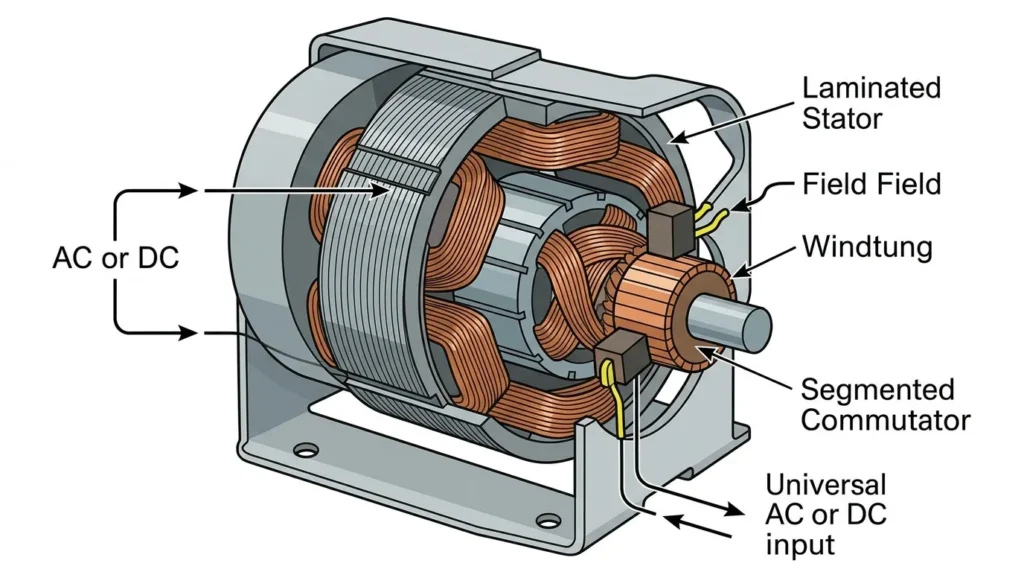
Main Components of a Universal Motor
A Universal Motor contains several important parts that work together.
1. Stator
The stator is the stationary part of the motor.
Function:
- Produces the magnetic field.
2. Field Winding
Copper wire wound around the stator poles.
Function:
- Creates the main magnetic field.
3. Rotor (Armature)
The rotating part of the motor.
Function:
- Converts electrical energy into mechanical rotation.
4. Commutator
A segmented copper ring attached to the rotor.
Function:
- Reverses current in the armature.
- Maintains continuous rotation.
5. Carbon Brushes
Brushes make electrical contact with the rotating commutator.
Function:
- Transfer electrical current.
6. Shaft
Connected to the rotor.
Function:
- Delivers mechanical power to the load.
7. Bearings
Bearings support the rotating shaft.
Function:
- Reduce friction.
- Ensure smooth rotation.
8. Cooling Fan
Some motors include a fan.
Function:
- Removes heat.
- Prevents overheating.
Advantages of Universal Motor
Universal Motors offer many practical benefits.
- Operates on both AC and DC supplies
- Very high starting torque
- High operating speed
- Compact and lightweight
- Simple construction
- Low manufacturing cost
- Easy speed control
- Suitable for portable equipment
- Excellent power-to-weight ratio
- Quick acceleration
Real-World Benefits
These advantages make Universal Motors ideal for handheld tools where high speed and lightweight construction are important.
Disadvantages of Universal Motor
Like every electrical machine, Universal Motors also have limitations.
- Brushes wear out over time
- Requires regular maintenance
- Produces electrical sparks
- Noisy operation
- Lower efficiency than induction motors
- Shorter lifespan
- Generates more heat
- Not suitable for continuous heavy-duty operation
These limitations make them less suitable for industrial continuous-duty applications.
Universal Motor Applications
The Universal Motor applications are mainly found where high speed and high starting torque are required.
Home Appliances
- Mixer grinder
- Blender
- Vacuum cleaner
- Hair dryer
- Juicer
- Food processor
Portable Power Tools
- Electric drill
- Circular saw
- Angle grinder
- Electric sander
- Router
Office Equipment
- Paper shredder
- Small printers
- Document handling machines
Industrial Equipment
- Portable polishing machines
- Handheld cutting tools
- Small workshop equipment
Medical Equipment
Some portable medical devices also use Universal Motors because of their compact size and high-speed capability.
Universal Motor vs Induction Motor
Many students ask about the difference between Universal Motor and Induction Motor.
| Feature | Universal Motor | Induction Motor |
|---|---|---|
| Power Supply | AC and DC | AC only |
| Speed | Very High | Moderate |
| Starting Torque | High | Medium |
| Brushes | Yes | No |
| Maintenance | High | Low |
| Noise | High | Low |
| Efficiency | Lower | Higher |
| Lifespan | Shorter | Longer |
| Applications | Portable tools | Fans, pumps, compressors |
Selection Guide
Choosing the right Universal Motor depends on your application.
Consider Power Rating
Select the motor according to load requirements.
Speed Requirement
Choose Universal Motors when high speed is needed.
Duty Cycle
Not suitable for continuous heavy-duty work.
Maintenance
If low maintenance is important, consider an induction motor instead.
Size
Universal Motors are excellent where compact size is required.
Cost
They are generally affordable compared to many other motor types.
Common Problems & Solutions
Why does the Universal Motor produce sparks?
Possible causes:
- Worn brushes
- Dirty commutator
- Loose connections
Solution:
Replace brushes and clean the commutator.
Why is the motor overheating?
Possible reasons:
- Overloading
- Poor ventilation
- Long operating time
Solution:
Reduce load and improve cooling.
Why is the motor noisy?
Reasons:
- Worn bearings
- Loose mounting
- Brush vibration
Solution:
Inspect bearings and tighten mounting bolts.
Why does the motor fail to start?
Possible causes:
- No power supply
- Broken winding
- Faulty switch
Solution:
Check voltage, continuity, and switch operation.
Why has the motor lost speed?
Reasons:
- Worn brushes
- Low voltage
- Mechanical friction
Solution:
Replace brushes and inspect moving parts.
Future Trends
Universal Motor technology continues to improve with modern manufacturing techniques.
Some future developments include:
Better Brush Materials
New carbon brush materials increase service life and reduce maintenance.
Improved Cooling Systems
Advanced fan designs improve heat dissipation.
Reduced Electrical Noise
Better commutator design minimizes sparking and electromagnetic interference.
Smart Motor Control
Modern electronic speed controllers provide:
- Smooth speed regulation
- Improved efficiency
- Better protection
Competition from Brushless Motors
Many manufacturers are replacing Universal Motors with Brushless DC (BLDC) motors in premium products because BLDC motors offer:
- Higher efficiency
- Lower maintenance
- Longer lifespan
- Quieter operation
However, Universal Motors remain popular because they are inexpensive and provide excellent high-speed performance.
Conclusion
The Universal Motor is one of the most versatile electric motors used in homes, workshops, and portable equipment. Its ability to operate on both AC and DC power makes it unique, while its high starting torque and very high speed make it ideal for appliances such as mixers, vacuum cleaners, drills, and grinders. Although it requires regular maintenance due to brushes and produces more noise than induction motors, it continues to be an excellent choice for applications where compact size, lightweight construction, and powerful performance are essential. Understanding the Universal Motor working principle, Universal Motor applications, and Universal Motor advantages and disadvantages helps students, technicians, and engineers choose the right motor for different tasks. As technology advances, Universal Motors will continue to evolve while sharing the market with efficient brushless motor technologies.