
Imagine coming home on a very hot summer day. The room feels warm and uncomfortable. You switch on a small air conditioner installed in the window, and within minutes the room becomes cool and comfortable. This simple but effective cooling system is known as a window air conditioner.
Window air conditioners have been used for many decades and remain one of the most common cooling solutions for small rooms, apartments, offices, and dormitories. They are popular because they are compact, affordable, and relatively easy to install.
For electrical students, engineers, and technicians, understanding how a window air conditioner works is important. These systems combine electrical motors, refrigeration cycles, control circuits, and heat transfer principles in a single compact unit. Studying them helps beginners understand the fundamentals of HVAC systems.
In this article, we will explain the window air conditioner working principle, types, main components, advantages, disadvantages, and applications. We will also discuss the difference between window air conditioner and split air conditioner, which is a common question among beginners. By the end of this guide, you will clearly understand how window air conditioners operate and where they are most useful.
What is a Window Air Conditioner?
A window air conditioner is a self-contained cooling system designed to cool a single room or a small area. All the important components—compressor, condenser, evaporator, expansion device, and fan—are installed inside a single unit.
This unit is usually mounted in a window opening or a wall slot, with one part facing inside the room and the other facing outside.
Simple Explanation
A window air conditioner works like a compact cooling machine that removes heat from indoor air and releases it outside through the back of the unit.
Practical Example
For example, a small bedroom in an apartment may not require a large central cooling system. Installing a window air conditioner allows the room to be cooled quickly without complicated installation.
Because everything is contained in one unit, window air conditioners are widely used in residential buildings around the world.
How Does a Window Air Conditioner Work?
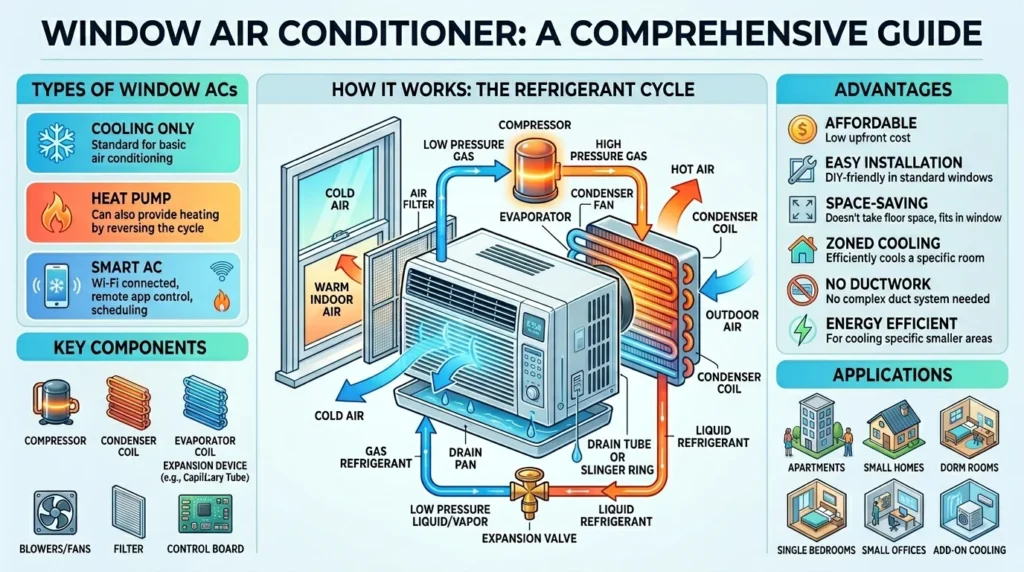
The working principle of a window air conditioner is based on the vapor compression refrigeration cycle, which transfers heat from inside a room to the outside environment. Instead of producing cold air, a window AC removes heat and humidity from indoor air and releases that heat outdoors. This continuous heat-transfer process keeps the room cool, comfortable, and dry.
A window air conditioner combines all major refrigeration components—the compressor, condenser, expansion device, evaporator, and fans—inside a single compact unit installed in a window or wall opening.
Step-by-Step Working Principle of a Window Air Conditioner
The cooling process takes place continuously while the air conditioner is operating.
1. Warm Indoor Air Is Drawn into the Unit
The indoor blower fan pulls warm and humid air from the room into the front section of the air conditioner. Before reaching the cooling coil, the air passes through an air filter that removes dust, pollen, lint, and other airborne particles, improving indoor air quality.
2. The Evaporator Coil Absorbs Heat
The filtered air flows over the evaporator coil, which contains cold, low-pressure refrigerant. As the warm air passes across the coil, heat transfers from the air to the refrigerant. At the same time, moisture in the air condenses on the cold coil, helping reduce indoor humidity.
3. The Refrigerant Evaporates
After absorbing heat, the refrigerant changes its state from a low-pressure liquid to a low-pressure vapor (gas). This phase change allows the refrigerant to carry a large amount of heat away from the room.
4. The Compressor Raises Pressure and Temperature
The compressor, often called the heart of the air conditioner, draws the low-pressure refrigerant vapor from the evaporator and compresses it. Compression significantly increases both the refrigerant’s pressure and temperature, creating a hot, high-pressure gas ready to release heat outdoors.
5. The Condenser Coil Releases Heat
The hot refrigerant enters the condenser coil, located at the rear (outdoor side) of the window AC. An outdoor fan forces outside air across the condenser coil, allowing the refrigerant to release the heat it absorbed from the room.
6. The Refrigerant Condenses into a Liquid
As heat is removed in the condenser, the refrigerant cools and changes from a high-pressure gas back into a high-pressure liquid. Although it remains under high pressure, it is now ready for the next stage of the refrigeration cycle.
7. The Expansion Device Reduces Pressure
The liquid refrigerant passes through an expansion valve or capillary tube, where its pressure drops rapidly. This sudden pressure reduction lowers the refrigerant’s temperature, producing a cold, low-pressure liquid mixture before it enters the evaporator again.
8. The Cooling Cycle Repeats Continuously
The cooled refrigerant returns to the evaporator coil to absorb more heat from the indoor air. This refrigeration cycle continues repeatedly until the desired room temperature is reached. The thermostat automatically turns the compressor on and off to maintain a comfortable indoor environment while improving energy efficiency.
Simple Explanation of How a Window Air Conditioner Works
A window air conditioner works by removing heat from the room and releasing it outside. It continuously circulates refrigerant through a closed system, where the refrigerant absorbs indoor heat at the evaporator and releases it outdoors through the condenser.
Unlike a fan, which simply circulates air, a window AC actively transfers heat out of the room, resulting in lower indoor temperatures and reduced humidity.
Simple Analogy
Imagine using a bucket to carry water from one place to another. Instead of transporting water, a window air conditioner transports heat.
- The evaporator collects heat from inside the room.
- The compressor moves the refrigerant through the system.
- The condenser dumps the collected heat outside.
- The expansion device cools the refrigerant before the process starts again.
This continuous movement of heat keeps the room cool, comfortable, and energy-efficient.
Key Components Involved in the Working Principle
The main components responsible for the cooling process include:
- Air Filter – Removes dust and airborne particles from incoming air.
- Evaporator Coil – Absorbs heat and moisture from indoor air.
- Compressor – Compresses and circulates the refrigerant.
- Condenser Coil – Releases absorbed heat to the outside environment.
- Expansion Valve or Capillary Tube – Lowers refrigerant pressure and temperature.
- Indoor Blower Fan – Circulates cool air throughout the room.
- Outdoor Fan – Removes heat from the condenser coil.
- Thermostat – Controls compressor operation to maintain the desired room temperature.
Together, these components form an efficient refrigeration system that delivers reliable cooling, humidity control, and improved indoor comfort in homes, offices, classrooms, and other small spaces.
Types of Window Air Conditioners
Window air conditioners are available in several types, each designed to meet different cooling requirements, energy-efficiency goals, and user preferences. While all window ACs operate on the same vapor compression refrigeration cycle, they differ in their control systems, compressor technology, features, and overall performance.
Choosing the right type of window air conditioner depends on factors such as room size, budget, energy consumption, and desired comfort level.
1. Manual Control Window Air Conditioner
A manual control window air conditioner is the traditional and most basic type of window AC. It uses mechanical knobs or rotary switches to control the temperature, fan speed, and operating mode. These models are simple to use, highly reliable, and relatively inexpensive, making them suitable for homes, shops, and small offices.
Key Features:
- Mechanical thermostat for temperature adjustment.
- Manual fan speed selection.
- Simple on/off controls.
- Durable and robust design.
- Easy maintenance and repair.
- Lower initial purchase cost.
Advantages:
- Affordable and easy to operate.
- Fewer electronic components reduce maintenance costs.
- Reliable performance for basic cooling needs.
- Suitable for areas with stable power supply.
Best Applications:
- Bedrooms.
- Small offices.
- Retail shops.
- Rental properties.
- Budget-conscious households.
2. Electronic Control Window Air Conditioner
An electronic control window air conditioner uses digital electronics to provide more precise temperature control and greater convenience. Instead of manual knobs, these units feature electronic control panels and often include a remote control for easier operation.
Key Features:
- Digital thermostat with accurate temperature settings.
- LED or LCD display panel.
- Remote control operation.
- Multiple cooling and fan modes.
- Programmable timer functions.
- Sleep mode and energy-saving mode.
- Automatic restart after power failure (in many models).
Advantages:
- More precise temperature regulation.
- Greater user convenience.
- Improved energy efficiency compared to manual models.
- Additional comfort features and operating modes.
- Better control over cooling performance.
Best Applications:
- Homes.
- Apartments.
- Offices.
- Hotel rooms.
- Classrooms.
3. Inverter Window Air Conditioner
An inverter window air conditioner is the most energy-efficient type of window AC. Unlike conventional models that repeatedly switch the compressor on and off, inverter technology continuously adjusts the compressor speed according to the room’s cooling requirements. This provides smoother operation, consistent cooling, and significantly lower electricity consumption.
Key Features:
- Variable-speed inverter compressor.
- Intelligent temperature control.
- Continuous cooling operation.
- Reduced power consumption.
- Low operating noise.
- Faster cooling performance.
- Enhanced humidity control.
Advantages:
- Excellent energy efficiency.
- Lower monthly electricity bills.
- Stable and consistent room temperature.
- Quieter operation with minimal compressor cycling.
- Longer compressor lifespan due to reduced wear and tear.
- Improved indoor comfort.
Best Applications:
- Homes with frequent AC usage.
- Bedrooms requiring quiet operation.
- Offices.
- Energy-conscious households.
- Areas with hot climates where air conditioners run for extended periods.
Comparison of Window Air Conditioner Types
| Feature | Manual Control | Electronic Control | Inverter Window AC |
|---|---|---|---|
| Temperature Control | Mechanical | Digital | Intelligent Variable Control |
| Compressor Operation | Fixed Speed | Fixed Speed | Variable Speed |
| Energy Efficiency | Standard | Better | Highest |
| Noise Level | Moderate | Moderate | Low |
| Remote Control | Usually No | Yes | Yes |
| Timer Functions | No | Yes | Yes |
| Electricity Consumption | Higher | Moderate | Lowest |
| Initial Cost | Lowest | Medium | Highest |
Which Type of Window Air Conditioner Should You Choose?
The best choice depends on your cooling needs and budget.
- Manual Control Window AC: Ideal for users looking for an affordable, durable, and easy-to-maintain cooling solution.
- Electronic Control Window AC: Suitable for those who want greater convenience, digital controls, and additional operating features.
- Inverter Window AC: The best option for long-term energy savings, quieter performance, superior comfort, and continuous daily use.
Selecting the right window air conditioner ensures efficient cooling, reduced operating costs, improved comfort, and reliable performance for years to come.
Main Components of a Window Air Conditioner
Understanding the main components helps technicians maintain and troubleshoot the system effectively.
Compressor
The compressor is the heart of the air conditioner.
Functions include:
- Compressing refrigerant gas
- Increasing refrigerant pressure
- Circulating refrigerant through the system
Condenser Coil
The condenser coil releases heat from the refrigerant to the outdoor air.
A fan helps improve heat transfer efficiency.
Evaporator Coil
The evaporator coil is located in the indoor section.
Functions include:
- Absorbing heat from room air
- Cooling the air before it returns to the room
Expansion Device
The expansion device reduces refrigerant pressure before it enters the evaporator coil.
Lower pressure results in lower temperature.
Fans or Blowers
Window air conditioners typically use two fans:
- Indoor fan to circulate cool air inside the room
- Outdoor fan to remove heat from the condenser
Air Filter
The air filter removes dust and particles from the air before it enters the evaporator.
Regular cleaning improves performance.
Control System
The control system regulates:
- Compressor operation
- Fan speed
- Temperature settings
Modern units include digital control boards.
Window Air Conditioner Advantages
Understanding window air conditioner advantages and disadvantages helps engineers choose the correct cooling solution.
Key Advantages
- Compact and space-saving design
- Easy installation
- Lower cost compared to split systems
- Suitable for small rooms
- Simple maintenance
- All components contained in one unit
- No need for duct systems
Real-World Benefits
Window air conditioners are ideal for small apartments, rented homes, and temporary cooling needs.
Disadvantages / Limitations
Despite their benefits, window air conditioners also have some limitations.
Common Disadvantages
- Noisy compared to split systems
- Limited cooling capacity
- Blocks part of the window
- Less attractive appearance
- Not suitable for large spaces
- Limited energy efficiency in older models
These limitations explain why many buildings now prefer split or central air conditioning systems.
Window Air Conditioner Applications
The window air conditioner applications are mainly focused on small or individual spaces.
Residential Applications
Window air conditioners are commonly used in:
- Bedrooms
- Small apartments
- Dormitories
- Rental houses
Commercial Applications
They can also be found in:
- Small offices
- Shops
- Guard rooms
- Temporary cabins
Technical Applications
Window air conditioners may also be used in:
- Small server rooms
- Control rooms
- Security booths
These environments require simple and affordable cooling solutions.
Difference Between Window Air Conditioner and Split Air Conditioner
Understanding the difference between window air conditioner and split air conditioner is important for HVAC system selection.
| Feature | Window Air Conditioner | Split Air Conditioner |
|---|---|---|
| Design | Single unit | Two separate units |
| Installation | Simple | More complex |
| Noise Level | Higher | Lower |
| Cost | Lower | Higher |
| Cooling Area | Small rooms | Medium to large rooms |
| Appearance | Visible unit | More aesthetic |
Split systems provide better comfort, but window units remain popular due to their simplicity and affordability.
Window Air Conditioner Buying Guide: How to Choose the Right Unit
Choosing the right window air conditioner is essential for achieving efficient cooling, lower electricity bills, and long-term reliability. Selecting a unit with the correct cooling capacity and features ensures maximum comfort while preventing unnecessary energy consumption. Before purchasing a window AC, consider factors such as room size, cooling capacity, energy efficiency, noise level, installation requirements, and additional features.
Choose the Right Cooling Capacity (BTU)
The cooling capacity of a window air conditioner is measured in BTU (British Thermal Units). A unit with too low a BTU rating may struggle to cool the room, while an oversized unit may cool too quickly without properly removing humidity.
Recommended BTU Ratings:
- 5,000–8,000 BTU: Small bedrooms, study rooms, or offices (up to approximately 150–350 sq. ft.).
- 8,000–12,000 BTU: Medium-sized living rooms or bedrooms (approximately 350–550 sq. ft.).
- 12,000–18,000 BTU: Large rooms, halls, or open living spaces (approximately 550–1,000 sq. ft.).
- 18,000 BTU and above: Very large rooms, commercial spaces, or offices with higher cooling demands.
Always match the BTU rating to your room size for the best performance and energy efficiency.
Check the Energy Efficiency Rating
Energy efficiency is one of the most important factors when buying a window air conditioner. Models with higher Energy Efficiency Ratio (EER) or Combined Energy Efficiency Ratio (CEER) ratings consume less electricity while providing the same cooling performance.
Benefits of High-Efficiency Models:
- Lower monthly electricity bills.
- Reduced environmental impact.
- Better cooling performance.
- Lower long-term operating costs.
- Improved overall energy savings.
If available, inverter window air conditioners generally offer the highest energy efficiency.
Consider Room Size and Heat Load
Room size alone does not determine cooling requirements. Other factors that increase the cooling load should also be considered.
Factors Affecting Cooling Performance:
- Ceiling height.
- Number of windows.
- Direct sunlight exposure.
- Number of occupants.
- Electrical appliances generating heat.
- Quality of room insulation.
Rooms with large windows or significant sun exposure may require a higher-capacity air conditioner than similarly sized shaded rooms.
Evaluate Noise Level
Noise is an important consideration, especially if the air conditioner will be installed in a bedroom, study room, or office.
Choose Models That Offer:
- Low indoor operating noise.
- Quiet fan operation.
- Silent or sleep mode.
- Inverter compressor technology for quieter performance.
A quieter air conditioner creates a more comfortable environment for sleeping, working, and studying.
Verify Electrical Requirements
Before installation, ensure that your home’s electrical system can safely support the air conditioner.
Check the Following:
- Correct supply voltage.
- Required current rating.
- Compatible electrical outlet.
- Proper circuit breaker capacity.
- Reliable grounding (earthing).
- Stable power supply.
Installing the unit according to the manufacturer’s electrical specifications improves both safety and performance.
Consider Installation Requirements
Window air conditioners require a properly sized window or wall opening for secure installation and effective heat dissipation.
Installation Considerations:
- Compatible window dimensions.
- Strong mounting support.
- Adequate outdoor ventilation.
- Proper drainage for condensate water.
- Easy access for cleaning and maintenance.
Professional installation is recommended to ensure safe operation and maximum efficiency.
Look for Useful Features
Modern window air conditioners include several features that improve comfort and convenience.
Popular Features Include:
- Digital temperature control.
- Remote control operation.
- Sleep mode.
- Energy-saving mode.
- Programmable timer.
- Auto restart after power failure.
- Multiple fan speeds.
- Washable air filters.
- Dehumidification mode.
These features enhance user comfort while helping reduce energy consumption.
Check Maintenance Requirements
Regular maintenance keeps a window air conditioner operating efficiently.
Choose a model that offers:
- Easily removable air filters.
- Accessible front panel.
- Simple cleaning procedures.
- Readily available replacement parts.
- Good manufacturer warranty and service support.
Quick Buying Tips
Before purchasing a window air conditioner, remember these recommendations:
- Select the correct BTU rating for your room size.
- Choose a model with a high EER or CEER rating.
- Consider an inverter window AC for better energy savings.
- Check the operating noise level if installing in a bedroom.
- Verify electrical compatibility before installation.
- Look for useful features such as a timer, remote control, and sleep mode.
- Purchase from a reputable brand that offers warranty coverage and after-sales support.
By considering cooling capacity, energy efficiency, room size, electrical requirements, installation needs, noise level, and modern features, you can choose a window air conditioner that delivers reliable cooling, improved comfort, and lower operating costs for many years.
Common Window Air Conditioner Problems and Their Solutions
Window air conditioners are generally reliable and easy to maintain, but like any cooling system, they can develop problems over time due to dirt buildup, worn components, refrigerant issues, or electrical faults. Identifying the cause of a problem early helps restore cooling performance, improve energy efficiency, and prevent costly repairs.
Why Is My Window Air Conditioner Not Cooling Properly?
Poor cooling is one of the most common issues experienced by users. The problem may be caused by restricted airflow, insufficient refrigerant, or a malfunctioning cooling component.
Possible Causes:
- Dirty or clogged air filter.
- Low refrigerant due to a leak.
- Dirty evaporator or condenser coil.
- Blocked condenser airflow.
- Faulty compressor.
- Incorrect thermostat setting.
- Room size exceeds the unit’s cooling capacity.
Solution:
- Clean or replace the air filter regularly.
- Clean both the evaporator and condenser coils.
- Ensure nothing blocks the outdoor section of the unit.
- Set the thermostat to the desired cooling temperature.
- Have a qualified technician inspect refrigerant pressure and repair any leaks.
- Check compressor operation if cooling remains inadequate.
Why Is Water Leaking from the Window Air Conditioner?
Water leakage usually occurs when condensation cannot drain properly or when the unit is installed incorrectly.
Possible Causes:
- Blocked condensate drain channel.
- Dirty drain pan.
- Incorrect installation angle.
- Frozen evaporator coil producing excess water.
- Excessive indoor humidity.
Solution:
- Clean the drain channel and drain pan.
- Install the unit with a slight outward tilt to allow proper drainage.
- Replace or clean clogged air filters.
- Check for frozen coils and allow them to thaw before restarting.
- Schedule routine maintenance to prevent drain blockages.
Why Is My Window AC Making Unusual Noise?
A window air conditioner normally produces some operating sound, but loud or unusual noises often indicate a mechanical problem.
Possible Causes:
- Loose mounting brackets or screws.
- Fan blades striking debris.
- Worn fan motor bearings.
- Compressor vibration.
- Loose internal components.
Solution:
- Tighten all mounting hardware.
- Inspect and clean the indoor and outdoor fan blades.
- Remove any debris from the unit.
- Replace worn fan motors or bearings if necessary.
- Have the compressor inspected if abnormal vibration continues.
Why Does the Air Conditioner Turn On and Off Frequently?
Frequent starting and stopping, known as short cycling, reduces cooling efficiency and increases electricity consumption.
Possible Causes:
- Faulty thermostat.
- Dirty air filter restricting airflow.
- Oversized air conditioner.
- Low refrigerant charge.
- Electrical control board problems.
- Compressor overheating.
Solution:
- Verify thermostat settings and calibration.
- Clean or replace the air filter.
- Inspect refrigerant levels.
- Check electrical connections and control circuits.
- Consult a qualified technician if short cycling persists.
Why Is the Airflow Weak?
Weak airflow prevents the room from cooling efficiently.
Possible Causes:
- Dirty air filter.
- Blocked evaporator coil.
- Faulty blower motor.
- Obstructed air vents.
Solution:
- Clean or replace the air filter.
- Clean the evaporator coil.
- Inspect the blower fan and motor.
- Keep furniture and curtains away from air outlets.
Why Is the Window Air Conditioner Consuming Too Much Electricity?
Higher-than-normal electricity consumption usually indicates reduced operating efficiency.
Possible Causes:
- Dirty coils.
- Clogged air filter.
- Low refrigerant level.
- Poor room insulation.
- Continuous operation during extremely hot weather.
Solution:
- Perform regular maintenance.
- Keep doors and windows closed while the AC is running.
- Seal air leaks around windows and doors.
- Choose an inverter or high-efficiency model for long-term energy savings.
Future Trends in Window Air Conditioner Technology
Although window air conditioners have been used for decades, modern innovations are making them smarter, more energy-efficient, quieter, and environmentally friendly. Manufacturers continue to improve performance while reducing electricity consumption and environmental impact.
Smart Window Air Conditioners
Modern window ACs now include built-in Wi-Fi connectivity, allowing users to control cooling through smartphone apps, voice assistants, and smart home platforms. Features such as remote operation, scheduling, energy monitoring, and automatic diagnostics provide greater convenience and efficiency.
Advanced Inverter Compressor Technology
Inverter compressors automatically adjust their operating speed according to the room’s cooling demand instead of repeatedly switching on and off. This technology provides:
- Lower electricity consumption.
- Faster and more consistent cooling.
- Quieter operation.
- Longer compressor lifespan.
- Improved temperature stability.
Eco-Friendly Refrigerants
The air conditioning industry is gradually replacing older refrigerants with environmentally friendly alternatives that have lower Global Warming Potential (GWP) and zero ozone depletion potential. These refrigerants improve environmental sustainability while maintaining excellent cooling performance.
Higher Energy Efficiency
Future window air conditioners are being designed with improved heat exchangers, high-efficiency compressors, intelligent airflow systems, and better insulation. These improvements reduce operating costs while complying with modern energy-efficiency standards.
AI-Based Climate Control
Artificial intelligence is beginning to play a role in residential air conditioning. Future systems may automatically adjust cooling based on room occupancy, outdoor weather conditions, user preferences, and historical usage patterns to maximize comfort while minimizing energy consumption.
Improved Air Purification
Many new window air conditioners are incorporating advanced air filtration technologies, including multi-stage filters, antimicrobial coatings, and air purification systems that help remove dust, allergens, bacteria, and other airborne pollutants, improving indoor air quality.
Sustainable Manufacturing
Manufacturers are increasingly using recyclable materials, environmentally responsible production methods, and energy-efficient manufacturing processes to reduce the environmental impact of window air conditioners throughout their life cycle.
As technology continues to advance, future window air conditioners will become smarter, quieter, more energy-efficient, environmentally friendly, and capable of delivering superior indoor comfort while reducing electricity consumption and operating costs.
Conclusion
Window air conditioners remain one of the most widely used cooling systems for small spaces. Their compact design, simple installation, and affordable cost make them ideal for bedrooms, apartments, offices, and temporary spaces.
In this article, we explored the window air conditioner working principle, types, main components, advantages, disadvantages, and applications. Understanding these concepts helps electrical students and technicians gain practical knowledge about HVAC systems.
We also discussed the difference between window air conditioner and split air conditioner, which helps engineers choose the most suitable system for specific environments.
For beginners in electrical and HVAC fields, studying window air conditioners provides valuable insight into refrigeration cycles, electrical motors, and heat transfer systems. With proper maintenance and correct installation, these systems can provide reliable cooling for many years.