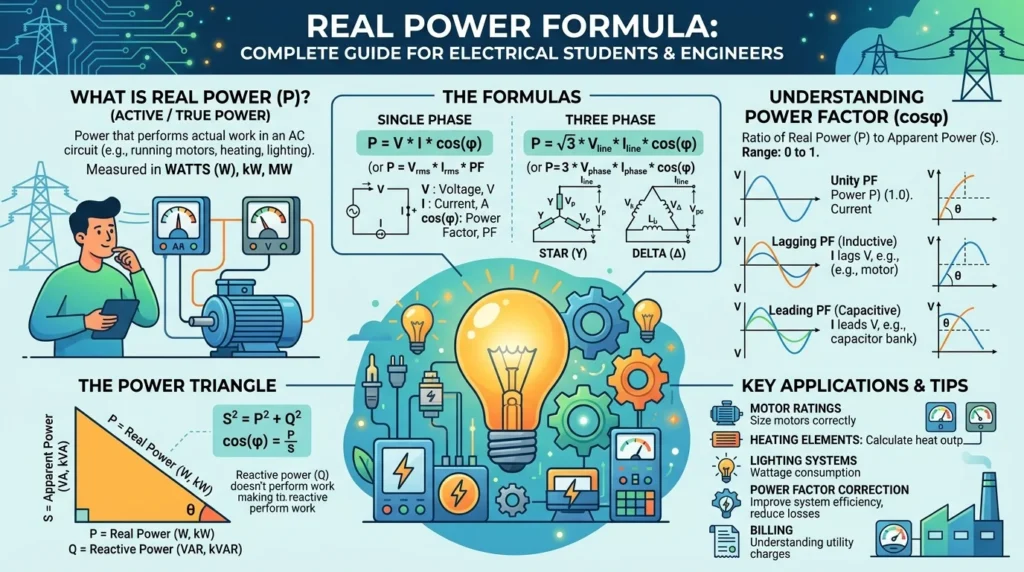

Imagine you switch on an electric heater at home during winter. The heater converts electrical energy into heat that warms the room. The actual electrical energy consumed and converted into useful work is called real power. This is the power that performs the real task in electrical systems, such as running motors, lighting bulbs, heating water, or operating industrial machines.
In electrical engineering, understanding the Real Power Formula is extremely important because it helps engineers measure how efficiently electrical energy is being used. Without understanding real power, it becomes difficult to design safe electrical systems, calculate electricity consumption, or improve power efficiency.
Whether you are an electrical student, electrician, technician, or beginner, learning the real power formula is essential for understanding AC circuits, power systems, and industrial electrical applications.
In this article, you will learn the definition of real power, the real power formula, working principle, types, components, advantages, disadvantages, applications, comparison with related power types, troubleshooting, and future trends in power systems.
What is Real Power Formula?
The Real Power Formula is used to calculate the actual useful power consumed in an electrical circuit.
In AC (Alternating Current) circuits, not all supplied power performs useful work. Some power is lost due to magnetic and reactive effects. The portion that actually performs useful work is called real power or active power.
The standard real power formula is:
P = VI\cos\phi
Where:
- P = Real Power (Watts)
- V = Voltage (Volts)
- I = Current (Amperes)
- cos φ = Power Factor
Simple Explanation
- Voltage pushes electricity
- Current carries electricity
- Power factor shows efficiency
- Real power is the actual usable electrical power
Practical Example
Suppose:
- Voltage = 230V
- Current = 10A
- Power Factor = 0.8
Then:
P = 230 \times 10 \times 0.8 = 1840\text{ W}
This means the circuit consumes 1840 watts of useful power.
Working Principle of Real Power Formula
The real power working principle is based on the relationship between voltage, current, and phase angle in AC circuits.
Step-by-Step Explanation
Step 1: Voltage is Applied
An AC voltage source supplies electrical energy to the circuit.
Step 2: Current Flows
Current flows through electrical devices such as motors, fans, or heaters.
Step 3: Phase Difference Occurs
In AC systems, current may lag or lead voltage because of inductive or capacitive loads.
Step 4: Power Factor Determines Useful Power
Only the in-phase component of current performs useful work.
Step 5: Real Power is Produced
The usable energy converted into work becomes real power.
Types / Classification of Power in AC Circuits
To understand real power better, it is important to know the types of power in electrical systems.
Real Power (Active Power)
- Performs actual useful work
- Measured in Watts (W)
- Used in heating, lighting, and motor operation
Formula:
P = VI\cos\phi
Reactive Power
- Does not perform useful work
- Required for magnetic field generation
- Common in motors and transformers
Formula:
Q = VI\sin\phi
Measured in VAR (Volt-Ampere Reactive)
Apparent Power
- Total supplied power
- Combination of real and reactive power
Formula:
S = VI
Measured in VA (Volt-Ampere)
Main Components in Real Power Calculation
Several important electrical quantities are involved in the real power formula.
Voltage (V)
- Electrical pressure that pushes current
- Measured in volts
- Supplied by generators or power sources
Current (I)
- Flow of electric charge
- Measured in amperes
- Depends on load demand
Power Factor (cos φ)
- Efficiency indicator
- Ratio between real power and apparent power
- Higher power factor means better efficiency
Phase Angle (φ)
- Difference between voltage and current waveforms
- Important in AC circuits
Advantages of Real Power Formula
The real power advantages and disadvantages section helps understand its practical importance.
Advantages
- Helps calculate actual energy consumption
- Useful for electricity billing
- Improves power system efficiency
- Essential for industrial load calculations
- Helps reduce energy wastage
- Important in generator and transformer sizing
- Supports power factor correction
- Simplifies electrical analysis
Real-World Benefits
- Industries can reduce electricity costs
- Engineers can improve system efficiency
- Electricians can design safer circuits
Disadvantages / Limitations
- Mainly used in AC systems
- Requires accurate power factor measurement
- Complex for beginners in three-phase systems
- Reactive loads affect calculations
- Harmonics may reduce accuracy
- Not sufficient alone for complete power analysis
Applications of Real Power Formula
The real power applications are very important in electrical engineering.
Residential Applications
- Home electricity consumption calculation
- Air conditioner power analysis
- Heater and appliance load calculation
Industrial Applications
- Motor power analysis
- Generator sizing
- Factory power monitoring
Commercial Applications
- Office electrical systems
- HVAC systems
- Shopping mall energy management
Modern Technology Applications
- Solar power systems
- Smart grid monitoring
- Electric vehicle charging systems
- Energy-efficient automation
Difference Between Real Power and Reactive Power
| Feature | Real Power | Reactive Power |
|---|---|---|
| Purpose | Performs useful work | Supports magnetic fields |
| Unit | Watt (W) | VAR |
| Formula | P = VI cosφ | Q = VI sinφ |
| Energy Consumption | Actual consumption | No useful consumption |
| Examples | Heaters, bulbs | Motors, transformers |
Difference Between Real Power and Apparent Power
| Feature | Real Power | Apparent Power |
|---|---|---|
| Meaning | Useful power | Total supplied power |
| Unit | Watt (W) | VA |
| Efficiency | Depends on power factor | Independent of efficiency |
| Formula | P = VI cosφ | S = VI |
Selection Guide
Understanding how to properly use the real power formula is important for beginners.
Choose Correct Formula
- Single-phase systems use:
P = VI\cos\phi
- Three-phase systems use:
P = \sqrt{3}VI\cos\phi
Measure Power Factor Correctly
- Low power factor reduces efficiency
- Use power factor meters for accurate readings
Use Proper Measuring Instruments
- Clamp meters
- Wattmeters
- Multimeters
- Power analyzers
Understand Load Type
- Resistive loads → High power factor
- Inductive loads → Lower power factor
Common Problems & Solutions
Problem 1: Incorrect Power Calculation
Solution:
Check voltage, current, and power factor values carefully.
Problem 2: Low Power Factor
Solution:
Use capacitor banks for power factor correction.
Problem 3: High Electricity Bills
Solution:
Improve real power efficiency and reduce reactive power losses.
Problem 4: Motor Overheating
Solution:
Monitor real power and load conditions properly.
Problem 5: Inaccurate Measurements
Solution:
Use calibrated measuring instruments.
Future Trends in Real Power Systems
Electrical systems are becoming smarter and more efficient.
Smart Power Monitoring
- Real-time power measurement
- IoT-based monitoring systems
AI-Based Energy Optimization
- Automatic efficiency improvement
- Intelligent load balancing
Renewable Energy Integration
- Solar and wind systems require accurate power calculations
- Real power analysis improves renewable efficiency
Smart Grids
- Advanced power monitoring
- Better load distribution
- Improved energy savings
Digital Power Analyzers
- Highly accurate measurements
- Wireless monitoring systems
Conclusion
The Real Power Formula is one of the most important concepts in electrical engineering because it measures the actual useful power consumed in a circuit. From home appliances to large industrial systems, real power helps engineers, technicians, and electricians understand energy usage and improve efficiency.
By learning the real power working principle, formulas, applications, and comparisons with reactive and apparent power, students can build a strong foundation in AC power systems. Accurate real power calculations help reduce energy losses, improve system performance, and lower electricity costs.
As modern power systems continue to evolve with smart grids, renewable energy, and intelligent monitoring systems, understanding real power becomes even more important. Every electrical student and professional should master this concept to succeed in modern electrical engineering.