
Imagine entering a large shopping mall on a hot summer afternoon. Outside, the temperature is above 40°C, but inside the building the air feels cool, fresh, and comfortable. This comfort is usually created by a Central Air Conditioner system. Unlike small room air conditioners, a central air conditioning system can cool an entire building through a network of ducts and vents.
Central air conditioning has become essential in homes, offices, hospitals, and commercial buildings. It improves comfort, increases productivity, and maintains controlled indoor environments. For engineers and technicians, understanding how these systems work is very important because central AC systems involve electrical components, refrigeration systems, and airflow control.
In this article, we will explore the Central Air Conditioner working principle, its types, main components, advantages, disadvantages, and real-world applications. The goal is to explain the topic in simple language so that electrical students, engineers, technicians, and beginners can clearly understand how a central air conditioning system operates and how to select the right system.
What is a Central Air Conditioner?
A Central Air Conditioner is a cooling system designed to regulate the temperature of an entire building from a central location. Instead of installing separate air conditioners in each room, a central AC cools the air in one place and distributes it through ducts to multiple rooms.
In simple terms, a central air conditioner removes heat from indoor air and replaces it with cooler air. The system typically consists of an outdoor unit, an indoor unit, ducts, and vents that distribute the cooled air.
Simple Example
Consider a large office building with multiple rooms and floors. Installing separate air conditioners in every room would consume more energy and space. A central air conditioner solves this problem by cooling air in one central system and delivering it to all rooms using ducts.
Because of this design, central air conditioners are commonly used in large houses, malls, hospitals, and office buildings.
How Does a Central Air Conditioner Work?
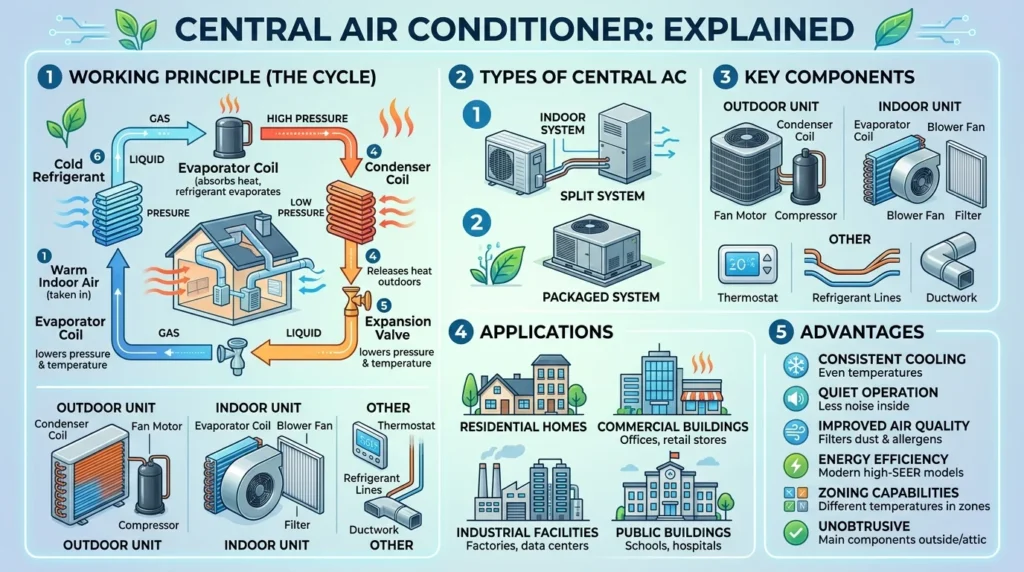
A central air conditioner works by removing heat from indoor air and transferring that heat to the outdoor environment. The system uses a refrigeration cycle along with fans, coils, ducts, and controls to provide cooling throughout a building.
Unlike a portable or window air conditioner that generally serves a single room, a central AC system distributes conditioned air through a network of supply and return ducts.
Step-by-Step Working Process
1. Warm Indoor Air Is Collected
Warm air from different areas of the building enters the central AC system through return air ducts. The air usually passes through a filter that helps remove dust and airborne particles.
2. Air Passes Over the Evaporator Coil
The return air flows across the cold evaporator coil. Refrigerant inside the coil absorbs heat from the indoor air, causing the air temperature to decrease.
3. Blower Circulates the Cooled Air
A blower fan moves the cooled air through the supply duct system. The air travels through ducts toward different rooms and areas of the building.
4. Compressor Raises Refrigerant Pressure
After absorbing heat, the refrigerant leaves the evaporator as a low-pressure vapor and enters the compressor. The compressor increases the refrigerant’s pressure and temperature.
5. Condenser Releases Heat Outdoors
The high-pressure, high-temperature refrigerant flows through the outdoor condenser coil. The condenser fan moves outdoor air across the coil, allowing heat to transfer from the refrigerant to the outside environment.
6. Expansion Device Reduces Pressure
After releasing heat, the refrigerant passes through an expansion device. Its pressure and temperature decrease, preparing it to absorb heat again in the evaporator.
7. Cooling Cycle Repeats
The refrigerant returns to the evaporator coil, where it can absorb more heat from indoor air. This cycle continues while the system is operating and cooling is required.
8. Thermostat Controls the System
A thermostat monitors the indoor temperature and signals the system when cooling is needed. Modern systems may also use variable-speed equipment and smart controls to adjust operation according to cooling demand.
Simple Central AC Working Flow
Warm Indoor Air → Return Duct → Filter → Evaporator Coil → Cooled Air → Supply Ducts → Rooms
At the same time, the refrigeration cycle follows:
Evaporator → Compressor → Condenser → Expansion Device → Evaporator
This coordinated process allows a central air conditioner to continuously remove heat from indoor spaces and distribute cooled air throughout the building.
Central Air Conditioner Power Consumption
The power consumption of a central air conditioner depends on several factors, including the system’s cooling capacity, efficiency rating, compressor type, outdoor temperature, thermostat setting, and operating hours. Larger central AC systems generally require more electrical power than smaller systems.
Central air conditioners are commonly rated by their cooling capacity in BTU per hour (BTU/h) or tons, while their electrical consumption is measured in watts (W) or kilowatts (kW).
Central Air Conditioner Electricity Consumption Formula
The basic formula for calculating electrical energy consumption is:
Energy Consumption (kWh) = Power (kW) × Operating Time (hours)
For example, if a central AC system uses 3 kW of electrical power and operates for 8 hours:
3 × 8 = 24 kWh
Therefore, the system would consume approximately 24 kWh during 8 hours of operation at that power level.
How to Calculate Monthly AC Consumption
Suppose a central air conditioner consumes an average of 3 kW and operates for 8 hours per day.
Daily consumption:
3 × 8 = 24 kWh
30-day consumption:
24 × 30 = 720 kWh
This is an illustrative calculation. Actual electricity consumption can be lower or higher because a central AC compressor may cycle on and off rather than operate continuously at full power.
Factors Affecting Central AC Power Consumption
Several factors can increase or decrease electricity usage:
- Cooling capacity: Larger systems may require more electrical power.
- Operating hours: Longer operation increases total energy consumption.
- Energy efficiency: Higher-efficiency systems can provide cooling with less electricity.
- Outdoor temperature: Extremely hot weather can increase cooling demand.
- Thermostat setting: Lower temperature settings can increase operating time.
- Building insulation: Poor insulation can cause more heat to enter the building.
- Air filters: Dirty filters can restrict airflow and reduce system performance.
- Duct condition: Leaking or poorly insulated ducts can result in cooling losses.
- Compressor type: Variable-speed and inverter-driven compressors can adjust operation according to cooling demand.
Does Central AC Use a Lot of Electricity?
A central air conditioner can use a significant amount of electricity because it is designed to cool large areas or entire buildings. However, electricity consumption should be evaluated together with the system’s cooling capacity and efficiency rather than by wattage alone.
A properly sized, well-maintained, and efficient system can provide effective cooling while reducing unnecessary energy use.
How to Reduce Central AC Electricity Consumption
You can reduce energy consumption by maintaining clean filters, keeping doors and windows closed while the system is cooling, improving building insulation, and using appropriate thermostat settings.
Regular professional maintenance can also help identify airflow restrictions, dirty coils, refrigerant problems, and other conditions that may cause the system to operate inefficiently.
For an accurate estimate of electricity cost, use the system’s actual power consumption and your local electricity rate.
Central Air Conditioner Cooling Capacity: BTU and Tons
Choosing the correct cooling capacity is one of the most important steps when selecting a central air conditioner. Cooling capacity indicates how much heat the system can remove from a building over a specific period.
Central air conditioning systems are commonly described by their cooling capacity in BTU per hour (BTU/h) or tons of refrigeration.
What Is BTU in Air Conditioning?
BTU stands for British Thermal Unit. In air conditioning, BTU/h indicates the amount of heat an air conditioner can remove from an indoor space in one hour.
For example, a system rated at 36,000 BTU/h has a nominal cooling capacity of 36,000 BTU per hour.
A higher BTU rating generally indicates greater cooling capacity, but the correct size depends on the building’s heat load rather than floor area alone.
What Is a Ton of Cooling?
In HVAC systems, a ton of refrigeration is a unit of cooling capacity.
1 ton of cooling = 12,000 BTU/h
Common examples include:
- 1 ton = 12,000 BTU/h
- 1.5 tons = 18,000 BTU/h
- 2 tons = 24,000 BTU/h
- 2.5 tons = 30,000 BTU/h
- 3 tons = 36,000 BTU/h
- 4 tons = 48,000 BTU/h
- 5 tons = 60,000 BTU/h
These ratings describe cooling capacity, not the amount of electricity the air conditioner consumes.
How Is Central AC Size Determined?
The required capacity of a central air conditioner depends on the building’s total cooling load. HVAC professionals consider several factors when sizing a system.
Important factors include:
- Building floor area
- Ceiling height
- Outdoor climate
- Number of occupants
- Windows and doors
- Sun exposure
- Building insulation
- Lighting and electrical equipment
- Heat generated by appliances
- Ventilation and outdoor air requirements
Because these factors vary between buildings, simply choosing an AC size based only on square footage can result in an improperly sized system.
What Happens If the AC Is Too Small?
An undersized central air conditioner may struggle to meet the desired indoor temperature during hot weather.
Possible results include:
- Longer operating periods
- Difficulty maintaining the thermostat setting
- Increased wear on components
- Reduced comfort
- Higher operating costs in some conditions
What Happens If the AC Is Too Large?
An oversized system can also create problems. It may reach the thermostat setting quickly and cycle on and off more frequently than intended.
Short cycling can reduce efficiency, increase mechanical wear, and provide less effective humidity control in some climates.
Therefore, the goal is not simply to select the largest available system. The AC should be properly matched to the building’s cooling load.
Why Proper Central AC Sizing Matters
Correct sizing helps the system provide effective temperature control while operating efficiently. It can also improve comfort, reduce unnecessary cycling, and support proper humidity control where applicable.
For a new central AC installation or replacement, a qualified HVAC professional should perform an appropriate cooling-load calculation before selecting the equipment.
The correct system size depends on the actual characteristics of the building, not just its floor area.
Types / Classification of Central Air Conditioner
Central air conditioning systems are classified based on their design and cooling method.
Split Central Air Conditioner
This system has two main units:
- Indoor unit (evaporator coil and blower)
- Outdoor unit (compressor and condenser)
The two units are connected through refrigerant pipes.
Common Uses
- Residential homes
- Small offices
- Apartments
Packaged Central Air Conditioner
In this type, all components are installed in a single outdoor cabinet. The cooled air is delivered through ducts into the building.
Common Uses
- Hotels
- Small commercial buildings
- Shopping centers
Chilled Water Central AC System
Large buildings often use a chilled water system. Water is cooled in a chiller plant and circulated through pipes to air handling units.
Common Uses
- Airports
- Hospitals
- Large commercial complexes
Main Components of Central Air Conditioner
A central air conditioner contains several important components. Each component performs a specific function.
Compressor
The compressor is the heart of the system. It compresses the refrigerant gas, increasing its pressure and temperature.
Condenser Coil
The condenser releases heat from the refrigerant into the outside environment.
Evaporator Coil
This coil absorbs heat from indoor air. As a result, the air becomes cooler.
Expansion Valve
The expansion valve controls refrigerant flow and reduces its pressure before entering the evaporator.
Blower Fan
The blower circulates air through ducts and distributes cooled air across the building.
Duct System
Ducts carry cooled air from the central system to different rooms.
Thermostat
The thermostat controls the temperature by turning the system on or off automatically.
Central Air Conditioner Maintenance
Regular maintenance is important for keeping a central air conditioner operating efficiently and reliably. Dust, restricted airflow, dirty coils, clogged filters, and mechanical problems can reduce cooling performance and increase operating costs.
A proper maintenance routine should include basic homeowner checks as well as professional HVAC servicing when required.
1. Replace or Clean Air Filters
Air filters collect dust and airborne particles before air enters the HVAC system. A dirty filter can restrict airflow and make the system work harder.
Check the filter regularly and clean or replace it according to the filter type and manufacturer’s recommendations.
2. Clean the Evaporator Coil
The evaporator coil transfers heat from indoor air to the refrigerant. Dust and dirt buildup can reduce heat transfer and restrict system performance.
The evaporator coil should be inspected and cleaned when necessary. Internal coil cleaning may require professional HVAC service.
3. Clean the Condenser Coil
The outdoor condenser coil releases heat from the refrigerant into the outside air. Dirt, leaves, grass, and other debris can block airflow around the coil.
Keep the area around the outdoor unit clear and have the condenser coil cleaned when required.
4. Inspect the Duct System
Ducts carry conditioned air throughout the building. Leaks, damaged insulation, or blocked ducts can reduce airflow and cause cooling losses.
Inspect accessible ducts for visible damage and have significant leaks or insulation problems repaired by a qualified HVAC professional.
5. Check the Blower and Airflow
The blower moves air through the HVAC system and ductwork. Restricted airflow can result from dirty filters, blocked ducts, or problems with the blower assembly.
If airflow from supply vents becomes noticeably weaker, the system should be inspected to identify the cause.
6. Check the Thermostat
Make sure the thermostat is operating correctly and accurately responding to indoor temperature. For programmable or smart thermostats, review the temperature schedule and operating settings regularly.
Incorrect settings can cause unnecessary system operation and increase energy consumption.
7. Inspect Refrigerant System
Low refrigerant levels are not normally something that should be corrected simply by adding refrigerant without finding the underlying cause. A refrigerant shortage can indicate a leak or another system problem.
Refrigerant inspection, leak detection, recovery, and charging should be performed by a qualified HVAC technician using the appropriate equipment.
8. Inspect Electrical Connections
Central AC systems contain electrical components such as contactors, capacitors, motors, disconnects, and control wiring.
During professional maintenance, these components can be inspected for signs of wear, loose connections, overheating, or damage.
Always disconnect electrical power before performing any maintenance that requires access to electrical components.
9. Keep the Outdoor Unit Clear
Maintain adequate clearance around the outdoor condenser unit. Remove leaves, branches, grass, and other debris that could restrict airflow.
Do not place objects directly against the condenser or block its air discharge area.
10. Schedule Professional Maintenance
Some maintenance tasks require specialized tools and technical knowledge. Professional HVAC servicing can include inspection of refrigerant pressures, electrical components, coils, motors, airflow, controls, and overall system operation.
The appropriate service interval depends on the equipment, operating conditions, manufacturer recommendations, and building environment.
Benefits of Regular Central AC Maintenance
Proper maintenance can help:
- Maintain effective cooling performance
- Improve airflow
- Reduce unnecessary energy consumption
- Identify problems before they become more serious
- Extend equipment service life
- Reduce unexpected breakdowns
- Maintain more consistent indoor comfort
Regular maintenance does not guarantee that a system will never fail, but it can help keep the equipment operating safely and efficiently.
Central Air Conditioner Advantages and Disadvantages
Understanding the Central Air Conditioner advantages and disadvantages helps engineers and technicians evaluate system performance.
Advantages
- Provides uniform cooling across the entire building
- Quiet operation compared to multiple room AC units
- Improves indoor air quality with filtration
- Higher energy efficiency for large spaces
- Increases comfort and productivity
- Enhances property value
Disadvantages / Limitations
- High installation cost
- Requires duct system installation
- Maintenance can be complex
- Energy consumption can be high in large buildings
- System failure affects the entire building
Central Air Conditioner Safety Tips
Central air conditioners contain electrical equipment, moving mechanical parts, refrigerant, and pressurized components. Following basic safety practices can help reduce the risk of electrical hazards, equipment damage, and improper servicing.
1. Turn Off Power Before Servicing
Always disconnect the electrical power before cleaning, inspecting, or servicing components that require access to the equipment. The outdoor unit may have a dedicated disconnect, but the appropriate shutdown procedure should follow the manufacturer’s instructions.
2. Do Not Work on Live Electrical Components
Central AC systems can contain high-voltage electrical circuits, capacitors, contactors, motors, and control wiring. Do not attempt electrical repairs while the system is energized.
Electrical troubleshooting and repairs should be performed by a qualified technician.
3. Keep the Outdoor Unit Clear
Keep leaves, grass, branches, tools, and other objects away from the outdoor condenser unit. Blocked airflow can reduce heat transfer and affect system performance.
Maintain the clearance specified by the equipment manufacturer.
4. Protect the System From Water Damage
Do not spray water directly into electrical control components or other areas where moisture could cause damage. When cleaning an outdoor condenser coil, follow the manufacturer’s cleaning instructions and avoid unnecessary contact with electrical components.
5. Check the Power Cord and Wiring
Inspect accessible wiring and electrical connections for visible signs of damage, overheating, melting, or loose connections.
If damaged wiring or electrical components are found, turn off the system and have the problem inspected by a qualified professional.
6. Handle Refrigerant Carefully
Refrigerants are used under pressure and require proper handling equipment and procedures. Refrigerant recovery, leak detection, charging, and other refrigerant-system work should be performed by trained and qualified HVAC professionals.
Do not attempt to release refrigerant into the atmosphere.
7. Keep Air Filters Clean
A severely clogged air filter can restrict airflow and cause the HVAC system to operate improperly. Check filters regularly and clean or replace them according to the manufacturer’s recommendations.
8. Do Not Block Supply or Return Vents
Keep furniture, curtains, boxes, and other objects away from supply and return air vents. Blocked vents can restrict airflow and reduce system performance.
9. Watch for Unusual Sounds or Odors
Turn off the system and arrange for an inspection if you notice unusual grinding, buzzing, burning smells, repeated electrical tripping, or other abnormal behavior.
Continuing to operate equipment with a serious electrical or mechanical fault can cause additional damage.
10. Use the Correct Replacement Parts
When components need replacement, use parts that are compatible with the specific AC system and follow the manufacturer’s specifications. Incorrect electrical or mechanical components can affect system performance and create safety risks.
11. Schedule Professional Inspections
Regular professional inspections can help identify electrical, refrigerant, airflow, drainage, and mechanical problems before they become more serious.
For complex repairs, electrical faults, refrigerant work, or internal component replacement, use a qualified HVAC technician.
Why Central AC Safety Matters
Proper safety practices protect both people and equipment. Central air conditioning systems combine electricity, refrigeration, airflow, and mechanical components, so maintenance should always be performed according to the manufacturer’s instructions and appropriate safety procedures.
For homeowners, basic tasks such as checking filters and keeping outdoor areas clear are generally straightforward. More advanced electrical, refrigerant, and mechanical work should be left to qualified professionals.
Central Air Conditioner Applications
Central AC systems are widely used in different environments.
Residential Applications
- Large houses
- Luxury apartments
- Villas
Commercial Applications
- Shopping malls
- Office buildings
- Hotels
Industrial Applications
- Factories
- Data centers
- Manufacturing plants
Modern Technology Uses
- Hospitals and laboratories
- Airports and railway stations
- Smart buildings
These Central Air Conditioner applications show why the system is essential for modern infrastructure.
Comparison Section
Many people ask about the difference between central air conditioner and split air conditioner.
| Feature | Central Air Conditioner | Split Air Conditioner |
|---|---|---|
| Cooling Area | Entire building | Single room |
| Installation Cost | High | Moderate |
| Energy Efficiency | Better for large spaces | Better for small rooms |
| Maintenance | Complex | Easy |
| Noise Level | Quiet indoors | Slight indoor noise |
This comparison helps users choose the right cooling system.
Central Air Conditioner vs Window AC
Central air conditioners and window air conditioners are both designed to cool indoor spaces, but they differ significantly in their capacity, installation, airflow distribution, and typical applications. A central AC system is designed to provide cooling to multiple rooms through ductwork, while a window AC is generally installed in a single room or enclosed area.
Understanding the difference can help homeowners, technicians, and building managers select a suitable cooling system.
Central AC vs Window AC: Key Differences
| Feature | Central Air Conditioner | Window Air Conditioner |
|---|---|---|
| Cooling Area | Multiple rooms or entire building | Usually one room |
| Air Distribution | Uses ducts and vents | Directly cools the room |
| Installation | More complex | Relatively simple |
| Initial Cost | Generally higher | Generally lower |
| Ductwork | Usually required | Not required |
| Space Requirement | Requires indoor and outdoor equipment or a packaged system | Installed in a window or suitable wall opening |
| Maintenance | More complex | Generally simpler |
| Capacity | Available in larger capacities | Usually designed for smaller spaces |
| Temperature Control | Can control multiple zones depending on system design | Primarily controls one room |
| Best For | Large homes and commercial buildings | Small rooms and individual spaces |
How Central Air Conditioning Differs
A central air conditioner cools air at a central location and distributes it through supply ducts to different areas of a building. Return ducts collect indoor air and send it back to the central system for conditioning.
This design makes central AC suitable for buildings that require consistent cooling across multiple rooms.
How a Window Air Conditioner Differs
A window air conditioner is a self-contained unit that contains major refrigeration components, including the compressor, condenser, evaporator, and fans.
The unit is installed in a window or specially prepared opening. It removes heat from the room and releases that heat outdoors while supplying cooled air directly into the room.
Which Is More Energy Efficient?
Energy efficiency depends on the specific equipment, cooling capacity, operating conditions, and building requirements. A window AC may use less total electricity simply because it is cooling a smaller space.
A properly sized and efficient central AC system can be a practical solution for cooling a large building. However, operating a central system to cool an entire building when cooling is needed in only one small room may not be the most efficient approach.
Which Is Easier to Install?
A window air conditioner generally requires less installation work because it is a self-contained unit. It needs an appropriate window or wall opening and a suitable electrical supply.
Central AC installation is more complicated because it may require indoor and outdoor equipment, refrigerant lines, ductwork, electrical connections, condensate drainage, controls, and professional system commissioning.
Which One Should You Choose?
A central air conditioner is generally better suited to large homes, offices, commercial buildings, and other spaces that require cooling across multiple rooms.
A window air conditioner can be a practical option for a single room, smaller space, rental property, or situation where installing a complete central duct system is not practical.
The best choice depends on building size, cooling requirements, installation conditions, budget, energy efficiency, and long-term maintenance needs.
Central Air Conditioner vs Heat Pump
Central air conditioners and heat pumps can both provide cooling for buildings, and their cooling operation is based on a similar refrigeration cycle. The main difference is that a heat pump can reverse the refrigeration cycle to provide heating as well as cooling.
A central air conditioner is primarily designed for cooling, while a heat pump can provide both heating and cooling from the same system.
Central AC vs Heat Pump: Key Differences
| Feature | Central Air Conditioner | Heat Pump |
|---|---|---|
| Cooling | Yes | Yes |
| Heating | Requires a separate heating system | Yes |
| Refrigeration Cycle | Primarily operates in cooling mode | Can reverse between cooling and heating |
| Main Components | Compressor, condenser, evaporator, expansion device | Similar components plus reversing controls |
| Year-Round Use | Primarily cooling | Heating and cooling |
| Outdoor Unit | Releases heat during cooling | Releases or absorbs heat depending on operating mode |
| Best For | Buildings primarily needing cooling | Buildings needing both heating and cooling |
How a Central Air Conditioner Works
During cooling operation, a central air conditioner absorbs heat from indoor air through the evaporator coil and transfers that heat outdoors through the condenser coil.
The system then distributes cooled air throughout the building using ductwork.
How a Heat Pump Works
A heat pump can operate in cooling mode in a similar way to a central AC system. However, it contains a reversing valve that allows the direction of refrigerant flow to change.
In heating mode, the heat pump extracts heat from the outdoor environment and transfers it indoors. This allows the same system to provide heating without requiring a separate conventional heating appliance.
Which Is More Energy Efficient?
Efficiency depends on the equipment, climate, operating conditions, system design, and energy prices.
A heat pump can be an efficient option for buildings that require both heating and cooling because one system can perform both functions. A central AC may be a practical choice in climates where cooling is the primary requirement and heating is provided separately.
Modern heat pumps can also use variable-speed compressors and advanced controls to adjust operation according to heating or cooling demand.
Which System Should You Choose?
A central air conditioner may be suitable when the primary requirement is reliable cooling and the building already has a separate heating system.
A heat pump may be a better choice when both heating and cooling are required and the climate is suitable for heat-pump operation.
The final selection should consider building heat load, cooling requirements, heating requirements, climate, equipment efficiency, installation cost, and long-term operating costs.
Important Difference
The simplest way to remember the difference is:
Central AC = Primarily Cooling
Heat Pump = Heating + Cooling
Both systems can use similar refrigeration components, but the heat pump adds the ability to reverse the refrigeration cycle and transfer heat in the opposite direction.
Central Air Conditioner Energy Efficiency: SEER and SEER2
Energy efficiency is an important factor when selecting a central air conditioner because cooling equipment can operate for many hours during hot weather. A more efficient system can provide the required cooling while using less electricity under comparable operating conditions.
One important efficiency metric for central air conditioners is SEER, which stands for Seasonal Energy Efficiency Ratio. In the United States, newer equipment may be rated using SEER2, an updated testing and rating methodology.
What Is SEER?
SEER measures the amount of cooling an air conditioner provides during a typical cooling season compared with the electrical energy it consumes during that period.
In simple terms:
SEER = Seasonal Cooling Output ÷ Seasonal Electrical Energy Consumption
A higher SEER rating generally indicates greater seasonal cooling efficiency, although actual energy use depends on factors such as climate, thermostat settings, system size, operating hours, installation quality, and maintenance.
What Is SEER2?
SEER2 is an updated version of the seasonal efficiency rating used for applicable residential air-conditioning equipment in the United States. It uses updated testing procedures intended to better reflect real-world operating conditions.
When comparing newer central AC systems, consumers may see SEER2 rather than the older SEER rating.
Why Does Energy Efficiency Matter?
A central air conditioner can represent a significant portion of a building’s electricity use during hot weather. Selecting an appropriately sized and efficient system can help reduce unnecessary energy consumption.
However, the highest efficiency rating is not always automatically the best choice. The purchase price, expected operating hours, local climate, equipment capacity, installation quality, and expected service life should also be considered.
Factors That Affect Central AC Efficiency
Several factors influence the actual efficiency of a central air conditioning system:
- SEER or SEER2 rating
- Proper equipment sizing
- Compressor technology
- Outdoor temperature
- Thermostat settings
- Building insulation
- Duct condition
- Air filter condition
- Evaporator and condenser coil cleanliness
- Correct refrigerant charge
- Quality of installation and commissioning
Even a highly rated system may perform poorly if it is incorrectly sized, improperly installed, or poorly maintained.
How to Improve Central AC Efficiency
You can help improve system efficiency by keeping air filters clean, maintaining clear airflow around the outdoor unit, inspecting ductwork, using appropriate thermostat settings, and scheduling recommended professional maintenance.
Proper insulation and sealing of the building envelope can also reduce the amount of heat entering the building, which can lower the cooling demand placed on the AC system.
Should You Choose a Higher SEER2 Rating?
A higher efficiency rating can be beneficial, especially for buildings that require frequent cooling. However, the best choice depends on the total cost of ownership rather than the efficiency rating alone.
Before purchasing a central AC system, compare:
- Equipment purchase price
- Installation cost
- Cooling capacity
- SEER2 rating
- Expected operating hours
- Local climate
- Available rebates or incentives
- Maintenance requirements
- Expected service life
A properly sized, correctly installed, and well-maintained central air conditioner can provide efficient cooling throughout its operating life.
Central Air Conditioner Common Problems and Troubleshooting
Central air conditioners can develop problems due to restricted airflow, dirty components, electrical faults, refrigerant issues, drainage problems, or normal component wear. Identifying the symptoms can help determine when basic maintenance may be enough and when professional service is required.
1. Central AC Is Not Cooling
If the central air conditioner is running but the building is not cooling properly, several factors may be responsible.
Possible causes:
- Dirty or clogged air filter
- Dirty evaporator or condenser coil
- Incorrect thermostat settings
- Restricted airflow
- Refrigerant leak or incorrect refrigerant charge
- Compressor or electrical problems
Solution: Check the thermostat and air filter first. Make sure the outdoor unit has adequate airflow. If the problem continues, have the system inspected by a qualified HVAC technician.
2. Weak Airflow From Vents
Weak airflow can prevent conditioned air from reaching rooms effectively.
Possible causes:
- Dirty air filter
- Blocked supply or return vents
- Leaking or damaged ducts
- Blower motor problems
- Restricted ductwork
Solution: Check the filter and make sure vents are not blocked by furniture or other objects. Persistent airflow problems may require professional duct and blower inspection.
3. Central AC Is Making Unusual Noises
Unusual sounds can indicate mechanical or electrical problems.
Common sounds include:
- Rattling
- Grinding
- Buzzing
- Hissing
- Excessive vibration
Possible causes:
- Loose components
- Fan motor problems
- Debris around the outdoor unit
- Electrical component faults
- Refrigerant or airflow-related issues
Solution: Turn off the system if the noise is severe, unusual, or accompanied by a burning smell or repeated electrical tripping. Arrange for professional inspection.
4. AC Is Short Cycling
Short cycling occurs when the air conditioner turns on and off repeatedly without completing a normal cooling cycle.
Possible causes:
- Incorrect system sizing
- Thermostat problems
- Restricted airflow
- Dirty components
- Refrigeration-system problems
Solution: Check the air filter and thermostat settings. If short cycling continues, professional diagnosis is recommended because repeated cycling can increase equipment wear.
5. Central AC Uses Too Much Electricity
Higher-than-normal electricity consumption can occur when the system operates for longer periods or loses efficiency.
Possible causes:
- Dirty air filter
- Dirty coils
- Poor insulation
- Duct leakage
- Incorrect equipment sizing
- Very high outdoor temperatures
- Aging or inefficient equipment
Solution: Maintain clean filters and coils, inspect ductwork, and make sure the thermostat is set appropriately. A professional energy or HVAC inspection can identify less obvious efficiency problems.
6. Water Is Leaking From the AC
Water around the indoor unit may indicate a condensate drainage problem.
Possible causes:
- Clogged condensate drain
- Damaged drain pan
- Drainage system problems
- Excessive condensation
Solution: Turn off the system if significant water is accumulating and arrange for inspection. Do not allow water to reach electrical components.
7. AC Keeps Tripping the Circuit Breaker
A circuit breaker that repeatedly trips should not simply be reset again and again.
Possible causes:
- Electrical short circuit
- Overloaded circuit
- Compressor problem
- Motor fault
- Damaged wiring
- Electrical component failure
Solution: Turn off the equipment and have the electrical and HVAC systems inspected by a qualified professional.
8. Thermostat Is Not Working Properly
A faulty thermostat can cause incorrect temperature control or prevent the AC from operating normally.
Possible causes:
- Incorrect settings
- Low battery in battery-powered thermostats
- Wiring problems
- Sensor problems
- Thermostat failure
Solution: Check the settings and batteries if applicable. If the thermostat still does not respond correctly, professional diagnosis may be required.
When Should You Call a Professional?
Professional service is recommended for problems involving:
- Refrigerant systems
- Compressor faults
- High-voltage electrical components
- Repeated circuit-breaker trips
- Motor replacement
- Major ductwork repairs
- Persistent water leakage
- Serious mechanical damage
Basic tasks such as checking filters and keeping outdoor areas clear can often be performed by the building owner. More complex electrical, refrigeration, and mechanical work should be handled by qualified technicians.
Regular maintenance can help identify many problems before they lead to major equipment failure.
Frequently Asked Questions About Central Air Conditioners
1. What is a central air conditioner?
A central air conditioner is a cooling system designed to cool multiple rooms or an entire building. It removes heat from indoor air and distributes conditioned air through a network of ducts and vents.
2. How does a central air conditioner work?
A central AC uses a refrigeration cycle to remove heat from indoor air. Warm air passes over the evaporator coil, where heat is absorbed by the refrigerant. The refrigerant then carries the heat to the outdoor condenser, where it is released into the outside environment.
3. What are the main components of a central air conditioner?
The main components include the compressor, condenser coil, evaporator coil, expansion device, blower fan, air filters, ductwork, thermostat, and electrical controls.
4. What are the different types of central air conditioners?
Common types include split central air conditioners, packaged central air conditioners, and chilled-water central air conditioning systems. The appropriate type depends on the building size, cooling requirements, and system design.
5. Does a central air conditioner cool the entire house?
Yes. A properly designed central AC system can distribute conditioned air to multiple rooms through supply ducts. Zoning controls can also allow different areas to be controlled separately in suitable systems.
6. Does central AC use a lot of electricity?
Central AC can consume a significant amount of electricity because it is designed to cool large areas. Actual consumption depends on system capacity, efficiency, outdoor temperature, thermostat settings, operating hours, insulation, and maintenance.
7. What is the difference between central AC and split AC?
A central AC system typically distributes conditioned air to multiple rooms through ductwork, while a conventional split AC generally serves an individual room or zone. Central AC is commonly used for larger buildings, while split systems can be practical for individual spaces.
8. What is BTU in a central air conditioner?
BTU/h is a measure of cooling capacity. It indicates how much heat an air-conditioning system can remove from a space in one hour.
For example, 1 ton of cooling capacity equals 12,000 BTU/h.
9. How often should a central air conditioner be maintained?
Maintenance frequency depends on the equipment, operating conditions, environment, and manufacturer’s recommendations. Air filters may require more frequent attention, while professional inspection and servicing should follow the equipment manufacturer’s recommended schedule.
10. Why is my central AC not cooling properly?
Common causes include a dirty air filter, restricted airflow, dirty coils, thermostat problems, duct issues, or refrigeration-system problems. Check basic items such as the thermostat and filter first. Persistent problems should be inspected by a qualified HVAC technician.
11. Why does my central AC keep turning on and off?
Frequent cycling can be caused by incorrect system sizing, thermostat problems, restricted airflow, dirty components, or other equipment faults. Repeated short cycling should be investigated because it can affect comfort and increase equipment wear.
12. Can a central AC also provide heating?
A conventional central air conditioner is primarily designed for cooling. A separate heating system may be used for heating. However, a heat pump can provide both heating and cooling by reversing the refrigeration cycle.
13. What is SEER2 in central air conditioning?
SEER2 is a seasonal energy-efficiency rating used for applicable air-conditioning equipment in the United States. It provides an indication of seasonal cooling efficiency under standardized testing conditions. Actual energy consumption depends on equipment, installation, climate, and operating conditions.
14. How long does a central air conditioner last?
The service life of a central AC system depends on equipment quality, installation, climate, operating hours, maintenance, and other conditions. Regular maintenance and proper operation can help extend equipment life, but individual systems can vary considerably.
15. Is central AC better than a window air conditioner?
It depends on the application. Central AC is generally better suited to large homes and buildings that require cooling across multiple rooms. A window AC can be more practical for cooling a single room without installing a central duct system.
16. Can a central air conditioner improve indoor air quality?
A central HVAC system can help manage indoor air quality through filtration and, depending on the system, ventilation and other air-treatment equipment. Performance depends on the filter, system design, ventilation, maintenance, and indoor conditions.
17. Why is regular central AC maintenance important?
Regular maintenance helps maintain airflow and cooling performance and can identify problems such as dirty filters, coil buildup, drainage issues, electrical faults, and other equipment problems before they become more serious.
18. What should I consider when choosing a central air conditioner?
Important factors include building cooling load, system capacity, energy efficiency, climate, installation requirements, ductwork, equipment cost, operating costs, maintenance requirements, and availability of professional service.
Conclusion
A Central Air Conditioner is one of the most effective cooling solutions for large buildings. Instead of cooling individual rooms separately, the system cools air at a central location and distributes it through ducts to multiple areas. This approach ensures consistent temperature control, improved comfort, and efficient cooling performance.
Understanding the Central Air Conditioner working principle, components, and system types is important for electrical students, technicians, and engineers. Knowledge of system advantages, limitations, and maintenance practices helps in designing and operating efficient HVAC systems.
As technology advances, central air conditioning systems are becoming smarter, more energy-efficient, and environmentally friendly. Engineers who understand these systems today will play an important role in designing the sustainable buildings of tomorrow.
Learning the fundamentals of central air conditioning is therefore an important step for anyone interested in electrical engineering, HVAC technology, or building infrastructure.