
Imagine a large factory where hundreds of electrical machines are running at the same time. Suddenly, a short circuit occurs in one machine. Without a proper protection system, the fault could spread through the entire electrical network, damaging expensive equipment and putting workers at risk. This is where switchgear becomes essential. It quickly detects electrical faults, disconnects the affected circuit, and keeps the rest of the power system operating safely.
Switchgear is one of the most important parts of modern electrical systems. It is used in homes, commercial buildings, factories, power plants, substations, and renewable energy systems. Its main job is to control, protect, and isolate electrical equipment during normal operation and fault conditions. Without switchgear, electrical systems would be much more dangerous and less reliable.
In this guide, you will learn what switchgear is, the switchgear working principle, its different types, main components, advantages, disadvantages, applications, selection tips, common problems, and future trends. Whether you are an electrical student, engineer, technician, or beginner, this article will help you understand switchgear in simple and practical language.
What Is Switchgear?
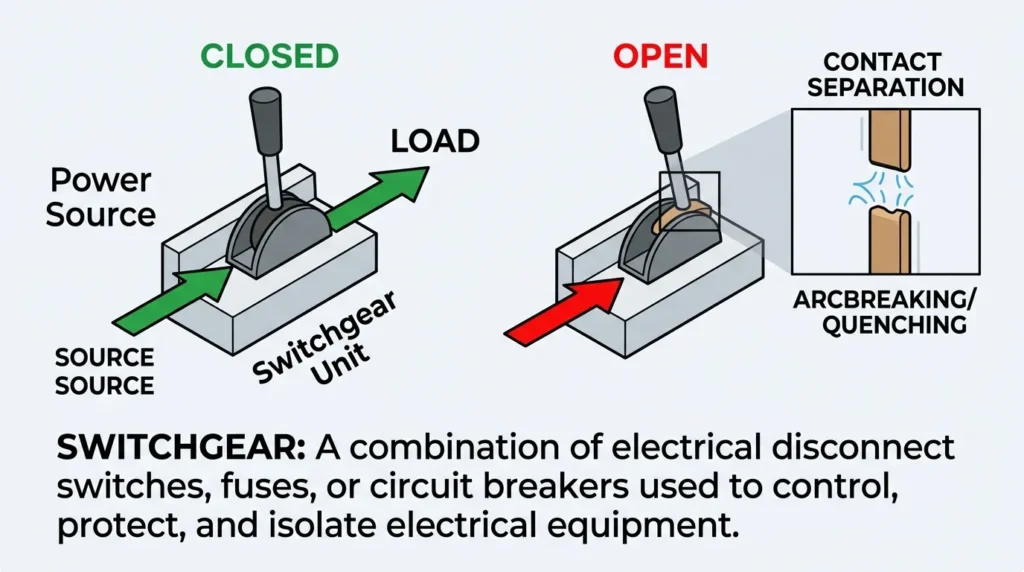
Switchgear is a combination of electrical devices used to control, protect, and isolate electrical circuits and equipment. It allows operators to safely switch electrical power on or off while protecting the system from faults such as short circuits, overloads, and earth faults.
In simple words, switchgear acts like the security system of an electrical network. It monitors the electrical system and disconnects faulty circuits before they can damage equipment or cause accidents.
Switchgear is commonly installed in:
- Residential buildings
- Commercial offices
- Industrial factories
- Electrical substations
- Power generation plants
- Renewable energy systems
- Data centers
- Hospitals
- Airports
Simple Example
Think of the electrical system in your home. If a fault occurs, the circuit breaker trips and cuts off power to the affected circuit. This prevents overheating, electrical fires, and damage to appliances. Industrial switchgear performs the same function but on a much larger scale, protecting equipment that operates at medium and high voltages.
Why Is Switchgear Important?
Switchgear provides several important functions:
- Protects electrical equipment from damage.
- Prevents electrical fires caused by faults.
- Improves system reliability.
- Ensures safe maintenance by isolating equipment.
- Reduces downtime in industries.
- Protects people from electric shock and arc faults.
- Helps maintain continuous power supply.
Without switchgear, even a small electrical fault could result in major equipment failure and costly downtime.
Switchgear Working Principle
The switchgear working principle is based on detecting abnormal electrical conditions and disconnecting the faulty circuit before serious damage occurs. It continuously monitors the electrical system and reacts automatically whenever it detects dangerous conditions.
Step 1: Normal Power Flow
During normal operation:
- Electricity flows through cables and busbars.
- Circuit breakers remain closed.
- Protective relays continuously monitor voltage, current, and other electrical parameters.
- All equipment operates normally.
At this stage, switchgear simply allows electricity to flow safely through the system.
Step 2: Fault Detection
If a fault occurs, such as:
- Short circuit
- Overload
- Earth fault
- Phase-to-phase fault
- Equipment failure
the protective relay immediately detects the abnormal condition.
Modern digital relays can identify faults within milliseconds.
Step 3: Relay Sends a Trip Signal
After detecting the fault, the protective relay sends an electrical signal to the circuit breaker.
This signal tells the breaker that the circuit must be disconnected immediately.
Step 4: Circuit Breaker Opens
The circuit breaker opens its contacts and interrupts the current flow.
Special arc-extinguishing methods quickly stop the electrical arc that forms when the contacts separate.
Different circuit breakers use different arc-quenching methods, including:
- Air
- Vacuum
- SF₆ gas
- Oil
Step 5: Fault Is Isolated
Only the faulty section is disconnected.
The remaining electrical system continues operating normally.
This selective isolation minimizes power interruptions and prevents damage from spreading to healthy equipment.
Step 6: Inspection and Restoration
After the fault has been repaired:
- Engineers inspect the affected equipment.
- Safety tests are completed.
- The circuit breaker is reset.
- Normal power supply is restored.
Easy Analogy
Imagine a water pipeline with several control valves.
If one pipe develops a leak, you close only the valve connected to that pipe instead of shutting off water to the entire city.
Switchgear works in the same way. It disconnects only the faulty electrical section while allowing the rest of the system to continue operating safely.
Simple Working Flow
Power Supply
      │
      ▼
 Switchgear
      │
      ▼
 Protective Relay
      │
Fault Detected?
      │
 ┌────┴────┐
 │         │
No        Yes
 │         │
 ▼         ▼
Continue  Trip Signal
Operation     │
              ▼
      Circuit Breaker Opens
              │
              ▼
      Fault Is Isolated
              │
              ▼
 System Remains Safe
Key Functions During Operation
The primary functions of switchgear include:
- Controlling electrical circuits.
- Protecting equipment from electrical faults.
- Isolating faulty sections for maintenance.
- Ensuring operator safety.
- Maintaining continuous power supply.
- Reducing equipment damage.
- Improving electrical system reliability.
These functions make switchgear one of the most critical systems in any electrical installation.
Types of Switchgear
Switchgear is classified based on voltage level, installation location, insulation method, and construction. Each type is designed for specific electrical applications and operating conditions.
Low Voltage (LV) Switchgear
Low Voltage (LV) switchgear operates at voltages up to 1,000 volts AC. It is the most common type used in residential, commercial, and light industrial electrical systems.
Features
- Compact design
- Easy to install and maintain
- Provides overload and short-circuit protection
- Suitable for low-power distribution systems
Common Components
- MCB (Miniature Circuit Breaker)
- MCCB (Molded Case Circuit Breaker)
- RCCB
- RCBO
- Contactors
- Relays
- Busbars
Applications
- Homes
- Office buildings
- Shopping malls
- Schools
- Hospitals
- Small industries
Medium Voltage (MV) Switchgear
Medium Voltage (MV) switchgear is designed for systems operating between 1 kV and 36 kV. It is widely used in industrial plants and electrical substations.
Features
- Handles higher electrical loads
- Offers advanced fault protection
- Supports automatic control systems
- High operational reliability
Applications
- Industrial factories
- Renewable energy plants
- Utility substations
- Mining operations
- Large commercial buildings
High Voltage (HV) Switchgear
High Voltage (HV) switchgear operates above 36 kV and is used in power transmission and large electrical networks.
Its main purpose is to safely control and protect high-energy electrical circuits.
Features
- Very high insulation strength
- Excellent fault interruption capability
- Designed for continuous operation
- Suitable for outdoor installations
Applications
- Transmission substations
- Power generation stations
- National electrical grids
- Utility companies
Indoor Switchgear
Indoor switchgear is installed inside buildings where environmental conditions can be controlled.
Advantages
- Protected from rain and dust
- Longer service life
- Easier maintenance
- Better operator safety
Common Locations
- Control rooms
- Electrical equipment rooms
- Commercial buildings
- Manufacturing plants
Outdoor Switchgear
Outdoor switchgear is specially designed to withstand harsh weather conditions.
Its enclosure protects electrical equipment from:
- Rain
- Sunlight
- Wind
- Dust
- Snow
- Moisture
Applications
- Electrical substations
- Solar farms
- Wind farms
- Transmission networks
Air-Insulated Switchgear (AIS)
Air-Insulated Switchgear (AIS) uses air as the primary insulation medium between live electrical parts.
Advantages
- Lower installation cost
- Simple construction
- Easy inspection
- Easy maintenance
Limitations
- Requires more installation space
- More exposed to environmental conditions
AIS is commonly used in outdoor substations.
Gas-Insulated Switchgear (GIS)
Gas-Insulated Switchgear (GIS) uses SF₆ gas or other insulating gases to provide electrical insulation.
Because gas has excellent insulating properties, GIS equipment can be much smaller than AIS.
Advantages
- Compact design
- High reliability
- Excellent insulation
- Minimal maintenance
- Suitable for limited spaces
Applications
- Urban substations
- Underground substations
- Offshore platforms
- High-rise buildings
Metal-Enclosed Switchgear
In this design, electrical equipment is housed inside a grounded metal enclosure.
Benefits
- Improved operator safety
- Better protection from accidental contact
- Reduced exposure to dust and moisture
Metal-Clad Switchgear
Metal-clad switchgear provides individual metal compartments for each major component.
These compartments typically include:
- Circuit breaker
- Busbars
- Instrument transformers
- Cable connections
This design improves maintenance safety and minimizes the risk of fault propagation.
Hybrid Switchgear
Hybrid switchgear combines the benefits of Air-Insulated Switchgear (AIS) and Gas-Insulated Switchgear (GIS).
It offers:
- Reduced installation space
- High reliability
- Lower maintenance
- Cost-effective performance
Hybrid systems are becoming increasingly popular in modern power systems.
Main Components of Switchgear
A switchgear system consists of several electrical devices working together to control and protect the electrical network.
Circuit Breaker
The circuit breaker is the most important component of switchgear.
Its job is to:
- Carry normal electrical current.
- Detect trip commands from protective relays.
- Interrupt fault current safely.
Different types include:
- Air Circuit Breaker (ACB)
- Vacuum Circuit Breaker (VCB)
- SF₆ Circuit Breaker
- Oil Circuit Breaker
Protective Relay
A protective relay continuously monitors the electrical system.
When abnormal conditions occur, it sends a trip signal to the circuit breaker.
Modern digital relays can detect:
- Short circuits
- Earth faults
- Overloads
- Under-voltage
- Over-voltage
- Frequency abnormalities
Isolator (Disconnect Switch)
An isolator disconnects equipment from the electrical supply during maintenance.
Unlike circuit breakers, isolators are operated only after the circuit has been de-energized.
Their primary purpose is to provide visible electrical isolation for maintenance personnel.
Busbars
Busbars are thick copper or aluminum conductors that distribute electrical power throughout the switchgear.
Benefits include:
- Low electrical resistance
- High current-carrying capacity
- Efficient power distribution
Current Transformer (CT)
A Current Transformer (CT) reduces high current values to safe levels for meters and protective relays.
It enables accurate measurement and fault detection without exposing instruments to dangerous currents.
Potential Transformer (PT)
A Potential Transformer (PT), also called a Voltage Transformer (VT), reduces high voltage to measurable levels.
It supplies safe voltage signals to:
- Protective relays
- Measuring instruments
- Energy meters
Fuses
Fuses provide additional protection by melting when excessive current flows.
Although many systems now use circuit breakers, fuses remain useful in certain low-voltage applications.
Earthing Switch
An earthing switch safely grounds isolated equipment before maintenance begins.
This protects workers from dangerous residual or induced voltages.
Control and Protection Panel
The control panel contains:
- Protection relays
- Control switches
- Indicator lamps
- Measuring instruments
- Communication devices
- Alarm systems
Operators use this panel to monitor and control the switchgear system.
Metal Enclosure
The enclosure protects internal components from:
- Dust
- Moisture
- Mechanical damage
- Accidental human contact
It also improves operator safety and extends equipment life.
Summary of Main Components
| Component | Main Function |
|---|---|
| Circuit Breaker | Interrupts fault current |
| Protective Relay | Detects electrical faults |
| Isolator | Provides safe isolation |
| Busbar | Distributes electrical power |
| Current Transformer (CT) | Measures current |
| Potential Transformer (PT) | Measures voltage |
| Fuse | Backup overcurrent protection |
| Earthing Switch | Grounds isolated equipment |
| Control Panel | Controls and monitors the system |
| Metal Enclosure | Protects internal equipment |
Advantages of Switchgear
Switchgear plays a vital role in modern electrical systems. It not only protects equipment but also improves the overall safety and reliability of power distribution.
1. Protects Electrical Equipment
The biggest advantage of switchgear is its ability to protect transformers, motors, generators, cables, and other electrical equipment from faults such as short circuits and overloads.
2. Improves Safety
Switchgear quickly disconnects faulty circuits, reducing the risk of:
- Electric shock
- Electrical fires
- Arc flash accidents
- Equipment explosions
This makes the workplace much safer for electricians and maintenance personnel.
3. Ensures Reliable Power Supply
By isolating only the faulty section, switchgear allows the remaining electrical system to continue operating.
This reduces unnecessary power outages and improves system reliability.
4. Reduces Equipment Damage
Fast fault detection minimizes damage to expensive electrical equipment, reducing repair costs and extending equipment life.
5. Easy Maintenance
Switchgear includes isolators and earthing switches that allow engineers to safely disconnect equipment before maintenance.
6. Supports Automatic Operation
Modern switchgear can work with:
- PLC systems
- SCADA systems
- Remote monitoring
- Smart protection relays
This improves operational efficiency.
7. Handles High Fault Currents
High-quality switchgear can interrupt extremely large fault currents within milliseconds, protecting the electrical network.
8. Long Service Life
With proper maintenance, switchgear can operate reliably for many years.
9. Flexible Installation
Switchgear is available for:
- Indoor installations
- Outdoor installations
- Low voltage systems
- Medium voltage systems
- High voltage systems
10. Improves System Stability
Switchgear prevents electrical faults from spreading throughout the network, helping maintain stable power distribution.
Disadvantages of Switchgear
Although switchgear offers many benefits, it also has some limitations.
1. High Initial Cost
Medium- and high-voltage switchgear systems are expensive to purchase and install.
2. Requires Regular Maintenance
To ensure reliable operation, switchgear requires:
- Periodic inspection
- Cleaning
- Testing
- Calibration
Poor maintenance may reduce system reliability.
3. Large Installation Space
Some Air-Insulated Switchgear (AIS) systems require significant installation space.
4. Skilled Personnel Required
Installation, operation, testing, and maintenance should only be performed by qualified electrical professionals.
5. Environmental Concerns
Traditional SF₆ gas used in some Gas-Insulated Switchgear (GIS) has a high global warming potential. Manufacturers are increasingly developing environmentally friendly alternatives.
6. Downtime During Major Maintenance
Large industrial facilities may need planned shutdowns for major switchgear maintenance.
Switchgear Applications
Switchgear is used in almost every electrical power system because it provides protection, control, and isolation.
Residential Buildings
In homes, switchgear protects electrical circuits through:
- Distribution boards
- Circuit breakers
- RCCBs
- MCBs
These devices protect occupants from electrical hazards.
Commercial Buildings
Commercial facilities such as offices, shopping malls, hotels, and hospitals depend on switchgear for safe and reliable power distribution.
Industrial Plants
Factories use switchgear to protect:
- Electric motors
- Pumps
- Compressors
- Conveyor systems
- Production machinery
Reliable switchgear minimizes production downtime.
Power Generation Plants
Power stations use high-voltage switchgear to control electricity generated by:
- Thermal power plants
- Hydroelectric plants
- Nuclear power plants
- Wind farms
- Solar power plants
Electrical Substations
Substations use switchgear for:
- Power distribution
- Transformer protection
- Feeder control
- Fault isolation
Renewable Energy Systems
Modern renewable energy installations require switchgear to protect:
- Solar panels
- Wind turbines
- Battery storage systems
- Grid connections
Data Centers
Data centers rely on uninterrupted power.
Switchgear protects critical equipment such as:
- Servers
- UPS systems
- Cooling systems
- Backup generators
Transportation
Switchgear is widely used in:
- Railways
- Metro systems
- Airports
- Electric vehicle charging stations
Switchgear vs Circuit Breaker
Many beginners think switchgear and circuit breakers are the same. They are closely related but not identical.
| Feature | Switchgear | Circuit Breaker |
|---|---|---|
| Definition | Complete protection and control system | Single protective switching device |
| Main Purpose | Control, protect, and isolate electrical systems | Interrupt fault current |
| Components | Circuit breakers, relays, CTs, PTs, isolators, busbars, panels | Only the breaker mechanism |
| Protection Level | Complete electrical system | Individual circuit |
| Applications | Power plants, substations, industries, buildings | Homes, industries, substations |
| Cost | Higher | Lower |
| Complexity | High | Moderate |
Key Difference
A circuit breaker is one component of a switchgear system, while switchgear is a complete assembly containing multiple protective and control devices.
How to Select the Right Switchgear
Choosing the correct switchgear improves safety, reliability, and long-term performance.
1. Determine the Voltage Level
Select switchgear based on your system voltage:
- Low Voltage (LV)
- Medium Voltage (MV)
- High Voltage (HV)
2. Calculate Current Rating
The current rating should safely handle the maximum electrical load without overheating.
3. Check Fault Current Rating
Ensure the switchgear can interrupt the maximum possible short-circuit current.
4. Consider Installation Location
Choose:
- Indoor switchgear for protected environments.
- Outdoor switchgear for exposed locations.
5. Select the Insulation Type
Common insulation options include:
- Air-Insulated Switchgear (AIS)
- Gas-Insulated Switchgear (GIS)
- Hybrid Switchgear
Choose according to available space and environmental conditions.
6. Evaluate Safety Features
Look for features such as:
- Arc fault protection
- Interlocking systems
- Earthing switches
- Digital protective relays
7. Consider Future Expansion
Select a system that allows additional feeders or equipment to be added later without replacing the entire switchgear.
8. Check Applicable Standards
Use switchgear that complies with recognized electrical standards to ensure safe and reliable operation.
Beginner Tips
If you are selecting switchgear for the first time:
- Match the voltage rating to the application.
- Never choose equipment with an insufficient fault current rating.
- Consider future load growth.
- Buy from reputable manufacturers.
- Follow proper installation and maintenance practices.
- Consult experienced electrical engineers for large projects.
Selecting the correct switchgear increases safety, improves equipment reliability, and reduces maintenance costs over the system’s lifetime.
Common Problems & Solutions
Even the best switchgear can develop problems over time due to aging, poor maintenance, environmental conditions, or electrical faults. Regular inspection and preventive maintenance help improve safety and reliability.
Problem 1: Circuit Breaker Does Not Trip
Possible Causes
- Faulty protective relay
- Mechanical failure
- Incorrect breaker settings
- Damaged trip coil
Solution
- Test the protective relay.
- Inspect the breaker mechanism.
- Check the trip coil.
- Reset or replace faulty components.
Problem 2: Overheating
Possible Causes
- Loose electrical connections
- Overloaded circuits
- Poor ventilation
- Damaged busbars
Solution
- Tighten all electrical connections.
- Reduce excessive load.
- Improve cooling and ventilation.
- Replace damaged conductors.
Problem 3: Frequent Tripping
Possible Causes
- Short circuit
- Earth fault
- Overload
- Incorrect protection settings
Solution
- Locate and repair the fault.
- Check insulation resistance.
- Verify relay settings.
- Test connected equipment.
Problem 4: Insulation Failure
Possible Causes
- Moisture
- Dust accumulation
- Aging insulation
- High temperatures
Solution
- Keep switchgear clean and dry.
- Perform insulation resistance tests.
- Replace damaged insulation materials.
Problem 5: Arc Flash Risk
Possible Causes
- Equipment failure
- Poor maintenance
- Loose terminals
- Human error
Solution
- Follow safe operating procedures.
- Wear proper personal protective equipment (PPE).
- Perform regular inspections.
- Use arc-resistant switchgear where required.
Preventive Maintenance Tips
Proper maintenance extends the life of switchgear and reduces unexpected failures.
- Inspect switchgear regularly.
- Clean dust and dirt from enclosures.
- Tighten all electrical connections.
- Test circuit breakers periodically.
- Check protective relay operation.
- Measure insulation resistance.
- Replace worn or damaged components.
- Record maintenance activities for future reference.
Preventive maintenance is usually much less expensive than repairing equipment after a major failure.
Future Trends in Switchgear Technology
Electrical power systems are becoming smarter, safer, and more efficient. Modern switchgear continues to evolve with new technologies.
Smart Digital Switchgear
Modern switchgear uses intelligent electronic devices (IEDs) that provide:
- Real-time monitoring
- Remote control
- Automatic fault detection
- Digital communication
IoT-Based Monitoring
Internet of Things (IoT) technology allows engineers to monitor switchgear remotely.
Benefits include:
- Predictive maintenance
- Faster fault diagnosis
- Reduced downtime
- Better asset management
Eco-Friendly Insulation
Many manufacturers are developing environmentally friendly alternatives to traditional SF₆ gas to reduce environmental impact while maintaining excellent insulation performance.
Condition Monitoring
Modern sensors continuously monitor:
- Temperature
- Humidity
- Partial discharge
- Mechanical wear
- Contact condition
This helps identify problems before failures occur.
Artificial Intelligence
AI-based systems can analyze operating data and predict equipment failures, allowing maintenance teams to take action before unexpected shutdowns occur.
Compact Designs
New switchgear designs require less installation space while providing improved safety, higher efficiency, and easier maintenance.
Frequently Asked Questions (FAQs)
1. What is switchgear used for?
Switchgear is used to control, protect, and isolate electrical equipment. It protects power systems from faults such as short circuits, overloads, and earth faults.
2. What is the difference between switchgear and a circuit breaker?
A circuit breaker is one protective device, while switchgear is a complete system that includes circuit breakers, relays, isolators, busbars, transformers, and other protective equipment.
3. What are the main types of switchgear?
The main types include:
- Low Voltage (LV) Switchgear
- Medium Voltage (MV) Switchgear
- High Voltage (HV) Switchgear
- Air-Insulated Switchgear (AIS)
- Gas-Insulated Switchgear (GIS)
- Indoor Switchgear
- Outdoor Switchgear
4. Why is switchgear important?
Switchgear improves electrical safety by detecting faults, disconnecting damaged circuits, protecting expensive equipment, and ensuring reliable power distribution.
5. Where is switchgear commonly installed?
Switchgear is commonly installed in:
- Homes
- Commercial buildings
- Industrial plants
- Electrical substations
- Power stations
- Solar and wind energy systems
- Data centers
- Hospitals
6. How often should switchgear be maintained?
Maintenance schedules depend on the equipment and operating conditions. Most facilities perform routine inspections, testing, and preventive maintenance at regular intervals to ensure reliable operation.
7. What is the working principle of switchgear?
The switchgear working principle involves continuously monitoring the electrical system. When a fault is detected, protective relays send a trip signal to the circuit breaker, which disconnects the faulty circuit and prevents damage to the remaining system.
Conclusion
Switchgear is one of the most important systems in modern electrical engineering because it ensures the safe control, protection, and isolation of electrical equipment. From residential distribution boards to high-voltage substations, switchgear plays a critical role in preventing equipment damage, reducing downtime, and protecting people from electrical hazards.
Understanding what switchgear is, its working principle, types, components, applications, and advantages and disadvantages helps students, technicians, and engineers make better decisions when designing, operating, or maintaining electrical systems. Choosing the correct switchgear and following proper maintenance practices significantly improves system reliability and safety.
As technology advances, smart digital switchgear, IoT-based monitoring, predictive maintenance, and environmentally friendly insulation solutions will continue to shape the future of electrical power systems, making them more efficient, reliable, and sustainable.