
Imagine this: It’s a quiet evening in your home. You’re watching TV while the kids sleep upstairs. Behind the walls, a loose wire in an old outlet begins to spark. The tiny arc generates heat hotter than 10,000 degrees Fahrenheit. Within minutes, insulation catches fire. This scenario happens more often than most people realize—electrical arcs cause thousands of home fires every year. An arc fault breaker stops this danger before it starts.
As a senior electrical engineer with over 25 years in the field, I’ve seen firsthand how these devices save homes and lives. In this guide, you will learn exactly what an arc fault breaker is, how it works, the different types available, its advantages and disadvantages, real-world applications, and how to choose the right one. Whether you are an electrical student, technician, engineer, or a homeowner wanting safer wiring, this article explains everything in simple, clear steps. By the end, you will understand why arc fault breakers are now required in many homes and how they provide peace of mind.
What is an Arc Fault Breaker?
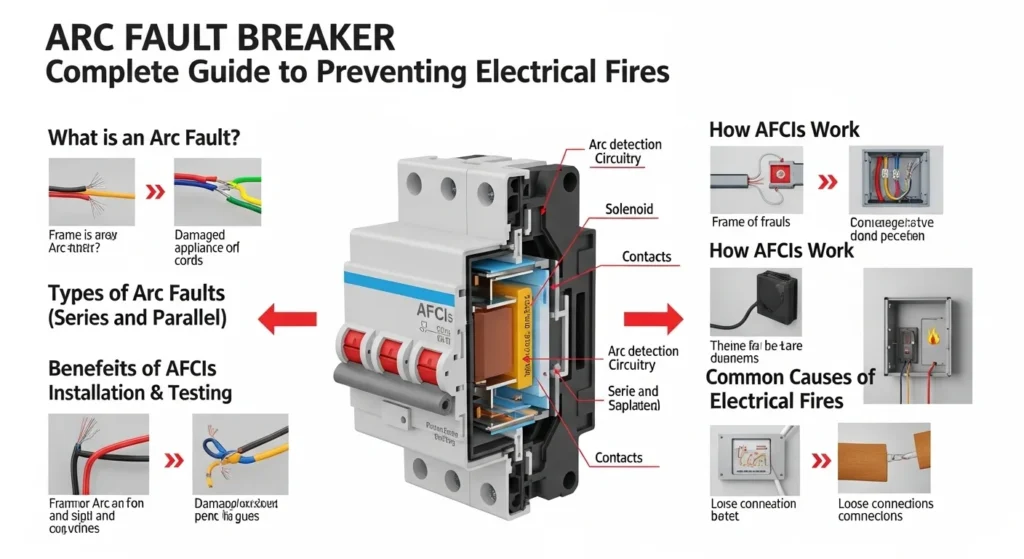
An arc fault breaker, also known as an Arc Fault Circuit Interrupter (AFCI), is a special type of circuit breaker that detects dangerous electrical arcs and shuts off power instantly to prevent fires.
Unlike a regular breaker that only reacts to overloads or short circuits, an arc fault breaker watches for tiny sparks caused by damaged wires, loose connections, or worn cords. These arcs create intense heat that can ignite nearby materials like wood, insulation, or curtains—even if the current is not high enough to trip a normal breaker.
Think of it like a smoke detector for your wiring. A practical example: If a nail accidentally punctures a wire inside a wall during remodeling, the resulting arc could start a hidden fire. The arc fault breaker senses the unique electrical “signature” of that arc and trips the circuit in a fraction of a second, stopping the problem before anyone notices.
Arc Fault Breaker Working Principle
The arc fault breaker working principle is straightforward yet clever. It uses advanced electronics to listen to the electrical flow in the circuit, much like a doctor uses a stethoscope to hear a heartbeat.
Here is how it works step by step:
- Constant monitoring: The breaker has sensors that measure the current flowing through the hot and neutral wires hundreds of times per second.
- Pattern recognition: Normal arcs (like when you unplug a lamp or flip a switch) are short and harmless. Dangerous arcs produce a unique high-frequency noise and irregular waveform.
- Decision making: A small microprocessor inside the breaker compares the pattern to known dangerous arc signatures. If it matches, the breaker trips.
- Instant shutdown: The internal contacts open, cutting power to the entire circuit before the arc can cause a fire.
It is like your breaker has a built-in “brain” that distinguishes between a safe spark and a fire-starting one. This technology has been refined since the late 1990s and is now required by electrical codes in bedrooms, living rooms, and many other areas.
Types of Arc Fault Breakers
Arc fault breakers come in different types to suit various installation needs. Here are the main ones explained simply.
Branch/Feeder Type
This type installs at the main panel and protects the wiring that runs through walls and ceilings. It is good for stopping arcs in the fixed parts of your home’s electrical system.
Outlet Circuit Type
Placed at the first outlet on a circuit, this type protects cords plugged into outlets and downstream wiring. It works well for extension cords and appliance plugs.
Combination Type (Most Common Today)
The combination arc fault breaker does both jobs above. It protects the entire branch circuit wiring plus any cords and plugs. Most new homes and upgrades now use this type because it offers the best overall safety.
Dual-Function Type
This breaker combines arc fault protection with ground fault protection (GFCI) in one unit. It is perfect for kitchens, bathrooms, or outdoor areas where both fire and shock protection are needed.
Main Components of an Arc Fault Breaker
Every arc fault breaker has a few key parts that work together:
- Current Sensors: Detect tiny changes in electrical flow.
- Microprocessor: The “brain” that analyzes waveforms and decides if an arc is dangerous.
- Trip Mechanism: Opens the circuit contacts quickly when needed.
- Test Button: Allows you to check if the breaker is working properly.
- LED Indicator: Many models show why the breaker tripped (arc fault, overload, etc.).
- Standard Breaker Parts: It still includes the usual thermal and magnetic protection for overloads and short circuits.
These components make the device reliable and easy to use.
Arc Fault Breaker Advantages and Disadvantages
Advantages
- Prevents most electrical fires caused by arcing—saving lives and property.
- Required by modern electrical codes in many rooms, giving automatic compliance.
- Works silently in the background with no daily effort needed.
- Provides early warning before a fire starts.
- Dual-function models offer both fire and shock protection in one device.
- Easy to test and reset yourself.
Disadvantages and Limitations
- Higher cost than standard breakers (usually $40–$80 each).
- Can sometimes cause nuisance trips with certain motors or electronics (like vacuum cleaners or older dimmer switches).
- Requires proper installation—incorrect wiring can reduce effectiveness.
- Does not replace the need for regular wiring inspections or GFCI protection in wet areas.
- Older homes may need panel upgrades to fit these breakers.
Overall, the benefits far outweigh the drawbacks when safety is the priority.
Arc Fault Breaker Applications
Arc fault breaker applications are growing fast in both homes and workplaces.
In homes, they are now required in bedrooms, living rooms, dining rooms, and many other living areas under the National Electrical Code. They protect against hidden wiring damage from age, pests, or accidental nails.
In industry, factories use them in offices, control rooms, and areas with extension cords to reduce fire risks around sensitive equipment.
Modern tech uses include solar power systems (with DC arc fault versions), EV charging stations, and smart homes where breakers connect to apps for alerts.
Whether you are wiring a new house, remodeling, or upgrading an old panel, installing arc fault breakers is one of the smartest safety steps you can take.
Difference Between Arc Fault Breaker and GFCI Breaker
Many people ask about the difference between arc fault breaker and GFCI breaker. Here is a clear comparison:
| Feature | Arc Fault Breaker (AFCI) | GFCI Breaker |
|---|---|---|
| Main Purpose | Prevents electrical fires from arcs | Prevents electric shocks from ground faults |
| What It Detects | Dangerous arcing (sparks in wiring) | Current leaking to ground (e.g., through water or a person) |
| Where Usually Required | Bedrooms, living areas | Kitchens, bathrooms, outdoors |
| Protection Focus | Property and fire safety | People and shock safety |
| Can They Work Together? | Yes – many dual-function models combine both | Yes – use together or in one breaker |
In short, they protect against different dangers, so using both (or a dual-function model) gives complete safety.
Selection Guide for Arc Fault Breakers
Choosing the right arc fault breaker is easier than you think. Follow these tips:
- Check your local electrical code—most areas now require combination-type AFCIs for new work.
- Match the amperage (15A or 20A) and voltage (120V) to your circuit.
- For wet areas, choose a dual-function AFCI/GFCI breaker.
- Buy from trusted brands listed to UL 1699 standard.
- For beginners: Start with combination breakers—they cover the most situations.
- If replacing an old panel, consider a full upgrade for easier installation.
- Always have a licensed electrician install them to ensure correct wiring.
A quick tip: Test the breaker monthly by pressing the test button—it should trip immediately.
Common Problems and Solutions
Here are answers to the most frequent questions I hear from juniors and homeowners:
Q: Why does my arc fault breaker keep tripping?
A: It could be a real arc (check for damaged cords) or a nuisance trip from a motor appliance. Unplug devices one by one to find the cause.
Q: Can I install it myself?
A: Only if you are a licensed electrician. Incorrect installation can create new hazards.
Q: Does it protect against all fires?
A: No, only those started by electrical arcs. Smoke detectors and good maintenance are still essential.
Q: How long do they last?
A: 15–30 years with proper use. Replace if the test button fails.
Q: What if it trips with no obvious reason?
A: Call an electrician to inspect wiring—hidden damage may be present.
These simple troubleshooting steps solve 90% of issues quickly.
Future Trends in Arc Fault Breakers
The future of arc fault breakers looks exciting. Manufacturers are adding smart features that connect to home apps, sending alerts to your phone when an arc is detected. Some models now use artificial intelligence to reduce nuisance trips even further.
DC arc fault breakers are becoming common for solar panels and EV chargers. Integration with whole-home automation systems will let breakers work together with smart lights and energy monitors for even better safety and efficiency.
As homes get smarter and renewable energy grows, arc fault protection will become even more advanced and affordable.
Conclusion
An arc fault breaker is one of the most important safety upgrades you can make to any electrical system. From its simple yet smart working principle to the wide range of types and real-world applications, it gives reliable protection against hidden fire hazards that regular breakers cannot stop. We have covered the arc fault breaker advantages and disadvantages, the key difference between arc fault breaker and GFCI, selection tips, and even future trends.
Whether you are studying electrical engineering, working in the field, or simply want a safer home, understanding arc fault breakers helps you make better decisions. Take the time to check your panel today and consider upgrading where needed. Safe electrical practices start with knowledge—and a good arc fault breaker is a smart step toward protecting what matters most.