
Think about the last time you switched on a ceiling fan, started a water pump, or drove an electric vehicle. These machines begin operating almost instantly because several internal components work together efficiently. One of the most important of these components is the stator. Although it never rotates, the stator is responsible for creating the magnetic field that allows electric motors and generators to function properly.
The stator is often called the “stationary heart” of an electrical machine because it provides the foundation for energy conversion. Whether in an industrial motor, household appliance, wind turbine, or power generator, the stator plays a vital role in ensuring smooth, reliable, and efficient operation.
If you are an electrical student, engineer, technician, or beginner, understanding the stator working principle is essential for learning how motors and generators operate. In this complete guide, you’ll learn what a stator is, its types, components, working principle, stator applications, advantages, disadvantages, common problems, maintenance tips, and the difference between stator and rotor.
What is Stator?
A stator is the stationary (non-moving) part of an electric motor or generator. It contains magnetic poles or electrical windings that create a magnetic field, which interacts with the rotor to produce motion in motors or generate electricity in generators.
Unlike the rotor, the stator does not rotate. Instead, it remains fixed inside the machine while providing the magnetic environment needed for energy conversion.
Simple Explanation
Imagine a running track where athletes run around in circles. The running track itself never moves, but it guides the runners. Similarly, the stator remains fixed while the rotor rotates inside it.
Practical Example
A household ceiling fan contains a stator with copper windings. When electrical power flows through these windings, a rotating magnetic field is created. This magnetic field causes the rotor and fan blades to spin, producing airflow.
Stator Working Principle
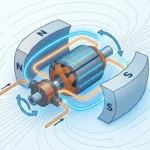
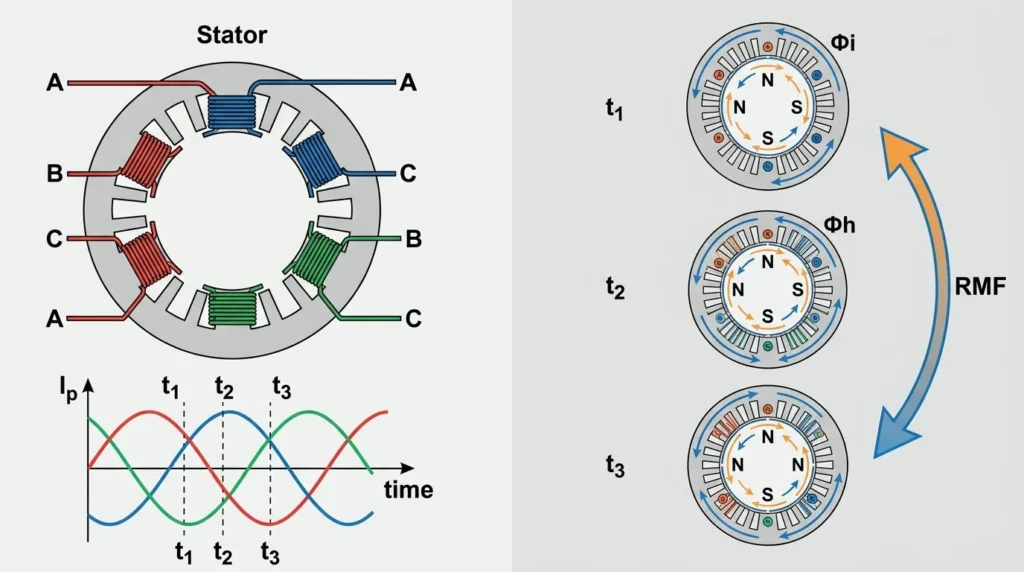
The stator working principle is based on electromagnetic induction. When electric current flows through the stator windings, a magnetic field is produced. This magnetic field interacts with the rotor to create rotational motion or electrical energy.
In motors, electrical energy is converted into mechanical energy.
In generators, mechanical energy is converted into electrical energy.
Step-by-Step Working Process
- Electrical power is supplied to the stator winding.
- Current flows through the copper coils.
- The coils generate a magnetic field.
- In AC machines, the magnetic field rotates continuously.
- The rotating magnetic field interacts with the rotor.
- Magnetic attraction and repulsion create torque.
- The rotor begins rotating.
- Continuous current keeps the motor operating smoothly.
Easy Analogy
Imagine several people standing in a circle passing a ball to one another. Although each person stays in one place, the ball keeps moving around the circle. Similarly, the stator remains stationary while its magnetic field appears to rotate, driving the rotor.
Types of Stator
Different electrical machines use different stator designs depending on their operating principle and application.
Laminated Stator
This is the most common stator used in modern electrical machines.
Features
- Made from thin silicon steel laminations
- Reduces eddy current losses
- Improves efficiency
- Produces less heat
Applications
- AC motors
- DC motors
- Industrial generators
Slotted Stator
The slotted stator contains specially designed slots that hold insulated copper windings.
Features
- Better winding protection
- Improved magnetic performance
- Easy maintenance
- High efficiency
Applications
- Induction motors
- Synchronous motors
- Alternators
Permanent Magnet Stator
Instead of field windings, permanent magnets create the magnetic field.
Features
- No excitation current required
- Higher efficiency
- Compact construction
- Lower energy loss
Applications
- Brushless DC motors (BLDC)
- Electric vehicles
- Robotics
- Drones
Wound Field Stator
The magnetic field is produced using copper field windings.
Features
- Adjustable magnetic field strength
- Suitable for large machines
- Better control
Applications
- Large generators
- Industrial synchronous motors
- Hydroelectric generators
Main Components of a Stator
The stator consists of several important parts that work together to create a strong and reliable magnetic field.
Stator Core
The stator core is made of laminated silicon steel sheets.
Function
- Provides a magnetic path
- Supports the windings
- Reduces magnetic losses
Stator Windings
Copper coils are placed inside the stator slots.
Function
- Carry electrical current
- Produce magnetic fields
- Generate rotating magnetic flux
Stator Slots
Slots are grooves cut into the stator core.
Function
- Hold the windings securely
- Protect insulation
- Improve magnetic performance
Insulation
Electrical insulation separates winding turns and the core.
Function
- Prevents short circuits
- Improves safety
- Extends service life
Frame (Housing)
The frame supports the entire stator assembly.
Function
- Provides mechanical strength
- Protects internal components
- Helps dissipate heat
Terminal Box
The terminal box connects the stator winding to the power supply.
Function
- Electrical connections
- Easy maintenance
- Safe wiring access
Advantages of Stator
Understanding the stator advantages and disadvantages helps engineers choose the right machine for different applications.
Advantages
- High operational reliability
- Strong mechanical construction
- Efficient magnetic field generation
- Long service life
- Low maintenance requirements
- Excellent heat dissipation
- Suitable for high-power applications
- Supports smooth motor operation
- Improves overall machine efficiency
- Compatible with modern automation systems
These advantages make stators an essential component in nearly every electric motor and generator.
Disadvantages of Stator
Although stators are highly reliable, they also have certain limitations.
- Copper windings increase manufacturing cost.
- Insulation may deteriorate with age.
- Overheating can damage windings.
- Repairs may require motor disassembly.
- Heavy construction in large machines.
- Moisture can reduce insulation resistance.
- Vibration may loosen winding supports.
- Poor cooling reduces efficiency.
- Rewinding requires skilled technicians.
- Large stators occupy more installation space.
Stator Applications
The stator applications extend across residential, commercial, industrial, and renewable energy sectors.
Home Applications
- Ceiling fans
- Washing machines
- Air conditioners
- Refrigerators
- Water pumps
Industrial Applications
- Conveyor systems
- Compressors
- Industrial pumps
- Machine tools
- Cranes
- Rolling mills
Power Generation
- Alternators
- Hydroelectric generators
- Steam turbine generators
- Diesel generators
Renewable Energy
- Wind turbines
- Small hydro generators
- Renewable power plants
Transportation
- Electric vehicles
- Electric trains
- Metro rail systems
- Electric forklifts
Modern Technology
- Robotics
- CNC machines
- Medical equipment
- Factory automation
- Smart manufacturing systems
Difference Between Stator and Rotor
Many beginners confuse these two essential machine components.
| Feature | Stator | Rotor |
|---|---|---|
| Position | Stationary | Rotating |
| Movement | Does not move | Rotates continuously |
| Main Function | Produces magnetic field | Produces mechanical rotation |
| Location | Outer part of machine | Inner rotating part |
| Windings | Usually contains field or armature windings | May contain conductors or magnets |
| Power Supply | Connected to external supply | Receives induced or supplied current |
| Maintenance | Lower | Higher |
| Mechanical Stress | Low | High |
Understanding the difference between stator and rotor makes it easier to understand how motors and generators work together.
Selection Guide
Choosing the correct stator improves machine performance and efficiency.
Select the Correct Machine Type
Choose a stator designed for your specific motor or generator.
Check Voltage Rating
Ensure the stator matches the machine’s rated voltage.
Consider Frequency
Select windings suitable for the operating frequency (50 Hz or 60 Hz).
Core Material
Laminated silicon steel cores provide higher efficiency and lower energy loss.
Insulation Class
Choose insulation suitable for the operating temperature.
Cooling Method
Machines operating continuously should include effective cooling systems.
Environmental Conditions
Consider:
- Dust
- Moisture
- Temperature
- Chemical exposure
- Outdoor installation
Industrial environments often require additional protection.
Common Problems & Solutions
Why does the stator overheat?
Possible causes
- Overloading
- Poor ventilation
- Winding short circuit
- High ambient temperature
Solution
Reduce the load, improve cooling, and inspect the winding insulation.
Why does the motor trip frequently?
Possible reasons include:
- Damaged stator winding
- Loose electrical connections
- Insulation failure
Check winding resistance and repair faulty connections.
Why is insulation resistance low?
Low insulation resistance may result from:
- Moisture
- Dirt accumulation
- Aging insulation
Dry the motor and perform insulation testing using a megohmmeter.
Can a damaged stator be repaired?
Yes. Damaged windings can often be rewound by qualified technicians if the stator core remains in good condition.
How can stator life be increased?
- Keep the motor clean.
- Avoid overloading.
- Maintain proper cooling.
- Perform regular insulation testing.
- Inspect electrical connections periodically.
Future Trends
Modern electrical machines continue to evolve with improved stator technology.
Important industry developments include:
- High-efficiency silicon steel cores.
- Better insulation materials.
- Hairpin winding technology for electric vehicles.
- Improved cooling systems.
- Smart temperature monitoring sensors.
- AI-based predictive maintenance.
- Lightweight stator construction.
- Reduced magnetic losses.
- Greater energy efficiency.
- Advanced automated winding processes.
These innovations are helping manufacturers build motors and generators that are more efficient, reliable, and environmentally friendly.
Conclusion
The stator is one of the most important components of electric motors and generators because it creates the magnetic field required for energy conversion. Understanding the stator working principle, types, components, stator applications, and stator advantages and disadvantages helps students, technicians, and engineers understand how modern electrical machines operate. Whether used in household appliances, industrial machinery, electric vehicles, or renewable energy systems, the stator provides the foundation for reliable and efficient performance. As electrical technology continues to advance, improved stator materials, insulation systems, and manufacturing techniques will further increase efficiency and reduce energy losses. Building a strong understanding of the stator is an essential step toward mastering electrical machines and power systems.