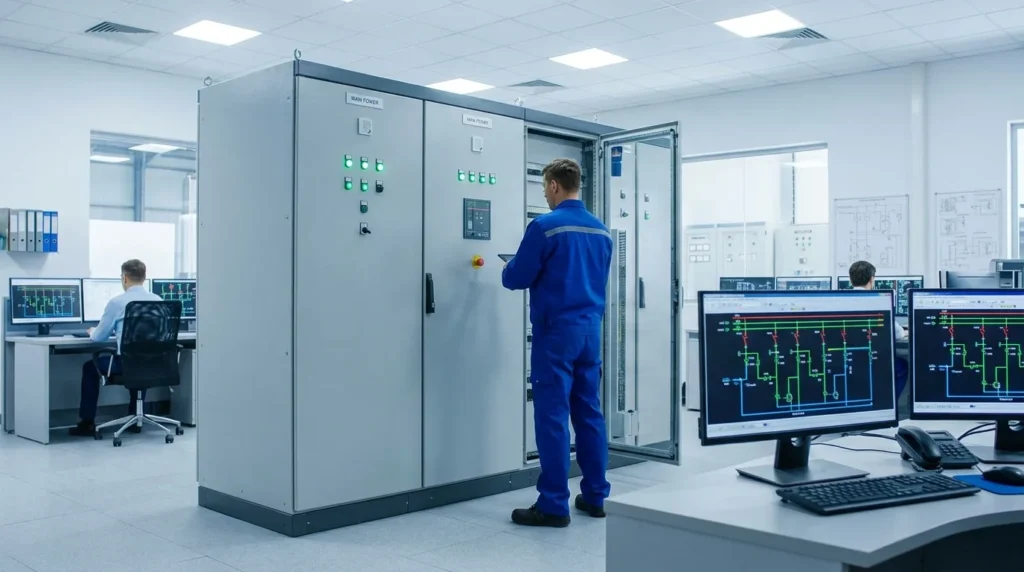

Imagine a hospital during a power outage. The main utility supply suddenly fails, but critical equipment such as lights, medical systems, pumps, and communication equipment must continue working. There is no time for an electrician to manually change the power source.
An ATS panel solves this problem by automatically transferring an electrical load from the normal power source to a backup source when the main supply fails.
ATS stands for Automatic Transfer Switch. An ATS panel is an important part of many backup power systems because it helps keep essential electrical loads supplied during a power interruption.
ATS systems are used in hospitals, data centers, factories, commercial buildings, telecom facilities, water plants, and homes with standby generators.
In this guide, you will learn what is ATS panel, how the ATS panel working principle operates, its types, main components, advantages and disadvantages, applications, selection methods, common problems, and future trends. The explanation uses simple language so electrical students, technicians, engineers, and beginners can understand the system clearly.
What Is ATS Panel?
An ATS panel is an electrical control and switching system that automatically transfers a connected load between two or more power sources when the normal source becomes unavailable or falls outside acceptable limits.
ATS = Automatic Transfer Switch
In simple terms, an ATS panel works like an automatic electrical changeover switch.
It normally supplies the load from the main utility power. If the utility supply fails, the ATS detects the problem and transfers the load to a backup power source, such as a generator.
When normal utility power returns and remains stable, the ATS transfers the load back to the normal source.
Simple Example
Consider a building with:
- Utility power
- Standby generator
- ATS panel
- Essential electrical loads
Under normal conditions:
Utility → ATS → Building Load
During a utility failure:
Utility fails → ATS detects failure → Generator starts → ATS transfers load → Generator supplies load
After the utility returns:
Utility becomes stable → ATS transfers load back → Generator cools down → Generator stops
The ATS performs these operations automatically according to its programmed settings.
ATS Panel Working Principle
The ATS panel working principle is based on continuously monitoring the available power sources and safely transferring the load when required.
Think of an ATS like a railway track switch.
A train can use one track at a time. If the main track becomes unavailable, the switching system directs the train to another safe track.
Similarly, an ATS selects the appropriate electrical source while preventing unsafe connection between incompatible sources.
Step 1: Utility Power Is Available
Under normal conditions, the ATS monitors the utility supply.
If the voltage and frequency are within the programmed limits, the normal source remains connected to the load.
Step 2: ATS Monitors the Supply
The ATS controller continuously checks electrical conditions.
It may monitor:
- Voltage
- Frequency
- Phase loss
- Phase sequence
- Undervoltage
- Overvoltage
The exact functions depend on the ATS model and system design.
Step 3: Utility Failure Occurs
Suppose a power outage occurs.
The ATS detects that the normal supply has fallen outside its acceptable limits.
The system may use a short time delay to prevent unnecessary transfer caused by a very brief voltage disturbance.
Step 4: Generator Start Command
If the backup source is a standby generator, the ATS sends a start signal to the generator controller.
The generator starts and reaches suitable operating conditions.
Step 5: Backup Source Becomes Ready
The ATS checks whether the generator voltage and frequency are acceptable.
It does not normally transfer the load immediately after receiving the generator start command.
It waits for the backup source to become ready.
Step 6: Load Transfers to Generator
Once the generator is stable, the ATS changes the source connection.
The load is transferred from:
Utility → Generator
The switching method depends on the ATS design.
Step 7: Utility Power Returns
When utility power returns, the ATS continues monitoring it.
A return delay may be used to confirm that the utility supply is stable.
Step 8: Load Transfers Back
Once the utility source is confirmed healthy, the ATS transfers the load back:
Generator → Utility
Step 9: Generator Stops
After the load is returned to the utility, the generator may continue running for a short cool-down period.
The ATS then removes the generator start signal.
The generator stops and remains ready for the next outage.
Types of ATS Panels
ATS panels can be classified according to switching method, transition method, application, and control arrangement.
1. Open-Transition ATS
An open-transition ATS disconnects the load from one source before connecting it to the other source.
The sequence is:
Source A OFF → Short break → Source B ON
This is sometimes called break-before-make switching.
It is widely used because the two sources are not normally connected together during transfer.
2. Closed-Transition ATS
A closed-transition ATS can briefly connect the sources together during the transfer process when the system is designed and synchronized for this operation.
It is often called make-before-break transfer.
This can reduce interruption to the load, but it requires suitable equipment and controls.
3. Delayed-Transition ATS
A delayed-transition system intentionally provides a delay between disconnecting one source and connecting the other.
This can be useful for certain loads that need time for residual voltage or stored energy to decay.
4. Manual Transfer Switch
A manual transfer switch requires an operator to change the power source.
It is not a fully automatic ATS, but it can be used in backup power systems where automatic transfer is not required.
5. Automatic Transfer Switch With Generator
This is one of the most common arrangements.
The ATS monitors utility power and controls the generator start signal.
It transfers the load to the generator when utility power fails.
6. Dual-Utility ATS
Some systems use two independent utility sources instead of a generator.
For example:
Utility A → ATS → Load
and:
Utility B → ATS → Load
If one source fails, the ATS can transfer the load to the other source, provided the system is designed for it.
Main Components of an ATS Panel
An ATS panel contains power-switching and control components that work together.
Automatic Transfer Switch
The transfer switch is the main switching device.
It connects the load to the selected power source and disconnects it from the other source according to the transfer logic.
Controller
The controller is the decision-making part of the ATS.
It monitors the electrical sources and controls the transfer sequence.
Depending on the model, it may display:
- Source voltage
- Frequency
- Source status
- Transfer status
- Alarm information
- Timers
- Event history
Utility Input
The normal electrical supply enters the ATS from the utility or main distribution system.
Emergency Input
The emergency source enters the ATS from equipment such as a standby generator or another independent supply.
Load Output
The ATS supplies the connected load from the selected source.
Circuit Breakers
Circuit breakers may be installed for source protection and isolation, depending on the overall design.
Fuses
Fuses can protect control circuits and specific components.
Voltage Monitoring Devices
The ATS uses monitoring circuits to determine whether a source is available and within acceptable limits.
Frequency Monitoring
Frequency monitoring helps determine whether a generator or other source is operating correctly.
Mechanical Interlock
A mechanical interlock can help prevent both source switching devices from being closed in an unsafe configuration.
Electrical Interlock
Electrical interlocking provides another layer of control to prevent an unintended connection between sources.
Control Wiring
Control wiring connects the ATS controller with:
- Generator
- Breakers
- Sensors
- Remote signals
- Building management systems
Bypass Isolation System
Some critical installations use a bypass-isolation arrangement.
This allows the ATS to be bypassed and isolated for maintenance while helping maintain power to the load, depending on the system design.
Enclosure
The enclosure protects internal components from environmental conditions and accidental contact.
Its rating should match the installation environment.
ATS Panel Advantages and Disadvantages
Understanding ATS panel advantages and disadvantages helps engineers choose the correct transfer arrangement.
Advantages
- Automatic operation: No operator is required to manually change the power source.
- Fast transfer: The load can be transferred according to the ATS settings and equipment response.
- Improved reliability: Critical loads can receive backup power after a normal-source failure.
- Generator integration: ATS systems can automatically send start and stop commands to standby generators.
- Source monitoring: The system continuously checks electrical supply conditions.
- Reduced downtime: Automatic transfer can reduce the duration of a power interruption.
- Improved safety: Proper interlocking helps prevent unsafe source connections.
- Remote monitoring: Advanced ATS controllers can provide status and alarms to monitoring systems.
- Flexible applications: ATS equipment can be used with generators, dual utilities, and other backup sources.
Disadvantages and Limitations
- Higher initial cost: Automatic systems cost more than simple manual changeover arrangements.
- Maintenance required: Mechanical and electronic components require inspection.
- Control failure: A faulty controller or sensor can prevent correct operation.
- Generator dependency: If the generator fails to start, the ATS cannot provide backup power from that source.
- Complex installation: Large systems require careful design and coordination.
- Transfer interruption: Standard open-transition systems can create a short interruption during transfer.
- Battery dependency: Generator-based systems depend on a healthy starting battery and associated equipment.
- Environmental limitations: Extreme heat, moisture, dust, or corrosive conditions can affect equipment performance.
ATS Panel Applications
ATS panel applications are found wherever reliable electrical supply is important.
Hospitals
ATS systems are used to transfer critical electrical loads to emergency power.
Possible loads include:
- Emergency lighting
- Medical equipment
- Fire and life-safety systems
- Critical HVAC
- Communication systems
The exact emergency-power arrangement depends on applicable codes and the facility design.
Data Centers
Data centers require high availability.
ATS systems can form part of a backup power architecture involving:
- Generators
- UPS systems
- Multiple power feeds
- Critical distribution systems
Commercial Buildings
ATS panels can support:
- Emergency lighting
- Elevators
- Fire systems
- Security systems
- HVAC equipment
- Critical pumps
Industrial Plants
Factories may use ATS panels to protect important equipment from utility outages.
Applications include:
- Production systems
- Pumps
- Compressors
- Control systems
- Emergency systems
Telecommunication Facilities
Telecom facilities depend on continuous power for network equipment.
An ATS can help transfer loads to backup generation when the utility source fails.
Water Treatment Plants
Water plants often use pumps and control systems that may require reliable backup power.
ATS systems can automatically transfer selected loads to emergency generators.
Residential Buildings
Smaller ATS systems can be used with standby generators in:
- Homes
- Small offices
- Shops
- Small commercial buildings
Fire Protection Systems
Emergency power systems can use automatic transfer equipment for selected fire and life-safety loads according to the applicable electrical and fire codes.
Difference Between ATS Panel and Manual Changeover Panel
The difference between ATS panel and manual changeover panel is mainly the method used to transfer the electrical load.
| Feature | ATS Panel | Manual Changeover Panel |
|---|---|---|
| Transfer method | Automatic | Manual |
| Operator required | No during normal transfer | Yes |
| Source monitoring | Yes | Usually limited |
| Generator start signal | Common | Usually manual or separate |
| Transfer speed | Automatic | Depends on operator |
| Cost | Higher | Lower |
| Complexity | Higher | Lower |
| Best for | Critical/automatic backup | Simple backup systems |
| Remote monitoring | Often available | Usually limited |
An ATS is generally preferred when power continuity is important and automatic operation is required.
Difference Between ATS and STS
ATS and STS are both transfer technologies, but they are designed for different applications.
ATS normally uses mechanical switching equipment and is common for generator or utility transfer.
STS, or Static Transfer Switch, uses solid-state switching technology and can transfer certain loads extremely quickly.
| Feature | ATS | STS |
|---|---|---|
| Full name | Automatic Transfer Switch | Static Transfer Switch |
| Switching technology | Mechanical/electromechanical or other specified technology | Solid-state |
| Typical transfer | Fast but may include interruption | Very fast |
| Common application | Generator backup | Critical electronic loads |
| Mechanical contacts | Often present | No conventional mechanical power contacts |
| Cost | Generally lower | Generally higher |
| Application | Buildings, industry, generators | Data centers and critical power systems |
The correct choice depends on the load, source arrangement, transfer-time requirement, and overall power system design.
ATS Panel Selection Guide
Selecting an ATS requires careful consideration of the electrical load and backup source.
1. Determine the Load Current
First calculate or measure the maximum current the ATS must carry.
Choose equipment with an appropriate continuous current rating.
2. Check System Voltage
Confirm the electrical system voltage.
For example:
- Low-voltage AC systems
- Single-phase systems
- Three-phase systems
The ATS must be compatible with the system.
3. Check Number of Poles
Determine whether the application requires switching of:
- Phase conductors
- Neutral
- Other conductors
The correct arrangement depends on the grounding system and electrical design.
4. Identify the Backup Source
Determine whether the second source is:
- Generator
- Second utility
- UPS-related source
- Other independent supply
5. Choose Transition Type
Select:
- Open transition
- Closed transition
- Delayed transition
The choice depends on the load and source characteristics.
6. Consider Generator Starting Time
The ATS should work with the generator’s starting and stabilization sequence.
The system needs suitable time delays so the generator has enough time to reach stable operating conditions.
7. Check Fault Ratings
The ATS and associated protective equipment must have suitable short-circuit and withstand ratings for the installation.
8. Consider Future Expansion
Choose an arrangement that can support expected future load changes where practical.
9. Check Environmental Conditions
Consider:
- Temperature
- Humidity
- Dust
- Indoor or outdoor installation
- Corrosive environments
Beginner Tip
Never select an ATS based only on the generator’s kVA rating.
Consider the load current, voltage, number of phases, poles, fault level, transfer type, control requirements, and installation environment.
Common ATS Panel Problems and Solutions
Why Does the ATS Not Transfer During a Power Failure?
Possible causes include:
- Controller fault
- Incorrect voltage settings
- Control-power failure
- Generator not starting
- Transfer mechanism problem
- Incorrect wiring
Check the controller status and source availability before investigating the switching mechanism.
Why Does the Generator Not Start?
The ATS may send a start signal, but the generator may have another problem.
Possible causes include:
- Weak battery
- Fuel problem
- Generator controller fault
- Emergency stop active
- Loose control wiring
The generator system should be checked separately.
Why Does the ATS Transfer Back and Forth?
Repeated transfers can occur because the source voltage or frequency is unstable.
Possible causes include:
- Unstable utility supply
- Generator voltage fluctuation
- Incorrect time-delay settings
- Faulty voltage sensing
The source measurements and ATS settings should be checked.
Why Does the ATS Stay on Generator Power?
Possible causes include:
- Utility supply still outside acceptable limits
- Utility sensing problem
- Incorrect return delay
- Controller configuration issue
- Source-side breaker problem
Check the normal-source voltage at the ATS and verify the controller status.
Why Is There a Short Power Interruption During Transfer?
In an open-transition ATS, a brief interruption is expected.
If the load cannot tolerate this interruption, the overall system may require a UPS, closed-transition arrangement, or another suitable power architecture.
Why Does the ATS Show a Source Failure Alarm?
The controller may detect:
- Low voltage
- High voltage
- Frequency problem
- Phase loss
- Phase sequence problem
Measure the source conditions and compare them with the ATS settings.
Safety Warning
ATS panels can contain multiple energized sources. Even when utility power is disconnected, the generator or second source may still energize the equipment.
Qualified personnel should use proper isolation, lockout/tagout, testing, and site safety procedures before working on an ATS panel.
Future Trends in ATS Panels
ATS technology is moving toward smarter monitoring, faster communication, and better integration with modern energy systems.
Smart Monitoring
Modern ATS controllers can provide detailed information about:
- Source voltage
- Frequency
- Load status
- Transfer events
- Alarms
- Operating time
This helps maintenance teams identify problems earlier.
Remote Communication
Advanced ATS systems can communicate with:
- Building management systems
- SCADA
- Energy-management systems
- Industrial networks
Technicians can monitor source status without standing directly in front of the panel.
Predictive Maintenance
Recorded operating data can help maintenance teams identify abnormal switching behavior, source problems, and equipment degradation.
Integration With Microgrids
Modern buildings and industrial facilities may have several energy sources, including:
- Utility
- Generators
- Solar systems
- Battery storage
- Other distributed energy resources
ATS and related transfer equipment can form part of these more advanced power architectures.
Improved Digital Controls
Modern controllers provide better event logging, diagnostics, adjustable timers, and communication capabilities.
Faster Transfer Technology
For sensitive loads, systems may combine ATS equipment with UPS or static transfer technologies to improve power continuity.
Remote Testing
Some modern systems support remote monitoring and test functions, reducing the need for manual inspection of basic operating status.
FAQs About ATS Panels
What is an ATS panel?
An ATS panel is an automatic electrical switching system that transfers a load between a normal power source and a backup power source when required.
What does ATS stand for?
ATS stands for Automatic Transfer Switch.
What is the main purpose of an ATS panel?
Its main purpose is to automatically transfer electrical loads from a failed or unacceptable power source to an available backup source.
Can an ATS start a generator?
Yes. Many generator-based ATS systems send an automatic start signal to the generator when the normal utility source fails.
What happens when utility power returns?
The ATS normally waits until the utility supply is stable and then transfers the load back to the normal source. The generator may then run through a cool-down period before stopping.
What is the difference between ATS and manual changeover?
An ATS transfers the load automatically. A manual changeover requires an operator to select the power source.
What is open-transition transfer?
Open-transition transfer means the ATS disconnects the load from one source before connecting it to another source. It is commonly described as break-before-make.
Where are ATS panels used?
ATS panels are used in hospitals, data centers, factories, commercial buildings, telecom facilities, water treatment plants, residential backup systems, and other locations requiring automatic source transfer.
Conclusion
An ATS panel is an important part of a reliable backup power system. It automatically monitors electrical sources and transfers the load when the normal source fails or becomes unsuitable.
The basic ATS panel working principle is straightforward: monitor the normal source, detect a problem, start or request the backup source, confirm that the backup source is ready, transfer the load, and return the load to normal power when the utility supply becomes stable again.
ATS panels are widely used in hospitals, data centers, industrial plants, commercial buildings, telecom facilities, water treatment systems, and homes with standby generators.
When selecting an ATS, engineers should consider voltage, current, phase arrangement, number of poles, fault rating, transition type, backup-source characteristics, environmental conditions, and future requirements.
For beginners, understanding automatic transfer, generator control, source monitoring, interlocking, and electrical protection provides a strong foundation for learning emergency power systems.
ATS Panel Maintenance Tips
Regular maintenance keeps an ATS panel reliable during power outages. Inspect the panel every six to twelve months: check for loose connections, dust buildup, and signs of overheating or discoloration on contacts and terminals. Keep the enclosure clean and dry, and confirm that indicator lamps, alarms, and the controller display work correctly.
Test the transfer function periodically by simulating a utility failure, following the manufacturer’s test procedure and site safety rules. Verify that the generator starts, the load transfers within the expected time, and the system returns to utility power smoothly. Record all test results and replace worn contacts, weak batteries, or faulty sensors without delay.