
Words that sound alike can cause some of the most common English mistakes. Elicit and illicit are a good example. They sound very similar, but they have completely different meanings and grammatical roles.
People often search for “Elicit vs Illicit” because both words appear in formal writing, business communication, news reports, academic work, and everyday English. The spelling difference is small, but using the wrong word can completely change the meaning of a sentence.
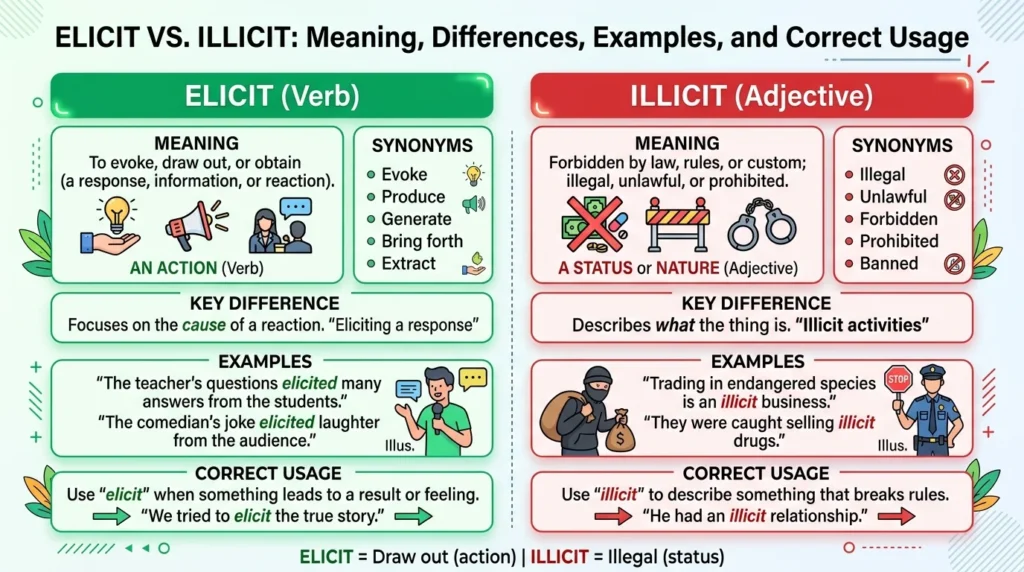
The key is simple: elicit is usually a verb that means “to get or bring out a response, answer, reaction, or information.” Illicit is an adjective that means “illegal, forbidden, or not allowed.”
For example, a teacher may elicit answers from students. An illicit activity, however, is one that breaks a law or rule.
Understanding these two words can help you write more clearly and avoid embarrassing grammar mistakes. In this guide, you will learn their meanings, origins, differences, common mistakes, everyday examples, spelling patterns, and practical tips for choosing the correct word.
Elicit vs Illicit – Quick Answer
The difference is easy to remember:
- Elicit = to get or bring out a response, reaction, answer, or information.
- Illicit = illegal, forbidden, or not permitted.
Elicit Examples
- The teacher tried to elicit an answer from the student.
- The survey was designed to elicit honest opinions.
- Her question elicited a strong reaction.
Here, elicit is a verb.
Illicit Examples
- Police discovered an illicit drug operation.
- The company was accused of making illicit payments.
- The website sells illicit products.
Here, illicit is an adjective.
Easy Memory Trick
Think:
Elicit → E = Extract a response
Illicit → Illegal
This simple connection can help you remember the difference.
The Origin of Elicit vs Illicit
Although elicit and illicit look and sound similar, they come from different Latin roots.
Origin of Elicit
Elicit comes from the Latin word elicere, meaning “to draw out” or “to draw forth.”
It entered English through French and developed the modern meaning of drawing out something such as:
- An answer
- A reaction
- Information
- A response
- A feeling
This explains why we say:
The question elicited a response.
The response was “drawn out” by the question.
Origin of Illicit
Illicit comes from the Latin word illicitus, meaning “not allowed” or “unlawful.”
It is connected to the Latin licere, meaning “to be allowed.”
The prefix il- gives the word a negative sense.
Therefore:
Illicit = not permitted
This meaning remains clear in modern English.
Why Do They Sound Similar?
Both words developed from Latin and have similar pronunciation patterns. However, their meanings are unrelated.
That is why elicit and illicit are often confused even though they perform different jobs in a sentence.
British English vs American English Spelling
There is no major spelling difference between British English and American English for elicit and illicit.
Both varieties normally use:
- elicit
- elicited
- eliciting
- elicits
- illicit
- illicitly
The difference is not between British and American spelling. The real problem is choosing the correct word based on meaning.
| Word | British English | American English | Meaning |
|---|---|---|---|
| Elicit | Elicit | Elicit | Draw out a response |
| Elicited | Elicited | Elicited | Drew out a response |
| Eliciting | Eliciting | Eliciting | Drawing out a response |
| Illicit | Illicit | Illicit | Illegal or forbidden |
| Illicitly | Illicitly | Illicitly | In an illegal or forbidden way |
Important Point
Do not change elicit to another spelling just because you are writing for a British or American audience.
The correct spelling remains elicit.
Likewise, illicit remains illicit in both major varieties of English.
Which Spelling Should You Use?
Use the spelling based on the meaning you want.
For US English
Use:
Elicit when you mean “draw out.”
Illicit when you mean “illegal or forbidden.”
Examples:
- The interview elicited useful information.
- Investigators found an illicit payment.
For UK and Commonwealth English
The same spellings and meanings apply.
Examples:
- The question elicited an emotional response.
- Officials investigated an illicit trade network.
For Global English
The same rule is best.
When writing for an international audience, focus on meaning rather than regional spelling.
A useful test is:
Am I talking about getting a response, or something forbidden?
If you mean getting a response, choose elicit.
If you mean something illegal or prohibited, choose illicit.
Common Mistakes with Elicit vs Illicit
Because the words sound similar, they are easy to mix up.
Mistake 1: Using Illicit for a Response
❌ The question illicited an angry response.
✅ The question elicited an angry response.
Why?
The question brought out a response, so the correct word is elicited.
Mistake 2: Using Elicit for Something Illegal
❌ The company was involved in elicit trade.
✅ The company was involved in illicit trade.
Why?
The trade was illegal or forbidden, so illicit is correct.
Mistake 3: Confusing Elicit With Illicit
❌ The survey was designed to illicit opinions.
✅ The survey was designed to elicit opinions.
Mistake 4: Writing “Illicited”
Illicited is not the standard past tense of illicit.
Illicit is normally an adjective, so it does not take a regular verb ending in this way.
Use:
- illicit activity
- illicit trade
- illicit payment
- illicit drugs
Use elicited when you need the past tense of elicit.
Mistake 5: Using Elicit as an Adjective
❌ The company was involved in elicit activities.
✅ The company was involved in illicit activities.
Elicit is primarily a verb.
Illicit is an adjective.
Elicit vs Illicit in Everyday Examples
Both words are common in formal English, but they appear in different contexts.
In Emails
Elicit:
We would like to elicit your feedback on the new proposal.
Illicit:
The audit identified several potentially illicit transactions.
In News
Elicit:
The announcement elicited strong reactions from the public.
Illicit:
Authorities launched an investigation into an illicit trading operation.
In Social Media
Elicit:
That video really elicited an emotional response.
Illicit:
The platform removed content linked to an illicit activity.
In Academic Writing
Elicit is common when discussing research.
The researcher used interviews to elicit detailed responses.
Illicit may appear when discussing illegal or prohibited behavior.
The study examined the effects of illicit drug use.
In Business Writing
Elicit:
The meeting helped elicit useful suggestions from employees.
Illicit:
The company has strict policies against illicit payments.
Elicit vs Illicit – Google Trends & Usage Data
Search interest for “Elicit vs Illicit” usually comes from people trying to understand a common vocabulary confusion.
The phrase is especially useful for:
- English learners
- Students
- Teachers
- Writers
- Editors
- Job applicants
- Business professionals
Search behavior can also vary by country and education level. People who frequently write essays, reports, emails, and academic documents are more likely to encounter these words.
The individual words have different usage patterns.
Elicit often appears in:
- Academic writing
- Research
- Interviews
- Surveys
- Psychology
- Education
- Business communication
Illicit often appears in:
- News
- Law
- Crime reporting
- Government documents
- Finance
- Public policy
- Security discussions
Because search trends change over time, exact Google Trends numbers should be checked for a specific country and date range rather than treated as permanent figures.
Elicit vs Illicit Comparison Table
| Feature | Elicit | Illicit |
|---|---|---|
| Part of speech | Verb | Adjective |
| Basic meaning | Draw out or obtain | Illegal or forbidden |
| Common object | Response, answer, reaction, information | Activity, trade, payment, goods |
| Example | The question elicited a response. | They discovered illicit activity. |
| Past form | Elicited | Not normally used as a verb |
| Common context | Research, interviews, education | Law, crime, business, news |
| Memory clue | Draw out | Illegal |
| Opposite idea | Suppress or hide | Legal or permitted |
Elicit vs Illicit: More Examples
Elicit
- The teacher tried to elicit ideas from the class.
- The interview elicited valuable information.
- The joke elicited laughter.
- The survey aims to elicit honest feedback.
- The question elicited a surprising answer.
Illicit
- Police seized illicit goods.
- The investigation uncovered illicit payments.
- The company was accused of illicit activity.
- Authorities are fighting illicit trade.
- The report discussed illicit financial transactions.
How to Remember Elicit and Illicit
A simple memory method can prevent most mistakes.
Remember Elicit With “Extract”
Elicit = Extract something
You elicit:
- An answer
- A reaction
- Information
- A response
- Feedback
For example:
The teacher elicited an answer.
Remember Illicit With “Illegal”
Illicit = Illegal or not allowed
You can have:
- Illicit trade
- Illicit drugs
- Illicit payments
- Illicit activities
- Illicit transactions
For example:
The investigation found illicit payments.
One-Line Rule
Elicit a response; avoid illicit activity.
This is one of the easiest ways to remember the difference.
FAQs About Elicit vs Illicit
1. What is the difference between elicit and illicit?
Elicit means to draw out or obtain a response, answer, reaction, or information. Illicit means illegal, forbidden, or not permitted.
2. Is elicit a verb or adjective?
Elicit is a verb.
Example:
The question elicited a response.
3. Is illicit a verb?
No. Illicit is normally an adjective.
Example:
Police investigated illicit activity.
4. What does elicit mean in simple English?
Elicit means to get something such as an answer, reaction, or information from someone.
5. What does illicit mean in simple English?
Illicit means something that is illegal, forbidden, or not allowed.
6. Is “illicited” a correct word?
In standard modern English, illicited is not the normal form of illicit. Use elicited when you mean “brought out a response.”
7. Are elicit and illicit pronounced the same?
They are very similar in pronunciation, which is one reason they are often confused. However, their meanings and grammatical roles are different.
8. What is an easy way to remember them?
Remember:
Elicit = extract a response.
Illicit = illegal.
Conclusion
Understanding Elicit vs Illicit is simple once you focus on meaning. Although the two words look and sound similar, they are used in completely different situations.
Elicit is a verb. It means to draw out, obtain, or bring forth something such as a response, answer, reaction, opinion, or piece of information. For example, a teacher can elicit an answer from a student, and an interview can elicit useful information.
Illicit is an adjective. It describes something illegal, forbidden, or not permitted. You may see it in phrases such as illicit trade, illicit payments, and illicit activity.
There is no important British-versus-American spelling difference for these words. The key is choosing the correct word for the intended meaning.
When in doubt, remember this simple rule: elicit a response, but illicit means illegal or forbidden. This distinction will help you write clearer emails, essays, reports, and professional documents.