
A few words can add meaning to a sentence without expressing a complete thought. For example, “in the morning,” “the tall boy,” and “very quickly” all add useful information. But what are these groups of words called? They are called phrases.
If you are learning English grammar, you may wonder, “what is a phrase?” This question is common because phrases can look like sentences. The main difference is that a phrase does not usually express a complete thought by itself. It works as part of a sentence.
Understanding phrases can make English grammar much easier. Phrases help us add details about people, places, actions, time, and manner. They also help us build longer and clearer sentences. For example, “the young teacher” is a phrase, while “The young teacher smiled” is a complete sentence.
In this guide, you will learn what a phrase is, where the word comes from, the main types of phrases, common mistakes, everyday examples, and the difference between phrases and sentences. You will also find simple tables and FAQs to help you understand the topic quickly.
What Is a Phrase? – Quick Answer
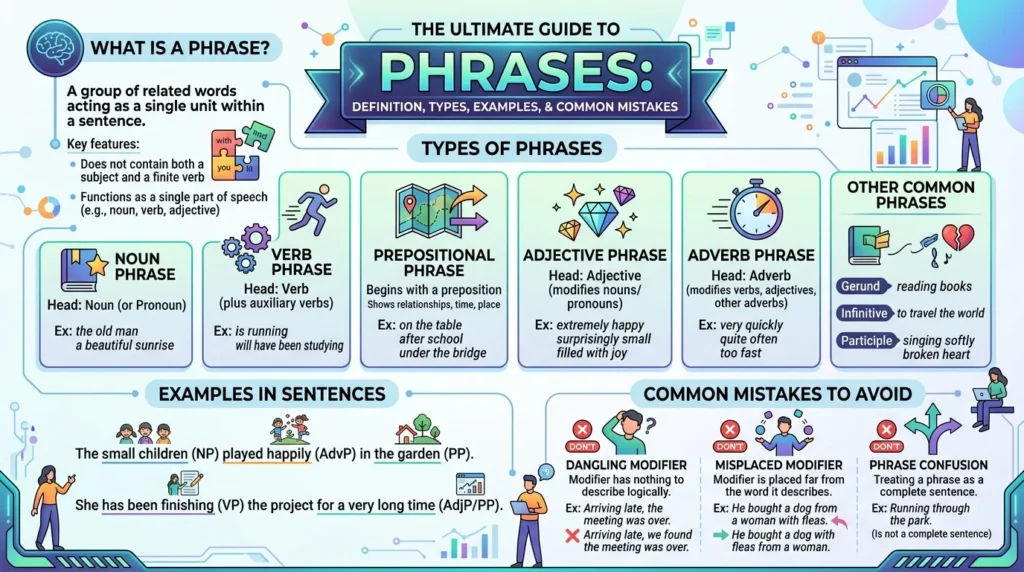
A phrase is a group of two or more words that work together as a unit but usually does not contain a complete subject-and-verb idea.
Examples include:
- in the house
- the red car
- very slowly
- after the meeting
- a beautiful garden
- running very quickly
A phrase adds information to a sentence.
Examples in Sentences
The cat is under the table.
She bought a new laptop.
He runs very quickly.
We met after the meeting.
The bold groups are phrases.
Phrase vs Sentence
A phrase does not normally express a complete thought.
After the meeting — phrase
A sentence expresses a complete thought:
We went home after the meeting. — sentence
A simple way to remember this is:
Phrase = part of a sentence
Sentence = complete grammatical unit
The Origin of Phrase
The word phrase comes from the Greek word phrasis, meaning “speech,” “expression,” or “way of speaking.” It is related to the Greek verb phrazein, meaning “to tell,” “declare,” or “express.”
The word entered English through French and Latin. Over time, phrase became a common grammar term for a group of words that works together as a unit.
The term is now used in both everyday language and grammar.
For example, people may say:
That is a common phrase.
In grammar, a phrase means:
a group of words that functions together within a sentence.
There is no British or American spelling difference for phrase. The spelling is the same in both varieties of English.
The plural form is phrases.
- One phrase
- Two phrases
British English vs American English Spelling
The word phrase has the same spelling in British and American English.
| Feature | British English | American English |
|---|---|---|
| Singular | phrase | phrase |
| Plural | phrases | phrases |
| Example | This is a phrase. | This is a phrase. |
| Verb | phrase | phrase |
| Spelling difference | None | None |
Phrase vs Phrases
Use phrase when talking about one group of words.
“In the morning” is a phrase.
Use phrases when talking about more than one.
“In the morning” and “after lunch” are phrases.
Common Spelling Errors
The correct spelling is:
✅ phrase
Common mistakes include:
❌ frase
❌ phraze
❌ phrasee
The correct plural is:
✅ phrases
Not:
❌ phrase’s
Which Spelling Should You Use?
There is no US-versus-UK spelling choice for phrase.
Use:
phrase
in both British and American English.
For US English
Use phrase in:
- school assignments
- grammar lessons
- websites
- emails
- academic writing
- professional documents
For UK and Commonwealth English
Use the same spelling:
phrase
The word does not change between British and American English.
For Global English
Phrase is also the best choice for international English.
While some English words have different spellings in British and American English, such as colour/color and centre/center, phrase is spelled the same in both.
Common Mistakes with What Is a Phrase?
Phrases can be confusing because they can look similar to clauses and sentences. Here are some common mistakes.
Mistake 1: Calling Every Group of Words a Sentence
Not every group of words is a sentence.
❌ Under the old bridge.
This is a phrase. It does not express a complete thought.
Better:
✅ The children played under the old bridge.
Mistake 2: Confusing a Phrase With a Clause
A clause usually contains a subject and a verb.
because she was tired
This is a clause because it contains:
- she = subject
- was = verb
Compare:
because of her tiredness
This is a phrase.
Mistake 3: Thinking Every Phrase Has a Verb
Not every phrase has a verb.
Examples:
- the blue car
- in the room
- very carefully
- after lunch
These are all phrases.
Mistake 4: Using a Phrase as a Complete Sentence
A phrase may not work as a complete sentence in formal writing.
❌ After the long meeting.
Better:
✅ We went home after the long meeting.
Mistake 5: Confusing a Phrase With an Idiom
A phrase is a grammatical unit.
An idiom is an expression whose meaning may not be clear from the individual words.
For example:
under the table
This is a prepositional phrase.
break the ice
This can be an idiom when it means to make people feel more comfortable.
An idiom can contain a phrase, but the two terms do not mean the same thing.
What Is a Phrase in Everyday Examples?
Phrases are used in almost every form of English communication.
In Emails
I will send the report after the meeting.
Please review the attached document.
We need to finish the work by Friday.
The bold parts are phrases that add useful details.
In News
The company announced a new product on Monday.
The player scored a goal in the final minute.
Phrases help news writers provide information about time, place, and manner.
In Social Media
A beautiful day at the beach!
I am working from home today.
We had dinner with our friends.
Short phrases are common in captions and posts.
In Formal Writing
The study was completed in three months.
The company operates in several countries.
The results were analyzed using a new method.
Phrases help formal writing provide precise information without making every sentence too long.
Types of Phrases
There are several common types of phrases in English grammar.
1. Noun Phrase
A noun phrase is a group of words that works like a noun.
Examples:
- the tall building
- my new phone
- a very interesting book
- the man in the blue shirt
Example:
The tall building is near my office.
The entire phrase the tall building acts as the subject.
2. Verb Phrase
A verb phrase contains a main verb and may include one or more helping verbs.
Examples:
- is running
- has finished
- will arrive
- was working
Example:
She has finished her work.
The verb phrase is has finished.
3. Adjective Phrase
An adjective phrase works like an adjective and describes a noun or pronoun.
Examples:
- very beautiful
- full of energy
- extremely difficult
Example:
She lives in a very beautiful house.
The phrase very beautiful describes the house.
4. Adverb Phrase
An adverb phrase works like an adverb. It can tell us how, when, where, or to what degree something happens.
Examples:
- very quickly
- quite carefully
- in a hurry
Example:
He completed the work very quickly.
5. Prepositional Phrase
A prepositional phrase begins with a preposition and usually includes a noun or pronoun.
Examples:
- in the room
- on the table
- under the bed
- with my friend
- after lunch
Example:
The keys are on the table.
6. Infinitive Phrase
An infinitive phrase begins with to + base verb and can include other words.
Examples:
- to learn English
- to finish the project
- to buy a new car
Example:
I want to learn English.
7. Gerund Phrase
A gerund phrase begins with a gerund, which is an -ing form that functions as a noun.
Example:
Swimming in the morning is good exercise.
Here, Swimming in the morning acts as the subject.
8. Participial Phrase
A participial phrase begins with a present or past participle and describes a noun.
Example:
Walking down the street, John saw his friend.
The phrase Walking down the street describes John.
Phrase Comparison Table
| Type of Phrase | Main Function | Example |
|---|---|---|
| Noun phrase | Acts like a noun | the old house |
| Verb phrase | Acts as the verb | has finished |
| Adjective phrase | Describes a noun | very beautiful |
| Adverb phrase | Modifies a verb or other word | very quickly |
| Prepositional phrase | Shows a relationship | under the table |
| Infinitive phrase | Uses to + verb | to learn English |
| Gerund phrase | Acts like a noun | swimming every day |
| Participial phrase | Describes a noun | running down the road |
Phrase vs Clause vs Sentence
These three grammar terms are easy to confuse.
| Feature | Phrase | Clause | Sentence |
|---|---|---|---|
| Group of words | Yes | Yes | Usually |
| Contains a subject | Not always | Usually | Usually |
| Contains a verb | Not always | Yes | Usually |
| Can express a complete thought | Usually no | Sometimes | Yes |
| Example | in the house | she lives there | She lives there. |
Simple Example
in the house = phrase
because she lives in the house = dependent clause
She lives in the house. = sentence
Knowing this difference is important for understanding English sentence structure.
What Is a Phrase? Keyword Variations Side by Side
| Keyword Variation | Meaning | Example |
|---|---|---|
| phrase | One group of words | This is a phrase. |
| phrases | More than one group of words | These are phrases. |
| phrase meaning | Meaning of an expression | What is the phrase meaning? |
| phrase definition | Grammar or language definition | Read the phrase definition. |
| types of phrases | Different grammatical phrase types | Learn the types of phrases. |
| phrase examples | Examples of phrases | Study these phrase examples. |
| noun phrase | Phrase acting as a noun | the red car |
| verb phrase | Phrase containing a verb | has finished |
| prepositional phrase | Phrase beginning with a preposition | under the table |
| adjective phrase | Phrase describing a noun | very beautiful |
What Is a Phrase? – Google Trends & Usage Data
The keyword “what is a phrase” has clear educational search intent. Students, teachers, English learners, and beginner writers may use this search to understand basic grammar.
Related searches can include:
- what is a phrase
- phrase definition
- phrase examples
- types of phrases
- phrase and clause
- phrase vs clause
- noun phrase
- verb phrase
- prepositional phrase
- adjective phrase
The keyword is an evergreen grammar topic. It does not depend on current events, so people can search for it throughout the year. Interest may increase during school terms, exams, homework periods, and English-learning courses.
Search interest can also vary by country. Regions with large numbers of English learners may have strong demand for simple grammar explanations.
Google Trends does not provide one permanent worldwide search-volume figure for “what is a phrase.” Search interest changes based on the country, time period, search type, and comparison keywords selected. Therefore, SEO content should not claim a fixed global search volume without stating the exact data source and settings.
For SEO, the keyword has strong informational intent. A useful article should answer the definition immediately and then cover phrase types, examples, phrase-versus-clause differences, common mistakes, and related searches.
FAQs About What Is a Phrase?
1. What is a phrase in simple words?
A phrase is a group of words that works together but usually does not express a complete thought.
Example:
under the table
2. What is an example of a phrase?
Here are some examples:
- the blue car
- in the morning
- very quickly
- after lunch
- a beautiful garden
3. What is the difference between a phrase and a sentence?
A phrase is normally part of a sentence and does not express a complete thought.
A sentence expresses a complete thought.
After lunch = phrase
We went home after lunch. = sentence
4. What are the main types of phrases?
Common types include:
- noun phrases
- verb phrases
- adjective phrases
- adverb phrases
- prepositional phrases
- infinitive phrases
- gerund phrases
- participial phrases
5. Does a phrase have a subject and verb?
Not necessarily. Many phrases do not contain a subject and verb.
Example:
in the classroom
However, a clause normally contains a subject and a verb.
6. Is “in the morning” a phrase?
Yes. In the morning is a prepositional phrase.
Example:
I exercise in the morning.
7. Can a phrase be a sentence?
In standard grammar, a phrase is not normally a complete sentence. However, phrases can sometimes be used as sentence-like fragments in titles, signs, captions, or informal communication.
For example:
No parking.
This is commonly used as a sign, even though it does not follow the structure of a typical full sentence.
Conclusion
So, what is a phrase? A phrase is a group of words that works together as a unit but usually does not express a complete thought on its own. Phrases are important because they help us add detail and make sentences more useful and precise.
Common examples include “the red car,” “in the morning,” “very quickly,” and “after the meeting.” English has several common phrase types, including noun phrases, verb phrases, adjective phrases, adverb phrases, prepositional phrases, infinitive phrases, gerund phrases, and participial phrases.
One of the most important grammar skills is knowing the difference between a phrase, clause, and sentence. A phrase does not normally contain a complete subject-and-verb idea. A clause normally has a subject and verb, while an independent clause can form a complete sentence.
There is no British or American spelling difference for phrase. The spelling phrase is correct in both varieties of English.
When you learn to identify phrases, you can understand sentence structure more easily and write clearer English. Start by finding groups of words that work together, then ask what job they perform in the sentence.