
A few words can change the meaning of a sentence, but not every group of words is a complete sentence. This is where clauses become important. If you are learning English grammar, you may ask, “what is a clause?” The answer is simple, but clauses can be confusing because they look like phrases and sentences.
A clause is a group of words that contains a subject and a verb. Some clauses can stand alone and express a complete thought. Others cannot stand alone and need another clause to complete their meaning. For example, “She works hard” is an independent clause, while “because she wants to succeed” is a dependent clause.
Understanding clauses helps you build better sentences and avoid common grammar errors. Clauses are used in emails, school assignments, news articles, conversations, and formal writing. They help us connect ideas, show reasons, describe conditions, and explain time.
In this guide, you will learn what a clause is, its origin, the difference between British and American spelling, types of clauses, common mistakes, everyday examples, and the difference between clauses, phrases, and sentences.
What Is a Clause? – Quick Answer
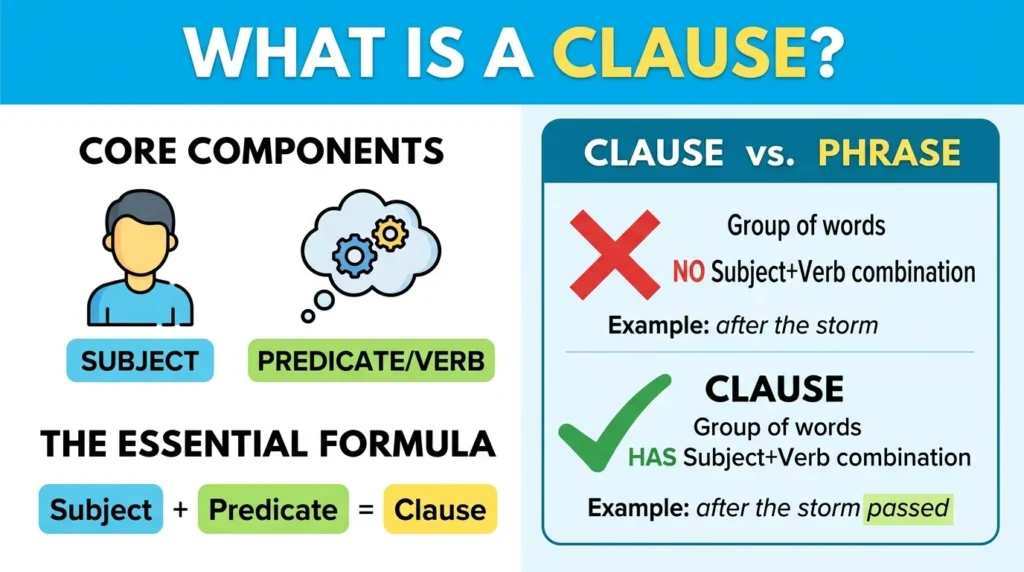
A clause is a group of words that contains a subject and a verb.
Examples:
She works every day.
because she works every day
Both contain a subject and a verb:
- she = subject
- works = verb
But they do not have the same function.
Independent Clause
An independent clause can stand alone as a complete sentence.
She works every day.
It expresses a complete thought.
Dependent Clause
A dependent clause contains a subject and verb but cannot normally stand alone as a complete sentence.
because she works every day
It leaves the reader waiting for more information.
Complete sentence:
She is successful because she works every day.
Simple Rule
Remember:
Clause = subject + verb
But:
Independent clause = complete thought
Dependent clause = incomplete thought
The Origin of What Is a Clause?
The word clause comes from the Old French clause, meaning “a sentence, section, or clause.” It comes from Latin clausa, meaning “a closing” or “a conclusion.”
The Latin term is related to claudere, meaning “to close.”
The word developed into a grammar term for a group of words that forms part of a larger sentence.
Today, clause is used in both grammar and legal writing.
In grammar:
because I was tired is a dependent clause.
In a legal document:
The contract contains an important clause about payment.
These meanings are related because a clause can be a distinct section or part of a larger structure.
There is no British or American spelling difference for clause. Both varieties use the spelling clause.
The plural is:
clauses
British English vs American English Spelling
The word clause is spelled the same way in British and American English.
| Feature | British English | American English |
|---|---|---|
| Singular | clause | clause |
| Plural | clauses | clauses |
| Example | This is a dependent clause. | This is a dependent clause. |
| Spelling difference | None | None |
Clause vs Clauses
Use clause for one.
This sentence contains one clause.
Use clauses for two or more.
The sentence contains two clauses.
Clause vs Claws
One common spelling confusion is between clause and claws.
Clause = a grammatical or legal unit.
The sentence has a dependent clause.
Claws = sharp, curved nails on an animal.
The cat has sharp claws.
They sound similar, but they have different meanings and spellings.
Which Spelling Should You Use?
There is no British-versus-American spelling choice for clause.
Use:
clause
in both British and American English.
For US English
Use clause in:
- school assignments
- grammar books
- emails
- business writing
- academic writing
- professional documents
For UK and Commonwealth English
Use the same spelling:
clause
There is no standard British spelling such as claus or another alternative.
For Global English
Clause is the best choice for international English.
The plural form is always:
clauses
The main spelling issue to remember is the difference between clause and claws.
Common Mistakes with What Is a Clause?
Clauses can be confusing for English learners. Here are some common mistakes.
Mistake 1: Confusing a Clause With a Phrase
A clause normally contains a subject and a verb.
because she was tired = clause
A phrase does not normally contain a complete subject-and-verb combination.
because of her tiredness = phrase
Mistake 2: Treating a Dependent Clause as a Complete Sentence
❌ Because I was tired.
This is normally a sentence fragment.
Better:
✅ I went home because I was tired.
Mistake 3: Forgetting the Subject
❌ Because was raining, we stayed home.
The clause needs a subject.
Better:
✅ Because it was raining, we stayed home.
Mistake 4: Creating a Comma Splice
A comma splice happens when two independent clauses are joined only with a comma.
❌ I was tired, I went home.
Better:
✅ I was tired, so I went home.
Or:
✅ I was tired. I went home.
Mistake 5: Confusing Clause and Claws
❌ The sentence contains two claws.
✅ The sentence contains two clauses.
Remember:
- clause = grammar
- claws = animal’s nails
Mistake 6: Assuming Every Clause Can Stand Alone
Not every clause is an independent clause.
when the meeting ends
This contains a subject and verb, but it needs more information.
We will leave when the meeting ends.
What Is a Clause in Everyday Examples?
Clauses appear in almost every type of English writing.
In Emails
I will call you when I arrive at the office.
This sentence contains:
- I will call you = independent clause
- when I arrive at the office = dependent clause
In News
The company changed its policy after sales declined.
Here:
- The company changed its policy = independent clause
- after sales declined = dependent clause
In Social Media
I stayed home because it was raining.
The second clause explains the reason.
In Formal Writing
Although the results were positive, the researchers requested more data.
Here:
- Although the results were positive = dependent clause
- the researchers requested more data = independent clause
Clauses allow writers to connect ideas in a clear way.
Types of Clauses
There are two major types of clauses: independent clauses and dependent clauses.
Independent Clause
An independent clause expresses a complete thought.
Examples:
She likes coffee.
The children are playing.
I finished my work.
An independent clause can stand alone as a sentence.
Dependent Clause
A dependent clause cannot normally stand alone.
Examples:
because she was tired
when the rain stopped
although he was busy
These clauses need an independent clause.
She went home because she was tired.
Adjective Clause
An adjective clause, also called a relative clause, describes a noun or pronoun.
Example:
The man who lives next door is a doctor.
The clause who lives next door describes the man.
Adverb Clause
An adverb clause modifies a verb, adjective, or whole clause. It often shows time, reason, condition, contrast, or purpose.
Examples:
I stayed home because it was raining.
Call me when you arrive.
We will go if the weather improves.
Noun Clause
A noun clause works like a noun within a sentence.
Example:
I know what you want.
The clause what you want acts as the object of know.
Clause Comparison Table
| Clause Type | Function | Example |
|---|---|---|
| Independent clause | Expresses a complete thought | She went home. |
| Dependent clause | Needs an independent clause | because she was tired |
| Adjective clause | Describes a noun | who lives next door |
| Adverb clause | Gives information about time, reason, condition, etc. | because it was raining |
| Noun clause | Acts like a noun | what you said |
Clause vs Phrase vs Sentence
These three terms are closely related but have different meanings.
| Feature | Phrase | Clause | Sentence |
|---|---|---|---|
| Group of words | Yes | Yes | Usually |
| Subject | Not always | Yes, normally | Usually |
| Verb | Not always | Yes | Usually |
| Complete thought | Usually no | Sometimes | Yes |
| Example | in the room | she is in the room | She is in the room. |
Easy Example
in the room = phrase
she is in the room = clause
She is in the room. = sentence
An independent clause can function as a complete sentence.
What Is a Clause? Keyword Variations Side by Side
| Keyword Variation | Meaning | Example |
|---|---|---|
| clause | One grammatical unit | This is a clause. |
| clauses | More than one clause | The sentence has two clauses. |
| what is a clause | Definition question | What is a clause in grammar? |
| clause definition | Meaning of clause | Learn the clause definition. |
| types of clauses | Different clause categories | Study the types of clauses. |
| clause examples | Examples of clauses | Read these clause examples. |
| independent clause | Complete clause | She went home. |
| dependent clause | Incomplete clause | because she was tired |
| relative clause | Clause describing a noun | who lives nearby |
| noun clause | Clause acting as a noun | what he said |
What Is a Clause? – Google Trends & Usage Data
The keyword “what is a clause” has clear educational search intent. Students, English learners, teachers, writers, and people studying grammar may use this query to understand sentence structure.
Related searches include:
- what is a clause
- clause definition
- clause examples
- types of clauses
- independent clause
- dependent clause
- clause vs phrase
- clause vs sentence
- relative clause
- noun clause
- adverb clause
The topic is evergreen, which means it remains useful throughout the year. Search interest can increase during school terms, exams, homework periods, and English-learning courses.
Interest may also vary by country. Countries with large English-learning populations may produce more searches for basic grammar topics.
Google Trends does not provide one fixed global monthly search volume for “what is a clause.” Search interest depends on the selected country, date range, search type, and comparison terms. Therefore, SEO writers should avoid claiming a permanent worldwide search number without giving the exact data source and settings.
From an SEO perspective, this keyword has strong informational intent. A useful article should answer the definition immediately and then explain independent clauses, dependent clauses, examples, common errors, and the difference between clauses and phrases.
FAQs About What Is a Clause?
1. What is a clause in simple words?
A clause is a group of words that normally contains a subject and a verb.
Example:
She is working.
2. What are the two main types of clauses?
The two main types are:
- Independent clause
- Dependent clause
An independent clause can stand alone. A dependent clause usually cannot.
3. What is an independent clause?
An independent clause contains a subject and verb and expresses a complete thought.
Example:
I finished my homework.
4. What is a dependent clause?
A dependent clause contains a subject and verb but does not normally express a complete thought by itself.
Example:
because I was tired
Complete sentence:
I went to bed because I was tired.
5. What is the difference between a phrase and a clause?
A clause normally contains a subject and a verb. A phrase does not normally contain a complete subject-and-verb combination.
Example:
after the meeting = phrase
after the meeting ended = clause
6. Can a clause be a sentence?
Yes. An independent clause can stand alone as a complete sentence.
Example:
The children are playing.
A dependent clause cannot normally stand alone.
7. What are the main types of dependent clauses?
Common types include:
- adjective clauses
- adverb clauses
- noun clauses
Each performs a different grammatical function.
Conclusion
So, what is a clause? A clause is a group of words that normally contains a subject and a verb. Clauses are essential because they help us build clear and meaningful sentences. The two main types are independent clauses and dependent clauses. An independent clause can stand alone as a complete thought, while a dependent clause usually needs an independent clause.
Clauses also have different functions. An adjective clause describes a noun, an adverb clause gives information such as time, reason, or condition, and a noun clause works like a noun. Learning these types can make sentence structure much easier to understand.
One important skill is knowing the difference between a phrase, clause, and sentence. A phrase does not normally contain a complete subject-and-verb idea. A clause normally contains a subject and verb, while an independent clause can form a complete sentence.
There is no British or American spelling difference for clause. The correct spelling is clause in both varieties of English. Be careful not to confuse it with claws, which refers to an animal’s sharp nails.
With regular practice, identifying clauses becomes simple and can greatly improve your grammar and writing skills.